The Student of Takshashila
Origins & Rise
In the ancient university city of Takshashila, a chance encounter between a humiliated Brahmin scholar and a young man of extraordinary potential would change the course of Indian history. Discover how Chanakya recognized in Chandragupta the kshatriya spirit needed to unite India, and how the world's most famous guru-shishya partnership was forged in the crucible of ambition, intellect, and a shared dream of Akhand Bharat.
The Meeting That Changed History
In 340 BCE, the great university of Takshashila hummed with the activity of thousands of students from across the known world. Greeks, Persians, and scholars from every corner of Bharat gathered in this ancient seat of learning, debating philosophy, studying medicine, and mastering the arts of war. Among them walked a Brahmin teacher whose brilliance was matched only by his burning rage.
Chanakya, also known as Kautilya and Vishnugupta, had been publicly humiliated by Dhanananda, the powerful king of the Nanda dynasty. According to tradition, the king had insulted Chanakya in open court, mocking his appearance and dismissing him from a ceremonial gathering. That day, Chanakya made a vow that would echo through the centuries:
"I will not tie my shikha until I have uprooted the Nanda dynasty and placed a worthy king on the throne of Magadha."
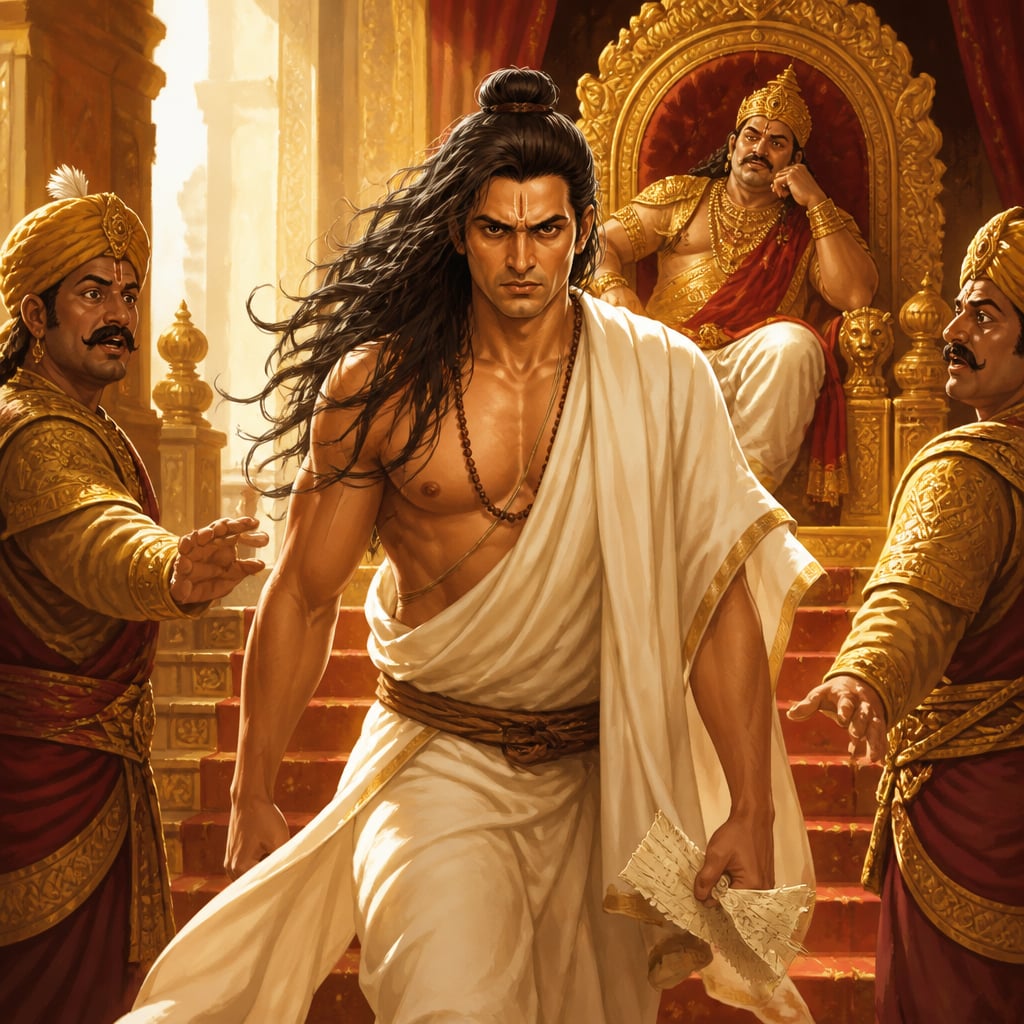
But to destroy the mightiest empire India had ever seen, Chanakya needed more than his genius for strategy. He needed a warrior, someone with the courage, ambition, and royal bearing to unite India's fragmented kingdoms. He found that person in an unlikely student.
The Young Chandragupta
The origins of Chandragupta Maurya are shrouded in deliberate mystery. Greek sources call him "Sandrokottos" and note his humble beginnings. The Mudrarakshasa, a later Sanskrit drama, suggests he came from the Moriya clan, hence "Maurya." Some traditions claim royal Kshatriya lineage; others suggest more modest origins.
What all sources agree upon is this: Chandragupta possessed extraordinary qualities that set him apart from ordinary men.
| Quality | Evidence |
|---|---|
| Physical prowess | Greek accounts describe him as a formidable warrior |
| Royal bearing | Even enemies recognized his rajlakshana (signs of kingship) |
| Sharp intellect | Mastered complex subjects at Takshashila |
| Burning ambition | Openly spoke of overthrowing the Nandas |
Chanakya, ever watchful for the instrument of his revenge, observed the young man carefully. In Chandragupta, he saw not just a capable student but the raw material of an emperor.
Takshashila: The Crucible of Greatness

To understand how Chandragupta was forged, we must understand Takshashila itself. Located in the Gandhara region (modern-day Pakistan), this university predated even the great academies of Greece. Here, education was not merely intellectual, it was comprehensive.
Students at Takshashila studied:
- The Vedas and Upanishads, spiritual and philosophical foundations
- Arthashastra, economics, statecraft, and political science
- Dhanurveda, the science of warfare and military strategy
- Ayurveda, medicine and healing arts
- Languages, Sanskrit, Prakrit, and foreign tongues
The curriculum lasted twelve years for most students. But Chanakya recognized that Chandragupta needed specialized training. He personally took charge of the young man's education, teaching him not just from books but from his own unfinished treatise, what would become the legendary Arthashastra.
The Guru-Shishya Bond
The relationship between Chanakya and Chandragupta transcended ordinary teacher-student dynamics. It was a partnership of complementary strengths:
Chanakya brought:
- Unmatched intellect and strategic thinking
- Deep knowledge of statecraft and economics
- A network of spies and informants
- The legitimacy of Brahminical learning
Chandragupta brought:
- Physical courage and military aptitude
- Natural charisma and leadership ability
- Kshatriya spirit and royal bearing
- The youth and energy to execute grand plans
Together, they formed a whole greater than the sum of its parts. Chanakya became the mind; Chandragupta, the sword. This division of labor, the Brahmin advisor guiding the Kshatriya king, would become a model for Indian governance for millennia.
"A king without a wise counselor is like a blind elephant, powerful but directionless. A counselor without a capable king is like a lamp without oil, brilliant but impotent." , Reflected in Arthashastra principles
The Vision of Akhand Bharat
What drove these two extraordinary individuals together? Beyond personal grievance and ambition lay a grander vision: the unification of Bharat.
In 340 BCE, India was a patchwork of warring kingdoms:
- The Nanda Empire controlled the Gangetic heartland with an army of 200,000 infantry, 20,000 cavalry, and thousands of war elephants
- The Mahajanapadas in the north remained fragmented and vulnerable
- Alexander of Macedon was conquering his way eastward through Persia
- Regional kings fought endless battles while foreign threats gathered
Chanakya saw what others couldn't: India's division was its greatest weakness. The Nandas, for all their military might, ruled through fear and extraction, not through dharmic legitimacy. They had grown decadent, and their arrogance had created enemies everywhere.
To Chanakya's strategic mind, the solution was clear: replace the corrupt Nandas with a dharmic ruler who could unite India, not just through conquest, but through righteous governance. Chandragupta would be that ruler.
The Training Begins

Under Chanakya's guidance, Chandragupta's education intensified. He learned:
Military strategy:
- The vyuhas (battle formations) of ancient warfare
- Siege tactics and fortification
- The use of elephants, cavalry, and infantry in coordination
- Guerrilla warfare and unconventional tactics
Statecraft:
- The Saptanga theory, the seven limbs of the state
- Diplomacy and the mandala theory of foreign relations
- Espionage networks and intelligence gathering
- Economic management and treasury building
Personal discipline:
- Control of the shadripus (six enemies): kama, krodha, lobha, moha, mada, matsarya
- Physical fitness and martial arts
- Public speaking and royal demeanor
- The duties of a dharmic king
Chanakya was not a gentle teacher. He tested Chandragupta constantly, with challenges, with hardships, with scenarios that forced the young man to think on his feet. Every lesson had a purpose; every hardship, a hidden teaching.
The Encounter with Alexander
Tradition holds that during this period, Chandragupta encountered Alexander the Great himself. Greek historians mention that a young Indian named Sandrokottos met Alexander, possibly at Takshashila, and boldly declared that the Nanda king could easily be overthrown because his people hated him.
Whether this meeting actually occurred, the timing is significant. Alexander's invasion of 326 BCE demonstrated two crucial lessons:
- Even the mightiest armies could be defeated, Alexander turned back at the Beas River, unable to advance further
- India needed unity against foreign threats, the fragmented kingdoms had nearly fallen to a foreign conqueror
For Chanakya and Chandragupta, Alexander's invasion was both warning and opportunity. It weakened the northwest kingdoms, created political chaos, and proved that India's disunity was an existential threat.
The Departure from Takshashila
By approximately 324 BCE, Chandragupta's education was complete. He had spent nearly two decades at Takshashila, transforming from a promising youth into a formidable leader. Chanakya judged him ready.
But ready for what? The task ahead seemed impossible:
- Overthrow the most powerful dynasty in Indian history
- Unite dozens of warring kingdoms under one rule
- Create an empire from chaos
- Establish dharmic governance across the subcontinent
As teacher and student prepared to leave Takshashila for the dangerous journey ahead, Chanakya reminded Chandragupta of the principles that would guide them:
"The king shall consider as good, not what pleases himself but what pleases his subjects. The king is a paid servant and enjoys the resources of the state together with the people." , Arthashastra, Book 1
This was not to be a conquest for personal glory. It was to be the establishment of dharmic rule, governance for the welfare of all.
The Foundation of Greatness
The years at Takshashila gave Chandragupta more than education. They gave him:
- A vision, of a united, dharmic Bharat
- A mentor, whose genius would guide every step
- A philosophy, that power exists to serve the people
- The skills, military, political, and personal, to achieve the impossible
Most importantly, they forged the bond between guru and shishya that would prove unbreakable through decades of struggle, triumph, and governance.
The student of Takshashila was about to become the unifier of India. The revolution was about to begin.
Historical context
Pre-Mauryan Period (c. 340-324 BCE)
India was fragmented into sixteen Mahajanapadas (great states) competing for supremacy. The Nanda dynasty controlled the powerful kingdom of Magadha in the Gangetic heartland, commanding the largest army in the subcontinent. Takshashila in the northwest was a thriving center of learning, attracting students from across Asia and the Mediterranean world.
Living traditions
Chanakya's Arthashastra is studied in business schools and public policy programs worldwide. The Indian government's policy think tank NITI Aayog draws inspiration from Kautilyan principles. 'Chanakya Niti' remains a popular subject in self-help and management literature. The guru-shishya tradition continues in Indian classical arts, academics, and spiritual lineages. Several Indian institutions bear Chanakya's name, including Chanakya National Law University.
- Taxila Archaeological Site: UNESCO World Heritage Site preserving the ruins of ancient Takshashila. Includes the Dharmarajika Stupa, Jaulian monastery, and remains of the ancient university where Chanakya taught and Chandragupta studied.
- Taxila Museum: Houses artifacts from the Taxila excavations including Gandhara sculptures, coins from the Mauryan period, and objects from the university era. Essential for understanding the material culture of Chandragupta's time.
Reflection
- Who has been a Chanakya figure in your life, a mentor who saw potential in you before you saw it yourself? How did their guidance shape who you became?
- Why do you think Chanakya chose to train Chandragupta for nearly two decades rather than immediately beginning their campaign against the Nandas?
- The Arthashastra states that 'the happiness of the king lies in the happiness of his subjects.' How does this principle distinguish legitimate authority from tyranny?