The Mauryan Administration
Governance & State
Conquering an empire is one thing; governing it is another. Chandragupta and Chanakya built history's first modern state, with a professional bureaucracy, spy network, postal system, and standardized regulations. Discover how the Arthashastra became the operating manual for an empire stretching from Afghanistan to Bengal.
The Art of Governance
Chandragupta had conquered the largest empire India had ever seen. Now came the harder task: making it work.
The Arthashastra opens with a simple truth:
"The root of wealth is activity. The root of inactivity is the lack of proper governance."
An empire that could not govern itself would collapse. Chanakya had spent decades thinking about statecraft. Now, with Chandragupta on the throne, he could put theory into practice.
The Saptanga: Seven Limbs of the State
The Arthashastra conceptualizes the state as a living body with seven essential limbs (saptanga):
| Limb | Sanskrit | Function |
|---|---|---|
| King | Svami | The head; provides direction |
| Ministers | Amatya | The eyes; advise and administer |
| Territory | Janapada | The body; provides resources |
| Fort | Durga | The arms; provides defense |
| Treasury | Kosha | The stomach; provides sustenance |
| Army | Danda | The legs; provides movement and force |
| Allies | Mitra | External support |
Weakness in any limb threatened the whole. Chanakya designed systems to strengthen each.
The Central Administration
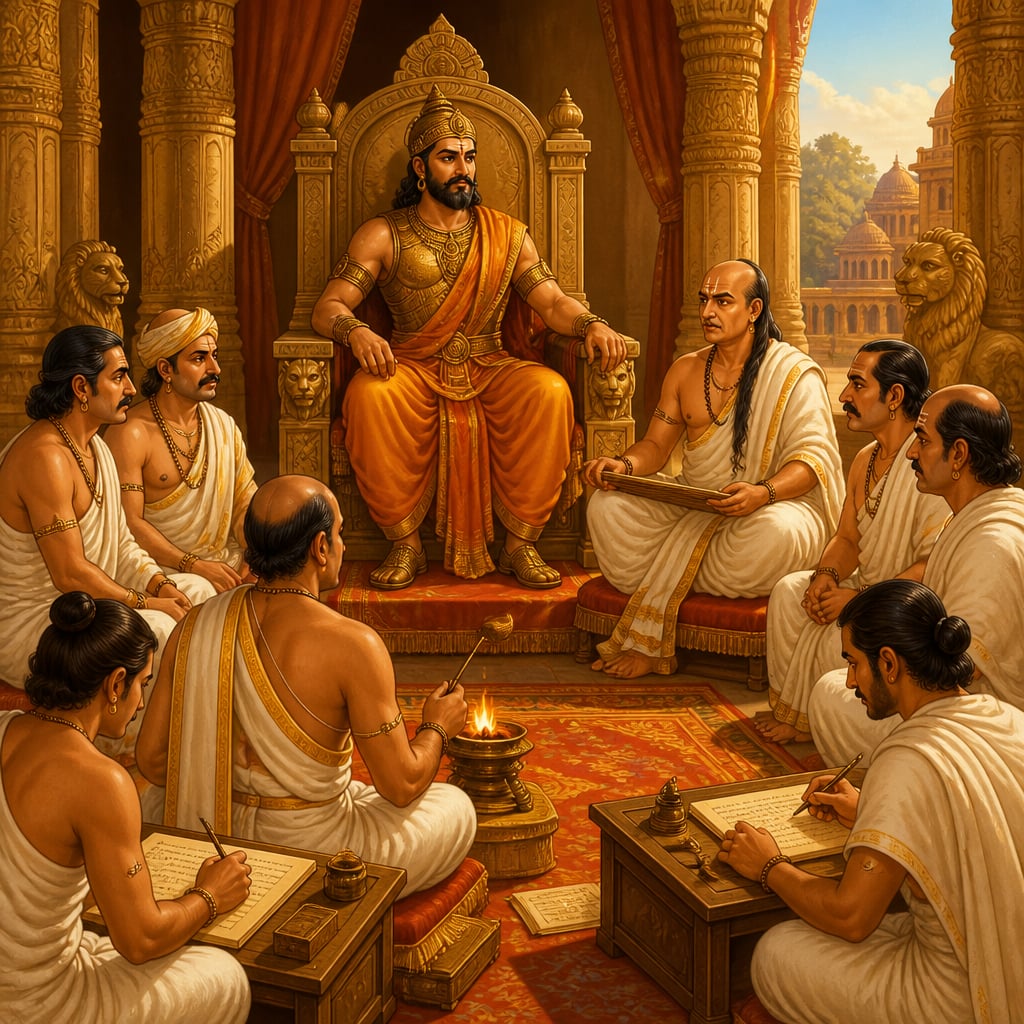
At the heart of Mauryan governance sat the Mantriparishad, the council of ministers. Unlike the informal advisors of earlier kings, these were professional administrators with defined portfolios:
Key Ministers:
- Mahamantri, Chief Minister (Chanakya himself initially)
- Purohita, Royal Priest, advisor on dharmic matters
- Senapati, Commander-in-Chief
- Yuvaraja, Crown Prince (trained in governance)
- Samaharta, Chief Revenue Collector
- Sannidhata, Treasurer
Below them worked thousands of officials, organized in departments covering every aspect of governance.
The Bureaucracy
The Mauryan bureaucracy was unprecedented in its scale and specialization:
Adhyakshas (Superintendents) managed specific domains:
- Mining and metallurgy
- Agriculture and irrigation
- Forests and wildlife
- Trade and commerce
- Weights and measures
- Gambling and liquor
- Prostitution (regulated, not prohibited)
- Elephants, horses, and chariots
Each superintendent reported to higher officials, creating a chain of accountability reaching to the king himself.
The Salary System
Officials were paid in cash, not land grants, a crucial innovation that kept the bureaucracy loyal to the central state rather than developing independent power bases:
| Position | Annual Salary (Panas) |
|---|---|
| Highest ministers | 48,000 |
| Superintendents | 12,000 |
| Accountants, scribes | 500 |
| Lowest officials | 60 |
The salary differential was 800:1 from top to bottom, Chanakya believed that high salaries for senior officials prevented corruption and ensured competence.
Provincial Administration
The empire was divided into provinces, each with its own hierarchy:
Provinces (Pradesha): Governed by Kumaras (princes) or Mahamatras (senior officials). Major provinces included:
- Taxila (northwest)
- Ujjain (central)
- Tosali (east)
- Suvarnagiri (south)
Districts: Governed by Rajukas with judicial and administrative powers.
Villages: The basic unit, governed by Gramani (village headmen) working with local assemblies.
Megasthenes noted that Greek city-states had nothing comparable to the Mauryan system of nested administration.
The Spy Network

Chanakya's most distinctive innovation was the institutionalized espionage system. The Arthashastra describes various types of spies:
Samstha (Stationary spies): Embedded in communities as:
- Students at universities
- Ascetics at temples
- Merchants in markets
- Farmers in villages
Sancara (Roving spies): Traveled disguised as:
- Merchants
- Entertainers
- Poison-sellers
- Astrologers
Their duties included:
- Monitoring officials for corruption
- Detecting conspiracies
- Assessing public sentiment
- Gathering intelligence on foreign states
"The king's eye is everywhere. Those who believe they act unseen deceive themselves." , Arthashastra principle
This network served not only security but also quality control, officials knew that their performance was being watched.
Economic Management
The Mauryan economy was actively managed, not merely taxed:
State enterprises: The government directly operated:
- Mines for metals and gems
- Salt production
- Armament manufacturing
- Textile production
- Liquor distillation
Regulated markets: The Panyadhyaksha (Superintendent of Commerce) controlled:
- Prices of essential goods
- Quality standards
- Weights and measures
- Trade routes and tolls
Agricultural support: The state provided:
- Irrigation infrastructure
- Seed and livestock loans
- Protection from bandits
- Famine relief
Taxation
The Arthashastra's taxation principles were sophisticated:
"Take like the bee", extract wealth without destroying the source:
"The king should collect taxes as the bee collects honey, taking just enough without harming the flower."
Standard rates:
- Land tax: 1/6 of produce (could vary by soil quality)
- Trade duties: 1/10 to 1/5 of goods' value
- Artisan income: 1/10
- Various fees for services
Excessive taxation was explicitly warned against, it bred rebellion and destroyed the productive capacity of the population.
Justice System
Mauryan justice combined royal authority with established law:
Court system:
- Village-level disputes resolved by Gramani and village assemblies
- District courts under Rajukas
- Provincial courts under governors
- Royal court for major cases and appeals
Legal sources:
- Sacred law (Dharmashastra)
- Royal edicts (Rajashasana)
- Custom (Vyavahara)
- Logical reasoning (Yukti)
Punishments ranged from:
- Fines (most common)
- Corporal punishment
- Mutilation (for serious crimes)
- Death penalty (for treason, murder)
The Arthashastra also recognized mitigating circumstances and required evidence for conviction.
Infrastructure
The Mauryas built infrastructure that would last centuries:

The Royal Road: Running from Pataliputra to Taxila (over 1,500 miles), with:
- Regular rest houses
- Distance markers
- Police stations
- Wells and shade trees
Postal system: Relays of runners and riders could carry messages across the empire in days.
Irrigation: State-funded canals and reservoirs, including the famous Sudarshana Lake in Gujarat.
Urban planning: Megasthenes described Pataliputra's organized streets, drainage, and zoning.
The King's Day
The Arthashastra prescribes a grueling schedule for the king:
Morning (6-8 AM): Receive intelligence reports, review treasury Late morning (8-10 AM): Public audience, hear petitions Midday (10 AM-12 PM): Personal time, meals Afternoon (12-2 PM): Meet with ministers, review correspondence Late afternoon (2-4 PM): Military matters Evening (4-6 PM): Religious observances Night: Study, meet with spies
Chanakya believed that a lazy king guaranteed a failed state:
"If the king is active, his servants become active. If the king is lazy, they become lazy and corrupt."
The Welfare State
Surprisingly modern welfare concepts appear in Mauryan governance:
Public works employment: During famines, the state employed workers on construction projects.
Price controls: Essential commodities had price caps during shortages.
Orphan care: The state cared for orphans and destitute children.
Widow support: Provisions for widows without family support.
Elder care: Support for the aged without means.
The Arthashastra explicitly states:
"In the happiness of his subjects lies the king's happiness. What is dear to the people should be dear to the king."
The Balance of Power
Chanakya designed the system to prevent any single point of failure:
- Spies watched officials, preventing corruption
- Multiple departments overlapped, creating checks
- Rotation of officers, preventing power accumulation
- Merit-based promotion, ensuring competence
No official, no matter how senior, was beyond accountability. The king himself was bound by dharma and the expectations of his subjects.
Legacy of Mauryan Administration
The Mauryan administrative system became the template for Indian governance:
- The Guptas adapted it four centuries later
- Muslim sultanates borrowed its revenue systems
- The British studied the Arthashastra when designing colonial administration
- Modern India draws on its principles in public administration training
Chanakya and Chandragupta proved that India could be governed as a unified state, not just conquered, but administered, developed, and held together through systems that outlasted any individual ruler.
Historical context
High Mauryan Period (c. 320-297 BCE)
With external threats eliminated and internal consolidation complete, Chandragupta focused on building the institutional foundations of empire. The Arthashastra's principles were being implemented across the subcontinent.
Living traditions
The Indian Administrative Service (IAS) traces conceptual roots to Mauryan governance principles. The Arthashastra is studied in Indian public administration courses. Terms like 'Mantri' (minister) derive from this era. The concept of systematic governance, professional bureaucracy, and accountable administration remains central to Indian political thought.
- Kumrahar Archaeological Site: The 80-pillar assembly hall where Chandragupta's Mantriparishad met. The polished sandstone pillars demonstrate Mauryan engineering and the scale of imperial administration.
- Junagadh Rock Inscription: Contains inscriptions from three eras, Ashoka, the Shakas, and the Guptas, all referencing the Sudarshana Lake irrigation works built under Chandragupta, demonstrating Mauryan infrastructure investment.
Reflection
- In your work or life, where do you rely on individual effort versus systematic processes? How might you build better systems?
- The Mauryan spy system watched everyone, including officials. Is constant surveillance necessary for good governance, or does it undermine trust?
- The Arthashastra says 'in the happiness of subjects lies the king's happiness.' Is this a moral principle or a pragmatic calculation about avoiding rebellion?