Legacy of the Founder

From Ancient Empire to Modern Wisdom

What does it mean to build something that outlasts you? Chandragupta Maurya's legacy reaches across 2,300 years, from the empire that unified India to the Arthashastra that still teaches leaders today. This final lesson traces how the student of Takshashila shaped history.

The Measure of Greatness

How do we judge a life? By wealth accumulated? By enemies defeated? By territory conquered? The Dharmic tradition offers a different metric: What did you build that outlasted you?

By this measure, Chandragupta Maurya stands among the greatest figures in world history. The empire he founded lasted nearly 140 years. The administrative systems he created influenced Indian governance for millennia. The strategic wisdom he helped preserve through the Arthashastra continues to be studied today. And his spiritual transformation demonstrated that even the most worldly success could be transcended.

The Dynasty He Founded

Chandragupta's immediate legacy was his son Bindusara, who ruled from approximately 297 to 273 BCE. Known by the Greek epithet "Amitrochates" (Slayer of Enemies), Bindusara expanded the empire southward, bringing most of the Indian peninsula under Mauryan control.

"From the Himalayas to the seas, the Mauryas ruled with a single will."
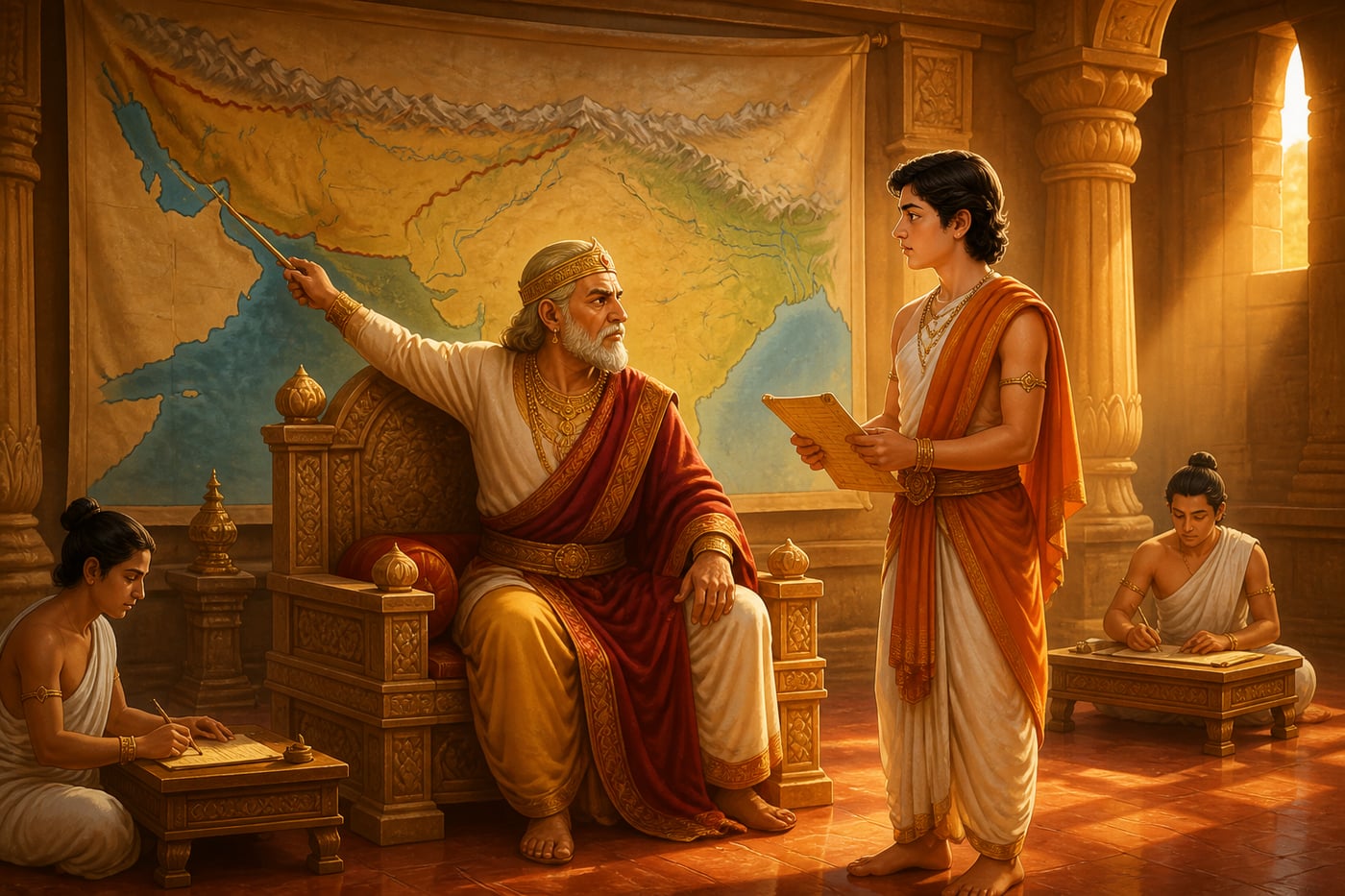
Bindusara instructs young Ashoka before the Mauryan empire map

But Chandragupta's greatest gift to posterity was his grandson: Ashoka, who would transform the empire and Buddhism alike. The irony is profound, the dynasty founded by the Arthashastra's pragmatic statecraft would eventually produce history's most famous proponent of dharmic governance.

Three Generations Chandragupta Bindusara Ashoka
Reign c. 321-297 BCE c. 297-273 BCE c. 268-232 BCE
Focus Unification Expansion Transformation
Legacy Founded empire Extended territory Spread Dharma
Religion Jainism (late) Ajivika (possible) Buddhism

The Empire's Achievements

The Mauryan Empire that Chandragupta created was not just the largest India had ever seen, it was one of the largest and best-administered states in the ancient world.

Territorial Extent:

Administrative Innovations:

Economic Achievement:

The Arthashastra's Enduring Influence

The text that guided Chandragupta's statecraft, Kautilya's Arthashastra, was lost for nearly 1,800 years after the Gupta period. Its rediscovery in 1905 by R. Shamasastry in a Mysore library revolutionized understanding of ancient Indian political thought.

An ancient palm-leaf Arthashastra manuscript studied by lamplight

What Makes It Remarkable:

The Arthashastra is not a work of abstract philosophy but a practical manual covering:

"Kautilya's work stands comparison with Machiavelli's The Prince, except it was written 1,800 years earlier and is far more comprehensive." , Modern scholarly assessment

Modern Relevance

The Arthashastra's insights continue to resonate in contemporary contexts:

In Business Strategy:

In International Relations:

In Leadership:

Indian Administrative Service training still includes study of Kautilyan principles. Business schools worldwide have begun incorporating Arthashastra concepts into strategy courses.

Sites of Memory

Chandragupta's legacy is inscribed in stone across the subcontinent:

Pataliputra (Patna, Bihar) The capital city he inherited and transformed. Archaeological excavations at Kumrahar have revealed the remains of the Mauryan assembly hall, massive sandstone pillars that once supported a structure described by Megasthenes as rivaling the palaces of Persia.

Shravanabelagola (Karnataka) Where his spiritual journey ended. The twin hills of Chandragiri and Vindhyagiri preserve Jain traditions linking them to the emperor-turned-monk.

Sudarshana Lake at Junagadh, the great Mauryan reservoir

Junagadh Rock (Gujarat) Sudarshana Lake, originally commissioned in Chandragupta's time, was maintained and improved by successors. Later inscriptions by Ashoka and the Kshatrapa rulers testify to continuing Mauryan influence.

The Student Becomes the Teacher

Chandragupta's life embodied the Dharmic principle of learning and then transmitting:

  1. As Student: He absorbed wisdom from Chanakya, from Takshashila's diverse scholars, from experience
  2. As Practitioner: He applied that learning in building an empire
  3. As Institution-Builder: He created systems that could teach future administrators
  4. As Renunciate: He demonstrated that wisdom transcends even its application

The guru-shishya parampara (teacher-student tradition) that shaped his youth continued through his descendants. The Mauryan court became a center of learning, hosting scholars from across the known world.

Comparison with Contemporaries

Chandragupta's achievements gain perspective when compared with his contemporaries:

Ruler Achievement Limitation
Chandragupta Maurya Unified India, defeated Greeks ,
Alexander the Great Conquered Persian Empire Empire collapsed at death
Seleucus I Nicator Founded Seleucid dynasty Lost India, dynasty eventually fell
Ptolemy I Founded Ptolemaic Egypt Required Greek military elite

Alexander's empire fragmented within a generation. The Seleucid realm gradually contracted. But the Mauryan state Chandragupta built endured for over a century and influenced Indian governance for much longer.

The Complete Legacy

Political: First unification of the Indian subcontinent under a single administration

Administrative: Systems of governance that influenced all subsequent Indian states

Strategic: The Arthashastra as a foundational text of political realism

Spiritual: Demonstration that material success and spiritual liberation are not opposed but sequential

Cultural: Patronage of learning that made the Mauryan court a cosmopolitan center

Dynastic: Three generations of capable successors, culminating in Ashoka's transformation

Lessons for Today

What can modern leaders learn from Chandragupta?

On Vision: Think in decades, not quarters. Chandragupta's institutions outlasted him because they were designed to.

On Mentorship: Seek teachers who challenge you. Chanakya was not gentle, he was transformative.

On Pragmatism: Ideals require resources. Build the material foundation before pursuing higher goals.

On Succession: Your work is incomplete if it cannot survive your departure. Plan transitions.

On Integration: Life has stages. Excellence at each stage, student, warrior, ruler, renunciate, constitutes a complete life.

The Story Continues

Chandragupta Maurya died as Chandragupta Muni on a hillside in Karnataka, having renounced everything he built. But what he built did not die with him.

His son Bindusara extended the empire. His grandson Ashoka transformed it. The administrative systems he created influenced the Guptas, the Mughals, and even the British. The Arthashastra he helped preserve continues to be studied. And the Jain tradition he embraced still honors his memory.

From nothing, he built an empire. At the height of power, he walked away. In walking away, he achieved something greater.

The student of Takshashila became the teacher of centuries. This is the legacy of Chandragupta Maurya, not just what he conquered, but what he created, and ultimately, what he transcended.


This concludes the story of Chandragupta Maurya. Next, we will explore the reign of his grandson Ashoka, the emperor who inherited an empire of power and transformed it into an empire of Dharma.

Historical context

Late Mauryan Period (c. 297 BCE onward)

After Chandragupta's abdication, the Mauryan Empire continued to expand under Bindusara and reach its zenith under Ashoka. The administrative systems Chandragupta established proved robust enough to support this continued growth.

Living traditions

The Arthashastra is studied in IAS training, MBA programs, and international relations courses worldwide. Chandragupta's story appears in Indian school textbooks as the founder of the first pan-Indian empire. His integration of Greek and Indian elements foreshadowed later Indo-Greek cultural synthesis. The guru-shishya tradition he exemplified with Chanakya remains a model for mentorship. And his final renunciation continues to inspire those who seek to transcend worldly success.

Reflection

More in Chandragupta Maurya

All lessons in Chandragupta Maurya · Great Emperors: The Golden Age course