Pancha Mahayajna: The Five Daily Economic Duties

Why the Ancient Household Was a Giving Engine

The five daily yajnas transformed every Indian household into a systematic redistribution center, sharing knowledge, feeding animals, honoring ancestors, welcoming guests, and maintaining cosmic order. Dana wasn't occasional charity; it was daily obligation woven into life's fabric.

The Morning That Never Ends
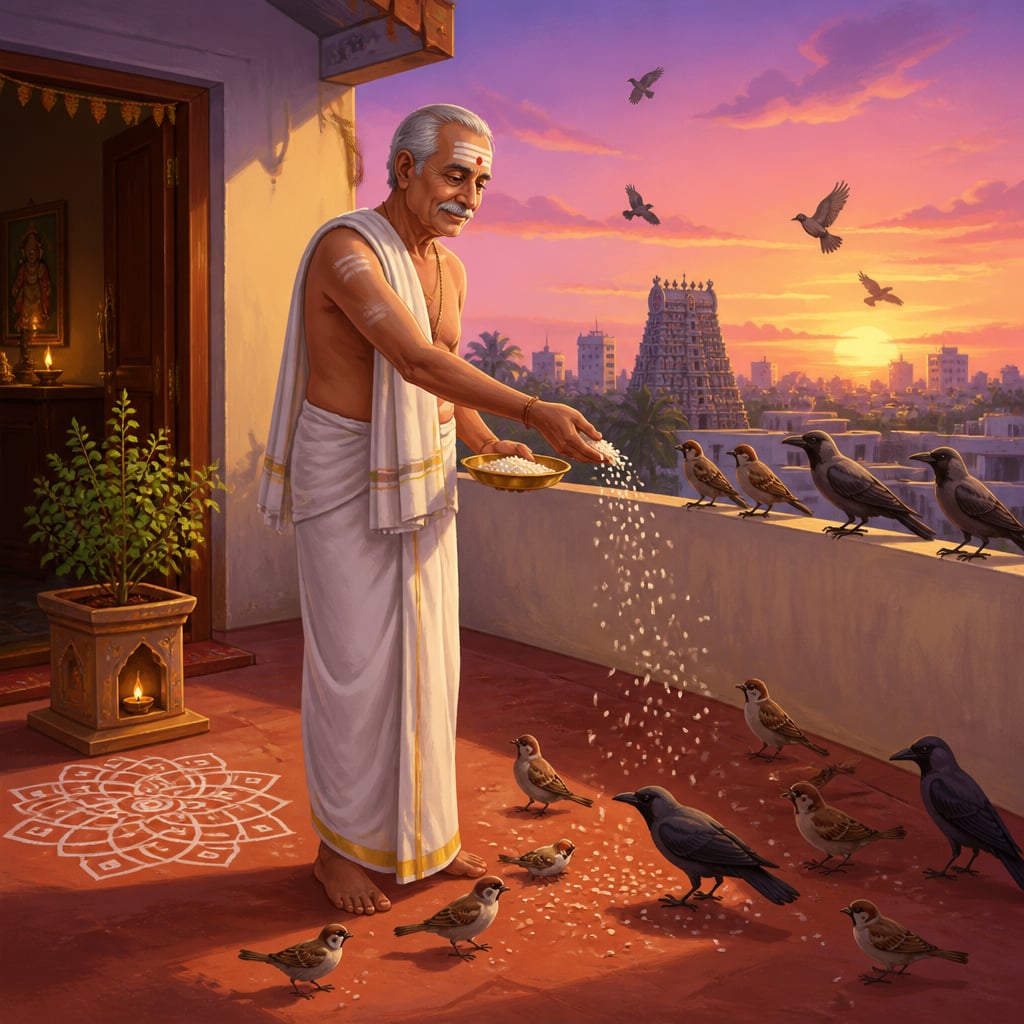
Sundaram Iyer feeding birds at dawn on Chennai terrace

Every morning at 5:30 AM, Sundaram Iyer, a retired bank manager in Chennai, follows the same routine his family has practiced for generations. He places rice grains on his terrace for crows and sparrows. He lights a lamp and offers a brief prayer. He reads two verses from the Gita aloud. He sets aside a portion of the day's food for any guest who might arrive. He remembers his departed parents with a moment of silence.

By 6:15 AM, before his first cup of coffee, Sundaram has completed five acts of giving.

His neighbors, a young IT couple, wake at 8 AM, scroll Instagram, order Swiggy, and head to work. They donate to charity once a year during Diwali. They consider themselves generous.

The difference between these households isn't generosity. It's architecture. Sundaram's morning operates on an ancient design: the Pancha Mahayajna, five daily sacrifices that transform every household into a giving engine. His neighbors operate on the modern design: the household as consumption unit, with charity as optional add-on.

The ancient design assumed something radical: that daily giving isn't virtue but duty, as non-negotiable as breathing.

The Five Daily Yajnas: A Complete Economics

The Pancha Mahayajna appear in Manusmriti, Taittiriya Aranyaka, and across the Dharmasutras. They mandate five daily "sacrifices" for every householder (grihastha):
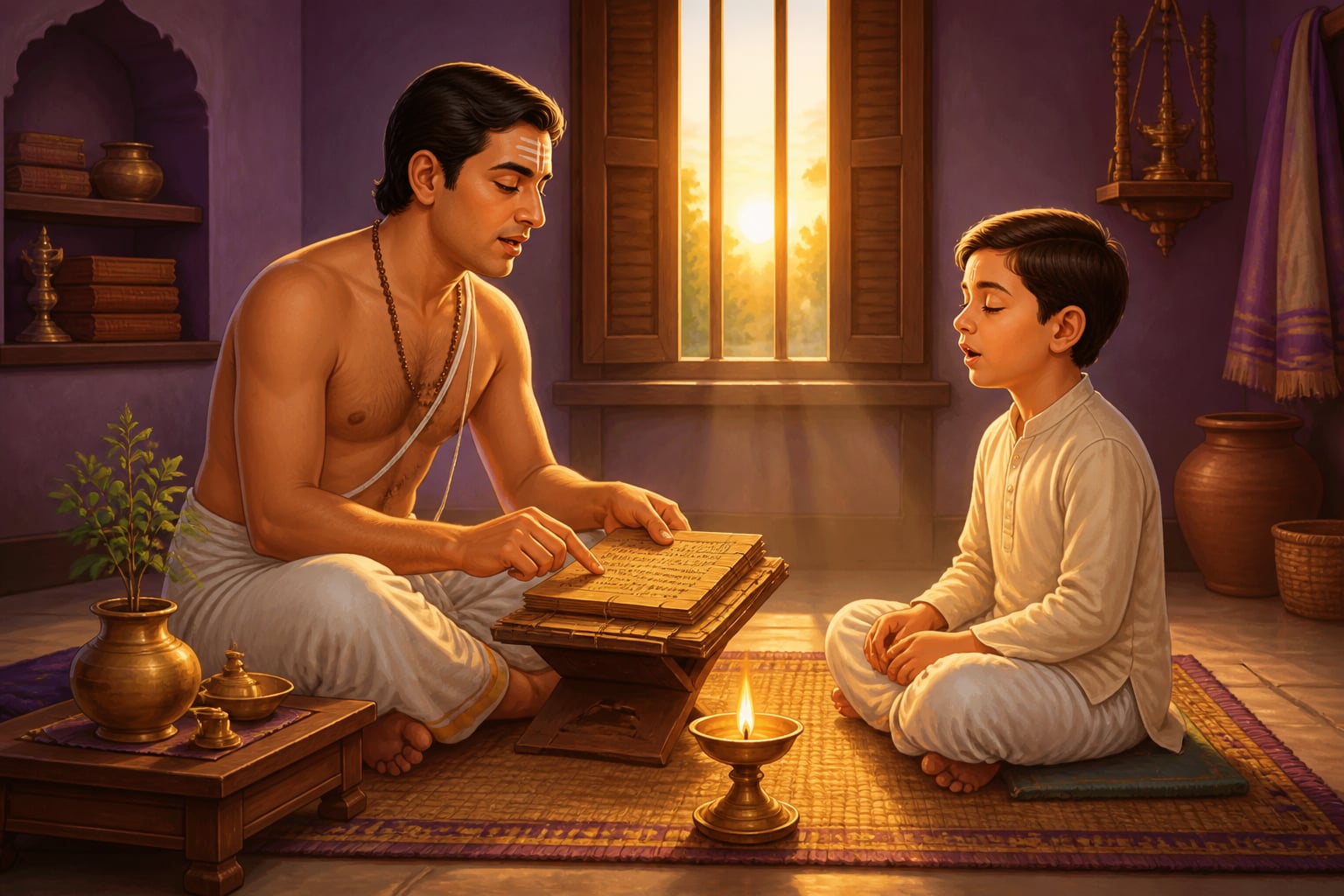
Father teaching son Vedic verse by oil lamp at home study

1. Brahma Yajna (ऋषि यज्ञ), Debt to Knowledge

"स्वाध्यायेन ऋषियज्ञः" "Through study, the sacrifice to the Rishis is performed."

Daily study and teaching honors the rishis who transmitted knowledge. This isn't passive reading, it's active preservation. The householder must study and teach, ensuring knowledge flows forward.

Economic function: Human capital preservation. Before printing, this oral tradition ensured civilization's knowledge survived. Every household was a micro-university.

2. Deva Yajna (देव यज्ञ), Debt to Cosmic Order

Daily worship, however brief, maintains the householder's relationship with cosmic forces. The lamp, the incense, the mantra: small acts acknowledging that human prosperity depends on larger systems.

Economic function: Funding religious infrastructure. Temple economies, priestly education, festival organization, all sustained by millions of small daily offerings.

Elder performing tarpana water offering in river at dawn

3. Pitri Yajna (पितृ यज्ञ), Debt to Ancestors

Daily remembrance of departed ancestors through tarpana (water offerings) or simple gratitude. The householder acknowledges that current prosperity is built on ancestral labor.

Economic function: Intergenerational accountability. This daily practice cultivates long-term thinking, you inherited from ancestors, you'll bequeath to descendants.

4. Bhuta Yajna (भूत यज्ञ), Debt to All Beings

Feeding animals, birds, even insects before eating yourself. The tradition of leaving grain for crows, milk for snakes, or food at the doorstep for wandering creatures.

Economic function: Ecological economics. This daily practice creates what modern economists call "positive externalities", benefits to the ecosystem that support human prosperity indirectly.

5. Manushya Yajna (मनुष्य यज्ञ), Debt to Humanity

Also called Atithi Yajna (guest sacrifice). The famous principle "Atithi Devo Bhava", the guest is God. Every household must be prepared to feed an unexpected visitor.

Economic function: Distributed social safety net. Before hotels, hostels, or government shelters, travelers relied on household hospitality. The system worked because every household participated.

The Architecture of Daily Redistribution

Consider what the Pancha Mahayajna actually mandates:

Yajna Recipient What Flows Modern Equivalent
Brahma Future generations Knowledge Education spending
Deva Spiritual institutions Material support Religious charity
Pitri Ancestral memory Ritual attention Estate planning, heritage preservation
Bhuta Non-human beings Food, water Environmental conservation
Manushya Fellow humans Hospitality Social welfare, disaster relief

This is a complete economic redistribution system, covering human capital, spiritual infrastructure, intergenerational transfer, environmental care, and social safety. And it's performed daily, by every householder.

The genius lies in the distribution. Not one massive annual donation, but thousands of small daily acts. Not centralized charity, but distributed obligation. Not professional philanthropy, but universal participation.

Global Perspectives on Household Economics

The idea that households have economic duties, not just rights, appears across civilizations, though few systems were as comprehensive as the Pancha Mahayajna.

Aristotle (384-322 BCE) coined the word oikonomia, literally "household management", from which we get "economics." For Aristotle, the household (oikos) was the fundamental economic unit, and good household management (oikonomia) was about meeting needs, not maximizing wealth. He distinguished this from chrematistics, wealth-accumulation for its own sake, which he considered unnatural. The Pancha Mahayajna would fit Aristotle's oikonomia: the household as a site of balanced production, consumption, and giving.

Marcel Mauss (1872-1950), the French anthropologist, documented gift economies across cultures in his landmark work The Gift (1925). Mauss showed that in traditional societies, gifts create social bonds, receiving obligates you to give in return. The Pancha Mahayajna goes further: the debts are built-in from birth. You owe the rishis, the gods, the ancestors, the animals, and humanity, and daily giving repays these debts. It's gift economy as cosmic accounting.

E.F. Schumacher (1911-1977) challenged modern economics in Small is Beautiful (1973), drawing on Buddhist principles. He argued that production should serve human well-being, not the other way around. His concept of "Buddhist Economics" emphasized right livelihood, sustainability, and local self-sufficiency. The Pancha Mahayajna embodies these principles: daily practice over occasional charity, local giving over distant philanthropy, ecological care as religious duty.

Amartya Sen (1933-) revolutionized economics with his "capabilities approach," arguing that development should expand human capabilities, not just GDP. His insight that famines result from distribution failures, not food shortages, echoes the Pancha Mahayajna logic: if every household shares, no one starves. Sen's emphasis on duty alongside rights aligns with the yajna framework: prosperity creates obligations.

Thinker Key Insight Pancha Mahayajna Parallel
Aristotle Household should meet needs, not maximize wealth Grihastha as giving engine, not hoarding shelter
Mauss Gifts create social bonds and obligations Five debts create cosmic bonds and obligations
Schumacher Local, sustainable, human-scale economics Daily local giving over occasional distant charity
Sen Development should expand capabilities for all Universal household participation ensures distribution

Modern Resonance: The Disappearing Daily Gift

Modern India retains fragments of the Pancha Mahayajna, but fragments only.

What survives:

What's weakened:

The economic consequences are visible. When Pancha Mahayajna operated fully, India had:

Today, these functions are either missing, professionalized (NGOs, hotels), or government-provided (welfare schemes), all less efficient than the distributed household system.

The Gift That Returns

Here's what modern economics struggles to explain: why would rational households give daily to entities who cannot reciprocate, dead ancestors, wild birds, passing strangers?

The Dharmashastra answer is elegant: because you are already in debt.

You didn't create the knowledge you use, you owe the rishis. You didn't create the ecological systems that sustain you, you owe the bhutas. You didn't create yourself, you owe your ancestors. The Pancha Mahayajna isn't generosity; it's repayment.

This reframing transforms giving from virtue (optional, praiseworthy) to duty (required, baseline). A household that doesn't practice the five yajnas isn't "less generous", it's in default on cosmic debt.

And practically? The system worked. When every household feeds birds, no one bears the cost alone, and the ecosystem thrives. When every household welcomes guests, travelers don't need hotels, and social bonds strengthen. When every household studies and teaches, knowledge survives generations without expensive institutions.

The Pancha Mahayajna created what economists call public goods through distributed private action, the most elegant solution to collective action problems ever designed.

Your Turn: The Micro-Yajna Experiment

You probably can't implement full Pancha Mahayajna in a modern apartment. But you can experiment with its logic.

This week, try one micro-yajna daily:

Notice what happens. Does daily giving feel different from occasional giving? Does duty feel different from choice?

Sundaram Iyer, our Chennai bank manager, will tell you: "It doesn't feel like giving. It feels like paying my bills. The cosmos sends me an invoice every morning, and I pay it before coffee."

That's the Pancha Mahayajna mindset. Not charity. Not virtue. Just daily accounts with the universe.

Next: Annadana, why the gift of food is considered supreme among all forms of giving, and how Akshaya Patra is scaling this ancient principle to feed millions.

Modern economics focuses on rights: property rights, contract rights, consumption rights. Amartya Sen's capabilities approach adds 'positive rights' (entitlements to education, health). But the starting point remains individual rights. The debt-first mindset starts with obligations: what do you owe before asking what you're owed?

Debt-first thinking reframes giving from generosity to justice. You're not being virtuous by teaching, you're repaying what the rishis gave. You're not being kind by feeding birds, you're acknowledging your ecological debt. This removes self-congratulation from giving.

Psychologist Adam Grant's research shows that people who view helping as 'paying forward' (debt-based) give more sustainably than those who view it as 'being generous' (virtue-based). The debt frame reduces burnout.

Distributed vs. centralized provision of public goods

Modern economies solve public goods problems through either government (taxes fund public services) or markets (private provision with regulation). E.F. Schumacher criticized both for creating dependency and destroying local capacity. His 'Small is Beautiful' advocated decentralized, human-scale solutions.

The Pancha Mahayajna predates Schumacher by millennia: radical decentralization where every household provides welfare services. No bureaucracy, no taxation, no market failures, just universal participation. The system's weakness: it works only if everyone participates.

Key terms

pañca mahāyajña
The five great sacrifices; daily obligations for every householder covering knowledge, gods, ancestors, beings, and humanity
atithi
Guest, especially an unexpected visitor; literally 'one without a fixed date' (a-tithi)
ṛṇa
Debt, obligation; the three (or five) debts every person is born with, to gods, ancestors, and sages
bali
Food offering, especially to beings other than humans; the portion of food set aside for animals, birds, and spirits

Key figures

Manu

Traditional: Primordial; Text composition: ~200 BCE - 200 CE

Ratan Tata

1937-2024

Marcel Mauss

1872-1950

Case studies

Indian Hotels Company: Atithi Devo Bhava at Industrial Scale

The Taj Mahal Palace Hotel in Mumbai, flagship of Indian Hotels Company Limited (IHCL), was founded in 1903 by Jamsetji Tata allegedly after being denied entry to a 'Europeans-only' hotel. From inception, Taj Hotels embodied 'Atithi Devo Bhava', treating guests as divine, regardless of origin. This wasn't marketing; it was operational philosophy. Staff were trained to anticipate needs before guests articulated them, to remember returning guests' preferences across years, to treat every visitor's comfort as sacred duty. The ultimate test came on November 26, 2008, when terrorists attacked the Taj Mumbai. Staff members, waiters, chefs, security, guided guests to safety, formed human shields, and refused to abandon their posts. Eleven employees died protecting guests they'd never met.

The 26/11 attacks revealed whether 'Atithi Devo Bhava' was slogan or soul. **Manushya Yajna at extreme**: Employees treated guests as literally divine, worth dying for. **Duty over self-preservation**: Staff acted from trained duty, not calculation. Post-attack interviews revealed employees didn't 'decide' to protect guests, it was automatic, the result of deep conditioning. **Universal application**: Kitchen staff, telephone operators, and security guards, not just managers, all acted identically. The atithi-dharma had permeated every level. This is Pancha Mahayajna logic: when hospitality is daily duty (not occasional heroism), it becomes reflex.

The Taj Mumbai reopened within a month, a statement that terror couldn't defeat dharma. IHCL's reputation soared globally; Taj became synonymous with exceptional hospitality. More significantly: the company didn't abandon its atithi-first philosophy post-attack. They enhanced security while maintaining warmth, proving that care and caution aren't contradictory. The Taj approach became a Harvard Business School case study. Indian hospitality, rooted in 'Atithi Devo Bhava,' gained global recognition as both ethically superior and commercially successful.

Manushya Yajna, practiced consistently as daily duty rather than occasional policy, becomes organizational reflex. The Taj employees didn't become heroes in crisis, they revealed who they already were through years of practice. Hospitality as yajna creates staff who instinctively serve, even unto death.

The hospitality industry's post-COVID recovery has split between brands cutting costs to recover margins and those doubling down on service quality. Taj Hotels' continued premium positioning, built on decades of treating hospitality as sacred duty rather than transactional service, demonstrates that cultural values create pricing power no cost-cutting strategy can achieve.

Post-26/11, Taj Hotels saw a 20% increase in occupancy rates globally within two years, customers voted with bookings for the brand that proved hospitality wasn't just service but sacred duty. Dharmic practice proved commercially viable.

The Gurukul System: Brahma Yajna as Educational Infrastructure

For over 2,000 years, the gurukul system provided universal education across ancient India without government funding, tuition fees, or institutional buildings. Students (brahmacharis) lived with teachers (gurus) in forest hermitages, learning through osmosis: oral recitation, debate, and practical work. The guru taught as Brahma Yajna, daily duty to repay the rishis who gave him knowledge. Students served the ashram as Manushya Yajna, their labor was their tuition. Food came from daily bhiksha (alms-seeking) in nearby villages, householders performing their own Brahma Yajna by feeding knowledge-seekers. The famous universities, Takshashila (est. ~700 BCE), Nalanda (est. ~5th century CE), Vikramashila, were scaled-up gurukuls maintaining the same principles.

The gurukul was Pancha Mahayajna institutionalized: **Brahma Yajna**: The guru's daily teaching was debt-repayment, not profession. No salary, teaching was sacred duty. **Bhuta Yajna**: Ashrams maintained forests, protected wildlife, practiced ecological harmony. **Manushya Yajna**: Students served visiting scholars; the ashram welcomed seekers regardless of origin. **Deva Yajna**: Daily rituals maintained the ashram's sacred atmosphere. **Pitri Yajna**: Lineage of knowledge from guru to shishya honored intellectual ancestors. The economic model was radical: zero fees, self-sustaining through community support, with 'payment' occurring only after completion, the student's voluntary dakshina based on gratitude, not obligation.

The gurukul system produced polymaths like Panini (grammar), Charaka (medicine), Aryabhata (astronomy), and Chanakya (political science). Takshashila at its peak had 10,000 students from across Asia studying 68 subjects. The system operated for millennia without bureaucracy, fees, or buildings, sustained entirely by the daily yajnas of householders feeding students and gurus teaching as duty. Chinese visitors like Xuanzang documented the system's effectiveness with wonder. The British disruption (Macaulay's 1835 Education Minute) didn't encounter a primitive system, it dismantled a sophisticated network that had educated subcontinent-scale populations through distributed household duty.

Mass education doesn't require massive institutions, it requires massive participation. When every household supports knowledge-seekers (feeding a wandering student) and every teacher teaches from duty (Brahma Yajna), education becomes public infrastructure without public spending. The gurukul model scaled through distribution, not centralization.

The global education crisis, with UNESCO reporting 250 million children out of school, has renewed interest in decentralized learning models. Homeschooling, learning pods, and community-based education share structural similarities with the gurukul model, relying on distributed networks rather than centralized institutions.

British surveys in 1820s found over 100,000 indigenous schools in Bengal and Bihar alone, educating children without government support, evidence of the distributed gurukul tradition persisting into the colonial era before systematic disruption.

Historical context

Vedic Period through Classical Period (~1500 BCE - 500 CE)

The Pancha Mahayajna emerged as a solution to a specific problem: how to maintain Vedic culture's redistribution systems after the elaborate shrauta yajnas (requiring animals, priests, elaborate rituals) became impractical for most householders. The five daily yajnas preserved the *function* of sacrifice (cosmic balance through giving) while simplifying the *form* (household-scale, daily, without priests).

Contemporary civilizations had similar concepts but less systematic implementation. Jewish tzedakah (righteousness through giving) was duty-based but less daily-structured. Greek household management (oikonomia) focused on production rather than redistribution. Roman patron-client relationships were reciprocal, not debt-based. Only the Indian system mandated five distinct giving categories as daily legal-religious duty.

Archaeological evidence shows bird-feeding platforms (for Bhuta Yajna) built into ancient Indian homes across regions and periods, suggesting the practice was architectural standard, not occasional choice. The home itself was designed for daily giving.

The Pancha Mahayajna represents humanity's most sophisticated distributed welfare system, solving public goods problems through universal household participation millennia before economists identified the challenges. Understanding this system offers alternatives to modern debates about government vs. market provision of welfare.

Living traditions

India's hospitality industry (3rd largest employer) draws directly from Atithi Devo Bhava culture. The country's bird populations in urban areas far exceed Western equivalents because of persistent Bhuta Yajna practices. The tradition of feeding wandering sadhus and brahmacharis created the cultural infrastructure that makes India uniquely hospitable to spiritual seekers.

Reflection

More in Dana: The Economics of Giving

All lessons in Dana: The Economics of Giving · Dharmic Economics course