Dakshina: Reciprocity in Sacred Economics
The Gift That Follows: Gratitude-Based Exchange
Dakshina represents a fundamentally different economic logic - the gift that follows receiving rather than the payment that precedes service. This lesson explores how reciprocity creates bonds that transactions cannot, and why gratitude-based exchange may be more efficient than price-based exchange.
The Gift After the Gift
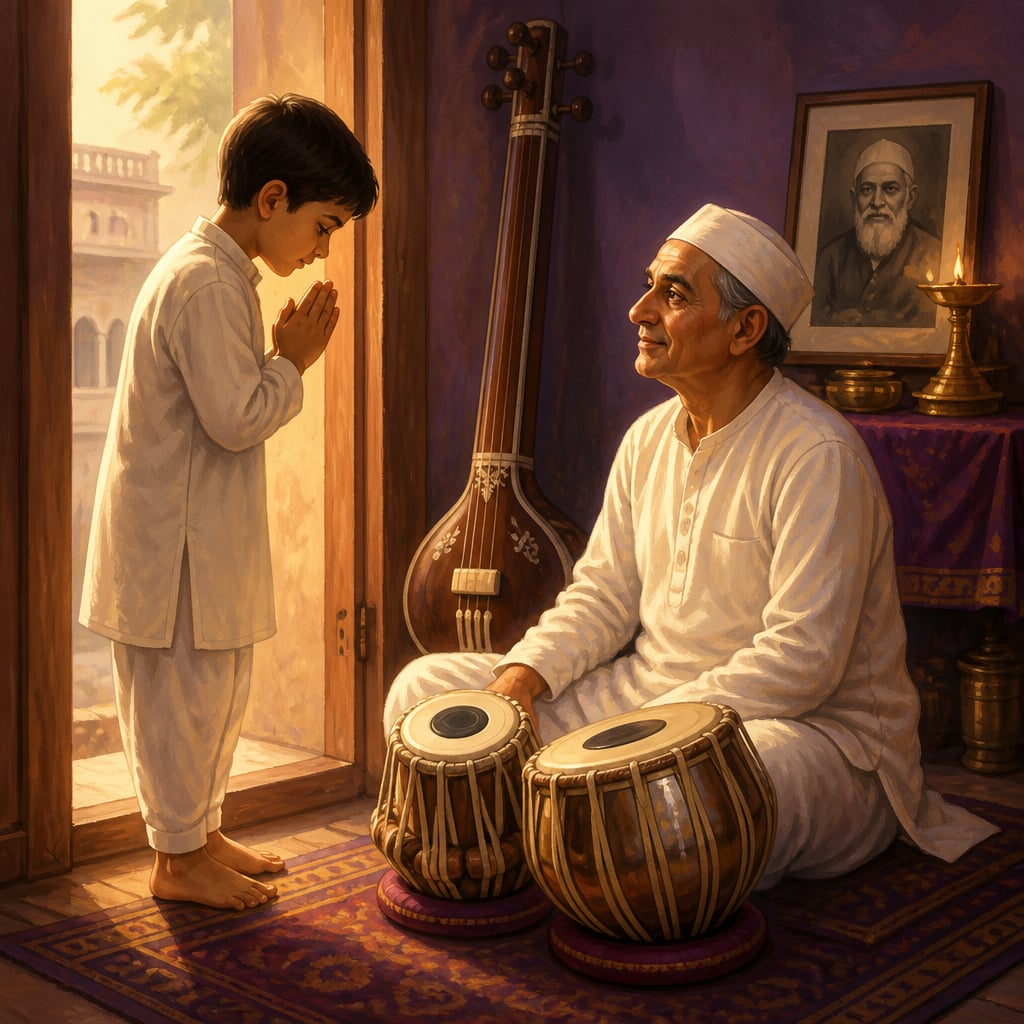
In 1956, a young student named Zakir Hussain arrived at the door of Ustad Allarakha, the legendary tabla master. He had no money to pay for lessons, no connections to recommend him, nothing but an overwhelming desire to learn. Allarakha accepted him. For years, Zakir received the most precious education in Indian classical percussion - not through any formal fee structure, but through the ancient guru-shishya parampara. When Zakir himself became world-famous, he never "paid back" his guru in any conventional sense. Instead, he honored his teacher through lifetime service, propagated his lineage, and eventually offered the same unconditional teaching to his own students. This is dakshina - not payment, but response. Not transaction, but transformation of relationship.
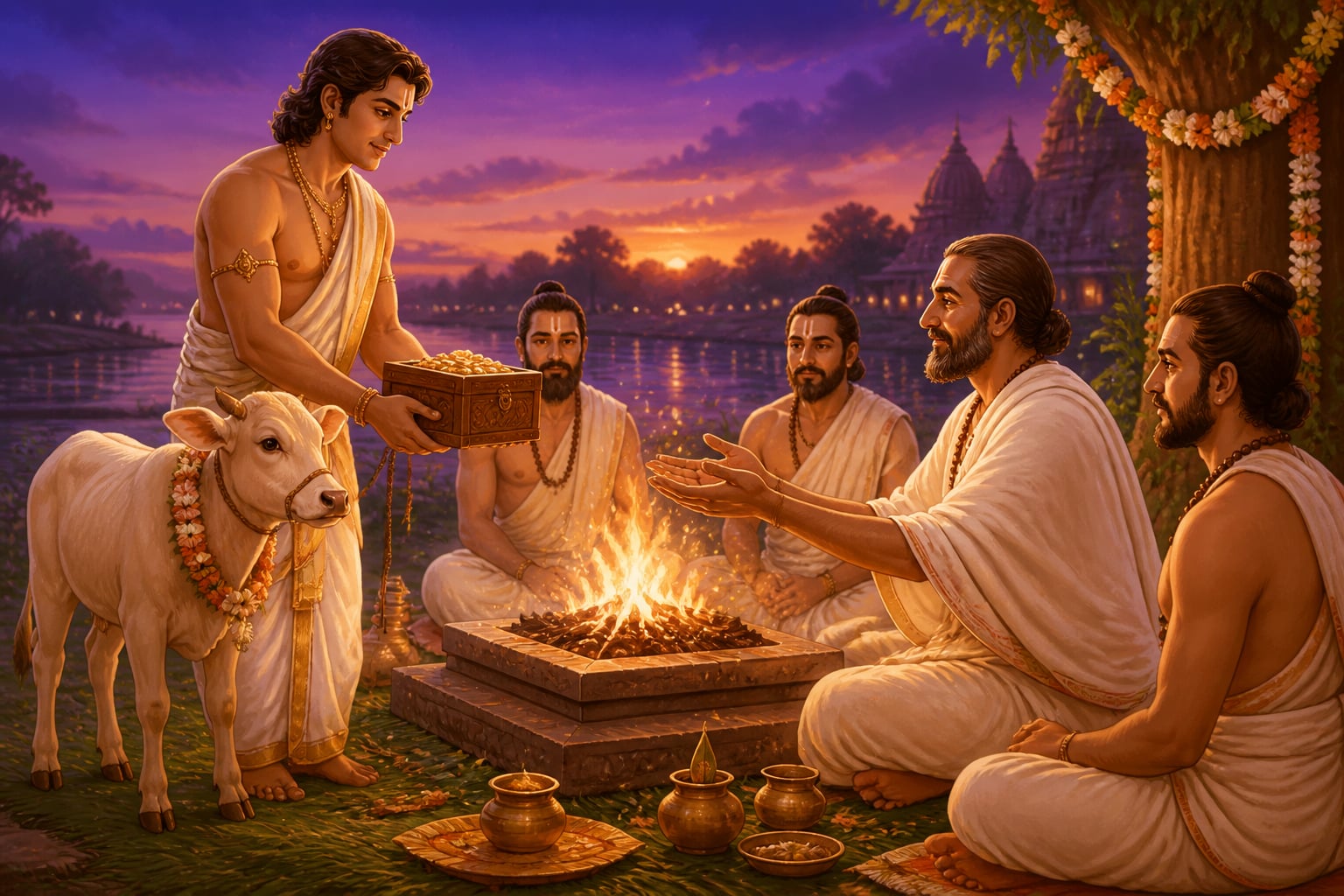
Ancient Roots: The Economics of the Vedic Yajna
The concept of dakshina originates in the Vedic yajna tradition, where it represented something far more sophisticated than priestly fees. The Rig Veda describes the cosmic yajna of creation itself, where the primordial being Purusha offers himself, and from this sacrifice emerges the ordered universe. Dakshina in human ritual mirrors this cosmic pattern - it is the response that completes the circle of giving.
Crucially, the Vedas distinguished dakshina from payment (mulya). A payment is determined beforehand, based on expected value. Dakshina is offered afterward, based on received value and transformed relationship. The Taittiriya Upanishad's teaching "shraddhaya deyam" (give with faith) applies especially to dakshina - it should flow from genuine recognition of what has been received, not from calculation of what was owed.
The texts describe dakshina as having three components: the material offering (often cattle, gold, or land in Vedic times), the emotional quality (shraddhaya - with faith, hriya - with humility, bhiya - with awe), and the relational dimension (it strengthens the bond between giver and receiver). A dakshina that lacks any of these three dimensions is considered incomplete.
The Principle: Why Reciprocity Outperforms Transaction
The genius of dakshina lies in its economic logic. Modern economics assumes that price-based exchange is the most efficient mechanism - buyer and seller negotiate a price, exchange goods, and the transaction ends. But dakshina-based exchange operates on a fundamentally different principle: the gift that follows creates obligations that the payment that precedes cannot.
Consider the difference: When you pay in advance for a service, the provider's obligation ends when the service is delivered. The relationship is complete. But when dakshina is offered after service, based on experienced value, the entire dynamic shifts. The provider gives their best without knowing the reward. The receiver responds based on actual benefit received. The exchange creates ongoing relationship rather than concluding transaction.
This is not mere idealism. Research in behavioral economics confirms that gift-based exchanges often outperform price-based ones in contexts requiring trust, creativity, and relationship. When teachers know their compensation depends on post-facto recognition rather than pre-negotiated fees, teaching quality often improves. When patients offer dakshina to healers based on recovery, trust increases. The "inefficiency" of undefined pricing actually creates efficiency through aligned incentives and sustained relationships.
Global Perspectives: The Universal Logic of Reciprocity
The wisdom of dakshina-based economics finds remarkable parallels in modern anthropological and economic thought. Lewis Hyde, in his influential work "The Gift: Creativity and the Artist in the Modern World," distinguishes between "commodity" and "gift" economies. Commodities create independence - once exchanged, buyer and seller owe each other nothing. Gifts create bonds - they circulate, creating networks of obligation and relationship. Hyde argues that certain goods - particularly knowledge, art, and spiritual teaching - cannot be commodified without being diminished. They must remain in "gift circulation" to retain their essential nature.
Karl Polanyi, the economic historian, identified three principles of economic integration across human societies: reciprocity, redistribution, and market exchange. Far from being primitive or inefficient, reciprocity-based economies handled complex exchanges for millennia before markets became dominant. Polanyi warned that the "disembedding" of economic relationships from social bonds - treating all exchange as commodity transaction - creates social breakdown. Dakshina represents embedded economics, where material exchange strengthens rather than replaces social relationship.
The sociologist Alvin Gouldner identified what he called the "norm of reciprocity" - a universal pattern across human cultures where receiving creates obligation to give in return. This isn't calculation but social instinct. Gouldner argued that reciprocity is foundational to stable society - more fundamental than either self-interest or altruism alone. Dakshina institutionalizes this universal norm within sacred economics.
Modern Resonance: Where Dakshina Logic Survives
The guru-shishya parampara in Indian classical arts remains the most vibrant living tradition of dakshina economics. In this system, a guru accepts a student based on perceived potential and commitment, not ability to pay. Training may last decades, with the student often living in the guru's household, serving the teacher while learning the art. "Payment" never occurs in the transactional sense. Instead, the student offers dakshina - which might include formal gifts at ceremonies, lifetime service to the guru, propagation of the lineage, and eventually offering the same unconditional teaching to the next generation.
What makes this economically sustainable? First, the guru's household is supported by multiple students, each contributing according to capacity. Second, established students performing professionally often channel significant resources back to their gurus. Third, the system selects for genuine dedication - only students truly committed to the art persist through years of demanding training without guaranteed outcomes. Fourth, the artistic community provides reputation mechanisms - gurus known for producing excellent students attract more students.
Beyond classical arts, dakshina logic operates wherever trust and relationship matter more than transaction. Ayurvedic practitioners in traditional settings often receive dakshina after treatment rather than fees before. Temple priests receive dakshina from devotees based on the devotee's experience of blessing. Even in modern India, relationships with family pandits, astrologers, and spiritual teachers often follow dakshina rather than fee structures.
Case Study: The Vedic Yajna Economy
In ancient Vedic society, an elaborate economic system organized around yajna (sacred ritual) and dakshina flourished for centuries. The rituals required specialists - priests who had memorized vast quantities of hymns, understood precise ceremonial procedures, and maintained ritual purity. These specialists didn't charge fees; they received dakshina.
The system worked because of interlocking relationships. Kings and wealthy householders sponsored major yajnas, providing dakshina in the form of cattle, gold, land, and villages. The receiving priests were expected to use these resources to maintain their households, support their own students, and sponsor subsequent rituals. The wealth circulated rather than accumulated.
Ashvamedhika and Rajasuya yajnas distributed enormous wealth through dakshina. Historical accounts describe kings giving away thousands of cattle, hundreds of horses, and vast quantities of gold. This wasn't charity in the modern sense - it was dakshina responding to received spiritual service. The priests who received these gifts were in turn expected to offer their wealth in subsequent rituals.
The system eventually evolved as market economies expanded, but its logic persists in temple traditions. Modern temple priests receive dakshina from devotees after performing pujas. The amount is not fixed, though conventions suggest appropriate ranges. Wealthy devotees give more; modest devotees give less. The priest serves all, with dakshina following service rather than determining it.

Case Study: Indian Classical Music's Living Gift Economy
The guru-shishya parampara in Hindustani and Carnatic music offers a contemporary window into dakshina economics. Pandit Ravi Shankar's relationship with his guru Baba Allauddin Khan exemplifies the tradition. Ravi Shankar surrendered his promising career as a dancer to become Allauddin Khan's student, living in Maihar for seven years in demanding conditions, serving his guru while absorbing his musical wisdom. There was no fee structure, no contract, no guarantee.
What Ravi Shankar "paid" was not money but transformation of self - surrender of ego, years of devoted practice, complete absorption in the lineage's musical philosophy. What he received could never have been purchased: not just technical skill but a complete aesthetic worldview, the authority to represent and extend the Maihar gharana, and eventually global recognition that reflected glory back on his teacher.
The same pattern repeats across generations. Zakir Hussain with Allarakha. Hariprasad Chaurasia with Annapurna Devi. Bismillah Khan maintaining his lineage through multiple generations of students. In each case, the economics of dakshina created bonds that contracts could never have formed. Students who might have become competitors instead became propagators of lineage. Knowledge that might have been hoarded instead flowed generationally.
Your Turn: Recognizing Reciprocity
Dakshina invites us to examine how we respond to what we have received. Not payment - that's transactional. Not charity - that's hierarchical. Reciprocity - that's relational.
Consider your education. You've received knowledge, guidance, and transformation from teachers, mentors, books, and experiences. Most of this came without price tags. What dakshina do you offer? The question isn't about money - it's about response. Do you use your education to contribute to others? Do you honor your teachers by embodying their values? Do you offer to the next generation what you received from the previous one?
Reciprocity operates in concentric circles. The most immediate circle includes those who directly gave to you. The next circle includes their sources - the traditions, institutions, and communities that enabled your teachers to teach. The widest circle includes all beings - the accumulated human heritage that makes your life possible.
As you reflect, notice that dakshina is not burden but joy. The finest response to having received knowledge is the pleasure of sharing it. The highest honor to a teacher is becoming someone worth teaching. Dakshina completes the circle of gift - and in completing it, keeps it flowing.
Key terms
- Dakshina
- The gift that follows receiving; reciprocal offering to one who has given spiritual, educational, or ritual service. Distinguished from payment (mulya) which precedes service and ends relationship.
- Guru-Shishya Parampara
- The traditional teacher-student lineage system, particularly in classical arts and spiritual traditions, where teaching flows through relationship rather than transaction, with dakshina replacing fees.
- Shraddhaya Deyam
- "Give with faith" - the Upanishadic principle that gifts (especially dakshina) must be accompanied by proper emotional and spiritual disposition to be complete.
- Rita/Rta
- Cosmic order or harmony; the universal principle that governs proper relationships between beings. Dakshina aligns the giver with rita by completing the circle of exchange.
Key figures
Dronacharya
The legendary guru of the Pandavas and Kauravas whose demand for Ekalavya's thumb as guru-dakshina illustrates both the power and potential for abuse within dakshina relationships, prompting ethical reflection.
Zakir Hussain
Tabla maestro who embodies the guru-shishya parampara through his relationship with his father and guru Ustad Allarakha, and his own subsequent role as guru to the next generation.
Lewis Hyde
American cultural critic whose book "The Gift" (1983) distinguishes commodity from gift economies and argues that creative work must remain in gift circulation to retain its essential nature.
Case studies
The Vedic Yajna Economy
The elaborate economic system organized around yajna and dakshina in ancient Vedic society, where specialized priests received lavish gifts following rituals, creating a circulation-based economy that distributed wealth while strengthening social bonds.
The Rig Veda and Arthashastra both describe wealth as something meant to flow, not stagnate. Kautilya's concept of kosha (treasury) emphasizes that hoarded wealth weakens the state, while circulated wealth strengthens it. The yajna economy operationalized this principle: kings gave dakshina to ritviks (priests), who spent on students and community, who in turn served the raja. Each participant acted as a trustee in a chain of reciprocity, not as an accumulator. This mirrors the Ishavasya Upanishad's teaching: 'tena tyaktena bhunjitha, ma gridhah kasyasvid dhanam' (enjoy through renunciation, do not covet).
The yajna-dakshina circuit sustained specialized priestly knowledge for over a thousand years without formal institutions or salaries. Archaeological evidence from sites like Kaushambi and Hastinapura shows that Vedic-era settlements maintained distinct priestly quarters with material prosperity, suggesting the system effectively supported knowledge specialists. The model eventually declined when royal patronage weakened and monetized temple economies replaced personalized dakshina relationships.
Dakshina created an economic system where wealth circulated rather than accumulated, where service preceded reward, and where material exchange strengthened rather than replaced social relationship.
Contemporary temple priest traditions and guru-shishya relationships in classical arts maintain this economic logic, demonstrating that reciprocity-based systems can sustain specialized knowledge transmission across millennia.
Vedic texts record dakshina of 10,000 to 100,000 cows for major yajnas like the Ashvamedha and Rajasuya. The Shatapatha Brahmana catalogues over 40 distinct yajna types, each with specified dakshina scales, indicating a formalized circulation economy operating centuries before coined money.
The Living Gharana System in Indian Classical Music
The gharana system in Hindustani music maintains dakshina economics through relationships like Ravi Shankar-Allauddin Khan and Zakir Hussain-Allarakha, where years of surrender and service replace transactional fees, creating deep mastery and lineage continuity.
The Arthashastra recognizes vidya (knowledge) as a category of wealth distinct from material goods, requiring its own transmission logic. The guru-shishya parampara operates on the principle that certain knowledge cannot be transacted, only transmitted through relationship. Dharmic texts describe three forms of debt (rna): deva-rna (to the gods), rishi-rna (to teachers), and pitr-rna (to ancestors). The gharana system embodies rishi-rna: the student's lifelong gratitude and service to the guru is not payment but acknowledgment of an unpayable debt. This is dakshina in its purest form, where the gift flows both ways and neither party calculates equivalence.
The gharana system has produced virtually every major figure in Hindustani classical music over the past 300 years. The Maihar gharana alone produced Ravi Shankar, Ali Akbar Khan, and Annapurna Devi from a single guru, Allauddin Khan. Zakir Hussain's training under his father Allarakha began at age three and continued for decades. These lineages have preserved and evolved complex ragas and compositions that no written notation could fully capture. However, the system faces pressure as fewer students commit to the multi-year residential training that traditional transmission requires.
The guru-shishya parampara selects for genuine dedication, creates bonds stronger than contracts, and produces artistic excellence that standardized music education rarely achieves.
As music education increasingly becomes commodified through schools and online platforms, the contrasting excellence produced by traditional dakshina-based transmission invites reflection on what is lost when relationship becomes transaction.
India's six major Hindustani gharanas (Gwalior, Agra, Jaipur-Atrauli, Kirana, Patiala, and Maihar) have collectively produced over 200 recognized master musicians across 6-8 generations, sustaining unbroken oral lineages for 300+ years without institutional infrastructure, tuition fees, or written curricula.
Living traditions
Modern adaptations include 'pay what you wish' models for yoga classes, coaching, and creative services - explicit attempts to recover dakshina logic within market economies. The gift economy movement in software (open source), information (Wikipedia), and culture (Creative Commons) also echoes dakshina principles, though usually without the explicit relational dimension.
- Guru-Shishya Parampara in Classical Arts: Students enter multi-year relationships with masters, serving while learning, eventually receiving permission to perform independently. Gharanas maintain distinct aesthetic lineages through this transmission - no fixed fees, only dakshina based on gratitude after years of training.
- Temple Priest Dakshina System: Temple priests throughout India receive dakshina rather than fixed fees. Devotees offer amounts based on their means and the significance of the ritual. This system creates accessibility - anyone can receive priestly service - while sustaining the priestly community through collective reciprocity.
- Kalakshetra Foundation, Chennai
- ITC Sangeet Research Academy, Kolkata
- Padmanabhaswamy Temple: The Travancore royal family's hereditary trusteeship demonstrates dakshina-based relationship with the divine - the rulers serve as dasa (servants) of Lord Padmanabha, receiving the privilege of service rather than claiming ownership, exemplifying how trusteeship transforms the relationship between wealth and duty
- Somnath Temple Trust: Rebuilt through the collective dakshina of the nation after Independence, Somnath represents reciprocity at civilizational scale - the temple given back to the people through voluntary contributions, with ongoing maintenance sustained through dakshina-based donations rather than government funding
Reflection
- Consider a teacher, mentor, or guide who significantly shaped your development. What would complete dakshina to them look like? Not just material gift, but full response - how you live, what you pass forward, how you honor their investment in you.
- In what areas of your life has market logic (pay first, receive service, relationship ends) replaced reciprocity logic (receive first, respond based on value, relationship continues)? What has been gained and lost in this transition?