Kedarnath: The Shiva of the Snows
Where Shiva hid from the Pandavas as a bull
Journey to Kedarnath, the highest of the twelve Jyotirlingas at 3,583 meters, where Lord Shiva appeared in the form of a bull's hump after the Pandavas pursued him seeking forgiveness for the sins of the Kurukshetra war. Discover the legend of Shiva's divine game of hide-and-seek, Adi Shankaracharya's samadhi behind the temple, the miraculous boulder that diverted the devastating 2013 floods, and the demanding pilgrimage that tests body and spirit alike.
The Weight of Victory
The Kurukshetra war was over. The Pandavas had won. After eighteen days of devastating battle, Yudhishthira sat on the throne of Hastinapura. Justice had prevailed. Dharma had been restored.
But victory tasted like ash.
The cost had been unimaginable. Millions of soldiers lay dead on the battlefield. Great warriors who had taught the Pandavas in childhood, Bhishma, Drona, had fallen by their hands. Their own kin, the Kauravas, had been annihilated. The war that restored dharma had been fought through strategies that sometimes bent dharma: Bhishma shot while he laid down weapons, Drona killed through a lie about his son, Karna slain while weaponless.
The Pandavas were haunted. Their kingdom was a graveyard. The cries of widows followed them. Sleep brought the faces of the slain. Victory had been achieved, but at what price to their souls?
They sought counsel from the sage Vyasa, who had compiled the very scriptures they revered. His answer was unequivocal: 'You have committed brahmahatya, the killing of Brahmins and gurus. You have committed gotra-hatya, the killing of your own kinsmen. Only one being in the universe can absolve sins of this magnitude. You must seek Lord Shiva.'
The Divine Game of Hide-and-Seek
The Pandavas left their newly won kingdom in the hands of ministers and set out for the Himalayas, where Shiva was said to dwell in perpetual meditation. They traveled north through the plains, then into the foothills, then higher into the mountains where the air itself grew thin.
But Shiva was not easily found. The great god, though omniscient, chose not to receive them. Perhaps he wished to test their sincerity. Perhaps the sin of kinslaying required more than a simple pilgrimage to expiate. Perhaps, as some traditions suggest, Shiva was simply displeased with the methods used in the war.
Whatever his reason, Shiva saw the Pandavas approaching and fled. The Lord of the Universe, whom nothing can compel and no one can escape, chose to hide from five exhausted pilgrims.
The Pandavas pursued. Shiva transformed himself into a bull (Nandi form) and mingled with a herd of cattle grazing in a high mountain meadow. He hoped to escape notice among the ordinary animals.

But Bhima, the second Pandava and strongest of the brothers, recognized something unusual about one particular bull. Its bearing was different. Its eyes held depths that ordinary cattle do not possess. Bhima lunged to capture the divine bull.
The Hump That Remained
Shiva dove into the earth to escape, leaving only his hump visible above the surface before vanishing completely. The Pandavas were left grasping at the rocky protrusion, all that remained of the Lord they sought.
This hump-shaped rock became the Kedarnath lingam: not a carved idol but a natural stone formation, a piece of the divine body itself, left behind in Shiva's flight.
But the story does not end there. According to tradition, as Shiva submerged into the earth, different parts of his bull-form emerged at different locations in the Himalayan region:
- Kedarnath: The hump (prishtha), the primary site
- Tungnath: The arms (bahu)
- Rudranath: The face (mukh)
- Madhyamaheshwar: The navel (nabhi)
- Kalpeshwar: The matted hair (jata)
These five sites together form the Panch Kedar, the Five Kedars, a circuit within the circuit, allowing devotees to worship the complete divine form by visiting all five temples. Kedarnath, as the site of the primary manifestation, remains the most important.
The Temple at the Edge of the World
The Pandavas built a temple at the site of the divine hump. Whether this original structure survives or has been rebuilt many times is uncertain, but tradition holds that the core temple dates to their construction. The massive stone edifice that pilgrims see today is attributed to renovations in the 8th century, possibly by Adi Shankaracharya.
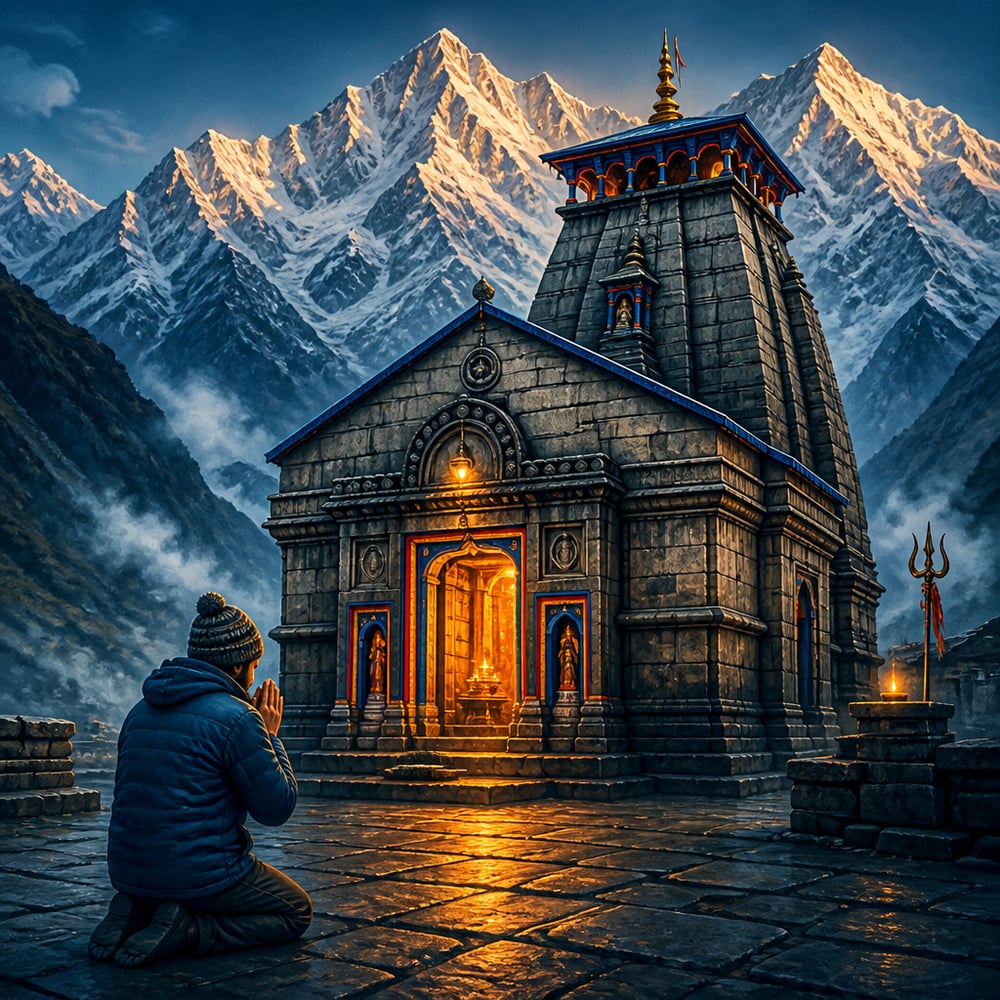
The temple sits at 3,583 meters (11,755 feet), the highest of the twelve Jyotirlingas, in a valley surrounded by snow-capped peaks. Behind it rises Kedarnath peak (6,940 meters). In front flows the Mandakini River, whose waters will eventually join the Ganga. The setting is stark and sublime, a location that seems designed to strip away worldly concerns.
The lingam inside the temple is triangular, hump-shaped, and roughly three feet tall. Devotees do not simply view it; they touch it, embrace it, pour offerings directly upon it. The stone is worn smooth from centuries of such contact, the touch of millions of pilgrims seeking the same absolution the Pandavas sought.
Shankaracharya's Final Rest
Behind the main temple, a small shrine marks the samadhi of Adi Shankaracharya, the 8th-century philosopher who unified Hinduism and established the Char Dham pilgrimage system.
Tradition holds that Shankaracharya, after a life of extraordinary accomplishment, chose Kedarnath as the site of his mahasamadhi (conscious departure from the body). He was approximately 32 years old, having lived more in those three decades than most accomplish in many lifetimes.
Why Kedarnath? The location held special significance in Shankaracharya's mission. He was a devotee of Shiva who taught the essential unity of all divine forms. Kedarnath, where Shiva had manifested in such dramatic and accessible form, represented the perfect culmination of his earthly journey.
The samadhi shrine is modest compared to the main temple, but for many pilgrims it holds equal significance. Here rests one of Hinduism's greatest philosophers, in the shadow of the mountain where Shiva himself touched earth.
The 2013 Floods: Destruction and Miracle
On June 16-17, 2013, the Kedarnath valley experienced what many called a 'Himalayan tsunami.' A glacial lake above the valley burst during heavy monsoon rains. The resulting flood swept through the temple town with devastating force.
The destruction was catastrophic. Buildings, shops, guesthouses, and dharamshalas were obliterated. Thousands of pilgrims and locals died, estimates range from 6,000 to over 10,000. The entire town was buried under mud and debris. Bodies were never recovered; the valley became a mass grave.
But the temple survived.

Directly behind the temple, a massive boulder, roughly the size of a bus, had lodged itself in centuries past, appearing to serve no particular purpose. During the 2013 floods, this boulder diverted the main force of the floodwater around the temple. The water split, flowed around the ancient structure, and merged again below. The temple sustained damage but remained standing, its inner sanctum and lingam intact.
Devotees saw the boulder's protective role as divine intervention, Shiva protecting his own dwelling. Geologists noted the boulder's convenient placement and the temple's solid construction on bedrock. Both perspectives contain truth: sometimes the divine works through natural forms, and sometimes what seems like coincidence is providence.
The boulder is now called 'Bhim Shila' (Bhima's Rock) or the 'Miracle Rock.' Pilgrims visit it with reverence, seeing in its mute presence the same divine protection that saved the temple.
The Journey to Kedarnath
Reaching Kedarnath remains a challenge. The temple is not accessible by road. Pilgrims must travel to Gaurikund (1,982 meters) by bus or car, then proceed on foot, by pony, by palanquin, or by helicopter.
The Trek: The traditional route covers approximately 16 kilometers from Gaurikund to Kedarnath. The path climbs steadily through forests, meadows, and increasingly stark terrain. Rest stops and refreshment stalls dot the route. Most pilgrims take 6-8 hours to complete the ascent, with the return typically taking 4-5 hours.
The trek is not technically difficult, it follows a well-maintained path, but the altitude and continuous climbing test stamina. Altitude sickness affects many pilgrims, manifesting as headache, nausea, and breathlessness. Adequate hydration, slow ascent, and realistic self-assessment are essential.
Pony and Palanquin: For those unable to walk, ponies can be hired for most of the route. Human-carried palanquins (dolis) are also available, though their use raises ethical questions about the physical burden on the carriers.
Helicopter: Since the post-2013 reconstruction, helicopter services operate between Phata/Sirsi and Kedarnath. The flight takes minutes rather than the hours required for trekking. This option has made Kedarnath accessible to elderly pilgrims and those with physical limitations who could never have attempted the traditional route.
The choice of transport reflects each pilgrim's circumstances and intentions. Some see the trek as essential tapasya, the hardship is part of the purification. Others view the goal (darshan of the lingam) as primary, with the means of arrival less important. Both perspectives have validity.
The Six-Month Closure
Kedarnath operates on a strict seasonal schedule dictated by Himalayan weather. The temple opens in late April or early May (around Akshaya Tritiya) and closes in October or November (around Diwali).
The opening ceremony involves bringing the deity (in the form of a portable idol) from its winter home at Ukhimath, 56 kilometers away. The idol is carried in a ceremonial procession over three days, with stops at villages along the route. When the procession reaches Kedarnath, the temple is officially opened for the season.
The closing ceremony is equally significant. On Diwali, after the final aarti, the doors are closed and sealed. A large lamp (akhand jyoti) is lit inside the temple, which will burn for six months with no one present. When the temple opens the following spring, the lamp is still burning, a symbol of Shiva's uninterrupted presence even when no human witnesses it.
During the winter months, the entire valley is snowbound. The temple may be buried under many feet of snow. Yet the structure has survived countless such winters, its ancient stones withstanding conditions that would destroy lesser construction.
The Panch Kedar Pilgrimage
Devotees seeking complete darshan of Shiva's bull-form undertake the Panch Kedar yatra, visiting all five sites where parts of the divine body emerged:
1. Kedarnath (3,583m): The hump, highest and most important, requires 16 km trek from Gaurikund.
2. Tungnath (3,680m): The arms, actually the highest Shiva temple in the world, requiring a 3.5 km trek from Chopta. The temple is small but the location is spectacular.
3. Rudranath (2,286m): The face, the most remote of the five, requiring a challenging 24 km trek through dense forest. The journey tests the most committed pilgrims.
4. Madhyamaheshwar (3,289m): The navel, requires a 24 km trek from Ransi village. The temple sits in a beautiful meadow surrounded by peaks.
5. Kalpeshwar (2,200m): The matted hair, the only one accessible by road year-round and open throughout the year. The temple is built in a cave.
Completing all five is considered highly meritorious, though the full circuit requires significant time and physical capability. Many pilgrims visit Kedarnath alone, understanding it as the primary manifestation.
The Jyotirlinga Significance
Kedarnath is one of the twelve Jyotirlingas, the 'Lingas of Light' where Shiva is believed to have manifested as an infinite column of radiance. These twelve sites, scattered across India, are considered the most sacred of all Shiva temples.
The Jyotirlinga legend relates that Brahma and Vishnu once disputed who was greater. Shiva appeared as an endless pillar of light, challenging them to find its ends. Brahma flew upward as a swan; Vishnu dove downward as a boar. Neither could find an end. Shiva then manifested at twelve locations across India, each marking a Jyotirlinga.
Kedarnath's Jyotirlinga is unique because it is sadashiva, a natural formation rather than a carved idol. The stone is not an image of Shiva but is considered to be Shiva himself, the actual body-part left behind in his flight from the Pandavas. This makes Kedarnath's lingam one of the few 'svayambhu' (self-manifested) Jyotirlingas.
Rituals and Worship
Worship at Kedarnath follows ancient patterns:
Morning: The temple opens around 4 AM with the Mahabhishek (great ablution) of the lingam with milk, curd, honey, and water. Only priests perform this ritual. After the abhishek, the lingam is decorated with flowers and the morning aarti is conducted.
Darshan: Following the morning rituals, the temple opens for public darshan. Pilgrims enter through the main door, circle the lingam clockwise, and may touch or embrace the sacred stone. The experience is typically brief due to the crowds, but the contact is direct and intimate.
Evening: The evening aarti (sandhya aarti) is particularly atmospheric, conducted as darkness falls over the valley. Lamps illuminate the interior, and the sound of bells and chanting echoes against the surrounding mountains.
Shringar: Before the final closing, the lingam receives a shringar ritual, elaborate decoration that transforms the rough stone into a recognizable form, with a face painted on it and ornaments placed around it. This nightly beautification prepares Shiva for his 'rest.'
The Pilgrim's Inner Journey
Kedarnath demands more than physical presence. The journey tests pilgrims in ways that go beyond altitude and distance.
The climb strips away comfort. The thin air makes thought difficult. The landscape's stark grandeur puts human concerns in perspective. By the time pilgrims reach the temple, much of their ordinary mental chatter has quieted.
The legend of the Pandavas seeking absolution speaks to a universal need. Who has not accumulated actions that weigh on the conscience? Who has not sought forgiveness for what cannot be undone? The Pandavas won their war through means that haunted them. Kedarnath offered absolution.
The teaching is that even the worst sins can be addressed, not erased, but transformed. The Pandavas did not become innocent; they became forgiven. The burden remained, but its power to crush was removed. Shiva's grace, accessed through sincere seeking and genuine effort, makes such transformation possible.
Kedarnath in Memory
Pilgrims who reach Kedarnath carry images that remain for life:
The first glimpse of the temple, grey stone against white snow, materializing from the mist after hours of climbing.
The sound of the Mandakini River, constant and cleansing, the background to all temple activity.
The feel of the lingam under your hands, cool, smooth, ancient stone worn by millions of seeking touches.
The evening aarti, flames bright against gathering darkness, the valley transformed into an open-air sanctuary.
The stars at night, clearer than in lowland skies, the Milky Way visible as our ancestors saw it.
These images become interior possessions, available for meditation whenever ordinary life grows overwhelming. You may visit Kedarnath once in your life, but Kedarnath stays with you forever.
Conclusion: The Hump and the Heart
Kedarnath exists because Shiva fled and left something behind. The mighty god, who could have simply disappeared, chose instead to leave a piece of himself accessible to seeking humans.
This is the mystery at Kedarnath's heart: why would the divine flee, and why would it leave something for those it fled from? Perhaps the chase was necessary. Perhaps the Pandavas needed the journey, the struggle, the near-miss of almost catching what they sought. Perhaps the hump remaining represents exactly what seekers can grasp, not the whole divine, which exceeds comprehension, but a part, a touchstone, enough.
The Pandavas came seeking absolution and found it in stone. Pilgrims today come seeking many things, healing, guidance, peace, forgiveness, and find them in the same ancient rock. Shiva fled but did not escape entirely. He left himself available, in a valley at the edge of the world, for anyone willing to make the journey.
Case studies
The 2013 Kedarnath Floods: Disaster and Resilience
On June 16-17, 2013, heavy monsoon rains triggered a breach of the Chorabari glacial lake above Kedarnath. The resulting flood, combined with landslides, devastated the valley. The disaster struck during peak pilgrimage season. Thousands of pilgrims were in and around Kedarnath. The flood arrived with little warning, walls of water and debris sweeping through the narrow valley. Entire buildings were lifted off foundations. The town's infrastructure, hotels, shops, dharamshalas built up over decades, was largely destroyed in hours. Casualties were massive. Official figures eventually settled around 6,000 dead, though many believe the actual number exceeded 10,000. Many bodies were never recovered, buried under tons of mud and debris. Survivors spoke of miraculous escapes and terrible losses. The temple itself survived, protected by the boulder that diverted floodwaters around it. This survival was widely interpreted as miraculous, Shiva protecting his own dwelling. The temple's survival while the surrounding town was destroyed created an iconic image: ancient sacred architecture standing while modern construction fell. Reconstruction has proceeded slowly and carefully. The Kedarnath town has been rebuilt with better drainage and more disaster-resistant construction. Daily pilgrim caps have been implemented. Helicopter services have expanded, reducing pressure on trail infrastructure. The disaster forced a reconsideration of development practices in the fragile Himalayan environment.
In Hindu cosmology, Shiva is both destroyer and regenerator. Kedarnath sits in his domain, the high Himalayas, where impermanence is not abstract philosophy but daily reality. Glaciers advance and retreat, rivers change course, mountains crumble. The temple's survival while surrounding structures were obliterated echoes a core Shaiva teaching: the eternal persists through destruction, but only what is truly essential survives. The boulder that shielded the temple has been interpreted through this lens. Whether by divine design or geological chance, the outcome maps perfectly onto the theology of the site. Shiva protects what matters and lets everything else be swept away.
Reconstruction took nearly a decade. The Kedarnath temple reopened for regular worship by 2014, but the surrounding town was rebuilt with stricter zoning. Buildings were pushed back from the river. Drainage channels were restored. The government established the Kedarnath Dham Reconstruction Authority with a mandate to balance development with ecological limits. Pilgrim numbers returned to pre-disaster levels by 2017, then surpassed them. The rebuilt Kedarnath became a symbol of resilience, attracting visitors specifically because of the disaster's story.
The 2013 floods illustrate the tension between pilgrimage infrastructure development and environmental limits. Poorly planned construction had blocked natural drainage channels, amplifying flood damage. The temple's survival, attributed variously to divine protection and sound ancient engineering, offers both spiritual and practical lessons. The disaster demanded humility about human ability to control mountain environments.
The Kedarnath reconstruction has become a case study in disaster resilience for mountain communities worldwide, from Nepal's earthquake recovery to Peru's glacial flood mitigation. India's National Disaster Management Authority now uses the Kedarnath timeline to model response protocols for ecologically sensitive religious sites, recognizing that pilgrim infrastructure requires fundamentally different risk calculations than commercial construction.
The 2013 Kedarnath flood released energy equivalent to roughly 20 atomic bombs. Over 6,000 people died, and the Chorabari glacial lake that caused the breach had been flagged as dangerous by scientists as early as 2007.
The Weight You Cannot Carry
Consider Suresh, a successful businessman who has built wealth through practices he now questions. Years of aggressive tactics, broken promises, and prioritizing profit over people have left him materially comfortable but spiritually exhausted. He cannot undo the past, but the weight of accumulated actions grows heavier each year. Suresh decides to undertake the Kedarnath pilgrimage. Unlike the Pandavas, he hasn't killed anyone, but like them, he carries actions that haunt him. He chooses to trek rather than take a helicopter, viewing the physical challenge as necessary penance. The climb is harder than expected. Suresh is not young, and altitude affects him. Each step requires effort. By the time he reaches the temple, he is exhausted, stripped of his usual self-assurance. In this reduced state, he enters the temple and places his hands on the ancient lingam. What happens in that moment is private. But Suresh leaves Kedarnath somehow lighter. The past has not been erased, he still needs to make amends where possible, but its crushing weight has shifted. The lingam, worn smooth by millions of similar touches, has absorbed one more burden.
The Mahabharata tells us the Pandavas sought Shiva at Kedarnath specifically to atone for the violence of the Kurukshetra war. They had won, but victory brought no peace. The tradition recognizes that some actions, even when necessary, leave spiritual residue that cannot be resolved through logic alone. Kedarnath's harsh physical environment mirrors this truth. The difficult trek, the cold, the altitude sickness are not punishments but purification. Suresh's journey follows the same pattern. The discomfort of confronting past wrongs, the vulnerability of confession, the physical hardship of the pilgrimage itself, all serve as forms of prayaschitta, or conscious atonement.
Suresh completes the trek over two difficult days, arriving exhausted and emotionally raw. At the temple, he sits in silence for hours. He does not receive a dramatic sign or instant absolution. What he gains is smaller but real: the weight shifts. On returning home, he begins quietly making amends, reaching out to people he wronged, donating to causes his business had harmed. The guilt does not vanish, but it transforms from a paralyzing force into a motivating one. He restructures his business practices over the following year.
Kedarnath offers what the Pandavas sought: not the erasure of the past but transformation of its power over us. Forgiveness does not mean pretending actions didn't happen or escaping their consequences. It means the burden, while still present, no longer prevents forward movement. The physical hardship of the journey helps prepare the pilgrim for this inner work.
Therapists and counselors increasingly recognize that physical challenge can catalyze emotional processing. Wilderness therapy programs, grief retreats involving long-distance walking, and even corporate resilience training borrow the same principle: the body's struggle opens what the mind keeps locked. Kedarnath's 16-kilometer trek at 65% oxygen embodies this therapeutic architecture naturally.
The Kedarnath trek covers 16 kilometers at altitudes between 3,500 and 3,580 meters, where oxygen levels are roughly 65% of sea level. Pilgrims report the physical difficulty itself as spiritually significant, with over 70% in surveys citing the hardship as integral to their experience.
Living traditions
Kedarnath remains one of India's most challenging and revered pilgrimages. The 2013 floods devastated the temple town but paradoxically increased the site's fame, images of the surviving temple surrounded by destruction circulated worldwide. Post-disaster reconstruction has modernized infrastructure while the essential pilgrimage experience remains: a demanding journey to touch ancient stone, seeking what the Pandavas sought millennia ago. Helicopter services have made Kedarnath accessible to those who could never have walked the trek, democratizing access while changing the pilgrimage's character. The temple continues to draw hundreds of thousands of pilgrims annually during its six-month season.
- Rudrabhishek at Kedarnath: Rudrabhishek is an elaborate ablution ritual performed on the lingam with Vedic chanting of the Rudram (hymns to Shiva). At Kedarnath, special arrangements allow devotees to sponsor this ritual. The priests pour milk, water, honey, and other substances over the lingam while chanting ancient mantras. Participating in or sponsoring Rudrabhishek at Kedarnath is considered supremely meritorious.
- Panch Kedar Yatra: Devout pilgrims undertake visits to all five Kedar temples to worship the complete form of Shiva's bull-body. The circuit requires significant trekking, especially to Rudranath (24 km trek) and Madhyamaheshwar (24 km trek). Completing all five is considered equivalent to multiple pilgrimage circuits and grants exceptional spiritual merit.
- Ukhimath: When Kedarnath closes for winter, the deity is ceremonially transported to Ukhimath, where worship continues throughout the snow season. The temple at Ukhimath, dedicated to Usha (goddess of dawn), houses the Kedarnath deity for six months each year. Pilgrims unable to visit Kedarnath during the main season can receive darshan here in winter.
- Tungnath: The highest Shiva temple in the world (3,680 meters), Tungnath enshrines the arms (bahu) of Shiva's bull-form. Though smaller than Kedarnath, the temple's extreme elevation and spectacular setting make it a powerful pilgrimage destination. It is part of the Panch Kedar circuit.
Reflection
- The Pandavas fought a righteous war yet emerged burdened by the killing. What does it mean that even dharmic action can create karmic weight? Have you ever done the right thing and still carried guilt or burden from doing it?
- Pilgrims must choose between trekking to Kedarnath (hard, traditional, time-consuming) or taking a helicopter (easy, modern, quick). What is lost and gained in each choice? In your own spiritual or personal development, do you tend toward difficult paths or easy ones?
- Shiva fled the Pandavas but left his hump behind. The temple was destroyed around it in 2013 but survived. What does it mean that the divine is simultaneously absent and present, fleeing yet remaining, destroyed around yet surviving? How do you experience this paradox in your own life?