Four Sacred Sites in God's Own Mountains
Overview of Uttarakhand's Chota Char Dham circuit
Discover the Chota Char Dham - the Himalayan pilgrimage circuit in Uttarakhand that draws millions each year. Learn why this circuit developed as a concentrated alternative to the all-India Char Dham, the traditional clockwise sequence from Yamunotri to Badrinath, the dramatic seasonal opening on Akshaya Tritiya and closing at Diwali, and how this yatra combines river-source worship with deity worship at India's holiest high-altitude sites.
The Land of the Gods
In the northern reaches of India, where the plains give way to the greatest mountain range on Earth, lies a landscape that has captivated spiritual seekers for millennia. The region known today as Uttarakhand was historically called 'Devbhoomi', the Land of the Gods. Here, at elevations where the air thins and snow caps the peaks year-round, ancient Indians believed the boundary between the earthly and divine grew thin.
This is the setting for the Chota Char Dham, literally, the 'Small Four Dhams.' While the original Char Dham pilgrimage established by Adi Shankaracharya spans the entire Indian subcontinent from Badrinath in the north to Rameswaram in the south, the Chota Char Dham concentrates four supremely sacred sites within a single Himalayan region. For pilgrims who cannot traverse the length and breadth of India, this circuit offers profound spiritual merit in a more accessible journey.
Understanding the Two Circuits
Confusion often arises between the 'big' and 'small' Char Dham. Let us clarify:
The original Char Dham comprises Badrinath (Uttarakhand), Dwarka (Gujarat), Puri (Odisha), and Rameswaram (Tamil Nadu). This circuit spans approximately 5,000 kilometers and was designed by Shankaracharya to unite India through pilgrimage. Completing it required months of travel, crossing regional boundaries, climatic zones, and cultural contexts.
The Chota Char Dham comprises four sites entirely within Uttarakhand: Yamunotri, Gangotri, Kedarnath, and Badrinath. This circuit is approximately 500 kilometers and can be completed in 10-12 days. Importantly, Badrinath appears in both circuits, it serves as the northern anchor of the all-India pilgrimage and as the culmination of the Himalayan circuit.
The Chota Char Dham is not a 'lesser' pilgrimage. In some ways, it is more challenging: the elevations are higher, the terrain more demanding, and the season extremely limited. What it offers is concentration, four of India's holiest sites compressed into a journey through the most sacred mountain landscape in Hindu tradition.
Why These Four Sites?
The Chota Char Dham combines two types of sacred geography:
River-source shrines: Yamunotri and Gangotri mark the origins of India's two holiest rivers. The Yamuna and Ganga are not merely rivers but goddesses, and their birthplaces in the Himalayan glaciers are among the most sacred sites in Hinduism. Pilgrims journey here not just to pray but to witness the miraculous emergence of holy waters from ice.
Deity temples: Kedarnath houses one of the twelve Jyotirlingas of Shiva, while Badrinath is the abode of Vishnu as Narayana. Together, they represent the two great devotional streams of Hinduism, Shaivism and Vaishnavism, united in a single pilgrimage.
This combination is unique: nowhere else can pilgrims visit both major river sources and both major deity traditions in a single journey. The circuit offers a complete spiritual experience.
The Sacred Sequence
Tradition prescribes a specific order for the Chota Char Dham yatra:
Yamunotri, The westernmost site, source of the Yamuna River. The pilgrimage begins here with the worship of the river goddess Yamuna.
Gangotri, Moving east, pilgrims visit the source of the Ganga. Here, the river goddess Ganga is worshipped at the point where she first touched Earth.
Kedarnath, Continuing east, the highest of the twelve Jyotirlingas awaits. Lord Shiva in his cosmic form blesses those who make the difficult journey.
Badrinath, The circuit concludes at this ancient Vishnu temple, the northernmost of the four.
This clockwise sequence follows the traditional Hindu practice of pradakshina (circumambulation) while also moving from west to east, following the path of the sun. Pilgrims begin with water (the river sources), move through the element of fire (Shiva, the cosmic destroyer), and conclude with preservation (Vishnu at Badrinath).
The Seasonal Gates
Unlike most pilgrimage sites in India, which are accessible year-round, the Chota Char Dham operates within a strict seasonal window. The temples open for only six months each year, their schedule dictated by the Himalayan winter.
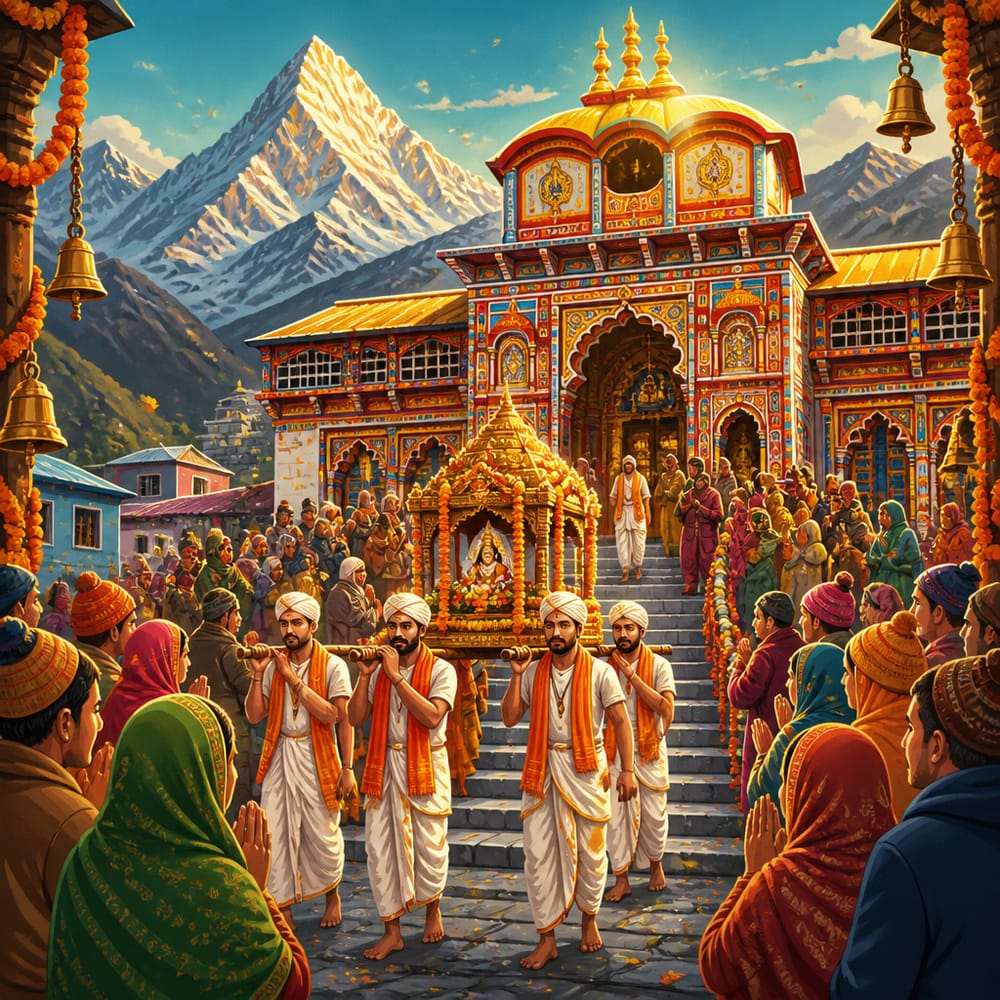
Opening (April-May): The temples open on or around Akshaya Tritiya, the auspicious day that falls in April or May. This day is considered so auspicious that any spiritual act performed then yields infinite merit, hence 'akshaya' (inexhaustible). The opening is accompanied by elaborate rituals as the deities, who have 'wintered' at lower altitudes, return to their high-altitude homes.
Closing (October-November): The temples close on or around Diwali in October or November. As winter descends on the high Himalayas, the deities are ceremonially moved to their winter homes at lower elevations. The temples are sealed, and the region enters months of snow-bound isolation.
This seasonal rhythm creates urgency and intensity. Pilgrims cannot visit at their convenience; they must coordinate with the cosmic calendar. The journey itself becomes an alignment with natural and divine cycles.
The Journey in Ancient Times
Historically, the Chota Char Dham yatra was an extreme undertaking. Pilgrims departed from the plains of North India and walked, there was no other option. The journey through the foothills, then up into the Himalayas, took weeks or months. The terrain demanded everything: steep climbs, dangerous river crossings, unpredictable weather.
Many pilgrims did not return. The journey was understood as potentially final, a one-way ticket to salvation. Those who died en route were considered blessed, they had given their lives in pursuit of the divine. Families would bid farewell to departing pilgrims with the same solemnity as they might attend a funeral.
This context explains the enormous spiritual merit attributed to completing the yatra. The pilgrimage was not tourism; it was tapasya (austerity), a physical ordeal that purified the body and focused the mind entirely on the divine. Every step was prayer, every hardship an offering.
The Modern Transformation

The Chota Char Dham yatra has been transformed by infrastructure development, particularly since the late 20th century. Roads now reach all four dhams (though the final approaches to some require trekking). Helicopters offer quick access for those who cannot walk. Hotels, guesthouses, and dharamshalas (pilgrim rest houses) line the routes.
This accessibility has democratized the pilgrimage. Where once only the young, fit, and wealthy could attempt the journey, now elderly pilgrims, families with children, and people of modest means can participate. The number of pilgrims has increased dramatically, from thousands annually to hundreds of thousands, sometimes approaching a million in peak seasons.
Yet accessibility brings its own challenges. The fragile Himalayan ecosystem struggles under the weight of pilgrimage infrastructure. Traffic congestion, waste management, and environmental degradation have become pressing concerns. The 2013 Kedarnath floods, which killed thousands, exposed the vulnerability of over-developed pilgrimage infrastructure in a geologically active region.
The Himalayan Pilgrimage Tradition
The Chota Char Dham belongs to a broader tradition of Himalayan pilgrimage that predates recorded history. The mountains themselves were considered sacred, the abode of gods, the meditation ground of sages, the source of India's great rivers.
Key elements of this tradition include:
Elevation as spiritual ascent: Higher elevations were associated with greater spiritual purity. The journey upward mirrored the inner journey toward transcendence. At the highest points, pilgrims stood closest to the heavens.
Rivers as divine presence: The Ganga and Yamuna were not just water but living goddesses. Their sources in the ice were the physical manifestation of divine energy entering the material world. To bathe in these waters at their source was to receive direct blessing.
Hardship as purification: The difficulty of the journey was not a flaw but a feature. Suffering burned away karma, physical exhaustion quieted the mind, and the stripping away of comfort revealed essential truths.
The sages' path: The Himalayas were believed to be populated by invisible sages and siddhas (perfected beings). Pilgrims walked in their footsteps, visited their caves, and hoped to receive their darshan (sacred vision).
Adi Shankaracharya's Contribution
Adi Shankaracharya (8th century CE) is central to the Chota Char Dham's significance. Though he did not 'discover' these sites, they were sacred long before him, he systematized their worship and established lasting institutions.
At Badrinath, Shankaracharya is credited with recovering the idol of Narayana from Narada Kund and establishing proper temple worship. At Kedarnath, he is believed to have attained his final samadhi (conscious death), with a shrine behind the temple marking the spot.

More broadly, Shankaracharya established Joshimath (Jyotirmath) as one of his four mathas (monasteries). This matha serves as the administrative center for Badrinath and as the winter home of the Badrinath deity. Through this institutionalization, Shankaracharya ensured that the Himalayan pilgrimage sites would be maintained, their rituals preserved, and their significance transmitted to future generations.
The Four Dhams at a Glance
Yamunotri (elevation: 3,293 meters)
- Source of the Yamuna River
- Goddess Yamuna in silver idol form
- Surya Kund hot springs for ritual bathing
- Divya Shila (divine rock) worshipped before the deity
- 6 km trek from Janki Chatti
Gangotri (elevation: 3,100 meters)
- Symbolic source of the Ganga (actual source at Gaumukh, 19 km further)
- Goddess Ganga in seated form
- Site where Ganga first touched Earth after flowing through Shiva's hair
- Accessible by road
- Temple built by Gorkha general Amar Singh Thapa in 18th century
Kedarnath (elevation: 3,583 meters)
- One of twelve Jyotirlingas
- Sadashiva (natural rock) linga said to be Shiva's hump in bull form
- Adi Shankaracharya's samadhi
- 16 km trek from Gaurikund (or helicopter)
- Survived the devastating 2013 floods
Badrinath (elevation: 3,133 meters)
- Abode of Vishnu as Narayana
- Part of both Chota Char Dham and original Char Dham
- Tapt Kund hot springs
- Chief priest (Rawal) always from Kerala's Nambudiri Brahmin community
- Accessible by road
The Spiritual Logic of the Circuit
The Chota Char Dham yatra is not merely a collection of four separate pilgrimages but a single integrated spiritual journey. Each stage builds upon the previous:
At Yamunotri, pilgrims encounter the river goddess Yamuna, associated with Yama (the god of death) and with the ethical demands of dharma. The journey begins with an acknowledgment of mortality and moral responsibility.
At Gangotri, pilgrims meet the goddess Ganga, whose waters purify and liberate. Having confronted mortality, the pilgrim now receives the blessing of spiritual cleansing.
At Kedarnath, pilgrims encounter Shiva, the great ascetic and transformer. Having been purified, the pilgrim now faces the challenge of transcendence, of releasing attachment and finding the Self beyond form.
At Badrinath, pilgrims worship Vishnu as Narayana, the supreme preserver and refuge. The journey concludes with rest in the divine, the ultimate destination of all spiritual seeking.
This progression from death-awareness through purification and transformation to final refuge mirrors the classic Hindu spiritual path. The physical journey through the mountains embodies the metaphysical journey of the soul.
Preparing for the Yatra
The Chota Char Dham yatra demands preparation, physical, logistical, and spiritual:
Physical: The elevations involved cause altitude sickness in many pilgrims. Gradual ascent, adequate hydration, and realistic assessment of one's fitness are essential. The treks to Yamunotri (6 km) and Kedarnath (16 km) require stamina.
Logistical: The short season means crowding, especially on weekends and auspicious days. Accommodation must be arranged in advance. Weather can change rapidly, and landslides sometimes close roads.
Spiritual: Traditional preparation includes dietary restrictions (vegetarianism, avoiding certain foods), mantras or prayers undertaken before departure, and a period of focused devotion. The journey is meant to be approached with reverence, not tourism.
The Yatra Today
Modern pilgrims experience the Chota Char Dham in diverse ways:
The traditional pilgrim still walks much of the route, stays in dharamshalas, and approaches the journey as tapasya. For them, the hardship is the point.
The religious tourist takes advantage of modern infrastructure, buses, helicopters, hotels, while maintaining devotional intent. The focus is on darshan at each temple rather than the journey between them.
The adventure seeker combines pilgrimage with trekking, viewing the dramatic Himalayan scenery as itself a form of spiritual experience.
All these approaches are valid. The Chota Char Dham accommodates multiple motivations and capacities, offering something to every seeker. What matters is that the pilgrim arrives at each temple with an open heart, ready to receive whatever blessing is offered.
Conclusion: Mountains as Teachers
The Chota Char Dham yatra teaches through landscape itself. The mountains humble us with their scale. The rivers remind us of the constant flow of time. The altitude challenges our bodies and clarifies our minds. The seasonal limitations teach us that sacred moments cannot be scheduled at our convenience.
For those who complete the circuit, the experience leaves lasting marks. The vision of Kedarnath against snow-covered peaks, the roar of the Ganga emerging from Gaumukh glacier, the ancient stones of Badrinath worn smooth by centuries of devotion, these images become inner touchstones, available for meditation long after the physical journey ends.
The Chota Char Dham is not merely four temples. It is an encounter with the Himalayan sacred landscape as a whole, a concentrated immersion in India's most ancient pilgrimage tradition. In these mountains, where the gods are said to dwell, the ordinary categories of human experience dissolve. What remains is pure presence, the eternal truth that every pilgrimage, ultimately, seeks.
Case studies
The Evolution of Himalayan Pilgrimage Infrastructure
The Chota Char Dham yatra has transformed dramatically over the past century. In the early 1900s, pilgrims walked the entire route from Haridwar, a journey of several weeks through dense forests and treacherous mountain paths. Deaths from exposure, falls, and illness were common. The British colonial administration built basic rest houses, but the journey remained arduous. After Indian independence in 1947, systematic road construction began. By the 1980s, motorable roads reached Badrinath, Gangotri, and the base points for Kedarnath and Yamunotri. Pilgrim numbers increased from thousands to tens of thousands annually. The real explosion came in the 2000s with helicopter services to Kedarnath, organized package tours, and improved highway infrastructure. By 2012, over 600,000 pilgrims visited the circuit annually. However, the 2013 Kedarnath floods exposed the vulnerability of this rapid development, poorly planned construction had blocked natural drainage channels, amplifying the disaster's impact. Over 6,000 people died. Post-2013, reconstruction has attempted to balance accessibility with environmental sustainability. The debate continues: should the Chota Char Dham remain challenging, preserving its character as tapasya, or should modern infrastructure make it accessible to all?
The concept of tirtha yatra treats the journey itself as a form of tapas, or spiritual discipline. Hardship along the way burns away karmic residue. The Skanda Purana prescribes that pilgrims should walk barefoot, sleep on the ground, and eat simply. This framing turns every obstacle into a spiritual opportunity. When roads replace footpaths and helicopters replace walking, the question becomes: can the inner transformation still happen without the outer hardship? Dharmic tradition answers yes, but only if the pilgrim consciously cultivates the attitude of surrender and devotion that hardship once forced upon them. Accessibility without intentionality risks reducing pilgrimage to tourism.
After the 2013 Kedarnath floods, the Indian government invested over 12,000 crore rupees in rebuilding and improving Char Dham highway infrastructure. By 2023, the all-weather road project was substantially complete, cutting travel times by half. Pilgrim numbers surged past pre-disaster levels, reaching over 50 lakh visitors in 2024. Environmental groups raised concerns about deforestation and landslide risks from the widened roads, leading to Supreme Court intervention and revised road width standards.
The Chota Char Dham's transformation illustrates the tension between accessibility and authenticity in sacred sites worldwide. Making pilgrimage easier democratizes spiritual access but can also diminish the transformative hardship that was historically central to the experience. The 2013 disaster showed that infrastructure development in fragile mountain environments has limits that must be respected.
Tourism boards worldwide face this exact tension: helicopter access to Everest Base Camp, cable cars at Machu Picchu, and express lanes at national parks all trade transformative difficulty for visitor volume. The 2013 Kedarnath floods proved that ignoring ecological limits for convenience can be catastrophic, a lesson now central to India's Smart Cities infrastructure planning.
In 1950, roughly 50,000 pilgrims completed the Chota Char Dham circuit annually. By 2024, that number exceeded 50 lakh, a hundredfold increase, with helicopter services alone ferrying over 3 lakh passengers per season.
Planning Your First Chota Char Dham Yatra
Consider Ananya, a software engineer in Bangalore with aging parents. Her parents have dreamed of the Chota Char Dham yatra their entire lives but never had the means or opportunity. Now retired, they want to complete the pilgrimage while they still can. Ananya decides to organize the trip. She faces several decisions: (1) When to go, early season (May) offers fewer crowds but uncertain weather; peak season (June) has better weather but massive crowds; late season (October) has lovely weather but risks early closure. (2) How to travel, helicopter to Kedarnath would help her parents but feels 'unearned'; walking is traditional but her father's knees won't permit it. (3) Accommodation, dharamshalas offer authentic pilgrim experience but lack medical facilities; hotels are comfortable but expensive. Ananya eventually chooses mid-September, when crowds have thinned after the monsoon. She books a mix of hotels and dharamshalas, opting for helicopter to Kedarnath but arranging for her parents to walk the last kilometer to the temple. She hires a local guide familiar with the pilgrimage's spiritual dimensions, not just logistics.
Hindu tradition distinguishes between the bahir yatra (outer journey) and antar yatra (inner journey). The physical pilgrimage is meant to mirror and catalyze an interior transformation. For elderly or infirm pilgrims, the tradition has always provided accommodations. Palki (palanquin) services have existed for centuries. The Dharma Shastras note that when physical capacity is limited, heightened devotion and mental focus can compensate. Ananya's parents are not cheating by using modern transport. They are following the ancient principle that pilgrimage bends to meet the pilgrim's capacity, as long as the pilgrim's intention remains sincere.
Ananya books a combination trip: helicopter to Kedarnath (the most physically demanding), road travel to the others with frequent rest stops, and short walking sections where her parents can manage. Her father, initially resistant to 'shortcuts,' discovers that arriving rested allows deeper engagement with temple rituals. Her mother collects sacred water from each site. The family spends quiet evenings reading about each site's history, turning travel days into learning days. The trip costs more than the budget route but less than full luxury packages.
The Chota Char Dham yatra can accommodate different capacities while maintaining spiritual integrity. Using helicopters doesn't invalidate the pilgrimage; the journey's meaning comes from intention, not suffering. However, thoughtful planning that honors the pilgrimage's character, walking what can be walked, staying in dharamshalas when possible, engaging with the spiritual context rather than treating it as tourism, enhances the experience for all.
With over 50 lakh annual pilgrims and growing helicopter services, the Chota Char Dham circuit mirrors the 'accessible vs. authentic' debate in wellness tourism globally. Travelers booking Himalayan treks on apps like AllTrails or Thrillophilia increasingly seek meaningful experience, not just convenience. Designing pilgrimage that honors both accessibility and depth is a live design challenge.
The Kedarnath helicopter service operates over 40 flights daily during peak season, carrying pilgrims on a 7-minute aerial route that replaces a grueling 16-kilometer uphill trek taking 6 to 8 hours on foot.
Living traditions
The Chota Char Dham has become India's most-visited pilgrimage circuit, generating significant economic activity in Uttarakhand. The state government has invested heavily in infrastructure under the 'Char Dham All-Weather Road Project,' a controversial initiative that aims to make the temples accessible year-round while critics warn of environmental damage to fragile Himalayan ecosystems. The circuit has also become popular among adventure tourists who combine pilgrimage with trekking in the Himalayan scenery. This blend of traditional pilgrimage and modern tourism characterizes the contemporary Chota Char Dham experience.
- Ganga Jal Collection: Pilgrims collect water from the Ganga at Gangotri (or preferably from Gaumukh, the actual source) in sealed containers to bring home. This water is considered supremely sacred and is used for important rituals, offered to dying family members, and stored in homes as a purifying presence. Some families have Ganga water passed down through generations.
- Rice Offering at Yamunotri: At Yamunotri's Surya Kund hot spring, pilgrims cook rice and potatoes in the boiling water by tying them in muslin cloth and lowering them into the spring. The cooked rice is offered to the deity and then taken home as prasad. This unique practice is found only at Yamunotri.
- Joshimath (Jyotirmath): Joshimath hosts one of Shankaracharya's four original mathas and serves as the winter home of the Badrinath idol. The town is the gateway to both Badrinath and the Valley of Flowers. Its monasteries maintain the administrative and ritual systems that govern the Chota Char Dham.
Reflection
- The Chota Char Dham temples close for six months each year, inaccessible due to snow and cold. What in your spiritual or inner life has seasons, times of accessibility and times of closure? How do you relate to the 'closed seasons' when certain experiences or insights are not available?
- Traditional pilgrims walked for weeks to reach the Chota Char Dham, understanding the journey as tapasya. Modern pilgrims can fly by helicopter. What is gained and what is lost when ease replaces difficulty? In your own life, are there valuable experiences you've made too easy?
- The Chota Char Dham combines river-source worship with deity temples, suggesting that both nature (rivers) and form (temple images) can be doors to the divine. What is your relationship to these two modes of sacred experience? Does the divine feel more accessible in natural settings or in constructed sacred spaces?