Gangotri and Yamunotri: Where Rivers Are Born
The glacial origins of India's holiest rivers
Journey to the birthplaces of India's two holiest rivers, the Ganga at Gangotri and the Yamuna at Yamunotri. Learn how King Bhagirath's thousand-year penance brought the Ganga from heaven, why the Gaumukh glacier is called the 'cow's mouth,' the tradition of cooking rice in Yamunotri's boiling Surya Kund hot springs, and how climate change threatens these sacred sources. Discover the twin river goddesses who define India's spiritual geography.
Rivers as Goddesses
In the Hindu imagination, rivers are not simply water. They are goddesses who have descended from celestial realms to grace the earth, purify those who touch them, and carry prayers from mortal shores to divine destinations.
The Ganga and Yamuna stand foremost among India's sacred rivers. Their waters sustain hundreds of millions of people. Their banks cradle ancient cities. Their confluences create supreme pilgrimage sites. Their names are invoked in every ritual, from birth to death and beyond.
The Chota Char Dham yatra includes pilgrimage to the birthplaces of both goddesses, to the Himalayan glaciers where ice transforms into sacred water, where the celestial becomes terrestrial, where rivers are born.
Yamunotri: Source of the Yamuna
The Chota Char Dham yatra traditionally begins at Yamunotri, the westernmost of the four sites. Here, at 3,293 meters, surrounded by peaks that stretch toward 6,000 meters, the river Yamuna emerges from the Champasar glacier.
The actual source lies at Saptrishi Kund, a glacial lake about 4.5 kilometers beyond the temple. Few pilgrims make this additional journey; the temple at Yamunotri serves as the practical pilgrimage destination.
The Goddess Yamuna
Yamuna is the daughter of the sun god Surya and his wife Sanjna (also called Chhaya, Shadow). Her brother is Yama, the god of death and dharma. This family connection gives Yamuna a unique position: while bathing in the Ganga washes away accumulated sin, bathing in the Yamuna is said to prevent premature death. Yama does not claim those devoted to his sister.
Yamuna is also intimately connected to Krishna. The Yamuna flows through Vrindavan and Mathura, the lands of Krishna's childhood and youth. She witnessed his divine play (lila), sheltered him from Kamsa's persecution, and received his flute songs on moonlit nights. Devotees speak of the Yamuna's dark waters as reflecting Krishna's own dark (shyam) complexion.
The Temple
The current Yamunotri temple dates to the 19th century, rebuilt by Maharani Gularia of Jaipur after the previous structure was destroyed by an earthquake. The simple stone edifice houses a silver idol of the goddess Yamuna in seated posture.
But before entering the main temple, pilgrims first worship the Divya Shila, a natural rock formation where thermal activity creates an offering space. The sequence is significant: the natural sacred form (Divya Shila) precedes the constructed sacred form (temple idol).
Surya Kund: The Sun's Pool
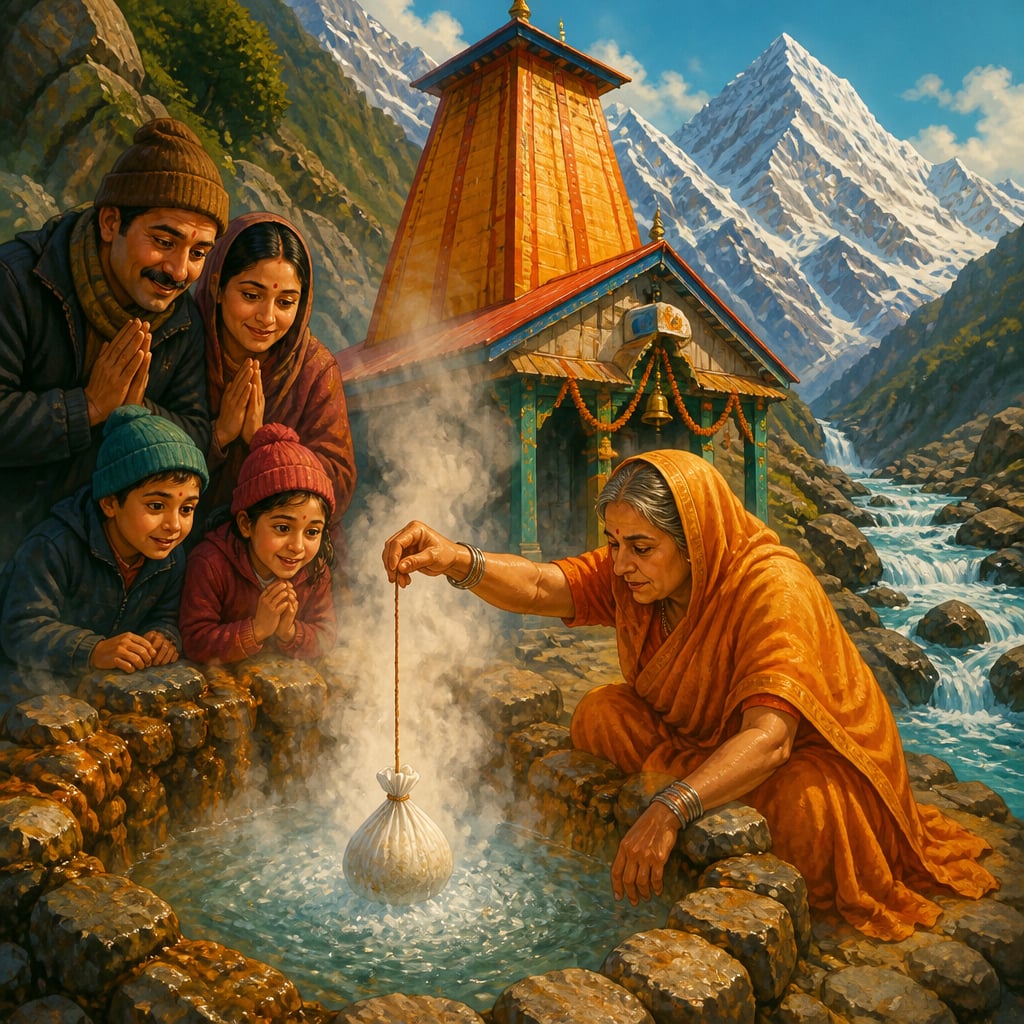
Adjacent to the temple lies Surya Kund, a hot spring named for Yamuna's father, the sun god. The water emerges at near-boiling temperatures, hot enough to cook food.
This creates one of the most distinctive pilgrimage traditions in India: cooking rice at Yamunotri. Pilgrims bring rice tied in cloth bundles, lower them into the boiling spring, and retrieve them cooked. This rice is offered to the goddess, then taken home as prasad (blessed food).
The practice transforms natural geothermal activity into sacred ritual. The Earth itself prepares the offering. No human fire is involved, only the heat stored in the mountain, released through water. Pilgrims prize this rice for its unique origin, preserving it for special occasions and sharing it with those who could not make the journey.
Getting There
Yamunotri is not accessible by road. Pilgrims travel to Janki Chatti (2,650 meters) by bus or car, then trek 6 kilometers to the temple. The path climbs steadily along the Yamuna valley, with rest stops and tea stalls along the way. Ponies and palanquins are available for those unable to walk.
The trek takes 3-5 hours depending on fitness and pace. The altitude affects many pilgrims, though Yamunotri is the lowest of the Chota Char Dham sites. Adequate hydration and gradual ascent help prevent altitude sickness.
Gangotri: Where Ganga Touched Earth
From Yamunotri, the pilgrimage proceeds east to Gangotri, the site where, according to tradition, the goddess Ganga first touched Earth after her descent from heaven.
Gangotri sits at 3,100 meters in the Uttarkashi district. The temple is accessible by road, making it the most easily reached of the Chota Char Dham sites. Yet Gangotri is not the actual source of the Ganga; that honor belongs to Gaumukh, the 'cow's mouth' glacier, 19 kilometers further into the mountains.
The Legend of Bhagirath
The story of the Ganga's descent is one of Hinduism's great narratives:
King Sagara of the Ikshvaku dynasty conducted a great horse sacrifice (ashvamedha yajna). The horse wandered near the ashram of the sage Kapila, who sat in deep meditation. Sagara's sixty thousand sons, pursuing the horse, disturbed the sage. Kapila opened his eyes and, with a single glance, burned them all to ash.
These sixty thousand souls could not attain liberation because their funerary rites could not be performed, there were no bodies, only ash. They remained trapped in limbo, neither fully dead nor capable of moving on.
Generation after generation, Sagara's descendants attempted to free their ancestors. Finally, Prince Bhagirath undertook severe penance, standing on one foot with arms raised for thousands of years. His tapasya was so intense that the gods themselves took notice.
Brahma appeared and granted Bhagirath's request: the heavenly river Ganga would descend to Earth and, touching the ashes of the sixty thousand, would liberate their souls.
But there was a problem. Ganga's fall from heaven was so powerful that it would destroy the Earth on impact. No surface could withstand her force.
Bhagirath then performed additional penance to Shiva. The great god agreed to receive Ganga in his matted hair, breaking her fall and releasing her gently onto the mountains.

Thus the Ganga descended: from heaven, through Shiva's locks, onto the Himalayas, down through the foothills, across the plains, to the sea. Where her waters touched Sagara's sons' ashes, their souls were released. The river continues that liberating work: even today, Hindu families bring the ashes of their deceased to the Ganga, trusting her to grant final rest.
The Temple
The current Gangotri temple was built in the early 18th century by the Gorkha general Amar Singh Thapa. The white granite structure sits beside the Bhagirathi River (as the Ganga is called at this elevation) and houses an idol of the goddess Ganga.
The temple's relatively recent construction belies the site's ancient sanctity. Pilgrims have journeyed here for millennia; the current structure simply provides architectural frame for eternal devotion.
Notable features include the Bhagirath Shila, a rock where Bhagirath is said to have performed his penance, and the submerged Shivling, a natural rock formation visible in the river when water levels are low.
Gaumukh: The True Source
The actual source of the Ganga lies at Gaumukh, 19 kilometers beyond Gangotri. Here, the Gangotri glacier terminates in a massive ice cave shaped vaguely like a cow's mouth, hence the name Gaum (cow) + mukh (mouth).
From this 'mouth,' the Bhagirathi River emerges, grey with glacial sediment, bitterly cold, sacred from its first drop.
The trek to Gaumukh is challenging but not technical. The path climbs from Gangotri (3,100m) to Gaumukh (4,023m) over 19 kilometers. Most pilgrims overnight at Bhojbasa (3,792m), completing the journey in two days.
At Gaumukh, the experience is primordial. The glacier looms overhead, groaning and cracking as ice shifts. The river emerges grey-white from darkness. The cold is penetrating, the altitude breathless. Here, where ice becomes water, the celestial becomes terrestrial.
Pilgrims who reach Gaumukh often describe the moment as transformative. To witness the Ganga's birth, to stand where the most sacred river begins, connects one to the countless millions who have drunk her waters, bathed in her flow, and surrendered their ashes to her current.
Environmental Crisis
Gaumukh glacier is retreating. Climate change has caused significant ice loss over recent decades. The 'cow's mouth' that gave the glacier its name has receded noticeably from historical descriptions and photographs.
This retreat has spiritual as well as practical implications. If the glacier disappears, what becomes of the Ganga's celestial origin? If the 'cow's mouth' closes, what happens to the river that sustains over 400 million people?
Environmentalists and religious authorities increasingly make common cause in protecting the Himalayan ecosystem. The Ganga's sanctity becomes an argument for environmental conservation. Those who revere the river have reason to protect its source.
The Twin Goddesses
Ganga and Yamuna are often depicted together, flanking temple doorways as paired guardians. Their images appear on currency, official seals, and government buildings. Their confluence at Prayagraj (Allahabad) is one of India's holiest sites.
Yet the two goddesses have distinct personalities:
Ganga is fierce, cosmic, overwhelming. Her descent from heaven required Shiva himself to break her fall. Her waters sweep away sins accumulated over lifetimes. She is the river of liberation, the final destination of the dead, the cosmic purifier.
Yamuna is gentler, more intimate. She witnessed Krishna's childhood play. Her waters are associated with love, devotion, and the protection from untimely death. Where Ganga liberates, Yamuna nurtures.
Together, they represent complementary aspects of divine grace. The Chota Char Dham yatra, beginning at Yamunotri and proceeding to Gangotri, allows pilgrims to experience both goddesses at their most primordial, as cold water emerging from ice, before temples and cities and human complexity gather along their banks.
Practical Matters
Yamunotri
- Elevation: 3,293 meters
- Access: Road to Janki Chatti, then 6 km trek
- Temple hours: 6 AM - 8 PM (varies seasonally)
- Key rituals: Divya Shila worship, rice cooking at Surya Kund
- Best time: May-June, September-October (avoid monsoon)
Gangotri
- Elevation: 3,100 meters (temple); 4,023 meters (Gaumukh)
- Access: Road reaches temple directly
- Temple hours: 6:15 AM - 9:30 PM (varies seasonally)
- Key rituals: Ganga aarti, water collection
- Best time: May-June, September-October
Seasonal Considerations
Both temples follow the Chota Char Dham seasonal schedule:
- Opening: Around Akshaya Tritiya (April-May)
- Closing: Around Diwali (October-November)
- Monsoon (July-August): Roads may be affected by landslides; cloud cover obscures mountain views; rivers run high and turbid
- Peak season (May-June): Largest crowds, warmest weather, clearest views
- Post-monsoon (September-October): Thinned crowds, crisp air, excellent visibility
The Water Collection Ritual

At both Yamunotri and Gangotri, pilgrims collect water in sealed containers to bring home. This water, drawn from the rivers' sources, is considered supremely sacred.
The collected water serves multiple purposes:
- Home worship: A few drops added to daily puja water sanctify the entire vessel
- Life events: Source water is used for births, marriages, and other auspicious occasions
- Death rites: Ganga water is placed in the mouth of the dying, believed to ensure liberation
- Sharing: Pilgrims distribute water to relatives and neighbors who couldn't travel
Some families maintain Ganga water across generations, adding new water to old, creating a continuous connection to the source spanning decades.
The Rivers' Journey
From their Himalayan sources, the Ganga and Yamuna follow different paths before meeting at Prayagraj:
Ganga flows from Gaumukh through Gangotri, Uttarkashi, Rishikesh, and Haridwar, then across the plains through Kannauj, Kanpur, Allahabad, Varanasi, and Patna before reaching the Bay of Bengal.
Yamuna flows from Yamunotri through Uttarkashi and the Dehradun valley, then past Delhi, Mathura, and Agra before joining the Ganga at Prayagraj.
Their confluence, where the two rivers meet, is called the Sangam, one of Hinduism's holiest sites. Every twelve years, the Kumbh Mela at Prayagraj draws tens of millions of pilgrims to bathe at this junction.
The Chota Char Dham pilgrim who visits both sources has thus touched both ends of the sacred geography that culminates at Sangam.
Environmental Spirituality
The Ganga and Yamuna face severe pollution in their lower reaches. Industrial effluents, sewage, and agricultural runoff have degraded water quality dramatically. Court cases have been filed to protect 'the rights' of the rivers, with some rulings granting the rivers legal personhood.
At their sources, the rivers remain relatively pure, but even here, climate change threatens. Glacial retreat reduces water flow. Changing precipitation patterns affect seasonal availability. The sacred sources themselves are vulnerable.
This creates an opportunity for environmental spirituality. Those who revere the rivers as goddesses have strong motivation to protect their health. Traditional pilgrimage, combined with environmental awareness, can generate powerful conservation advocacy.
Some argue that the rivers' spiritual significance should be emphasized in environmental campaigns. If the Ganga is a goddess, then polluting her is not merely environmental damage but sacrilege. This framing may motivate behavior change where purely scientific arguments have failed.
Sacred Waters, Mortal Hands
At Yamunotri and Gangotri, the divine touches earth in liquid form. The celestial river goddesses manifest as cold water emerging from ice, beginning journeys that will span thousands of kilometers and touch hundreds of millions of lives.
Pilgrims who reach these sources stand at the beginning of something vast. The water that flows past their feet will eventually reach the Bay of Bengal. The drops they collect will bless homes thousands of kilometers away. They witness birth, not human birth, but the birth of rivers that have sustained Indian civilization for millennia.
This witnessing carries responsibility. The rivers that begin here pure are polluted downstream by human activity. The glaciers that feed them are retreating due to human-caused climate change. The sacred sources are vulnerable to mortal harm.
The Chota Char Dham pilgrim is thus invited not only to reverence but to stewardship. Having witnessed the rivers' birth, one cannot be indifferent to their health. The blessing received at Yamunotri and Gangotri comes with implicit obligation: to protect what has blessed you.
Conclusion: At the Source
The journey to river sources has always attracted seekers. Something in the human spirit wants to find where things begin, to stand at the origin, to trace the stream to its first drop.
At Yamunotri and Gangotri, this seeking finds fulfillment. Here, where glaciers melt and thermal springs boil, where cold water emerges from ancient ice, the goddess rivers begin their earthly courses.
The pilgrim who visits these sources carries home more than bottled water and cooked rice. They carry the knowledge of having stood where sacred things begin. They have touched the origin. In Hindu understanding, this connection to the source purifies everything downstream, the pilgrim's life, their family's well-being, their community's blessing.
Rivers flow from source to sea, from origin to destination. The Chota Char Dham yatra reverses this flow, taking pilgrims upstream to the beginning. At the source, the water is coldest, purest, closest to its celestial origin. There, for a moment, the pilgrim touches the divine before it diffuses into the vast river systems of the plains.
That touch is enough. It sanctifies return.
Case studies
Glacial Retreat and the Future of Sacred Rivers
The Gangotri glacier has been retreating for over a century, but the pace has accelerated in recent decades. Studies show it retreated about 2,000 meters between 1780 and 2001, an average of 9 meters per year. More recent measurements suggest the rate may be increasing. This retreat has already altered the sacred landscape. The Gaumukh terminus, the 'cow's mouth' from which the Ganga emerges, has changed shape as ice has collapsed. Pilgrims in the early 20th century described a much more dramatic ice formation than what exists today. The implications are profound. If current trends continue, scientists project significant glacial loss within decades. This would reduce the Ganga's flow during dry seasons, when glacial melt supplements monsoon-fed rivers. The sacred river that sustains 400 million people could become seasonal rather than perennial. Religious and environmental groups have begun making common cause. The Ganga's spiritual significance provides motivation for conservation that scientific arguments alone may lack. If the goddess is threatened, her devotees have reason to protect her source. Some initiatives combine traditional pilgrimage with environmental education. Pilgrims to Gaumukh learn about glacial dynamics and climate change alongside spiritual teachings. The hope is that witnessing the source creates commitment to protecting it.
The Ganga is not merely a river in Hindu thought. She is a devi, a goddess who descended from heaven through Shiva's matted hair to purify the ashes of the 60,000 sons of King Sagara. Her waters carry the power of moksha. When the glacier retreats and the river's source moves, the theological implications are profound. If Ganga originates from the glacier, and the glacier disappears, where does the goddess go? Traditional scholars argue that the divine source transcends the physical one, that Ganga exists in all three realms (heaven, earth, underworld) regardless of glacial conditions. But for the pilgrim standing at Gaumukh, the physical and spiritual are inseparable. Protecting the glacier is protecting access to the divine.
The Indian government restricted tourist access to the Gangotri glacier in 2012, limiting the number of trekkers and banning camping near the glacier face. Scientific monitoring stations were established. Hindu religious leaders began incorporating environmental messaging into their teachings, with the Shankaracharya of Jyotir Math calling glacier protection a dharmic duty. Despite these measures, glacial retreat continues. Current projections suggest the Gangotri glacier could lose a third of its volume by 2100, fundamentally altering water supply for hundreds of millions downstream.
Climate change threatens not just water supplies but spiritual geographies. The sacred sources that define Hindu pilgrimage are vulnerable to human-caused environmental damage. Protecting these sources requires bridging scientific and spiritual worldviews, recognizing that reverence for the goddess and concern for the glacier serve the same end.
The Gangotri glacier's retreat is now a frontline issue in climate policy. India's National Mission for Sustaining the Himalayan Ecosystem directly addresses this, and organizations like the Wildlife Institute of India use glacial retreat data to argue for emission targets. Religious leaders citing the Ganga's sanctity have become unexpected allies in climate advocacy, proving that spiritual reverence and scientific urgency can reinforce each other.
The Gangotri glacier feeds the Bhagirathi River, which becomes the Ganga. It provides water to roughly 500 million people across the Indo-Gangetic plain. A 2019 study found the Himalayan glaciers are melting twice as fast as they were before the year 2000.
Carrying Water Home
Consider Lakshmi, an elderly woman from Tamil Nadu who has saved for years to undertake the Chota Char Dham yatra. Her particular goal is to collect water from both Yamunotri and Gangotri, source water of both sacred rivers. Her reasons are multiple: her husband is ill and may not survive much longer; she wants to have Ganga water ready for his final moments. Her daughter is trying to conceive; Yamuna water blessed at the source may help. Her village temple needs sacred water for an important consecration; she will be the courier. Lakshmi struggles with the Yamunotri trek, the altitude affects her, and her knees protest the climb. But she persists, reaching the temple, cooking rice in Surya Kund, filling her bottle with Yamuna water at the coldest, purest point she can safely reach. At Gangotri, she cannot attempt the Gaumukh trek; it's beyond her physical capacity. But she collects water from the Bhagirathi at Gangotri temple, as close to the source as she can reach. Returning home, she distributes the water carefully: some for her husband's care, some for her daughter's prayers, some for the village temple, some reserved for emergencies. The water she collected at the sources will touch dozens of lives in her community. Years later, after her husband's peaceful death (with Ganga water on his lips), after her daughter's successful pregnancy (attributed partly to Yamuna's blessing), Lakshmi is known in her village as the woman who went to the sources. Her pilgrimage became community blessing.
Carrying sacred water home is one of the oldest acts of pilgrimage in Hindu tradition. The Kavad Yatra, where Shiva devotees carry Ganga water hundreds of kilometers to their home temples, dates back centuries. The water is not just H2O. It is tirtha jal, sanctified by its source and by the pilgrim's devotion in collecting it. Lakshmi's act of gathering water for her ailing husband follows this same sacred logic. The water becomes a vessel of accumulated merit, carrying blessings from the source to those who could not make the journey themselves. The tradition recognizes that pilgrimage benefits extend beyond the individual pilgrim to the entire family and community.
Lakshmi completes both treks despite her age, moving slowly but steadily with the help of fellow pilgrims and local guides who recognize her determination. She fills copper vessels at both sources, sealing them carefully for the long journey home. On returning to Tamil Nadu, she distributes small portions to family members and neighbors, performs the puja she had promised, and pours the remaining water over her husband's head in a traditional healing ceremony. Her husband's condition does not dramatically change, but both report a sense of peace and completion. The story spreads through their community, inspiring three other families to plan similar pilgrimages.
Pilgrimage to the river sources is rarely purely individual. The water collected, the blessings received, the merit accumulated, these flow outward to family and community. Like the rivers themselves, pilgrimage blessings don't stay at the source but travel downstream, touching lives far from the Himalayan snows.
The Kavad Yatra's 3 crore participants annually demonstrate how pilgrimage functions as a distribution network for spiritual community. Modern social movements study this model: how do you move meaning, not just materials, across vast distances? The water carriers become connectors, linking source to home, sacred to ordinary, in a pattern that community organizers and social entrepreneurs find deeply instructive.
An estimated 3 crore Kavad pilgrims carry Ganga water from Haridwar to their home temples annually during the Shravan month, making it one of the largest annual pilgrimages on Earth.
Living traditions
Gangotri and Yamunotri have become increasingly accessible through improved roads and infrastructure. Gangotri is now reachable by car; Yamunotri requires a shorter trek than in historical times. This accessibility has increased pilgrim numbers dramatically while also raising concerns about environmental impact on fragile mountain ecosystems. Climate change adds urgency: as glaciers retreat, the very sources being worshipped are threatened. Some organizations now combine pilgrimage with environmental education, helping devotees understand the scientific as well as spiritual dimensions of the sacred rivers. The rivers' legal recognition as 'persons' in some court rulings reflects growing awareness that protection of sacred sources requires institutional as well as devotional commitment.
- Rice Cooking at Surya Kund: Pilgrims bring rice (and sometimes potatoes) tied in cloth bundles to Yamunotri. These are lowered into the boiling Surya Kund hot spring until cooked, typically 20-30 minutes. The cooked rice is offered to the goddess Yamuna, then taken home as prasad. This unique ritual transforms geothermal activity into sacred offering.
- Ganga Jal Collection: At Gangotri (and especially at Gaumukh for those who trek there), pilgrims fill sealed containers with source water. This water, drawn from as close to the Ganga's origin as possible, is considered supremely sacred. It is used for home rituals, shared with family members, reserved for death rites, and sometimes maintained across generations.
- Gaumukh Glacier: The actual source of the Ganga, the glacial terminus from which the river emerges. Though not a temple, Gaumukh is a pilgrimage destination for those seeking the Ganga's absolute origin. The 19 km trek from Gangotri typically takes two days with an overnight at Bhojbasa.
- Saptrishi Kund: The actual source of the Yamuna, a glacial lake from which the river emerges. Very few pilgrims attempt this additional trek due to difficult terrain. The Yamunotri temple serves as the practical pilgrimage destination, though the true source lies beyond.
Reflection
- The Ganga and Yamuna are simultaneously natural phenomena (water from glaciers) and divine beings (goddesses with personalities and powers). How do you hold these two truths together? Does scientific understanding diminish or enhance spiritual reverence?
- Pilgrims collect source water to share with those who couldn't travel, carrying blessing downstream. What have you received that wants to be shared? What blessings, insights, or gifts are you meant to carry home to others?
- King Bhagirath spent thousands of years in penance to bring the Ganga to earth for his ancestors' sake. What are you willing to work for, not for yourself, but for those who came before you or will come after? What is your 'Ganga' to bring down?