The Temple of Badrinath

Architecture of devotion at 3,133 meters

Discover the architectural uniqueness of Badrinath temple - its brightly-painted facade, the rare meditative form of Vishnu, and the 15 sacred murtis within the complex. Learn about the temple's dramatic seasonal rituals, the symbolism encoded in its structure, and how architecture serves as theology in stone.

A Temple Like No Other

Standing at 3,133 meters above sea level, the Badrinath temple is one of the highest and most remote major temples in the world. But elevation alone does not make it unique. The temple's architecture, iconography, and rituals set it apart from almost every other Hindu shrine.

From its brightly painted facade to the meditating form of Vishnu within, from the Kerala priests who serve here to the dramatic six-month closure each winter, Badrinath embodies a distinctive theology expressed through stone, ritual, and tradition.

This lesson explores the temple itself, what you see, what it means, and how architecture becomes a form of teaching.
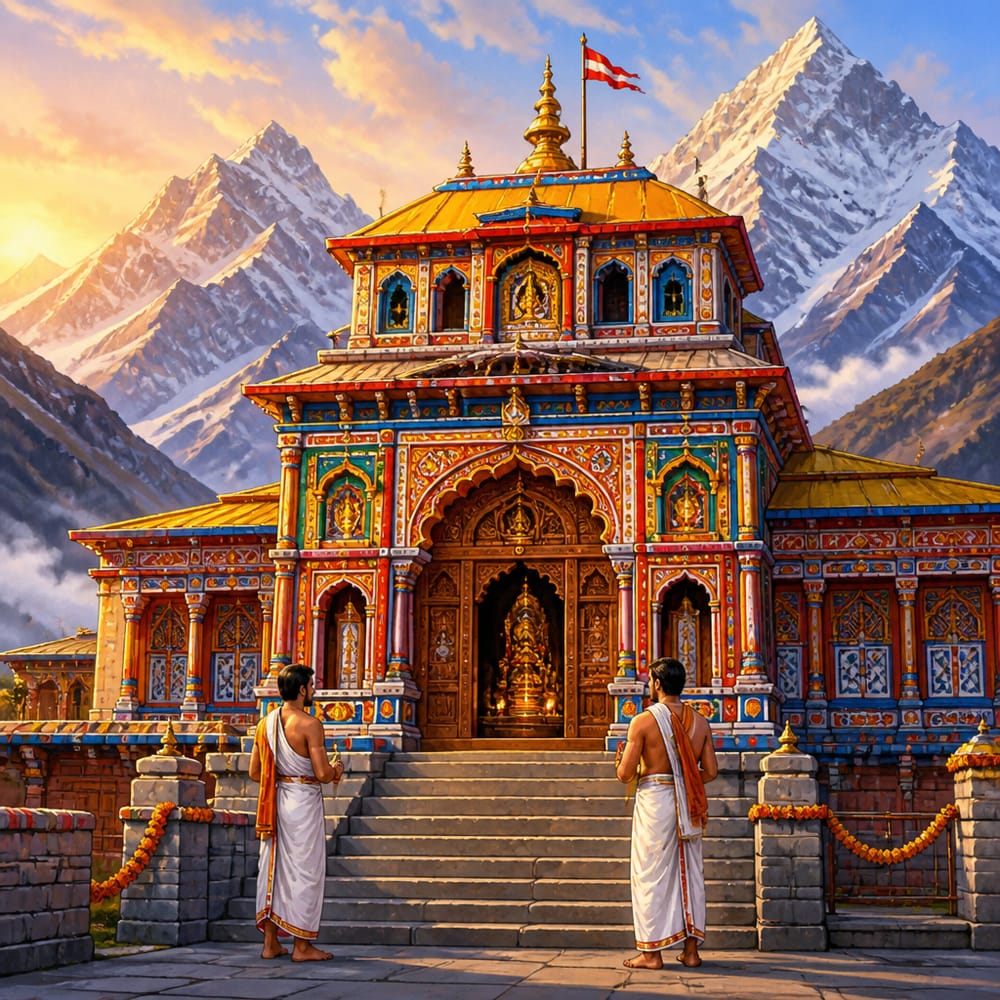
Brightly painted Badrinath temple facade glowing at first dawn in the high mountains

First Impressions: The Colorful Facade

Approaching Badrinath, the first thing that strikes most pilgrims is the temple's vibrant color. Unlike the weathered gray stone of most North Indian temples, Badrinath's facade blazes with bright paint, traditionally yellow, red, and blue, though the exact colors have varied over centuries of renovations.

This colorful appearance has several explanations:

Visibility in snow: For six months, snow buries the surrounding landscape. The bright colors help pilgrims spot the temple from a distance during the open season and create visual contrast against the white wilderness.

Tibetan influence: The region's proximity to Tibet and centuries of cultural exchange have left their mark. Tibetan Buddhist monasteries are also known for their colorful exteriors, and some scholars see direct influence.

Celebration of sacred space: The colors announce that this is no ordinary building. In a landscape dominated by stone and ice, the temple's brightness declares the presence of the divine, a beacon of spiritual warmth in the cold heights.

The Architectural Style

Badrinath's architecture does not fit neatly into standard categories of Hindu temple design. It lacks the soaring shikhara (spire) typical of North Indian Nagara style and the pyramidal vimana of South Indian Dravida temples. Instead, it presents a relatively modest structure with a low, pitched roof designed to shed heavy snow.

The temple is built in three sections:

Garbha Griha (Sanctum): The innermost chamber housing the main deity. Only the Rawal (chief priest) enters this space.

Darshan Mandap: The hall where devotees gather for darshan. Pilgrims can view the deity from here but cannot enter the sanctum.

Sabha Mandap: The outer assembly hall where priests perform preliminary rituals and devotees wait their turn for darshan.

The structure has been rebuilt multiple times due to earthquakes, avalanches, and floods, natural forces that regularly test construction at this altitude. Each rebuilding has modified the architecture while attempting to preserve the temple's essential character.

The meditating Vishnu murti in the Badrinath sanctum

The Meditating Vishnu

The main murti of Badrinath is extraordinary. Unlike most Vishnu temples where the Lord stands in tribhanga (three-bend pose) or reclines on Shesha, the Badrinath deity sits in padmasana, the lotus meditation posture typically associated with yogis and Buddha figures.

This meditative Vishnu is extremely rare in Hindu iconography. The Puranas explain that Lord Vishnu assumed this form to perform tapasya at Badrika-ashrama, demonstrating that even the Preserver of the Universe practices meditation.

The murti is carved from black shaligrama stone, itself considered a natural form of Vishnu found in the sacred rivers of Nepal and the Himalayas. The image shows Vishnu with four arms holding his traditional symbols: shankha (conch), chakra (discus), gada (mace), and padma (lotus).

Devotees note that the murti's expression is serene, almost otherworldly, appropriate for a deity engaged in eternal contemplation. Some describe feeling that the murti is more 'looking through you' than 'looking at you,' as if perceiving realities beyond the material world.

The Fifteen Murtis

While the main deity draws the most attention, the temple complex houses fifteen sacred images (panchadasha murtis), each with its own significance:

  1. Badrinarayan, The main meditative Vishnu
  2. Narada, The divine sage and devotee
  3. Uddhava, Krishna's friend and confidant
  4. Kubera, Lord of wealth and guardian of the north
  5. Narasimha, Vishnu's man-lion avatar
  6. Nara and Narayana, The twin sages
  7. Garuda, Vishnu's eagle vehicle
  8. Lakshmi, Vishnu's consort (in a separate small shrine)
  9. Ganesha, The remover of obstacles
  10. Adi Shankaracharya, The temple's restorer
  11. Various attendant deities and sages

The presence of Shankaracharya's image within the temple is notable, he is honored not just as a historical figure but as someone whose spiritual attainment warranted permanent presence in the sacred space he restored.

The Garuda Pillar

In front of the temple stands a tall pillar topped by an image of Garuda, the divine eagle who serves as Vishnu's mount. This dhvaja stambha (flag pillar) is common to Vishnu temples, but at Badrinath it carries special significance.

Garuda faces the temple, eternally gazing at his Lord. His posture is one of perfect devotion, alert, attentive, ready to serve. For pilgrims, Garuda models the proper attitude of darshan: not passive viewing but active, loving attention.

The pillar also marks a boundary. Traditionally, all pilgrims must pass the Garuda pillar to enter the temple. In doing so, they symbolically come under Garuda's protection and demonstrate that they approach as devotees, not merely tourists.

Pilgrims bathing in the Tapt Kund hot spring

The Tapt Kund: Sacred Hot Springs

Directly below the temple, hot springs maintain a temperature of around 45°C (113°F) even when air temperatures drop below freezing. These springs, called Tapt Kund ('hot pool'), are considered sacred and medicinal.

Pilgrims are expected to bathe in Tapt Kund before entering the temple for darshan. The bath serves multiple purposes:

Physical purification: The hot sulfurous waters are believed to cure skin ailments and wash away physical impurities.

Spiritual preparation: The dramatic temperature change (from frigid air to hot water) creates a shock that many find spiritually awakening, a transition from the ordinary state to sacred alertness.

Warmth: Practically speaking, the hot bath warms pilgrims before they enter the cold temple, where lengthy darshan lines can mean extended exposure to mountain chill.

The springs are separated into two sections: Narad Kund (usually for men) and Tapt Kund proper (for both, with separate timings). The water eventually flows into the Alaknanda River, sanctifying it further.

The Akhand Jyoti: Eternal Flame

Within the sanctum burns an akhand jyoti, an 'eternal lamp' that has remained lit, according to tradition, since Shankaracharya's restoration in the 8th century.

The lamp's continuity is especially remarkable given the six-month winter closure. When the temple doors close in November, the lamp is carefully tended and the doors sealed. No human enters until spring. Yet when the doors reopen in April or May, the lamp still burns.

How does this happen? Temple tradition ascribes it to divine maintenance, Nara and Narayana themselves, or celestial servants, tend the lamp through the winter. Skeptics suggest the lamp's design (large oil reservoir, protected location, careful sealing) enables months of unattended burning.

Either way, the phenomenon reinforces Badrinath's message: divine presence does not depend on human activity. The Lord is here whether we attend or not. Our pilgrimage is for our benefit, not His need.

The Opening and Closing Ceremonies

Badrinath's seasonal rituals are among Hinduism's most dramatic. The temple opens on Akshaya Tritiya (April-May) and closes on the day after Diwali (October-November).

The Opening (Kapaat Opening)

Weeks before the official opening, priests begin preparations at Joshimath, the winter seat of the deity. On the auspicious day:

  1. The utsava murti (processional image) is placed on a decorated palanquin
  2. A massive procession forms, priests, musicians, dancers, government officials, and thousands of pilgrims
  3. The procession travels the 45 km from Joshimath to Badrinath, taking several days
  4. At the temple, the Rawal performs elaborate rituals to 'awaken' the site
  5. The doors are unlocked with great ceremony
  6. The akhand jyoti is discovered still burning
  7. The first aarti is performed, officially beginning the pilgrimage season

The atmosphere combines religious solemnity with festival celebration. For locals, this day marks the return of life to the high valleys.

The Closing (Kapaat Closing)

The closing ceremony is equally elaborate but more somber:

  1. On the final day, special pujas honor the conclusion of the season
  2. The utsava murti is prepared for its journey to Joshimath
  3. The akhand jyoti is carefully reinforced with oil
  4. The Rawal performs final aartis and recites closing mantras
  5. The sanctum doors are sealed with the Rawal's personal seal
  6. A blanket of snow will soon cover the temple

The closure acknowledges what most religions deny: that sacred sites are not always accessible. Badrinath teaches that divine presence includes divine absence, or at least, times when approach is impossible.

The Rawal: A Priest from Kerala

The Rawal (chief priest) of Badrinath is always a Nambudiri Brahmin from Kerala, over 2,000 kilometers from the Himalayas. This extraordinary tradition, established by Shankaracharya, continues unbroken today.

The Rawal is not merely a ritual functionary. He is considered the human representative of Lord Badrinath, responsible for the deity's 'care' during the six months of accessibility. His duties include:

The Rawal serves until death or retirement. The position carries immense prestige within Hindu religious circles. When a new Rawal is needed, candidates are selected from qualified Nambudiri families, and complex rituals determine the successor.

The Temple's Message

Beyond its physical features, Badrinath temple communicates several theological teachings:

Vishnu as yogi: The meditating murti challenges common images of Vishnu as king or warrior. Here, divine power comes through contemplation, not action.

Accessibility through difficulty: The temple's remote location ensures that only committed seekers reach it. Spiritual attainment requires effort; it is not freely distributed.

Impermanence within permanence: The six-month closure acknowledges seasonal reality. The divine adapts to material conditions even while transcending them.

Unity across distance: The Kerala priests serving a Himalayan temple demonstrate that Hinduism transcends regional identity. North and South are united in shared devotion.

Nature as sacred context: Unlike temples in cities, Badrinath cannot be separated from its environment. The mountains, the river, the hot springs, the cold, all are part of the experience.

Visiting Today

Modern infrastructure has transformed the Badrinath pilgrimage. Roads (though still challenging) allow buses and cars to reach the temple town. Helicopters offer even faster access for those who can afford them. Hotels and dharamshalas provide accommodation for the lakhs of pilgrims who arrive each season.

Yet the essential experience remains. Pilgrims still feel the altitude, still gasp at the cold, still wonder at the painted temple rising against snow peaks. The darshan queue moves slowly, giving time for anticipation to build. When finally you stand before the meditating Vishnu, the journey's difficulties transform into preparation, you have earned this moment.

The temple's message is the same as it was when Shankaracharya stood here 1,200 years ago: the divine is accessible, but access requires journey. God waits at the edge of the habitable world, inviting us to find him where comfort ends and devotion begins.

Case studies

The Temple's Survival Through Natural Disasters

Badrinath temple has been destroyed and rebuilt multiple times throughout history. The Himalayan region experiences frequent earthquakes, and the temple has suffered damage from seismic events in 1803, 1991, and other years. Avalanches and floods pose additional threats. The 2013 Kedarnath disaster, which devastated the nearby Kedarnath temple and killed thousands, spared Badrinath but raised awareness of the risks facing high-altitude sacred sites. After each disaster, the temple has been rebuilt, sometimes with modifications to improve resilience, but always preserving the essential sacred character. The current structure incorporates lessons from past failures while maintaining the painted facade, the sanctum orientation, and the ritual spaces that pilgrims have known for centuries. Government agencies now work with temple authorities on disaster preparedness.

Hindu temple philosophy distinguishes between the sthula (gross, physical) form of the divine and the sukshma (subtle, energetic) form. The physical structure of a temple can be destroyed, but the prana pratishtha, the life-force installed during consecration, is understood to persist at the site. This is why temples are rebuilt on the same spot rather than relocated to safer ground. The Shilpa Shastras, ancient architectural treatises, acknowledge natural destruction as part of a temple's life cycle and provide detailed instructions for reconstruction and reconsecration. Badrinath's repeated rebuilding follows this prescribed cycle. Each reconstruction is not a defeat but a renewal, an opportunity to recommit to the site's sacred purpose.

After the 1803 earthquake severely damaged Badrinath, the King of Garhwal funded a complete reconstruction. The 1991 Uttarkashi earthquake triggered another round of structural assessment and reinforcement. Following the 2013 Kedarnath disaster, the Archaeological Survey of India conducted a comprehensive vulnerability study of all major Himalayan temples, including Badrinath. Modern engineering techniques were integrated with traditional construction methods. Retaining walls were strengthened, drainage improved, and early warning systems installed. The temple now combines ancient sacred geometry with contemporary seismic engineering.

Sacred sites exist in physical reality and must contend with physical forces. The repeated rebuilding of Badrinath demonstrates that tradition is not about preserving original stones but about maintaining continuity of practice and meaning. Each rebuilding is both a loss and a renewal, an opportunity to recommit to the site's sacred purpose.

Japan's approach to its Ise Grand Shrine, rebuilt every 20 years for over a millennium, follows this same principle: the sacred lives in continuity of practice, not preservation of materials. Modern disaster recovery for cultural sites, from Notre-Dame's rebuilding to Nepal's post-earthquake temple restoration, faces the same question Badrinath has answered repeatedly. What matters is not the original stones but the unbroken thread of worship.

The Badrinath temple sits in Seismic Zone V, India's highest risk category. The region has experienced at least 5 major earthquakes above magnitude 6.0 in the past 200 years, yet the temple has been rebuilt and maintained continuously for over 1,200 years.

Designing Sacred Spaces for Modern Seekers

Imagine an architect commissioned to design a meditation center for a contemporary spiritual community. The community wants a space that feels sacred without appropriating any specific tradition. How might Badrinath's principles inform the design? Following Badrinath's model: (1) Location matters, choose a site that naturally evokes transcendence (elevation, natural beauty, some difficulty of access); (2) Color and visibility, use design elements that announce 'this is different' without being garish; (3) Progressive access, create spaces of increasing intimacy, from public gathering to private contemplation; (4) Symbolic elements, include features that teach through presence, not explanation; (5) Seasonal rhythms, build in times of opening and closing, intensity and rest.

Vastu Shastra and the Shilpa Shastras encode centuries of observation about how physical space affects consciousness. The principles are specific: east-facing entrances invite morning light and prana. Water elements create cooling and reflective qualities. Sequential thresholds (gopuram, mandapa, garbha griha) choreograph a gradual intensification of focus. These are not arbitrary religious rules but accumulated wisdom about environmental psychology. Badrinath's design succeeds because it deploys these principles in service of a clear intention: bringing the visitor from the external world into progressively deeper states of contemplation. Any architect designing for inner transformation can study these principles, regardless of the specific tradition they serve.

The architect designs the meditation center using Badrinath's principles without copying its forms. The approach enters from the east, passing through a garden (outer world), then a social gathering space (mandapa equivalent), then a quiet transition corridor, then the meditation hall itself (sanctum equivalent). Natural hot spring water, sourced locally, feeds a small pool at the entrance for ritual hand-washing. The ceiling height decreases progressively, creating a sense of gentle compression and intimacy. The design wins recognition for creating genuinely contemplative space without appropriating any specific tradition's visual vocabulary.

Badrinath's architecture succeeds not through elaborate ornamentation but through meaningful choices, location, color, spatial progression, symbolic elements. These principles translate across traditions. Sacred space design is about creating conditions for encounter with transcendence, whatever form that takes.

Architects designing meditation centers, yoga studios, and contemplative spaces increasingly study temple design principles. The research on ceiling height affecting introspection validates what builders at Badrinath understood intuitively: spatial progression from open to enclosed, from bright to dim, physically prepares the mind for inward turning. These principles now inform hospital chapel design and even corporate quiet rooms.

Studies at the University of Utah found that rooms with progressively lower ceilings increased reported feelings of focus and introspection by 40%, validating the ancient temple design principle of narrowing space as one approaches the sanctum.

Living traditions

Badrinath temple today represents the intersection of ancient tradition and modern infrastructure. Helicopter services (operating weather permitting) now offer darshan in a single day, a journey that once took weeks on foot. The road from Joshimath, repeatedly damaged by landslides and rebuilt, allows buses and cars. Yet the temple administration works to preserve the experience's sacred character: no photography in the sanctum, maintained ritual timings, and continued emphasis on Tapt Kund bathing before darshan. The tension between accessibility and intensity, should it be harder to reach, to filter out the uncommitted?, continues to shape discussion among devotees and authorities alike.

Reflection

More in Badrinath: The Northern Gateway

All lessons in Badrinath: The Northern Gateway · Char Dham Yatra course