The Lost Temple in the Himalayas
Adi Shankaracharya's prophetic journey to restore Badrinath
Discover how Adi Shankaracharya, guided by divine vision, journeyed to the remote Himalayas in the 8th century to restore the ancient Badrinath temple. Learn about the swayambhu (self-manifested) idol of Vishnu that had been submerged in the Alaknanda river and how this restoration became part of Shankaracharya's grand vision to unite India through pilgrimage.
The Boy Who Would Change India
In the 8th century CE, a young Brahmin from Kerala set out on a journey that would reshape the spiritual geography of the Indian subcontinent. Adi Shankaracharya was barely in his thirties, yet he had already achieved what few could imagine: a complete mastery of the Vedas, the establishment of a philosophical school that would endure for millennia, and a mission to revive Sanatana Dharma across all of Bharatavarsha.
But philosophy alone was not enough. Shankaracharya understood that for Hinduism to survive and flourish, it needed something physical, sacred sites that would draw pilgrims from every corner of the land, creating bonds of shared experience that transcended regional differences.
This is the story of how he found the first and most remote of these sites: Badrinath, the Lord of the Berries.
A Vision in the Night
The Puranas speak of Badrika-ashrama, a sacred hermitage where the sages Nara and Narayana performed tapasya for thousands of years. Here, Lord Vishnu himself was said to reside in eternal meditation. But by Shankaracharya's time, this knowledge had faded from living memory.
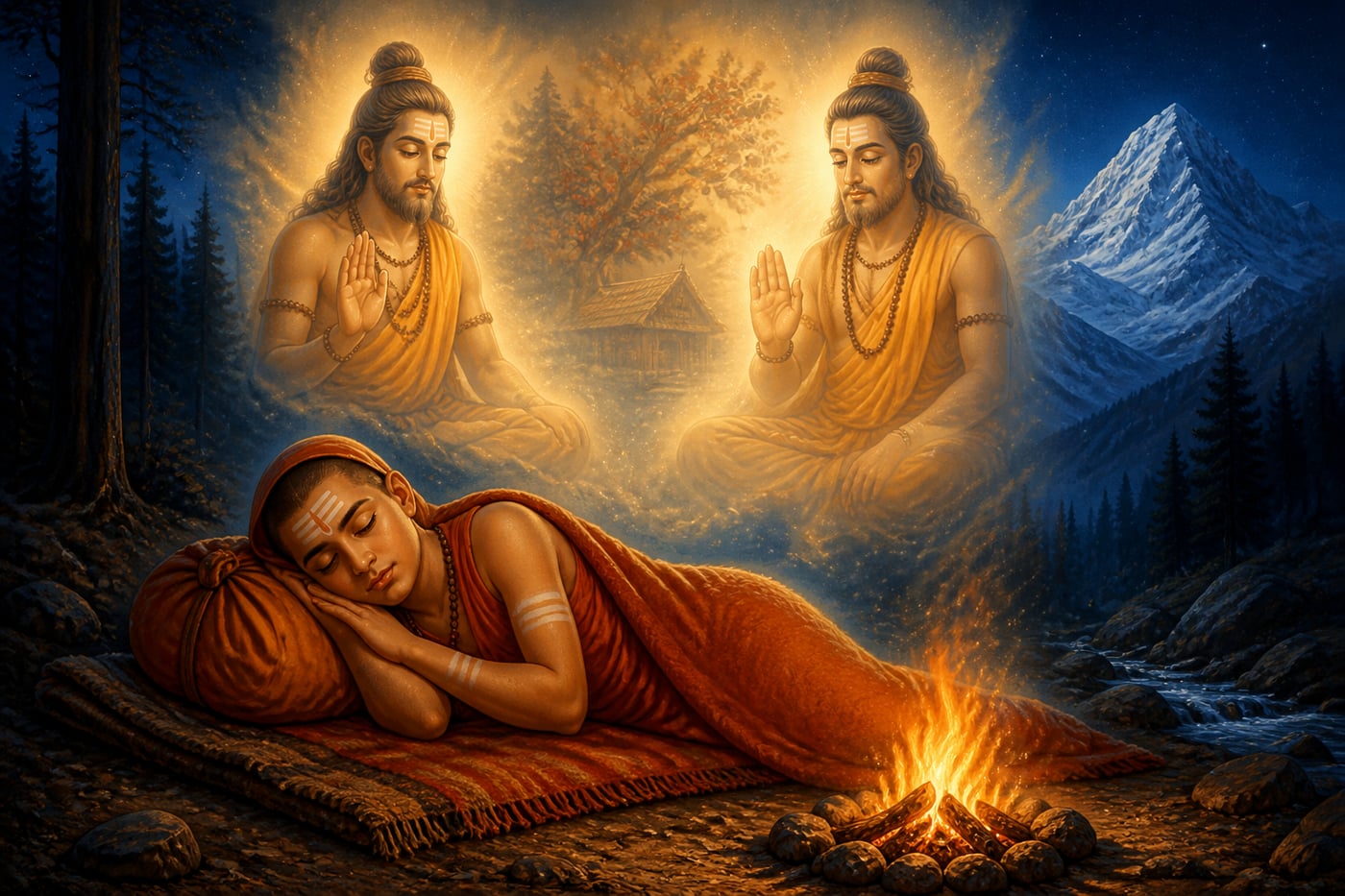
According to tradition, Shankaracharya received a divine vision. He saw the sacred murti of Badrinath, a self-manifested (swayambhu) image of Vishnu in meditative posture, lying submerged in the icy waters of the Alaknanda River. The Lord himself called to the young philosopher: "Retrieve me. Restore my worship. Unite my children."
Some historians suggest a more complex history. In the centuries before Shankaracharya, Buddhism had flourished in these high Himalayan regions. Buddhist monks may have hidden or submerged Hindu idols to protect their own sites, or the temple may simply have fallen into disrepair as trade routes shifted. Whatever the historical reality, the symbolism is clear: sacred knowledge can be lost, and it takes visionary effort to restore it.
The Journey North
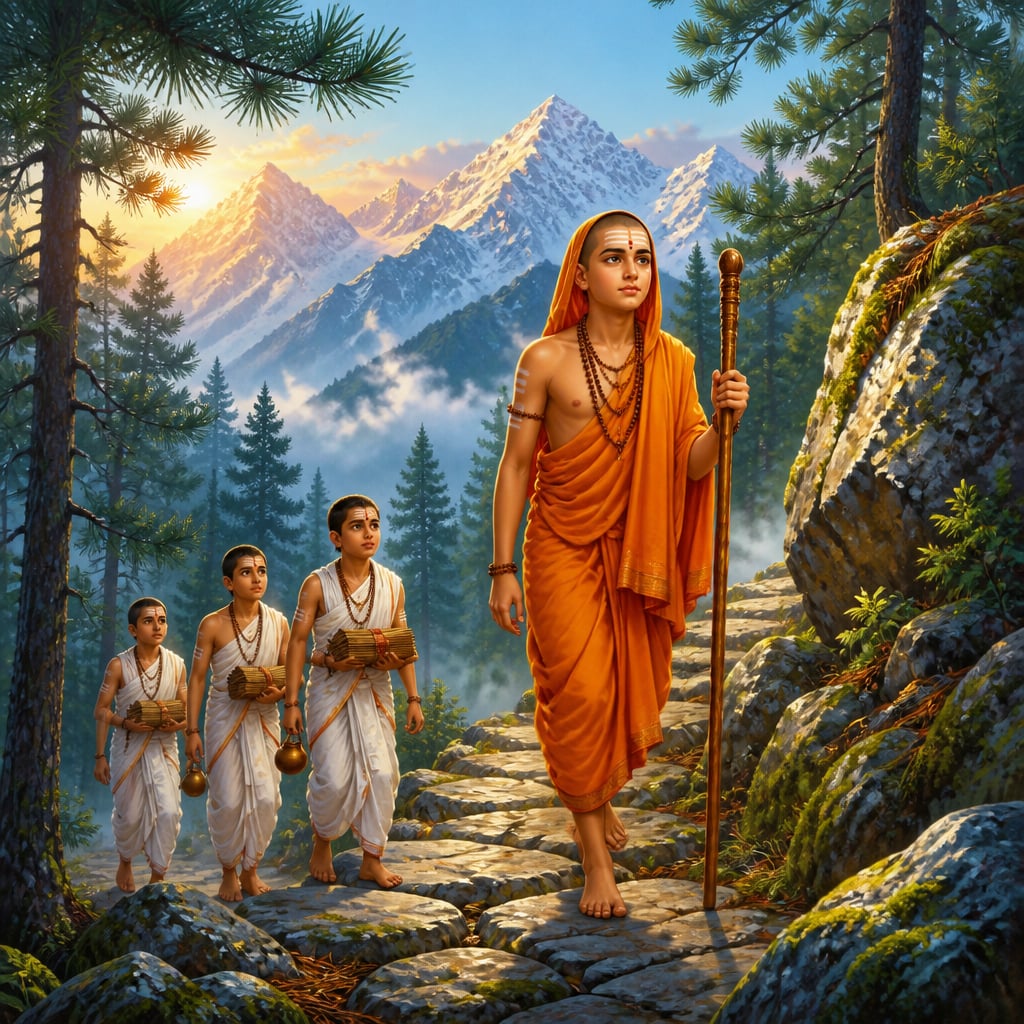
Imagine the journey. From the tropical coast of Kerala, where coconut palms sway in warm breezes, Shankaracharya traveled over two thousand kilometers north. He walked through dense forests where tigers prowled, crossed rivers on precarious ferries, climbed mountain passes where the air grew thin and cold.
No roads existed in those mountains. No guesthouses. No maps. Just endless ridges of stone and ice, treacherous paths carved by generations of shepherds, and the ever-present danger of avalanche and rockslide.
Shankaracharya traveled with a small group of devoted disciples. They carried minimal provisions, the philosophy of Advaita Vedanta they preached emphasized that the body's needs were secondary to the soul's liberation. Yet even ascetics need food, and at 3,133 meters elevation, the human body requires more calories just to stay warm.
The journey to Badrinath took weeks, perhaps months. Each step was an act of devotion.
The Recovery of the Lord
When Shankaracharya finally reached the sacred site, he found exactly what his vision had shown: a temple in ruins, and in the frigid waters of the Alaknanda, a dark stone image.
The murti was remarkable. Carved from black shaligrama stone, itself considered a form of Vishnu, it depicted the Lord in padmasana (lotus position), hands raised in a meditative gesture. This was not Vishnu the king or Vishnu the warrior, but Vishnu the eternal yogi, demonstrating that even the Preserver of the Universe finds his power through tapasya.
Shankaracharya performed the necessary rituals to consecrate the recovered idol. He rebuilt the temple according to traditional architectural principles. He established a system of priests to maintain continuous worship, and here he made a choice that endures to this day.
The Rawal Tradition
For the chief priest of Badrinath, Shankaracharya selected not a local Brahmin, but a Nambudiri Brahmin from his native Kerala. This tradition continues unbroken for over 1,200 years: the Rawal (head priest) of Badrinath is always a Nambudiri from the South.
Why this curious choice? Several explanations are offered:
The Practical Argument: Nambudiri Brahmins were known for their strict adherence to Vedic ritual. By selecting priests from far away, Shankaracharya ensured that local politics and family feuds would not corrupt the temple's administration.
The Unifying Argument: By connecting Kerala to the Himalayas through the priesthood, Shankaracharya created a living symbol of India's unity. The most southern Brahmins would serve at the most northern temple, their very presence declaring that Dharma knows no regional boundaries.
The Esoteric Argument: Some traditions hold that Shankaracharya was himself a Nambudiri, and that he established this connection to ensure his own spiritual lineage would forever tend the site of his greatest discovery.

The Dual Residence System
Badrinath sits at an elevation where winter brings not just cold, but complete inaccessibility. Snow piles meters deep. Temperatures plunge far below freezing. No human habitation is possible for six months of the year.
Shankaracharya's solution was elegant: he established Joshimath (Jyotir Math), a lower-altitude town about 45 kilometers away, as the winter seat of the Badrinath deity. Each November, as the first snows threaten, the murti is carried in procession from Badrinath to Joshimath. An akhand jyoti (eternal flame) is lit and left burning through the winter months, when pilgrims return in spring, they find this lamp still flickering, tended by no human hand.
In Joshimath, Shankaracharya also established one of his four great maths (monasteries), the Jyotir Math, which would become the northern seat of his philosophical tradition. The current Shankaracharya of Jyotir Math is the direct spiritual descendant of Adi Shankaracharya himself, charged with maintaining the Advaita Vedanta tradition in the Himalayan region.
The Vision of Four Corners
Badrinath was not Shankaracharya's only restoration project. He saw India as a sacred geography that needed to be traversed, not just inhabited. He established (or restored) four dhamas at the four corners of the subcontinent:
- Badrinath in the north, in the high Himalayas
- Dwarka in the west, on the Arabian Sea coast
- Puri in the east, on the Bay of Bengal
- Rameswaram in the south, at the tip of the peninsula
At each dhama, he established a math and appointed successors to continue his work. The pilgrimage circuit connecting these four sites, the Char Dham Yatra, was designed to take years. A pilgrim who completed it would have traversed the entire subcontinent, encountering every language, every regional tradition, every local deity. They would return home with a visceral understanding that their village Hinduism was just one part of a vast, unified tradition.
The Geography of Unity
Consider what Shankaracharya achieved. In an age without trains, planes, or even proper roads, he created a pilgrimage circuit that forced people to move. A Tamil Brahmin making the Char Dham journey would worship at Bengali temples, eat Gujarati food, and walk through Kashmiri valleys. A Rajasthani merchant would bathe in the southern seas and climb Himalayan peaks.
This was not merely religious, it was political genius. Shankaracharya understood that abstract philosophies and shared scriptures were not enough to create unity. People needed shared experiences, shared stories of hardship and wonder, shared memories of the same sacred sites. The Char Dham created exactly that: a common heritage of pilgrimage that transcended language, caste, and regional identity.
Badrinath, as the northern gateway, played a special role. It was the most difficult to reach, the most extreme in its environment, the most demanding of pilgrims' devotion. To complete the journey to Badrinath was to prove something, not to others, but to yourself. You had walked to the edge of the habitable world. You had stood where the gods themselves were said to meditate.
The Prophecy of Bhavishya Badri
An ancient prophecy adds a strange dimension to Badrinath's story. According to texts that Shankaracharya would have known, Badrinath is not the permanent abode of the deity. The prophecy of Bhavishya Badri states that one day, the mountains at Badrinath will collapse, closing the route to pilgrims forever.
When this happens, Lord Badrinath will relocate to a site called Bhavishya Badri, "Future Badri", located 24 kilometers from Joshimath in the Tapovan valley. A temple already exists at this site, maintained by the same Rawal who tends Badrinath itself.
Geologists note that this prophecy may have a factual basis. The Himalayan region is seismically active, and massive landslides are not uncommon. The 2013 Kedarnath disaster, which killed thousands and reshaped entire valleys, demonstrated how quickly sacred geography can change. The prophecy of Bhavishya Badri may encode ancient observations about mountain instability, or it may simply reflect the spiritual wisdom that nothing in the material world is permanent.
Shankaracharya's Legacy
Adi Shankaracharya died young, most accounts place his death at age 32, though some traditions give him a few more years. Yet in his brief life, he achieved more than most could in several lifetimes.
He composed commentaries on the Upanishads, the Bhagavad Gita, and the Brahma Sutras that remain definitive today. He founded four major monasteries that still operate. He trained disciples who spread his teachings across the subcontinent. And he restored or established sacred sites that still draw millions of pilgrims each year.
Badrinath stands as the first and perhaps the greatest of these restorations. Here, in a place so remote that simply reaching it was an act of devotion, Shankaracharya planted a flag. He declared that the Himalayas, those snow-capped peaks that seemed to touch heaven, were not outside India's sacred geography but at its very center.
When you visit Badrinath today, whether arriving by bus or helicopter, remember the young philosopher who walked these same paths 1,200 years ago. Remember that every temple you see, every ritual you witness, every priest who serves there is connected in an unbroken chain to that original restoration.
The lost temple is found. And it has never been lost again.
Case studies
The Buddhist-Hindu Transition at Badrinath
Historical evidence suggests that Badrinath may have been a Buddhist site before Shankaracharya's restoration. Chinese pilgrim Xuanzang (7th century) mentioned Buddhist monasteries in the region. Some scholars note that the Badrinath murti's meditative posture resembles Buddhist iconography. Local traditions about the deity being 'hidden' or 'submerged' may encode memories of religious transitions during the Buddhist-Hindu competition of the 6th-8th centuries. Shankaracharya's restoration can be seen as part of a broader Hindu revival that reclaimed sites across northern India. This wasn't necessarily violent displacement, Buddhism had already been declining, and many sites were simply abandoned. Shankaracharya gave them new purpose within a unified Hindu framework.
Hindu tradition does not typically frame religious transitions as hostile takeovers. The concept of adhikara, or spiritual qualification, suggests that different teachings serve different times and peoples. When Buddhism declined in the Himalayan regions, it was not because Hinduism 'defeated' it but because the spiritual needs of the population had shifted. Shankaracharya's restoration at Badrinath follows the principle of dharma samsthapana, re-establishing righteous order for the current age. He did not erase Buddhist elements. The murti's meditative posture was retained. The site's contemplative character was preserved. What changed was the theological framework, updated to serve the community that remained.
Shankaracharya's restoration at Badrinath became a template for his broader mission. He established the Jyotir Math nearby as one of four cardinal monasteries, ensuring permanent institutional support for the temple. The Rawal (head priest) tradition he initiated continues unbroken to this day, with the priest always appointed from a South Indian Namboodiri Brahmin family. This deliberate linking of South and North India through priestly succession became a powerful symbol of Hindu cultural unity. The temple grew into one of India's most visited pilgrimage sites, attracting over 12 lakh visitors annually.
Sacred sites often pass through multiple religious traditions. The question isn't who was 'first' but how each tradition honors and develops the site's spiritual potential. Shankaracharya's genius was integration rather than erasure, he built on what existed rather than destroying it.
This pattern of cultural integration over erasure appears in modern heritage conservation debates. UNESCO's approach to contested sacred sites, from Jerusalem's Temple Mount to Cambodia's Angkor Wat, grapples with the same question: when multiple traditions have shaped a site, whose narrative gets told? Shankaracharya's integrative approach offers a constructive alternative to the zero-sum framing that dominates many heritage disputes today.
Xuanzang, the Chinese Buddhist pilgrim who visited India around 635 CE, recorded over 1,600 Buddhist monasteries in the northern regions, many of which were repurposed as Hindu sites within 200 years of his visit.
Reviving Lost Traditions in Modern Organizations
Imagine you're the new CEO of a century-old family business that has lost its original mission. The founding vision has been forgotten; employees don't know why the company exists beyond making money. You discover old documents revealing the founder's beautiful philosophy of service. What do you do? Following Shankaracharya's model, you might: (1) Recover the 'buried idol', bring the original vision back into visibility through internal communications; (2) Establish a 'priesthood', identify culture carriers who will maintain and transmit the vision; (3) Create 'pilgrimage circuits', experiences that connect employees to the founding story; (4) Build institutional structures (like Shankaracharya's maths) that will outlast any individual leader.
The Bhagavad Gita describes the cyclical decline and renewal of dharma: 'Whenever righteousness declines and unrighteousness rises, I manifest myself.' This principle applies to organizations as much as civilizations. A company that has lost its founding vision is in a state of dharma glani, or righteous decline. The CEO's discovery of the founder's philosophy mirrors the recovery of the Badrinath idol from the Narada Kund. The wisdom was always there, submerged but not destroyed. Revival requires not just rediscovering the old principles but creating structures, rituals, and accountability systems that keep them active. Shankaracharya did not just reinstall an idol. He built an entire ecosystem of practice around it.
The CEO shares the founder's original documents at an all-hands meeting, framing the revival not as her idea but as a return to roots. She establishes a 'founder's principles' training program for all new hires and creates an annual day where the company revisits its original mission. Early resistance from those comfortable with the status quo gradually fades as the renewed sense of purpose improves morale and reduces turnover. Within two years, the company's reputation shifts from 'profitable but soulless' to 'values-driven,' attracting both talent and customers who want to align with something meaningful.
Organizational restoration requires more than discovering lost wisdom, it requires creating systems that keep that wisdom alive. Shankaracharya didn't just find the idol; he built temples, trained priests, and established institutions. Sustainable revival requires sustainable structures.
Companies like Patagonia, whose founder's original environmental mission now drives a $3 billion brand, demonstrate the Shankaracharya model in action. The most resilient organizational cultures are not invented from scratch but recovered from buried founding visions and reinforced with institutional systems. Startups that lose their way during hypergrowth often need this exact restoration playbook.
A 2023 Harvard Business Review study found that companies with a clearly articulated and actively practiced founding mission had 30% lower employee turnover and 25% higher customer loyalty than those without one.
Living traditions
Badrinath today receives over 1 million pilgrims annually, despite its remote location. Helicopter services now supplement the traditional road journey, making the pilgrimage accessible to those who cannot walk. The Indian government has invested heavily in road and infrastructure development as part of the Char Dham Highway Project. Yet the essential character of the pilgrimage remains: reaching Badrinath still requires effort, still involves leaving the comforts of plains life, still demands that pilgrims surrender to the mountain's rhythms. Shankaracharya's vision of a sacred geography that unifies India through shared pilgrimage continues to shape millions of lives each year.
- Kapaat Opening Ceremony: Each year in late April or May (on Akshaya Tritiya), the temple doors are opened after the winter closure. The ceremony begins at Joshimath, where the deity's winter murti is placed on a palanquin. Accompanied by bands, dancers, and thousands of pilgrims, the procession travels the 45 km to Badrinath. The Rawal opens the main doors while reciting mantras. The akhand jyoti that has burned all winter is discovered still lit. This 'door opening' is broadcast on television and marks the official beginning of the pilgrimage season.
- Tapt Kund Bathing: Below the temple, natural hot springs maintain a temperature of around 45°C (113°F) even when air temperatures are below freezing. Pilgrims bathe here before entering the temple, believing the waters cure skin diseases and wash away sins. The scientific explanation (geothermal activity) doesn't diminish the spiritual significance, the fact that hot water emerges at 3,133 meters seems miraculous enough.
- Joshimath (Jyotir Math): Winter seat of the Badrinath deity and one of Shankaracharya's four original maths. The Narasimha temple here houses the winter murti. Joshimath also features the ancient Narasimha idol, whose arm is said to be gradually becoming thinner, when it breaks, according to prophecy, the route to Badrinath will close forever.
Reflection
- Shankaracharya received a vision of the submerged idol before he found it physically. What 'buried' truth or capacity in yourself might be calling for recovery? What would it take to retrieve it from the depths where it lies hidden?
- Shankaracharya established the Nambudiri priesthood to maintain Badrinath after his departure. What systems or 'priesthoods' do you need to establish in your life so that your most important work continues even when you're not actively tending it?
- The prophecy of Bhavishya Badri suggests that even the most sacred sites are impermanent. How does accepting impermanence change your relationship to the things you consider most precious or permanent in your life?