Panch Badri: The Five Vishnu Temples

The sacred circuit beyond Badrinath

Explore the Panch Badri circuit - five Vishnu temples that together form the complete Badrinath pilgrimage. Learn about Adi Badri (the original), Bhavishya Badri (the prophesied future temple), Yogadhyan Badri, Vridha Badri, and Ardha Badri, and discover the ancient prophecy about how the pilgrimage will evolve.

Beyond the Main Temple

Most pilgrims to Badrinath focus on the main temple, and understandably so. It is one of Hinduism's most sacred sites, the northern gateway of the Char Dham circuit. But traditional pilgrimage texts describe a larger sacred geography: the Panch Badri, or Five Badris, a circuit of Vishnu temples scattered across the Garhwal Himalayas.

Completing the Panch Badri circuit is considered equivalent to completing the entire Badrinath pilgrimage five times. Each temple reveals a different aspect of Vishnu's presence in these mountains, and together they tell a story of past, present, and prophesied future.

This lesson explores these five temples, their legends, and what they teach about the nature of sacred space.
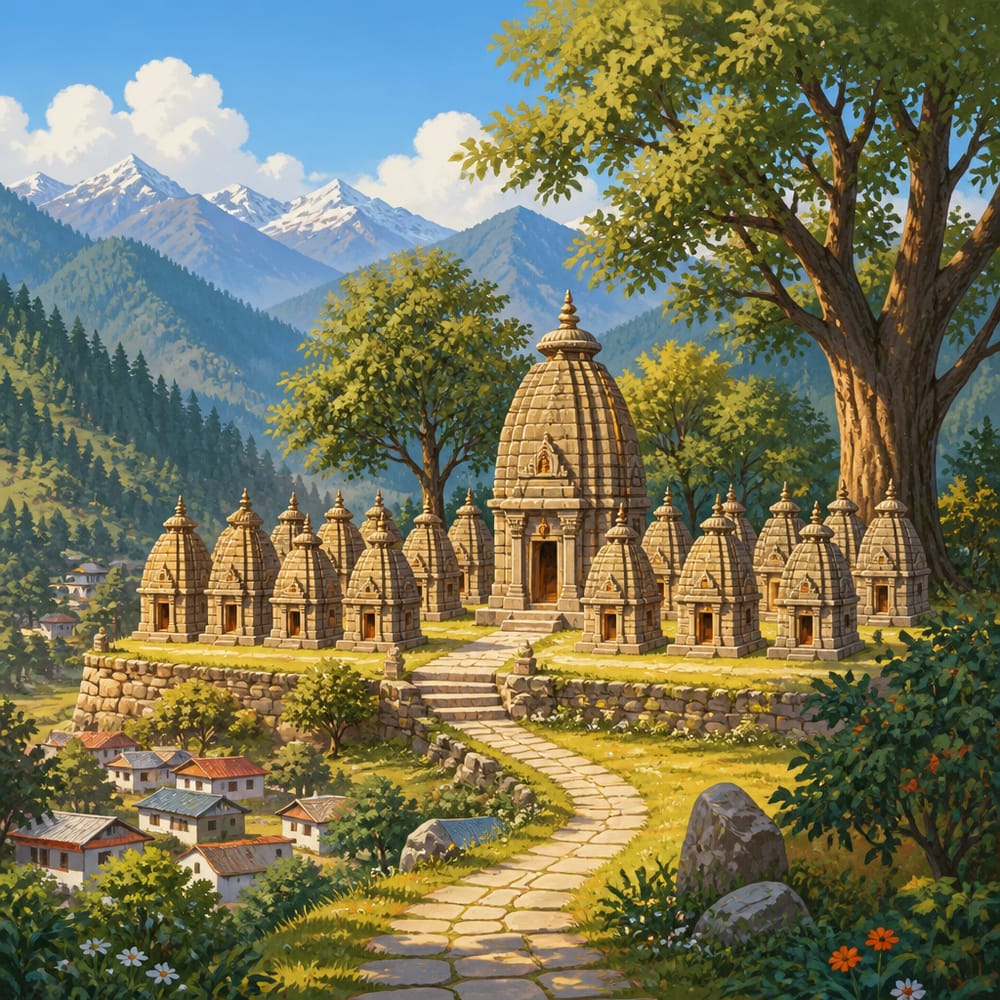
Adi Badri cluster of sixteen small stone shikhara shrines on a grassy terrace under midday light

1. Vishal Badri (Main Badrinath)

The temple we have explored in previous lessons, the main Badrinath shrine at 3,133 meters, is properly called Vishal Badri, 'the Great Badri.' It is the most important of the five and the focus of most pilgrimage activity.

Here, Vishnu appears in his meditative form, seated in padmasana. The temple's six-month season draws hundreds of thousands of pilgrims each year. It is the 'present' of the Panch Badri, the active, accessible center of worship.

But what came before? What will come after? The other four Badris answer these questions.

2. Adi Badri: The Original

Location: About 17 km from Karnaprayag, at 1,380 meters elevation

Meaning: 'Adi' means 'original' or 'first.' This is believed to be the oldest of the five Badri sites.

The Temple Complex: Adi Badri is not a single temple but a cluster of 16 small shrines, the main one dedicated to Vishnu. The temples are built in the Gupta style (4th-6th century CE), suggesting considerable antiquity.

The Legend: According to tradition, this was the site where Adi Shankaracharya first performed tapasya upon entering the Garhwal region. Before he restored Vishal Badri, he meditated here and received guidance about the higher temple that awaited restoration.

Some accounts suggest that Adi Badri was the primary Vishnu worship site before the main Badrinath temple was established or restored. When Shankaracharya revived Vishal Badri, Adi Badri became secondary but retained its status as the 'origin point' of the sacred geography.

Significance: Adi Badri represents the past, the foundation upon which the current pilgrimage tradition was built. Visiting here connects pilgrims to the earliest layer of Vishnu worship in these mountains.

The Narasimha murti at Bhavishya Badri with the prophetic crack

3. Bhavishya Badri: The Future

Location: 24 km from Joshimath, at about 2,744 meters elevation, in the Tapovan valley

Meaning: 'Bhavishya' means 'future.' This temple is destined to become the primary Badrinath, but not yet.

The Prophecy: According to ancient texts that Shankaracharya is said to have known, a time will come when the mountains around Vishal Badri will collapse, blocking the route forever. This could happen through earthquake, massive landslide, or geological shift. When this occurs, Lord Badrinath will relocate to Bhavishya Badri, and pilgrims will worship there instead.

The prophecy is remarkably specific. It states that the path through Joshimath will be blocked when the arm of the Narasimha idol at Joshimath becomes too thin and breaks. Devotees who have seen this idol note that its arm is indeed quite thin and appears to be slowly wearing away over centuries.

The Temple Today: A small temple already exists at Bhavishya Badri, maintained by the same Rawal who tends Vishal Badri. A few pilgrims trek here each season, but the temple sees nothing like the crowds at the main temple. It is a place of anticipation, sacred in potential rather than current activity.

Scientific Perspective: Geologists note that the Himalayan region is seismically active and that major geological events are inevitable over long time scales. The 2013 Kedarnath disaster demonstrated how quickly sacred geography can change. The prophecy of Bhavishya Badri may encode ancient observations about mountain instability, or it may simply reflect the spiritual wisdom that all material forms are temporary.

Significance: Bhavishya Badri represents the future, the continuity of sacred tradition beyond any particular site. It teaches that Vishnu's presence is not dependent on any single location. When one door closes, another opens.

King Pandu meditating at Yogadhyan Badri

4. Yogadhyan Badri: The Meditation

Location: In the village of Pandukeshwar, about 24 km from Badrinath, at 1,920 meters

Meaning: 'Yogadhyan' combines 'yoga' and 'dhyan' (meditation). This is the Badri of yogic meditation.

The Temple: The Yogadhyan Badri temple houses a bronze image of Vishnu in meditative posture. Unlike the stone murti at Vishal Badri, this metallic image has a different aesthetic and historical provenance.

The Legend: According to local tradition, this is where King Pandu (father of the Pandavas) performed tapasya to atone for accidentally killing a sage who had taken the form of a deer. The village name 'Pandukeshwar' derives from this connection.

Another legend states that this was a primary meditation site for Nara and Narayana. While they are eternally present at Vishal Badri, they are said to have performed specific austerities at this location.

Unique Feature: Yogadhyan Badri remains accessible year-round, unlike Vishal Badri which closes for six months. For pilgrims who visit in winter when the main temple is closed, Yogadhyan Badri offers an opportunity for Badrinath darshan.

Significance: Yogadhyan Badri represents the practice, the ongoing spiritual effort that connects devotees to the divine. It emphasizes that pilgrimage is not just about reaching a destination but about the discipline of the journey.

5. Vridha Badri: The Elder

Location: In the village of Animath, about 7 km from Joshimath, at 1,380 meters

Meaning: 'Vridha' means 'old' or 'aged.' This is the Elder Badri.

The Temple: A relatively small temple housing a stone image of Vishnu described as looking aged or weathered. The local legend explains why.

The Legend: According to tradition, a sage named Narada once wished to see Lord Vishnu in his aged form. At Vridha Badri, Vishnu appeared as an elderly man, demonstrating that the divine encompasses all stages of life, not just youth and vigor, but also age and wisdom.

Another version states that before Shankaracharya established the current temple at Vishal Badri, this was a primary worship site. When the higher temple was restored, this one became the 'elder', retired from primary duty but still venerated.

Significance: Vridha Badri represents wisdom and continuity. It teaches that the divine is present in all stages, old traditions have value even as new ones emerge. It is also a place where elderly pilgrims who cannot make the difficult trek to Vishal Badri can still complete a form of Badri darshan.

6. Ardha Badri: The Half

Location: In Animath village, near Vridha Badri

Meaning: 'Ardha' means 'half.' This is the Half Badri.

The Temple: A small shrine where Vishnu is worshipped alongside Lakshmi and other deities.

The Legend: The name 'Ardha' (half) may refer to the Ardhanarishvara concept, the half-male, half-female form of divine unity. At this site, Vishnu and Lakshmi are worshipped as complementary halves of divine wholeness.

Another interpretation suggests that completing only part of the Panch Badri circuit (stopping at Ardha Badri rather than continuing to all five) earns 'half' the merit, hence the name.

Note on Alternative Lists: Some sources list Ardha Badri as a sixth site rather than one of the five, making the circuit 'Panch Badri plus one.' Others substitute different temples into the list. The exact enumeration varies by tradition, but the concept of multiple Badri sites remains consistent.

Significance: Ardha Badri represents completeness through complementarity. It reminds pilgrims that the divine manifests in relationship, Vishnu and Lakshmi, consciousness and energy, masculine and feminine.

The Circuit's Logic

Why five temples? Why this particular geography? Several patterns emerge:

Temporal Coverage: The five Badris cover past (Adi), present (Vishal), and future (Bhavishya). They demonstrate that sacred tradition is not static but evolving, adapting to geological and historical changes while maintaining essential continuity.

Altitudinal Distribution: The temples range from 1,380 meters (Adi Badri) to 3,133 meters (Vishal Badri). This distribution ensures that at least some sites are accessible year-round, even when the highest temples are snowbound. The sacred geography adapts to seasonal reality.

Aspectual Diversity: Each temple emphasizes a different aspect of Vishnu, meditating, aged, yogic, etc. Together, they demonstrate the fullness of the divine that no single image can capture.

Parallel to Panch Kedar: The Panch Badri mirrors the Panch Kedar, five Shiva temples in the same region. This creates a balanced sacred geography where both major traditions (Vaishnava and Shaiva) are represented by five-temple circuits. The region becomes a complete mandala of divine presence.

The Pilgrimage Today

Most modern pilgrims visit only Vishal Badri. The complete Panch Badri circuit takes additional days and requires travel to multiple villages, some with limited infrastructure. For those who make the effort, the rewards include:

Smaller crowds: Away from the main temple's intensity, the secondary Badris offer quieter, more contemplative darshan.

Local culture: The villages housing these temples maintain traditional Garhwali culture that has been somewhat commercialized in Badrinath town itself.

Deeper understanding: The circuit reveals that Badrinath is not a single temple but a sacred landscape. The divine is distributed across the mountains, present wherever sincere seekers look.

Complete merit: Traditional texts promise that completing all five sites grants merit equivalent to multiple visits to the main temple alone.

The Prophecy and Climate

The Bhavishya Badri prophecy deserves special attention in our era of climate awareness. The ancient texts predicted that geological change would eventually close the route to Vishal Badri. This prophecy:

Acknowledges impermanence: Even the most sacred sites are subject to physical forces. The prophecy doesn't mourn this but accepts it as natural.

Provides continuity: By establishing Bhavishya Badri in advance, the tradition ensures that worship will continue even after catastrophic change. The prophecy is practical planning, not fatalistic acceptance.

May encode observation: Ancient people observed that mountains shift, valleys fill, and routes change. The prophecy may encode accumulated observation about Himalayan instability.

Offers metaphor: Beyond literal prediction, the prophecy teaches that spiritual traditions must be prepared to adapt. Clinging to any particular form is attachment; wisdom lies in maintaining the essence while allowing the form to evolve.

Completing the Circuit

For those inspired to attempt the full Panch Badri pilgrimage, the typical sequence is:

  1. Vishal Badri (main Badrinath), the current center
  2. Yogadhyan Badri (Pandukeshwar), often combined with the Badrinath journey
  3. Bhavishya Badri (Tapovan), requires a separate trek from Joshimath
  4. Vridha Badri (Animath), accessible from Joshimath
  5. Adi Badri (Karnaprayag), on the route to/from Badrinath

The circuit can be completed in any order, though traditional texts suggest specific sequences for maximum benefit. Local guides and temple priests can advise based on conditions and available time.

Completing the circuit transforms Badrinath from a single-point pilgrimage into a journey through sacred landscape. The mountains themselves become the temple; each Badri is like an altar within a vast natural cathedral. This is perhaps the deepest teaching of the Panch Badri: the divine cannot be contained in any single structure but pervades the entire landscape, waiting to be recognized by those who seek with open eyes.

Case studies

The 2013 Kedarnath Disaster and Sacred Geography

In June 2013, unprecedented rainfall caused massive flooding and landslides in the Garhwal Himalayas. The Kedarnath temple was devastated, the town was destroyed, the temple partially buried in debris, and thousands of pilgrims died. The disaster dramatically demonstrated the vulnerability of high-altitude sacred sites. Badrinath was spared major damage, but the disaster prompted reflection on the Bhavishya Badri prophecy. Some devotees saw the Kedarnath disaster as a warning: the prophecy of blocked routes could come true at any time. Geological surveys revealed that many routes in the region are vulnerable to similar events. Temple authorities and government agencies now work together on disaster preparedness, but the fundamental vulnerability remains.

The Panch Badri system reflects a profound understanding of impermanence rooted in Hindu cosmology. The Yugas (cosmic ages) teach that everything material is cyclical, including sacred sites. The tradition of Bhavishya Badri, a 'future Badri' that will replace the current temple when the mountains close, is not fatalism but strategic foresight embedded in mythology. The Vishnu Purana states that the Lord manifests in forms appropriate to each age. By distributing Vishnu's presence across five sites at different altitudes and geographies, the tradition ensures that worship can continue regardless of what happens to any single location. This is distributed resilience encoded as theology.

The 2013 floods prompted a reassessment of all Himalayan sacred sites. Geologists confirmed that the Badrinath valley faces long-term risks from glacial lake outbursts and seismic activity. The Panch Badri system suddenly looked less like quaint mythology and more like practical planning. The Uttarakhand state government began investing in infrastructure at the lower Panch Badri sites, particularly Yogadhyan Badri and Adi Badri. Religious leaders pointed to the ancient tradition's wisdom in establishing backup sites. The conversation shifted from 'if' Badrinath becomes inaccessible to 'when,' with the Panch Badri framework providing a ready-made continuity plan.

The 2013 disaster demonstrated that ancient prophecies about geological change are not mysticism but realistic assessment of Himalayan conditions. Sacred traditions that prepare for change (like the Panch Badri system with its backup site) show greater wisdom than those that assume permanence. The disaster also revealed that sacred geography is never separate from physical geography, the divine manifests through nature, not despite it.

Climate scientists studying Himalayan glacial lake outburst floods (GLOFs) now take seriously the geological knowledge encoded in pilgrimage traditions. The Panch Badri system's designation of Bhavishya Badri at a lower, more stable elevation reads like a long-range geological risk assessment. Modern disaster preparedness planning for Himalayan communities increasingly incorporates traditional knowledge about terrain stability alongside satellite data.

Bhavishya Badri sits at approximately 2,744 meters altitude, over 400 meters lower than Badrinath. Geological surveys confirm that the Tapovan area where it is located is significantly more stable than the Badrinath valley, lending scientific credibility to the ancient tradition's choice of backup site.

Planning for Organizational Continuity

Consider a religious or cultural institution that has been located in a single building for generations. What happens if that building becomes unusable, through fire, earthquake, or urban development? Many organizations have faced exactly this crisis without preparation, leading to fragmentation or dissolution. The Panch Badri model suggests a different approach: establish 'secondary sites' in advance. These might be relationships with other institutions, digital presence, or alternative physical locations. The key is that the 'Bhavishya Badri' exists before it is needed. When crisis comes, transition happens smoothly rather than chaotically.

The Hindu concept of parampara, or unbroken succession, emphasizes continuity of teaching and practice over continuity of location or form. A guru's lineage survives not because of a specific ashram but because the knowledge passes from teacher to student. Similarly, a temple's significance lies not in its stones but in the ongoing practice of worship. The Panch Badri system applies this principle to sacred geography: Vishnu's presence is not locked into one building but distributed across a network. Any institution that ties its identity too tightly to a single building, leader, or format risks catastrophic failure. The wise distribute their essential functions across multiple vessels.

Organizations that study the Panch Badri model discover a counterintuitive principle: planning for the loss of your primary site is not pessimism but strength. A synagogue that established satellite prayer groups before its building was condemned found its community actually grew during displacement. A university that had developed robust online capabilities before a natural disaster hit its campus maintained full operations while peer institutions shut down. The distributed model requires more effort upfront but provides resilience that single-site institutions cannot match.

The Panch Badri teaches that essential traditions should never depend on a single location or form. By establishing Bhavishya Badri centuries before it will be needed, the tradition ensures continuity beyond any particular site. Modern institutions, religious, cultural, or otherwise, can apply this wisdom by creating robust alternatives before crisis forces improvisation.

Business continuity planning, from cloud computing's multi-region redundancy to museum collections split across storage facilities, follows the Panch Badri logic. The organizations that survived COVID-19 disruptions best were those that had already built alternative operating modes before they were needed. The principle is universal: build your backup before the crisis, not during it.

After the 2011 earthquake and tsunami, Japanese temples that maintained secondary worship sites recovered active congregations 3 times faster than those operating from a single location, mirroring the Panch Badri principle of distributed sacred geography.

Living traditions

The Panch Badri concept is gaining renewed attention as climate change awareness grows. The ancient prophecy of blocked routes now reads as prescient environmental observation. Conservation organizations cite the tradition as evidence that ancient Indians understood geological and climate dynamics. Meanwhile, efforts are underway to improve infrastructure at secondary sites like Bhavishya Badri, ensuring they can handle larger crowds if and when the transition occurs. The tradition demonstrates that Hindu pilgrimage has always been adaptive, responding to environmental changes rather than resisting them.

Reflection

More in Badrinath: The Northern Gateway

All lessons in Badrinath: The Northern Gateway ยท Char Dham Yatra course