Sandeha: The Crossroads
When life demands difficult choices
On the battlefield of Kurukshetra, the mighty warrior Arjuna faces an impossible choice. As his chariot stands between two armies, he must decide: fight his own family or abandon his duty. This moment of crisis births the Bhagavad Gita's timeless wisdom.
The Crossroads: When Life Demands Difficult Choices
The Battlefield Awaits
Imagine standing at the edge of a vast plain, so wide you cannot see where it ends. The morning mist still clings to the ground, and the air smells of earth and horses and something else, the tension of a moment that cannot be undone. This is Kurukshetra, and on this day, everything is about to change.
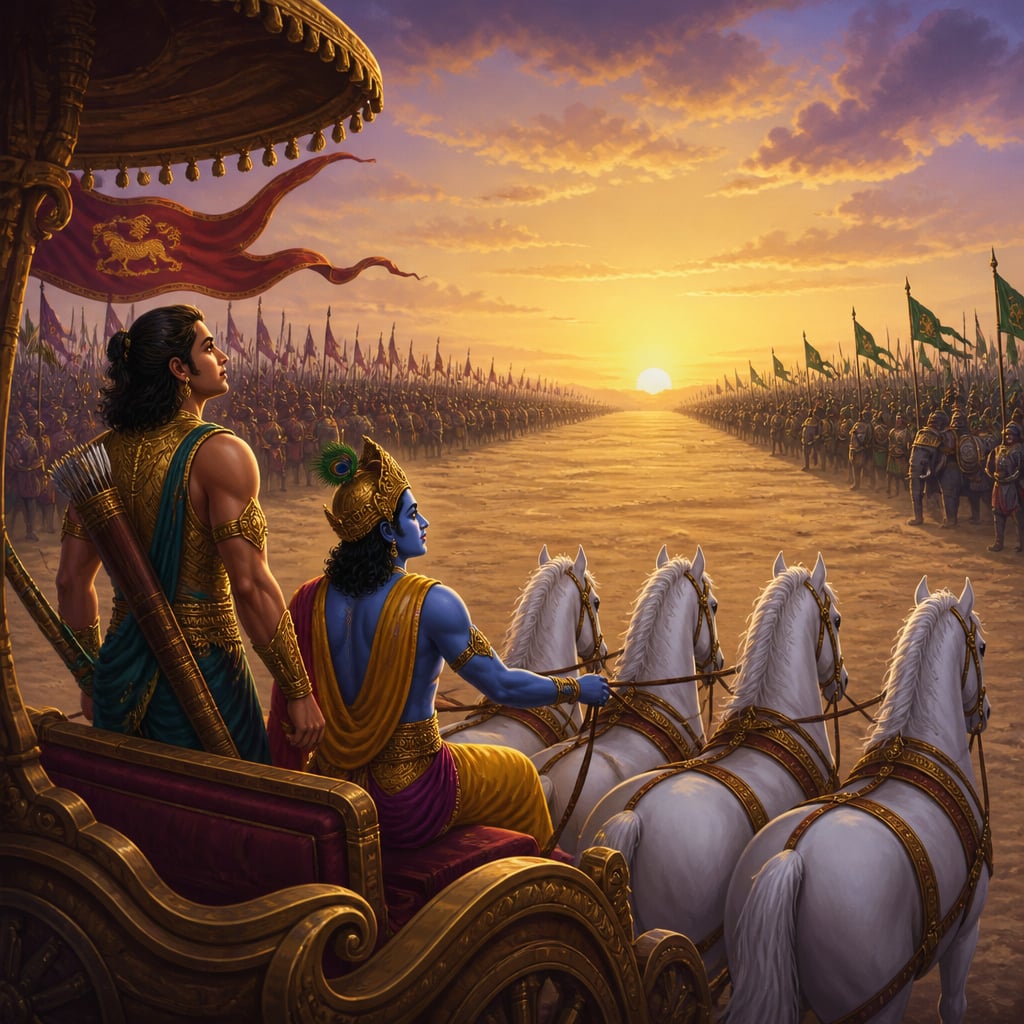
Arjuna, one of the greatest warriors the world has ever known, rides in a magnificent chariot pulled by white horses. His bow, Gandiva, rests beside him, a weapon so legendary that enemies tremble at its very name. His arrows never miss. His courage has never failed. Kings and soldiers alike look to him as a hero.
But today, Arjuna's heart carries a weight heavier than any armor.
Beside him stands his charioteer, his dearest friend, his guide through every adventure, Krishna. With a gentle smile and eyes that seem to hold the wisdom of the stars themselves, Krishna holds the reins, ready to take Arjuna wherever he needs to go.
"Take me between the two armies," Arjuna says. His voice is steady, but something in it wavers. "I want to see who has gathered here. I want to look upon those I must face in battle."
Krishna guides the horses forward, the chariot wheels creaking across the dusty earth. They stop in the empty space between two massive armies, thousands upon thousands of warriors stretching to the horizon on either side. Flags flutter in the wind. War drums beat like distant thunder. The moment before battle is always the loudest silence.
The Terrible Choice
Arjuna raises his eyes to look at his enemies. And his world shatters.
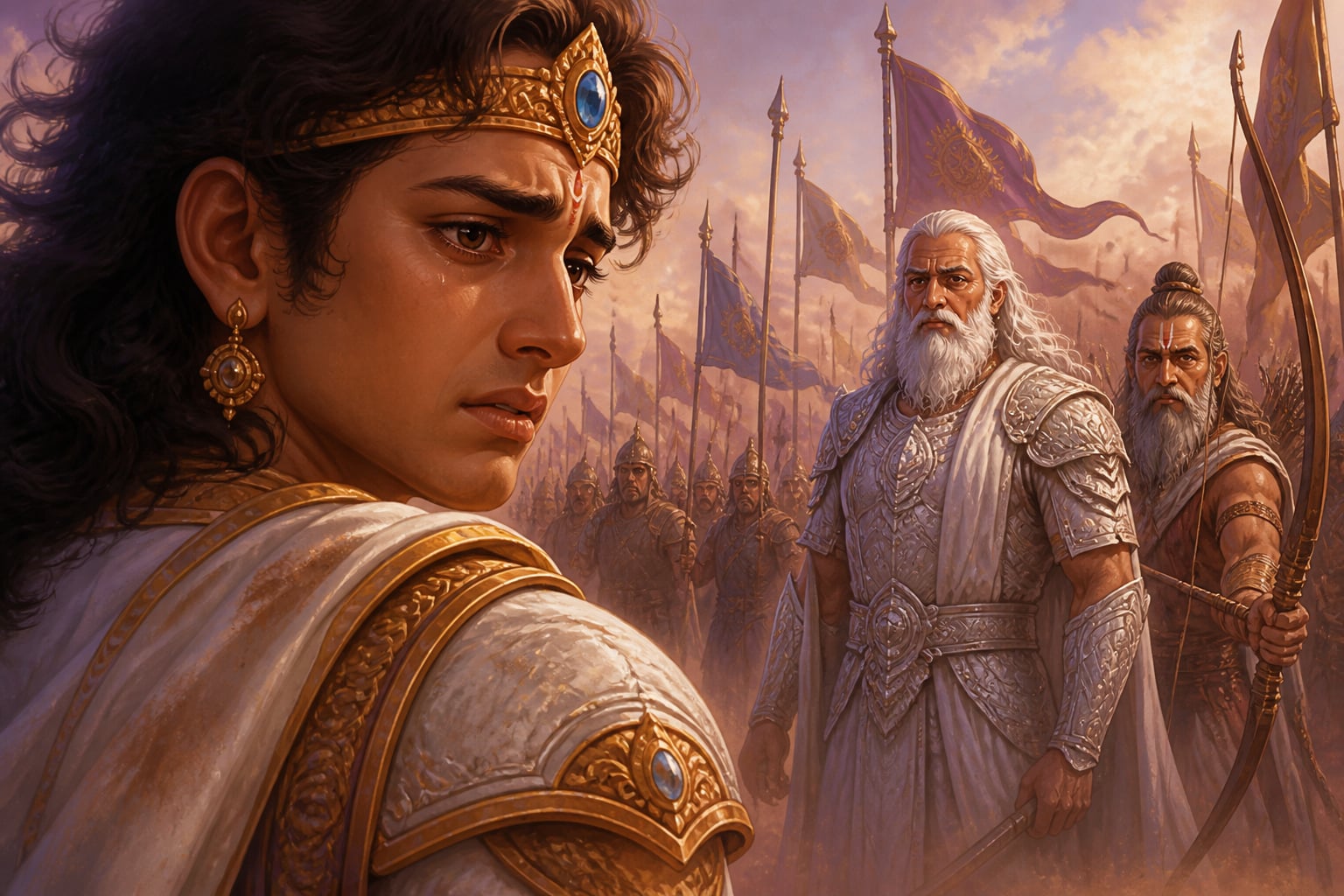
There, commanding the opposing army, stands Bhishma, the great-grandfather who held baby Arjuna in his arms, who taught him to walk, who told him stories of ancient heroes by firelight. Bhishma, whose silver hair gleams like moonlight, whose love for Arjuna has never wavered even though fate has placed them on opposite sides.
Beside Bhishma stands Drona, Arjuna's beloved teacher, the master who spent years patiently showing him how to draw a bow, how to focus his mind, how to become the archer he is today. Every skill Arjuna possesses came from Drona's patient guidance. Every victory carries his teacher's fingerprints.
And scattered throughout both armies, Arjuna sees cousins he played with as a child. Uncles who attended his wedding. Old friends who shared meals with him. His own nephews, young men whose births he celebrated.
This is not a battle against strangers. This is a war against his own family.
"What have we done?" Arjuna whispers. "What are we about to do?"
When the Body Speaks What the Heart Cannot
Have you ever felt so upset that your body seemed to speak for you? Maybe your stomach hurt before a big test, or your hands shook when you had to tell someone difficult news. Our bodies are wise, they often know what we're feeling before our minds can put it into words.
Now watch what happens to Arjuna, the fearless warrior:
His famous arms begin to tremble. These arms that have drawn the mightiest bow in the world, that have never shaken in any battle, now refuse to stay still.
His mouth goes completely dry. He tries to swallow, but cannot.
His skin burns as if touched by invisible fire. A cold sweat breaks across his forehead.
His legs give way beneath him. The hero who has stood firm against charging elephants and raging armies cannot stand at all.
And then, the moment that changes everything, Gandiva slips from his fingers. The legendary bow that has never left his hands in battle clatters to the chariot floor. Arjuna, the undefeated champion, sinks down and sits in despair.
"I cannot do this, Krishna," he says, his voice breaking. "I will not fight. What good is a kingdom won by killing the people I love? What happiness can come from victory if it means destroying my own family?"
His words pour out like water from a broken vessel: "My mind is spinning. I see no good path forward. Everything I believed about right and wrong seems confused now. I thought I knew what a warrior should do, but now I know nothing."
This Moment Lives in All of Us
Here is the secret that makes the Bhagavad Gita one of the most beloved books ever written: Arjuna's crisis is not just about an ancient battle. It is about every difficult choice any of us will ever face.
Think about a time when you had to choose between two things that both felt wrong. Maybe you saw a friend cheating on a test, do you stay silent and feel like you're helping them cheat, or do you speak up and risk losing the friendship? Maybe your parents are divorcing, and each one wants you to take their side. Maybe you know the right thing to do, but doing it will hurt someone you love.
These moments tear us apart inside. Like Arjuna, we want to sit down and refuse to choose. Like Arjuna, our bodies rebel, stomachaches, headaches, sleepless nights. Like Arjuna, we wish someone could just tell us the answer.
Kurukshetra is not just a place on a map. It is the battlefield inside each of us when life demands we make impossible choices.
The Question That Changed Everything
Arjuna does something remarkable in his moment of complete collapse. He does not run away. He does not pretend the problem doesn't exist. He does not make a hasty decision just to end his discomfort.
Instead, he turns to Krishna and asks for help.
"I am your student," Arjuna says, his pride finally crumbling. "I surrender to you. Please teach me. My mind is confused about what is right. Tell me clearly what I should do."
And here, in this moment of absolute honesty, when a great hero admits he is lost, when strength bows to wisdom, when a friend asks another friend for guidance, the teaching of the Bhagavad Gita begins.
Krishna does not immediately give Arjuna a simple answer. Instead, he begins to share something far more valuable: a way of understanding life, duty, and our own hearts that will help Arjuna, and us, navigate not just this crisis, but every crisis we will ever face.
What Comes Next
In our next lesson, we will hear Krishna's first response to his desperate friend. Why does Krishna smile at Arjuna's grief? What does he mean when he says that wise people do not mourn for either the living or the dead? And what exactly is this "self" that Krishna says can never be destroyed?
The battle of Kurukshetra is about to become a classroom. And the lessons taught on this battlefield will echo through thousands of years, offering guidance to anyone, young or old, who has ever stood at a crossroads and wondered which way to turn.
The bow lies on the chariot floor. The armies wait in silence. And Krishna begins to speak.
The Bhagavad Gita teaches us that our moments of greatest confusion can become our moments of greatest learning, if we have the courage to ask for guidance and the humility to listen.
Case studies
Desmond Tutu at the Crossroads
In the 1980s, South Africa was gripped by the brutal system of apartheid. Archbishop Desmond Tutu, as the first Black General Secretary of the South African Council of Churches, faced a defining choice. The government threatened him with imprisonment, revoked his passport, and monitored his every move. Speaking out meant risking his safety, his family's security, and potentially his life. Remaining silent would have preserved his comfort and position. Yet Tutu stood at the intersection of two worlds, the oppressed Black majority and the white establishment. Like Arjuna surveying the battlefield, he saw people he knew on both sides. Some white South Africans had been his teachers, colleagues, friends. The choice was not abstract; it was deeply personal. Every sermon, every march, every international speech could be his last.
Arjuna's paralysis in Chapter 1 came from seeing the battlefield personally, these were not abstract enemies but his own kin. Tutu faced the same moral vertigo. The Gita's teaching that one must act according to dharma regardless of personal cost applied directly. Krishna would later tell Arjuna that inaction born of fear is itself a choice with karmic consequences. Tutu understood this intuitively: silence in the face of injustice makes one complicit. The 'crossroads' is not merely choosing between options, but recognizing that refusing to choose is also a choice, and often the wrong one.
Tutu chose to speak. His prophetic voice became a moral compass for the anti-apartheid movement. He won the Nobel Peace Prize in 1984 and later chaired the Truth and Reconciliation Commission. Apartheid fell in 1994. His choice at the crossroads helped transform a nation without the bloodbath many had predicted.
Standing at a moral crossroads, the comfortable choice is rarely the right one. Dharma often demands we risk what we hold dear. Tutu's example shows that choosing righteousness over safety can transform not just oneself, but an entire society.
Today's professionals face their own crossroads when asked to speak against workplace injustice, corporate fraud, or institutional bias. The pattern holds: those who choose comfort over conscience rarely find lasting peace, while those who risk social standing for what is right often catalyze change far beyond what they imagined.
Desmond Tutu received the Nobel Peace Prize in 1984 for his nonviolent campaign against apartheid. South Africa's Truth and Reconciliation Commission, which he chaired from 1996 to 1998, heard testimony from over 21,000 victims and granted amnesty to 1,500 perpetrators.
The Bystander Dilemma
Maya is a high school junior who witnesses a group of popular students cornering Ravi, a quiet classmate, in the hallway. They mock his accent, knock books from his hands, and shove him against the lockers. Maya knows Ravi, they were in the same middle school. She also knows the bullies; one is her lab partner, another plays on her soccer team. Other students walk past, eyes averted, pretending not to see. Maya freezes. If she intervenes, she risks becoming the next target. Her social standing could crumble. The bullies might turn on her. But Ravi's eyes meet hers, a silent plea. She stands at the crossroads: the safety of the crowd or the loneliness of doing what's right.
Like Arjuna who saw his own teachers, cousins, and friends arrayed against him, Maya recognizes people on both sides of this conflict. The Gita's first chapter captures this paralysis precisely, the moment when duty collides with personal comfort. Arjuna wanted to lay down his bow and retreat. Many bystanders choose this path daily. Yet Krishna's coming teaching is clear: we cannot escape action. Walking away is itself an action, one that empowers the aggressor and abandons the vulnerable. Maya's crossroads mirrors Arjuna's: both must decide whether personal comfort outweighs moral responsibility.
If Maya speaks up, even something as simple as 'Leave him alone' or alerting a teacher, she breaks the bystander spell. Research shows one person's intervention often triggers others to act. The bullies lose their audience. Ravi gains an ally. Maya discovers courage she didn't know she had. If she walks away, the pattern continues, and both she and Ravi carry that moment forward.
Every crossroads presents the same essential choice: act according to dharma or retreat into comfortable inaction. The Gita teaches that our response in these moments defines who we become. One voice can break the silence that enables harm.
School hallways have moved online, and cyberbullying now follows students home through group chats and social media. The bystander dynamic is identical: most people scroll past harmful content, hoping someone else will intervene. One comment, one report, one refusal to share a cruel post can break the cycle just as powerfully as speaking up in person.
A 2011 study published in the American Psychologist found that a single bystander speaking up reduces group bullying incidents by 57%. The original bystander effect research by Darley and Latane (1968) showed that when alone, 85% of people helped in an emergency, but only 31% helped when others were present.
Living traditions
The Bhagavad Gita is taught in management courses at IIMs and Harvard Business School as a text on ethical leadership and decision-making under crisis. It has been translated into over 100 languages. Mahatma Gandhi called it his 'spiritual dictionary' and drew upon its teachings during India's freedom struggle. The Supreme Court of India has cited the Gita in judgments on duty and dharma. ISKCON's global network of 800+ centers teaches Gita philosophy to millions annually, while Gita Press, Gorakhpur has distributed over 70 million copies since 1926.
- Kurukshetra: The sacred battlefield where the Mahabharata war was fought and where Arjuna experienced his moral crisis. Key sites include Brahma Sarovar (holy tank where pilgrims bathe during eclipses), the Kurukshetra Panorama and Science Centre (depicting the war through 3D models), and the Krishna Museum showcasing artifacts related to the Gita's teachings.
- Jyotisar: The exact spot where Lord Krishna is believed to have delivered the Bhagavad Gita to Arjuna. A sacred banyan tree marks the location, said to be a descendant of the original tree under which the divine discourse took place. A marble chariot with Krishna and Arjuna commemorates the scene. Sound and light shows in the evening narrate the Gita's teachings.
Reflection
- When have you faced a situation where every available choice seemed to betray something you deeply valued?
- Why does Arjuna, the supreme warrior who never hesitated in battle, suddenly find himself unable to act at Kurukshetra?
- When one's various dharmas, as warrior, as grandson, as student, demand contradictory actions, what determines the right path?