Bhaya: The Weight of Consequence

Understanding what we fear

Arjuna voices his deepest fears - the destruction of families, the breakdown of society, the burden of killing those he loves. His honest confession teaches us that acknowledging our fears is the first step toward wisdom.

The Weight of Consequence: Understanding What We Fear

Still Standing Between Armies

The chariot has not moved. Arjuna still stands in the narrow strip of land between two vast armies, frozen in the silence that followed his first glimpse of those he must fight. But now his eyes move more carefully across the battlefield, searching, counting, recognizing.

In the last lesson, we saw Arjuna's world shatter when he recognized his grandfather Bhishma and his teacher Drona among the enemy ranks. But that was only the beginning. Now, as the morning sun rises higher over Kurukshetra, Arjuna looks deeper. And the more he sees, the more his heart breaks.

There is his cousin Duryodhana, the man who tried to poison him as a child, who cheated his brothers out of their kingdom, who humiliated Draupadi in front of the entire court. Yes, Duryodhana has done terrible things. But Arjuna also remembers playing hide-and-seek with him in the palace gardens when they were small. He remembers learning to ride horses together. He remembers a time before everything went wrong.
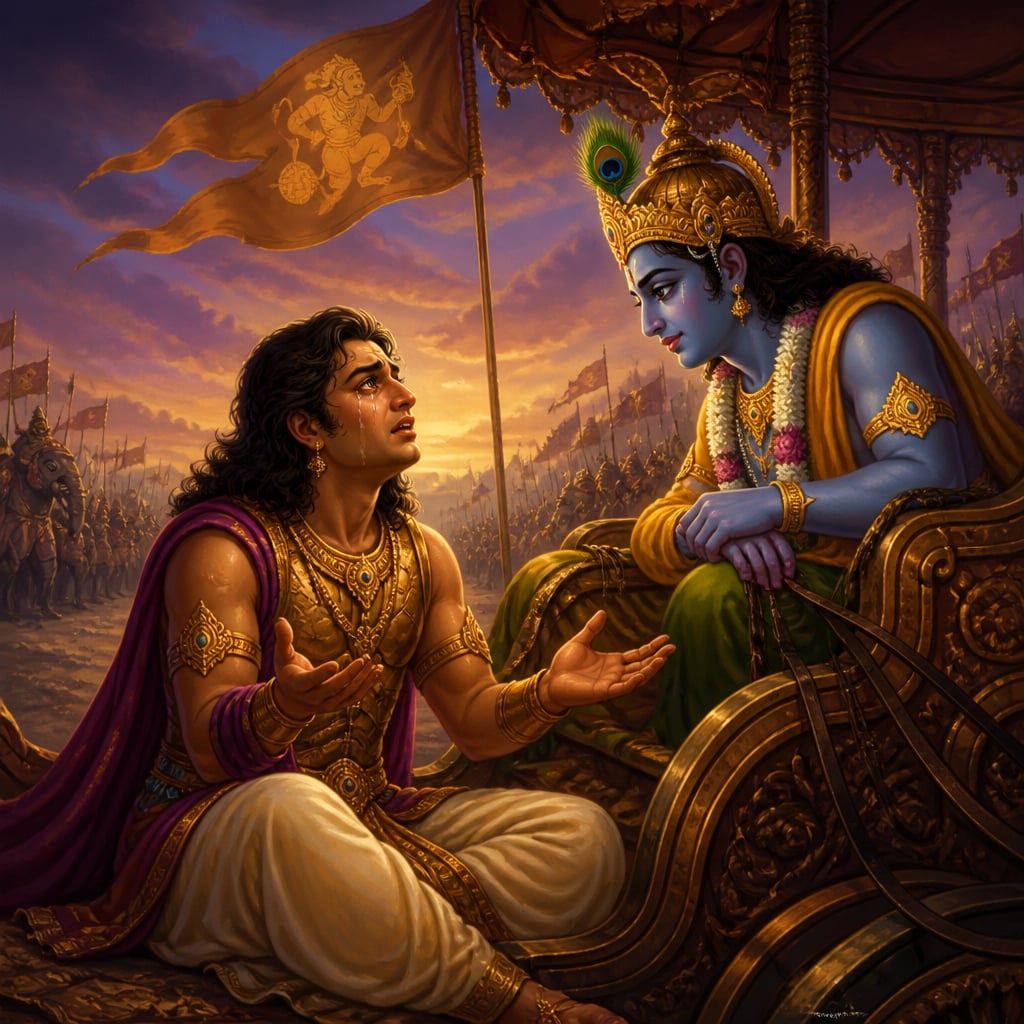
Arjuna half-collapsed in the chariot, voicing his fears to Krishna with open palms

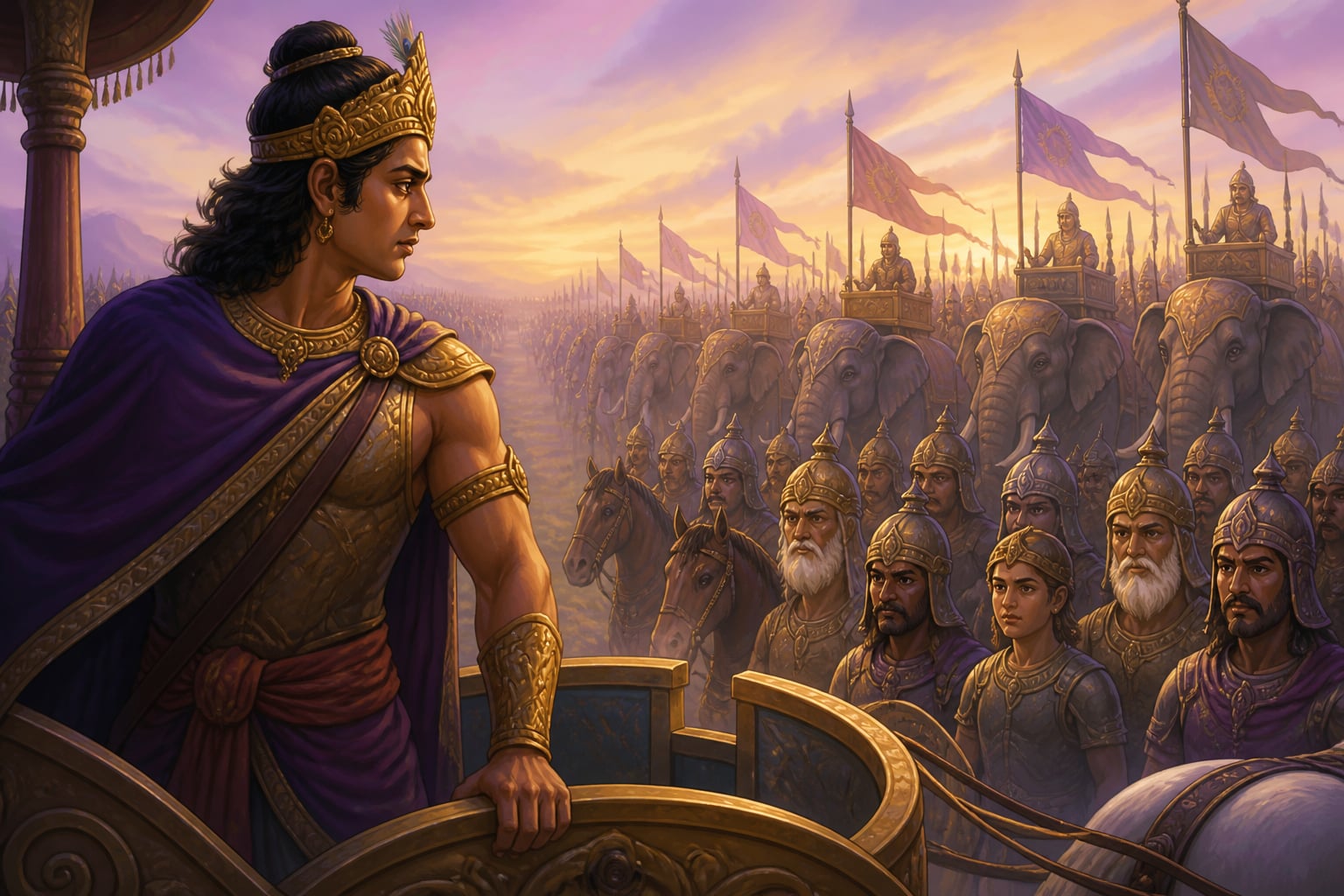
Arjuna recognizes nephews uncles and cousins in enemy ranks

And scattered across both armies, Arjuna sees hundreds more: young nephews who call him uncle, elderly cousins who bounced him on their knees, childhood friends who shared secrets with him around campfires. This is not a war against strangers. This is a family tearing itself apart.

Arjuna Names His Fears

What happens next reveals something extraordinary about Arjuna. He does not hide from his terror. He does not pretend to be brave. Instead, he does something that takes a different kind of courage: he puts his fears into words.

"Krishna," Arjuna says, his voice heavy, "I do not want this victory. I do not want the kingdom. I do not want the pleasures that could come from winning. What good is any of it if these people are destroyed?"

He pauses, and when he speaks again, his words come slowly, as if he is thinking through something terrible for the first time.

"When families are destroyed, everything falls apart. The traditions that have been passed down for generations, the stories, the rituals, the wisdom of our ancestors, all of it will be forgotten. Children will grow up without knowing who they are or where they came from. And when people lose their roots, Krishna, chaos follows."

This is what the ancient texts call kula-kshaya, the destruction of a family line. But Arjuna is not just worried about his own family name. He is seeing something much bigger: how violence ripples outward like a stone thrown into still water.

Think about your own family for a moment. Maybe your grandmother has a special recipe she learned from her mother. Maybe your family celebrates holidays in a particular way, or tells certain stories that only your relatives know. Maybe there are values your parents are teaching you that their parents taught them. This is what Arjuna fears losing, not just people, but everything that makes a family a family.

When the Body Speaks First

Here is something important to understand: Arjuna's body knew something was wrong before his mind could fully explain it.

Remember how we described his symptoms earlier? His limbs trembling, his mouth going dry, his skin burning, his legendary bow slipping from his fingers? These are not signs of cowardice. They are signs of wisdom.

Have you ever felt a "bad feeling" about something before you could say exactly why? Maybe your stomach tightened when you were about to do something you knew was wrong, even before you thought it through. Maybe you felt a chill when something seemed dangerous, before you could put the danger into words.

Our bodies are often smarter than our thoughts. When Arjuna's body refused to cooperate, when his arms would not stay steady and his legs would not hold him up, it was sending him an important message: Pay attention. Something here is very wrong. Do not rush.

Scientists today call this our "early warning system." When we face a situation that goes against our deepest values, our body often reacts before our thinking mind catches up. Arjuna's trembling was not weakness. It was his whole self, body and heart and conscience, sounding an alarm.

What Arjuna Could See That Others Missed

All around Arjuna, warriors were eager for battle. They polished their weapons. They boasted about the glory they would win. They dreamed of the honors and treasures that awaited the victorious.

But Arjuna saw what they were too blinded by excitement to notice: the true cost of what they were about to do.

"What is this great sin we are about to commit?" he asks Krishna. "We have gathered here, driven by greed for a kingdom, ready to destroy our own relatives. Those men over there, the Kauravas, they may be greedy and foolish, but does that mean we should be too?"

This is not a coward speaking. This is a clear-eyed warrior who has fought in countless battles, who has never hesitated to defend the innocent or punish the wicked. Arjuna is brave enough to ask the question everyone else is avoiding: Just because we can fight, should we?

He continues: "Even if they cannot see it, even if Duryodhana and his brothers are too lost in their greed to understand what they are doing, we should know better. We can see clearly that destroying a family is wrong. Shouldn't those who can see be held to a higher standard than those who are blind?"

The Courage to Name Our Fears

There is a kind of courage that has nothing to do with swords or arrows. It is the courage to look at what frightens us and give it a name.

When we are afraid, our first instinct is often to look away. We tell ourselves, "I don't want to think about that." We distract ourselves with other things. We pretend the scary thing does not exist.

But Arjuna shows us another way. Standing between two armies with his bow lying useless at his feet, he does not pretend to be fine. He does not hide his fears. Instead, he describes them carefully, one by one:

"I fear the destruction of my family." "I fear the loss of our traditions." "I fear that children yet to be born will grow up without guidance." "I fear the chaos that follows when order breaks down." "I fear the burden of sin on my conscience."

By naming his fears, Arjuna does something powerful: he transforms them from vague, overwhelming terrors into specific problems that can be examined. A fear without a name controls us. A fear with a name can be faced.

Try this yourself sometime. When you feel anxious or scared about something, stop and ask: "What exactly am I afraid will happen?" Often, the simple act of putting fear into words takes away some of its power over you.

A Declaration That Shocks Everyone

What Arjuna says next must have stunned every warrior within earshot.

"It would be better for me if the sons of Dhritarashtra, weapons in hand, killed me in battle, unarmed and unresisting."

Read that again. The greatest warrior of his generation, the man who had never lost a fight, is saying he would rather die without defending himself than lift a weapon against his own kin.

This is not giving up out of laziness or fear of getting hurt. This is Arjuna saying: "I have looked at both paths, and I cannot live with what victory would require. If the choice is between winning by killing those I love or dying without causing that harm, I choose to die."

Whether we agree with his conclusion or not, we have to respect what he is doing: he is taking his values seriously enough to face the ultimate consequence.

The Bow Falls Silent

And so, having spoken everything in his heart, having named every fear and examined every argument, Arjuna does something he has never done in his entire warrior's life.

He stops.

He sets aside his bow Gandiva, the divine weapon that has won him fame across the three worlds, and lets it rest on the chariot floor. He puts down his arrows. And he sits, right there in the middle of the battlefield, refusing to go forward and refusing to go back.

This is not the end. This is the beginning.

Because Arjuna's willingness to admit he is lost, his honesty about his fears, his refusal to act until he understands, all of this creates the sacred space for Krishna to begin teaching. The Bhagavad Gita, one of the most beloved books ever written, flows from this moment of surrender.

Sometimes we have to stop pretending we know what to do before we can learn what we need to know.

In our next lesson, we will see how Krishna responds to his friend's despair. Will he comfort Arjuna? Agree with him? Or challenge him in ways he never expected?

The bow lies silent on the chariot floor. The armies wait. And Krishna, with that mysterious smile still on his face, is about to speak.


Sometimes the bravest thing we can do is admit we are afraid, and ask for help.

Case studies

Bhagat Singh's Final Letters

In March 1931, Bhagat Singh awaited execution in Lahore Central Jail, just 23 years old. In his final letters, he articulated with remarkable clarity exactly what he feared and why he chose his path regardless. He wrote to his brother Kultar Singh about the weight of leaving his elderly father without support. He acknowledged the grief his death would cause his mother. He named the physical dread of the gallows, the uncertainty of whether his sacrifice would matter, the fear that his comrades might be forgotten. Yet in letter after letter, he faced each consequence with eyes open, never flinching from the full accounting of what his choices would cost, not just to himself, but to everyone he loved.

Like Arjuna on the battlefield, Bhagat Singh did not hide from his fears behind bravado or ideology. Arjuna named each consequence: 'My limbs fail, my mouth is parched, my body trembles, my hair stands on end' (1.29). He enumerated the specific people who would die, teachers, uncles, sons. This naming was not weakness but profound moral clarity. Bhagat Singh embodied the same practice: articulating fears transforms unnamed dread into understood reality. Both men teach that courage is not the absence of fear but the willingness to face consequences with full awareness.

Bhagat Singh was executed on March 23, 1931. His named fears came true, his father did grieve, his sacrifice was initially questioned. Yet because he had faced these consequences openly, his death became a catalyst rather than a tragedy. His letters, preserving his clear-eyed reckoning with fear, inspired generations. The act of naming transformed personal dread into shared understanding.

Naming your fears does not make you weak, it makes your choice conscious. When you articulate exactly what you stand to lose, you transform blind anxiety into informed courage. This is what separates paralysis from purposeful action.

Activists, journalists, and whistleblowers today face the same calculus Bhagat Singh did. Writing that resignation letter, publishing that investigative piece, or filing that complaint all require naming the specific costs. Vague anxiety paralyzes. A clear-eyed inventory of what you stand to lose, and what you refuse to lose, turns fear into fuel for deliberate action.

Bhagat Singh was executed on March 23, 1931, at age 23 in Lahore Central Jail. His final letters, written between February and March 1931, include 'Why I Am an Atheist' and letters to his father, totaling over 15,000 words that are now preserved in India's National Archives.

The Public Speaking Moment

Priya stands backstage at her university's annual research symposium, her thesis presentation moments away. Three hundred people wait in the auditorium, including the professor whose recommendation she needs for graduate school. Her heart pounds. Her hands shake so badly she nearly drops her notes. Her mouth goes dry. A wave of nausea rises. She has practiced for weeks, knows her research thoroughly, yet an unnamed terror grips her, a formless anxiety that whispers only 'something terrible will happen.' She considers fleeing, faking illness, anything to escape. The fear feels overwhelming precisely because she cannot articulate what she actually dreads.

Arjuna's genius in Chapter 1 was his specificity. He did not say 'I feel bad', he catalogued exact symptoms: trembling limbs, dry mouth, burning skin, inability to stand (1.29-30). Then he named specific fears: killing teachers, destroying family lineage, living with guilt. This precision transformed overwhelming dread into addressable concerns. If Priya names her fears, 'I fear Professor Sharma will think I'm foolish, I fear forgetting my data, I fear my voice cracking', each becomes a discrete challenge she can prepare for, rather than an amorphous monster she cannot fight.

Once Priya names her fears specifically, she can address each one: she brings backup notes for memory lapses, does vocal warm-ups for her voice, reminds herself that one presentation does not define her worth to Professor Sharma. The fears do not disappear, but they become manageable opponents rather than invisible demons. She presents imperfectly but completely, because she knew exactly what she was facing.

Unnamed anxiety is unconquerable because it has no shape. When you force yourself to articulate exactly what you fear, judgment, embarrassment, failure in specific forms, you give yourself something concrete to address. Precision transforms paralysis into possibility.

Presentation anxiety remains one of the most common fears in professional and academic settings, from startup pitch meetings to thesis defenses. The shift from 'I might fail' to 'my voice might crack, and that is survivable' applies directly to anyone preparing for a high-stakes moment. Specificity disarms fear in boardrooms just as it does on stage.

A 2014 Chapman University survey of American fears found that 25.3% of respondents reported being 'very afraid' of public speaking, making it the top social fear. Research by Harvard psychologist Alison Wood Brooks (2014) showed that reframing anxiety as excitement improved speech performance by 17% compared to trying to calm down.

Living traditions

The Gita's approach to fear - acknowledging it fully before seeking resolution - is now integrated into therapeutic frameworks. Dr. Ravi Chandra's work at UCSF incorporates Arjuna's moment of crisis as a model for processing anxiety. The Gita-based counseling program at NIMHANS Bangalore uses Chapter 1 to help patients articulate fears without shame. Corporate leadership programs at IIM Ahmedabad reference Arjuna's honest confrontation with consequences as essential for ethical decision-making. The American Psychological Association's 2023 publication on 'contemplative psychotherapy' cites the Gita's treatment of moral distress as anticipating modern exposure therapy principles.

Reflection

More in The Moment of Truth

All lessons in The Moment of Truth ยท The Bhagavad Gita course