Guru: Krishna the Teacher
Who can guide us in crisis
In his darkest moment, Arjuna turns to Krishna - not just as a charioteer, but as a guide. This lesson explores the relationship between teacher and student, and how to find wisdom when we need it most.
The Charioteer Who Became a Teacher
The horses stood still. The great conch shells had fallen silent. And in the space between two armies, in a chariot decorated with gold, something remarkable was about to happen.
Arjuna, one of the greatest warriors the world had ever seen, dropped his legendary bow. His hands were shaking. His mind was spinning with a thousand thoughts, each one more painful than the last. He had looked across the battlefield and seen the faces of people he loved, teachers who had taught him, cousins he had played with, elders who had blessed him.
And he didn't know what to do.
Have you ever felt completely stuck? Maybe you had to choose between two things, and both choices seemed wrong. Maybe you faced a problem so big that your brain just... stopped working. Maybe you felt so confused that you wanted to sit down and cry.
That's exactly where Arjuna was. And what he did next changed everything.
When the Warrior Asked for Help
Arjuna could have done many things in that moment. He could have pretended everything was fine and charged into battle anyway. He could have run away from the problem entirely. He could have kept arguing with himself, going in circles forever.
Instead, he did something incredibly brave.
He turned to Krishna, his charioteer, the person holding the reins of his horses, and said something that takes tremendous courage to say: "I don't know what to do. Please teach me."
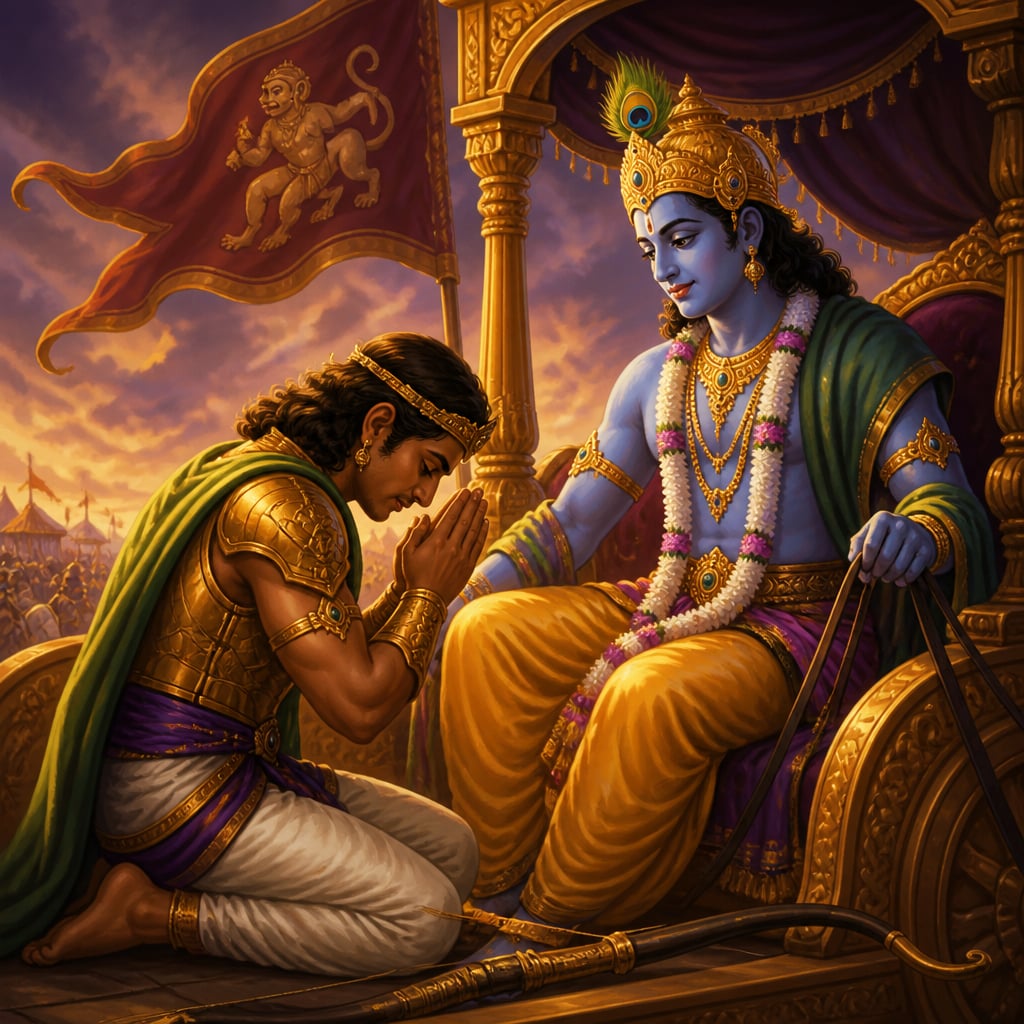
Think about that. Here was a famous warrior, a prince, someone who had won countless battles. And he admitted, out loud, that he was lost. He asked for help.
This wasn't weakness. This was wisdom.
Why Krishna?
Now, Arjuna knew many people. He had teachers who had trained him in archery for years. He had brothers who were also mighty warriors. He had advisors in the royal court. So why did he turn to Krishna?
Imagine you have a really difficult problem, not about homework, but about life. About what's right and wrong. About who you should be. Who would you talk to?
You probably wouldn't pick just the smartest person you know. You'd pick someone who truly understands you. Someone who cares about you, not just about being right. Someone who tells you the truth, even when it's hard to hear, but does it with kindness.
Krishna was Arjuna's friend. They had grown up together, shared meals together, laughed together. Krishna knew Arjuna's fears, his dreams, his strengths, and his weaknesses. He didn't see Arjuna as "the great warrior" or "the prince." He saw Arjuna as a person.
But Krishna was also wise, deeply, mysteriously wise. He seemed to understand things that others missed. When Krishna spoke, even simple words felt like they carried the weight of the stars.
And perhaps most importantly, Krishna was there. He wasn't far away in some palace. He was right beside Arjuna, in the chariot, ready to help.
The Art of Asking
The way Arjuna asked for help was special. He didn't demand answers. He didn't say, "Just tell me what to do so I can stop thinking about this." He opened his heart completely.
He admitted he was confused. He admitted he was suffering. He admitted that his usual ways of figuring things out weren't working. And then he said something beautiful: "I am your student. Please teach me."
This is called being teachable. It means being ready to learn, not just with your ears, but with your whole self. It means putting aside the need to look smart or strong. It means trusting someone enough to show them where you're broken.
A closed jar can't be filled with water. A clenched fist can't receive a gift. And a heart that pretends to know everything can't learn anything new. Arjuna opened himself completely, and that opening made everything that followed possible.
When the Teacher Responds

Krishna looked at his friend. He saw the tears in Arjuna's eyes, the trembling in his hands, the genuine anguish in his heart. And something shifted.
Until this moment, Krishna had just been a charioteer, a helper, a friend along for the ride. But Arjuna's sincere question transformed their relationship. It was like a key turning in a lock, opening a door to something vast.
Krishna didn't immediately give a simple answer. He didn't say, "Just do this and everything will be fine." Instead, he began with a smile, gentle, knowing, perhaps a little sad. He understood that real answers to real problems take time. They can't be rushed.
What followed was a conversation that would echo through thousands of years. But it started here, in this moment, with a warrior brave enough to admit he was lost and a friend wise enough to help him find his way.
Finding Your Own Guides

You may not have a Krishna sitting beside you. But you probably have people who can be guides when you're lost, parents, teachers, older friends, mentors who care about you and want to see you grow.
The key is learning to ask. Not demanding. Not pretending. But genuinely opening your heart and saying, "I don't understand this. Will you help me?"
And when you find such a guide, someone who listens deeply, who cares about you, who shares wisdom rather than just orders, treasure that relationship. It's one of the most precious things in life.
Because we all get lost sometimes. The question isn't whether we'll face moments of confusion and crisis. The question is whether we'll have the courage, like Arjuna, to ask for help, and whether we'll find, like he did, that help was right beside us all along.
Case studies
APJ Abdul Kalam's Mentors: The Teachers Who Shaped India's Missile Man
In the 1950s, young Abdul Kalam faced a crisis of direction. Born into a humble family in Rameswaram, he dreamed of becoming a fighter pilot but was rejected by the Indian Air Force. Devastated, he met Swami Sivananda who asked him a simple question: 'What is your true calling?' This encounter redirected Kalam's path. Later, at ISRO, Dr. Vikram Sarabhai became his mentor, entrusting the young engineer with satellite launch vehicle development despite his inexperience. When the first SLV-3 failed in 1979, Sarabhai's successor Professor Satish Dhawan took full public responsibility for the failure, but when SLV-3 succeeded in 1980, he pushed Kalam to the front to receive the credit. These three mentors, a spiritual guide, a visionary scientist, and a protective leader, each appeared precisely when Kalam needed guidance most.
Like Arjuna turning to Krishna at Kurukshetra, Kalam found himself at crossroads where personal effort alone was insufficient. The Gita teaches that a guru provides not just knowledge but clarity of vision (viveka) when our own discrimination fails. Swami Sivananda embodied the spiritual guide who clarifies purpose. Sarabhai, like Krishna with Arjuna, saw potential others missed and trusted his shishya with responsibilities beyond apparent qualification. Dhawan demonstrated the protective aspect of the guru, absorbing failure's blame while redirecting success's glory to the student.
Kalam became the father of India's missile program, leading Agni and Prithvi development. He later served as India's 11th President, known as the 'People's President.' Throughout his life, he credited his mentors for shaping his path. He himself became a beloved teacher, inspiring millions, his last breath came while teaching at IIM Shillong.
A true guru appears when the student is ready, but readiness means acknowledging that we need guidance. Kalam's humility to seek and accept mentorship at each crisis point transformed rejection into historic achievement.
In an era of online courses, self-help content, and AI tutors, the temptation is to believe you can learn everything alone. Kalam's story is a reminder that mentorship provides something no algorithm can: someone who sees your potential before you do, and who redirects you when your own vision is clouded by setback or self-doubt.
APJ Abdul Kalam led India's Agni missile program, which achieved its first successful test launch on May 22, 1989. He served as India's 11th President from 2002 to 2007 and personally interacted with over 100,000 students during his presidency through school visits across 27 states.
Asking the Right Question: How Framing Determines the Guidance We Receive
Priya, a 28-year-old software engineer, faces a career crisis. Her startup is failing, she has a secure job offer from a large corporation, and her family pressures her to take the safe path. Overwhelmed, she seeks advice. To her father, she asks: 'Should I take the corporate job?' He immediately says yes, stability is paramount. To her startup mentor, she asks: 'How can I save my company?' He launches into pivot strategies. To her friend, she complains: 'Why is this happening to me?' and receives sympathy but no clarity. Finally, exhausted from contradictory advice, she visits her grandmother and simply sits in silence before saying: 'I don't know what to do.' Her grandmother asks: 'What are you afraid to lose, the startup, or the person you've become while building it?' For the first time, Priya sees her real question.
Arjuna's genius was not in having the perfect question, but in admitting complete confusion: 'I cannot see what would remove this grief' (Gita 2.8). He didn't ask 'Should I fight?' or 'How do I win?', questions that would have yielded tactical answers. He surrendered his confusion completely: 'I am your shishya; teach me.' This total openness allowed Krishna to address not the symptom but the root cause. The Gita teaches that the quality of guidance depends on the quality of surrender.
Priya realized her closed questions had been seeking permission, not guidance. Her grandmother's reframing revealed that she feared losing her identity as a builder and risk-taker. She decided to wind down the startup thoughtfully while seeking a role that preserved her entrepreneurial spirit. The answer emerged from finally asking an open question to someone who could see beyond her words.
The guru can only illuminate the question we actually bring. Arjuna's greatest act before receiving the Gita was admitting total confusion rather than seeking validation. True guidance requires true surrender of our assumptions.
Therapy clients, coaching participants, and even people consulting AI chatbots get dramatically different value depending on how they frame their questions. 'Should I quit my job?' invites a yes/no answer. 'What is my work actually serving, and what do I need it to serve?' opens a much deeper conversation. The quality of guidance mirrors the quality of the question.
Research published in the Harvard Business Review (2018) found that managers who asked open-ended questions received 3x more actionable information than those who asked yes-or-no questions. A study at the MIT Human Dynamics Lab showed that the quality of questions asked by a team predicted its performance more accurately than the quality of answers.
Living traditions
The guru-shishya model Krishna demonstrated continues to shape Indian education and global mentorship. IIMs and business schools study Krishna's teaching methodology, how he adapted his discourse to Arjuna's specific doubts rather than delivering generic advice. Corporate mentorship programs draw on guru-shishya principles of personalized guidance. The tradition thrives in Indian classical music and dance, where the guru-shishya parampara remains the only authentic path to mastery. Organizations like Chinmaya Mission and Art of Living have globalized the model, establishing guru-led learning centers in over 50 countries. Executive coaching, popularized in Western management, mirrors the personalized wisdom-transfer that Krishna exemplified 5,000 years ago on the battlefield.
- Guru Purnima: Annual festival honoring the guru-shishya lineage, when students express gratitude to their teachers through puja, offerings, and seeking blessings. Disciples traditionally visit their gurus, offer flowers and sweets, and receive teachings or blessings.
- Guru Puja (Pada Puja): Ritual worship of the guru's feet, symbolizing humility and reverence. The student washes the guru's feet with water, applies sandalwood paste, offers flowers, and prostrates (sashtanga namaskar), the same surrender Arjuna demonstrated when he declared 'I am your disciple.'
- Jyotisar - The Guru's Seat: The sacred spot where Krishna became Arjuna's guru and delivered the Bhagavad Gita. A marble chariot depicts the exact moment when Arjuna surrendered as a shishya and Krishna began his teaching. The ancient banyan tree here is considered a descendant of the original tree witnessing the divine discourse. This is where the greatest guru-shishya dialogue in history took place.
- Sandipani Ashram: The gurukul where Krishna himself was a student, learning 64 arts and sciences from Guru Sandipani in just 64 days. Before becoming Arjuna's teacher, Krishna demonstrated the ideal student's qualities here, complete focus, humility, and devotion to his guru. The ashram includes the Gomti Kund where Krishna is said to have resurrected his guru's son as guru-dakshina (payment to the teacher).
Reflection
- When you face a personal crisis or difficult decision, who do you turn to for guidance, and what qualities make that person trustworthy in your eyes?
- Why do you think Arjuna, a renowned warrior with access to many wise elders, chose Krishna as his charioteer and ultimately his guru at this critical moment?
- What transforms an ordinary relationship into the sacred bond of guru and shishya, and why does this tradition emphasize surrender alongside inquiry?