Sthitaprajna: The Steady Mind

What emotional mastery looks like

Arjuna asks: 'How does a wise person act? How do they speak? How do they sit?' Krishna describes the sthitaprajna - one whose wisdom is steady like an ocean unmoved by rivers. This isn't about suppressing emotions, but about not being controlled by them.

The Steady Mind: What Emotional Mastery Looks Like

Arjuna's Beautiful Question

Arjuna has been listening intently. Krishna has just revealed that there is an eternal Self beyond the body, beyond death, beyond all harm. Arjuna's mind is spinning with possibilities.

But he is practical. He doesn't want abstract philosophy, he wants to know what this wisdom looks like in a real person. So he asks one of the most important questions in the entire Gita:
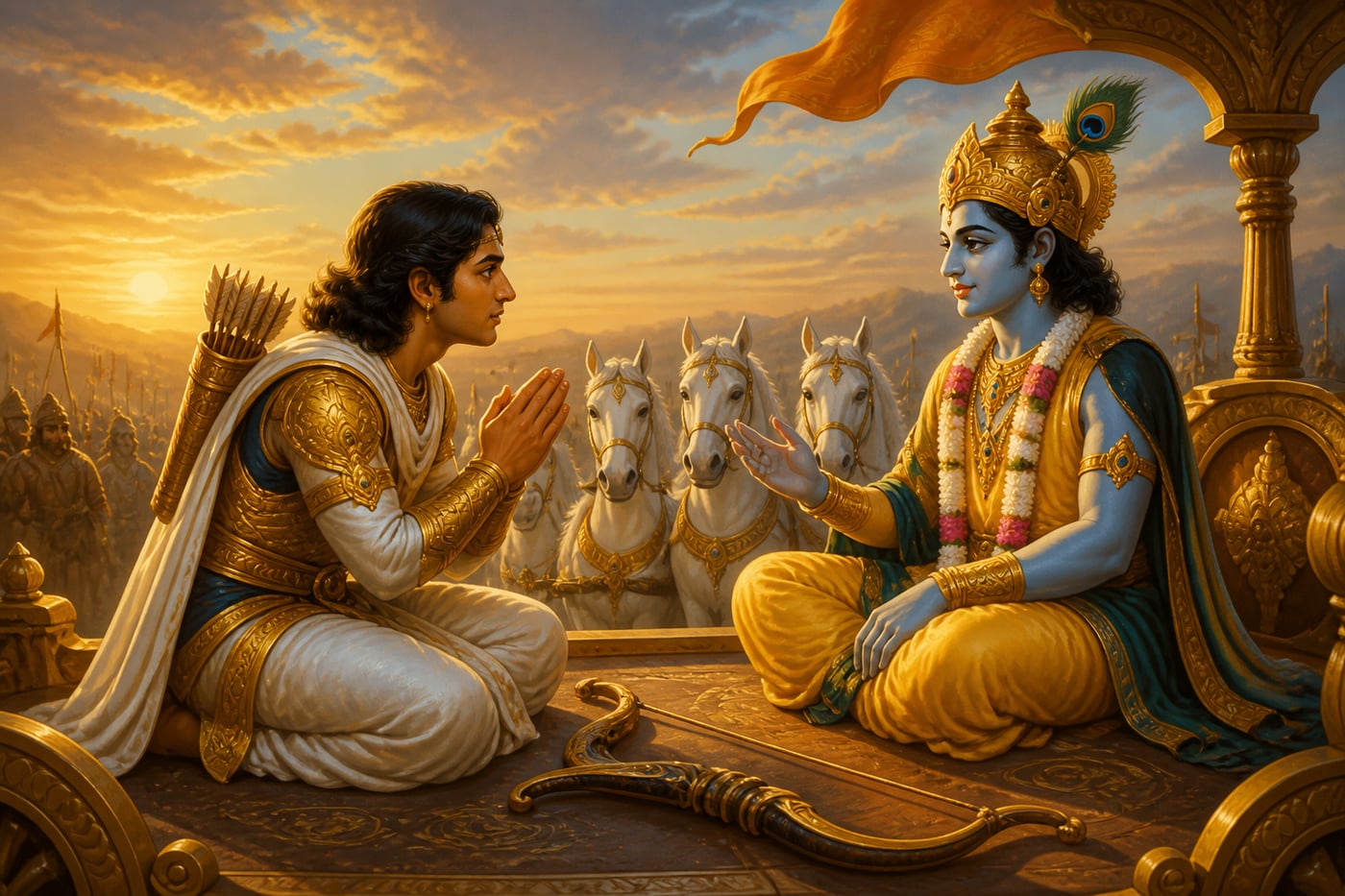
Arjuna leaning forward asking Krishna how wisdom appears in lived life

"Krishna, how would I recognize someone whose wisdom has become steady? How does such a person speak? How do they sit? How do they walk through the world?"

This question changes everything. Arjuna isn't asking for more theory. He's asking: "Show me what this looks like. Give me a picture I can recognize and aspire to."

And Krishna's answer has guided seekers for thousands of years.

The Portrait of the Wise

Krishna doesn't describe a person sitting in a cave, eyes closed, removed from life. Instead, he paints a portrait of someone living fully in the world, yet fundamentally unshaken by it.

"When a person completely abandons all the desires of the mind," Krishna says, "and finds satisfaction in the Self alone, by the Self, that person is called steady in wisdom."

Notice: it's not that such a person has no feelings or experiences. They simply don't depend on external circumstances for their inner peace. They have found something within that doesn't fluctuate with success or failure, praise or blame, gain or loss.

Krishna continues with a striking image:

"Unshaken by sorrow, without longing for pleasures, free from attachment, fear, and anger, such a person is called a sage of steady wisdom."

This isn't describing someone cold or emotionless. It's describing someone who feels everything but is not tossed about by feelings. They are like a deep lake, storms may ripple the surface, but the depths remain still.

The Ocean That Cannot Be Disturbed

Krishna offers an unforgettable metaphor:

"Just as the ocean remains undisturbed though many rivers flow into it, so too the wise person remains at peace though all desires flow toward them."

A vast tranquil ocean at sunrise receiving many rivers from different landscapes, the waters absorbed without ripple or disturbance

Think about this image. The ocean doesn't push away the rivers. It doesn't build walls against them. It receives everything, the Ganga, the Yamuna, the Godavari, countless streams, and yet its fundamental nature remains unchanged. It is vast enough to contain all that flows in without losing itself.

The sthitaprajna is like this. Life brings pleasures and pains, successes and failures, praise and criticism. The wise person receives it all without being destabilized. Not because they don't care, but because their sense of self doesn't depend on what arrives.

The Dangerous Chain

Krishna also warns Arjuna about what happens when we lack this steadiness. He describes a chain reaction that leads from desire to destruction:

"When a person dwells on sense objects, attachment to them arises. From attachment springs desire. From desire arises anger."

Think about the last time you were really upset. Often, if you trace it back, it started with wanting something, a grade, a relationship, recognition, a particular outcome. When we didn't get it (or feared losing it), frustration arose. The frustration became anger. And anger clouded our thinking.

"From anger comes delusion," Krishna continues. "From delusion, the loss of memory. From loss of memory, the destruction of intelligence. And when intelligence is destroyed, one is lost."

This isn't a threat; it's a map. Krishna is showing how instability works, so we can catch ourselves before we fall.

Not Suppression, But Freedom

Here's what the sthitaprajna is NOT:

They are not someone who pretends not to feel. That's suppression, and it creates suffering, not freedom.

They are not someone who withdraws from life. Krishna will spend the entire Gita arguing that action in the world is our duty.

They are not someone born special, different from the rest of us. The Gita presents this as a state anyone can develop through practice.

What the sthitaprajna IS:

Someone who has shifted their center of gravity from external circumstances to internal stability.

Someone who can feel joy without clinging to it and feel sorrow without drowning in it.

Someone who acts in the world from clarity rather than reaction.

The Three Qualities

Krishna identifies three qualities that keep us steady:

Freedom from attachment: Not that we don't love or care, but that our peace doesn't depend on getting what we want. We can prefer outcomes without being devastated if they don't happen.

Freedom from fear: When we know our true Self cannot be harmed, what is there to fear? We might feel the emotion of fear arise, but we're not controlled by it.

Freedom from anger: Anger usually comes from thwarted desire or threatened ego. When these don't drive us, anger loses its fuel. We might feel irritation, but it doesn't take over.

Two students in an exam hall, one tense and one steady

What This Looks Like in Real Life

Imagine two students taking an important exam.

Student A's entire sense of self-worth is tied to the result. They are anxious before, desperate during, and either elated or crushed after, depending on the outcome. Their mood, their relationships, their whole week is determined by a number on a paper.

Student B has prepared well and cares about the result. But they understand that their fundamental worth doesn't depend on any exam. They do their best with focus and calm. When results come, they learn what they can and move forward. Good result or disappointing one, they remain fundamentally the same person.

Student B isn't less motivated or less caring. They're just not enslaved by the outcome. That's what sthitaprajna looks like in everyday life.

The Promise at Day's End

Krishna ends his description with a beautiful promise:

"This is the brahmic state. Having attained it, one is never deluded. Established in this even at the hour of death, one attains the peace of Brahman."

The "brahmic state" isn't some far-off heaven. It's a way of being available right here, right now. It's the discovery that peace was never in the circumstances, it was always in the one experiencing the circumstances.

Arjuna is beginning to see. The battlefield hasn't changed. His family members are still arrayed against him. But Arjuna himself is changing. A new possibility is opening: acting not from fear and attachment, but from the steady place Krishna is describing.

The question is no longer just "What should I do?" It's becoming "Who do I want to become?"


The Gita's vision of emotional mastery isn't about becoming less human. It's about becoming fully human, feeling everything, controlled by nothing.

Case studies

MS Dhoni: Captain Cool Under Pressure

The 2011 Cricket World Cup final. India is chasing 275 against Sri Lanka in Mumbai. The crowd of 42,000 holds its breath. With 91 runs still needed, Virender Sehwag and Sachin Tendulkar are both out. The entire nation's hopes rest on the remaining batsmen. Then Dhoni does something astonishing: he promotes himself above in-form batsman Yuvraj Singh. Cameras catch his face, utterly calm. Over the next three hours, he builds an unbeaten 91, finishing the match with a towering six. Throughout, his heartbeat seems unchanged. In interviews, he explains his thought process with the same measured tone he might use discussing a practice session.

Dhoni exemplifies the sthitaprajña's qualities Krishna describes. His decision to promote himself wasn't reactive or ego-driven, it was calm analysis that the situation needed his particular skills. Like the ocean receiving rivers, he absorbed the immense pressure without being destabilized. His famous statement, 'I don't let negative emotions get the better of me,' echoes Krishna's teaching about freedom from attachment, fear, and anger. Dhoni doesn't suppress emotion, teammates say he feels deeply, but he doesn't let feelings dictate his decisions.

India won its first World Cup in 28 years. But more remarkable than the trophy was the manner: Dhoni's composure became a teaching moment for millions. His calm was credited not just for his own innings but for settling the entire team. Yuvraj Singh later said Dhoni's steadiness gave everyone confidence.

Emotional steadiness isn't cold or uncaring, it's the foundation of performing your best when it matters most. Dhoni cared deeply about winning; he simply didn't let that caring become anxiety that clouded his judgment.

High-pressure decision-making under public scrutiny is now a daily reality for executives, surgeons, first responders, and even content creators facing live audiences. The performance research is clear: emotional regulation, not suppression, separates those who choke from those who deliver. Training yourself to feel pressure without being consumed by it is a learnable skill.

In the 2011 World Cup final on April 2, Dhoni promoted himself above Yuvraj Singh at No. 5, scoring an unbeaten 91 off 79 balls to chase down 275. India won by 6 wickets, ending a 28-year World Cup drought. A study by ESPN Cricinfo found that Dhoni's average in successful run chases was 52.84, highest among all captains with a minimum of 20 innings.

The Board Exam Storm

Priya is three weeks from her Class 12 board exams. Her parents have made clear these results will determine everything, college, career, family honor. Her classmates are panicking; WhatsApp groups buzz with anxiety at 2 AM. Some friends have started having panic attacks. Priya herself feels her chest tighten every time she opens a textbook. She can't sleep. She's studying 14 hours a day but retaining nothing because her mind is racing with fears about failure. One evening, her grandmother notices her distress and sits with her.

Priya's state illustrates Krishna's chain of causation: dwelling on the 'sense object' (the exam result) has created attachment, which has become desperate desire, which is now generating fear and anger. Her intelligence is clouding. Her grandmother, who survived partition and raised four children through poverty, offers a different perspective: 'Beta, prepare as if everything depends on your effort. Then release the result as if nothing depends on it.' This is samatva, giving full effort without tying identity to outcome. Priya isn't asked to care less, just to separate her worth from a number on a marksheet.

Priya begins a new practice: each morning she reminds herself that she is not her exam score. She studies with focus but takes breaks. She turns off late-night WhatsApp groups. Exam day comes and she performs, not perfectly, but well. More importantly, whatever the result, she remains herself. Some classmates who scored higher were devastated for not meeting impossible expectations; Priya, with her good-but-not-extraordinary marks, moved forward with clarity and peace.

The sthitaprajña's equanimity isn't about caring less, it's about not staking your entire identity on outcomes you can't fully control. Prepare fully, then release the result. This is how steady wisdom meets exam season.

Student mental health crises have reached epidemic proportions globally, driven partly by the belief that a single exam or application determines an entire life trajectory. The sthitaprajna model offers a practical counter-narrative: prepare with full effort, then release the outcome. This is not passivity. It is the recognition that your worth exists independent of any scorecard.

India's National Crime Records Bureau reported 10,159 student suicides in 2018, with academic pressure cited as a leading factor. A 2020 study in the Indian Journal of Psychiatry found that 73.5% of Class 12 students experienced high to very high exam-related anxiety, while students who practiced mindfulness-based interventions showed a 23% reduction in exam anxiety scores.

Living traditions

The concept of sthitaprajña has deeply influenced corporate leadership training in India. IIM Bangalore's 'Consciousness and Leadership' course uses Chapter 2 as a core text. Google's 'Search Inside Yourself' program draws on similar principles. Sports psychology programs across India reference MS Dhoni as a contemporary model of the sthitaprajña. The concept has entered everyday Hindi vocabulary, calling someone 'sthitaprajna' is high praise for their composure.

Reflection

More in The Eternal Self

All lessons in The Eternal Self · The Bhagavad Gita course