Atman: Beyond Body and Mind

The indestructible essence

Krishna's first teaching to the grieving Arjuna reveals a profound truth: the real you cannot be touched by swords, burned by fire, or ended by death. This lesson explores the Gita's revolutionary insight that our deepest self is eternal, unchanging, and beyond all physical harm.

Beyond Body and Mind: The Indestructible Essence

Krishna Speaks at Last

Arjuna sits crumpled on his chariot, the legendary bow Gandiva lying abandoned at his feet. His body trembles. His mouth is parched. The greatest warrior of his age has been reduced to despair by the sight of his own family arrayed against him.
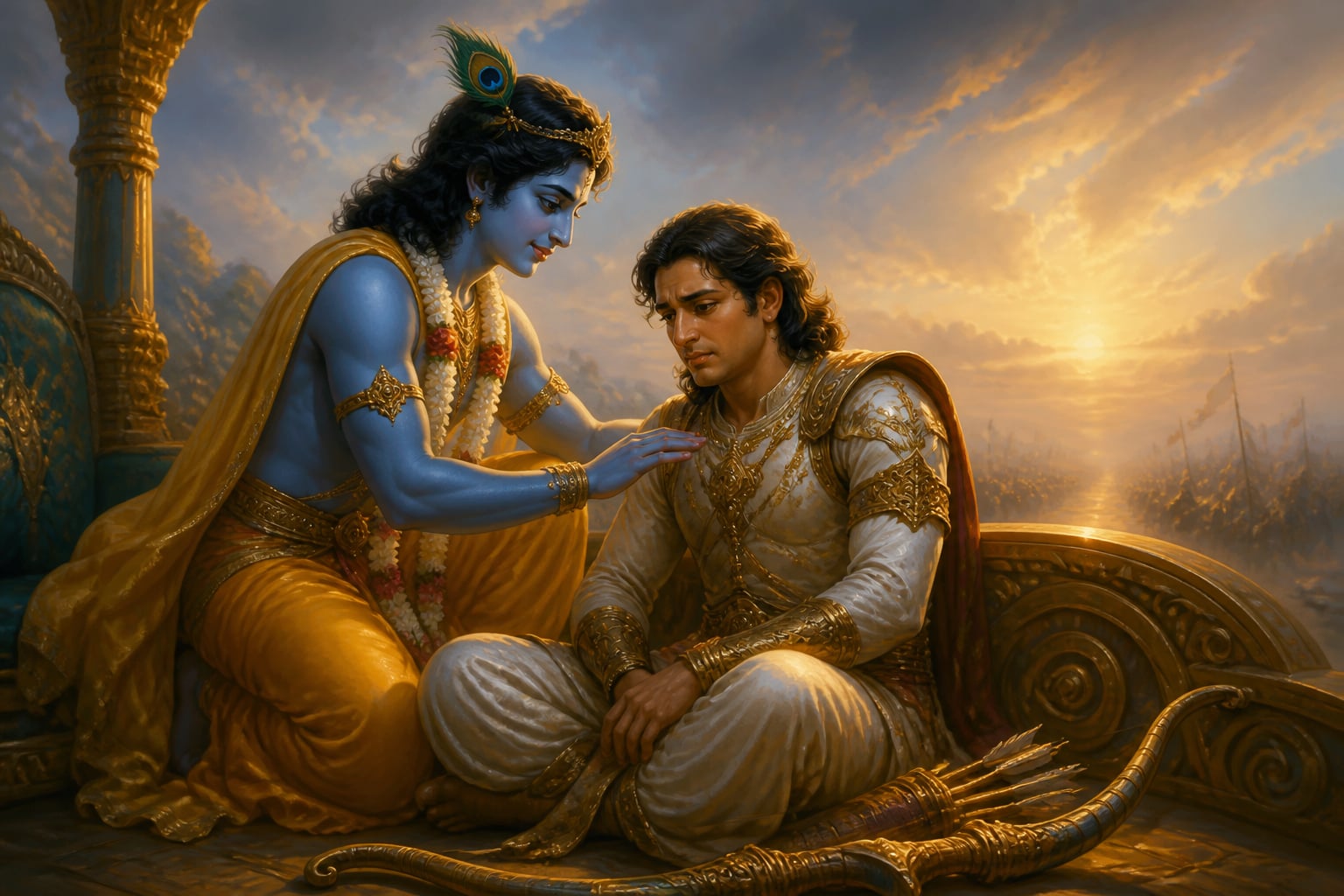
Krishna leaning gently toward Arjuna in the first teaching moment

And then Krishna speaks.

But his first words are not what Arjuna expects. There is no sympathy, no gentle comfort. Instead, Krishna's voice carries a hint of loving rebuke:

"You grieve for those who should not be grieved for, yet you speak words of wisdom. The wise grieve neither for the living nor for the dead."

Arjuna must have been startled. He had just delivered an eloquent speech about duty, family, and the terrible consequences of war. He thought he was being wise. And now Krishna tells him he is grieving for the wrong reasons entirely.

What could Krishna possibly mean?

The Question That Changes Everything

Imagine you have a favorite shirt, one you've worn for years, through countless adventures. It has faded, perhaps torn in places, patched and re-patched. One day, it finally falls apart beyond repair. Would you mourn for that shirt as if a person had died?

Of course not. It was just clothing. You are still here, unchanged, even though the shirt is gone.

Now Krishna asks us to consider something radical: What if your body is like that shirt?

Not you. Just something you wear.

"Just as a person casts off worn-out garments and puts on new ones," Krishna explains, "so the embodied Self casts off worn-out bodies and enters into new ones."
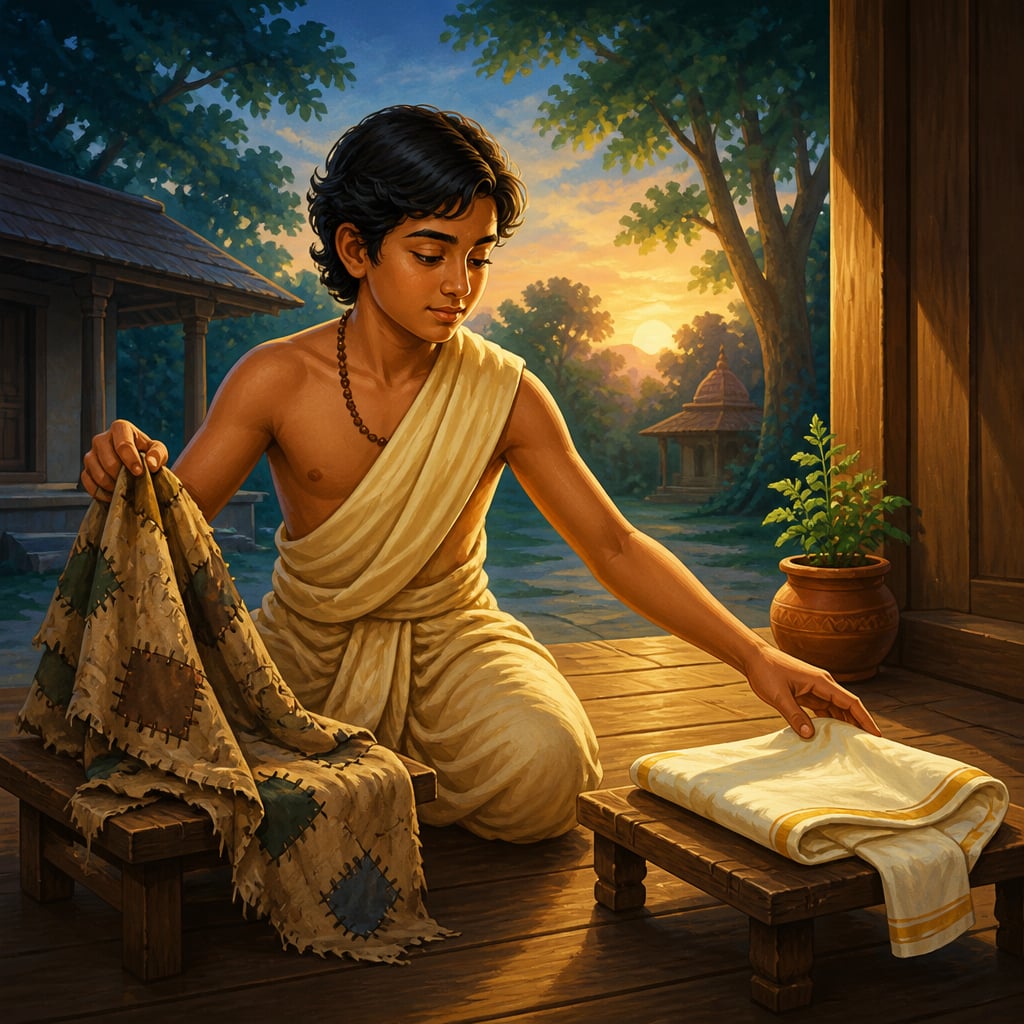
A young seeker in a dawn courtyard calmly folding aside a worn patched dhoti and reaching for a fresh white-and-gold cloth, the metaphor of the Self changing bodies

This is not merely a belief to accept or reject. Krishna presents it as a perspective that transforms how we understand ourselves and everything that happens to us.

The Self That Cannot Be Touched

Krishna describes this true Self, the Atman, in language so vivid it has echoed through millennia:

A meditator unmoved as weapons fire water and wind pass harmlessly around

"Weapons cannot cut it. Fire cannot burn it. Water cannot wet it. Wind cannot dry it."

Close your eyes for a moment and feel what Krishna is pointing toward. Your body can be cut, burned, soaked, and dried. Your body changes every day, cells dying and being born, growing from infant to child to adult to elder. But is there something in you that has remained constant through all these changes?

When you look at a photograph of yourself as a baby, your body is completely different. Yet you recognize that baby as you. What is this "you" that persists while the body transforms?

Krishna says this unchanging awareness, this sense of being the one who experiences life, is your true nature. And it cannot be harmed by anything that happens to the body.

Not a Belief, But an Inquiry

The Gita doesn't ask us to blindly believe this. Instead, it invites us to investigate our own experience.

Think about a time when you were very sick. Your body felt terrible, but was there still a "you" observing the sickness? When you dream at night, your body lies still, but "you" are having adventures in another world. When you think about your body, "my hand hurts," "my legs are tired", who is the "my" that owns these parts?

This inquiry leads to a startling possibility: perhaps we have been confusing the container with the contents, the vehicle with the driver, the costume with the actor.

Why This Matters When Life Hurts

This teaching is not abstract philosophy for comfortable times. Krishna offers it to Arjuna at the worst moment of his life, when he is about to face unimaginable loss.

And this is precisely when the teaching matters most.

When someone we love dies, when our health fails, when everything we built crumbles, these are the moments when we need to know: What can truly be lost? What remains?

If we are only our bodies, then every illness threatens our existence, every aging sign announces our doom, and death is the final defeat. But if our deepest self is untouched by physical changes, then we can face life's hardships with a different kind of courage.

This doesn't mean we stop caring about our bodies or the bodies of those we love. We still feed them, heal them, protect them. But we hold them differently, with love but without terror, with care but without desperation.

The Teacher and the Student

Notice how Krishna teaches. He doesn't begin with rituals or rules. He doesn't tell Arjuna what to do. He starts by transforming how Arjuna sees himself.

This is the Gita's method: change your understanding, and right action will follow naturally.

Arjuna thought he knew who he was, a warrior, a son, a nephew, a student. All these identities seemed to be in conflict on the battlefield. But Krishna points to something beneath all these roles: the unchanging awareness that wears these identities like costumes in a play.

From this perspective, the battlefield looks different. Death looks different. Duty looks different. Everything is transformed when we stop identifying with what we are not.

The Journey Ahead

This first teaching is just the beginning. Krishna will go on to explain how this understanding applies to action, to emotions, to relationships, to life's purpose itself.

But the foundation is here: You are not your body. You are not your thoughts. You are not your emotions. These are experiences you have, not what you are. Your true nature, the Self, the Atman, is beyond birth and death, beyond pleasure and pain, beyond all the pairs of opposites that make life feel like a constant struggle.

Arjuna is not yet convinced. He has more questions, more objections. But something has shifted. The despair in his eyes gives way to curiosity. If what Krishna says is true, then perhaps everything Arjuna feared is not quite what it seemed.

The teaching has begun.


The Gita begins not with rules for behavior, but with a radical reframing of who we are. Only when we know ourselves can we know what to do.

Case studies

Helen Keller: Finding the Self Beyond the Senses

In 1882, nineteen-month-old Helen Keller lost both sight and hearing to illness. Trapped in a dark, silent world, she lived like a wild creature, unable to communicate, prone to violent tantrums, seemingly cut off from everything that makes us human. When Anne Sullivan arrived as her teacher in 1887, Helen was nearly seven years old and had never formed a single word. By the end of her life, Helen Keller had authored twelve books, earned a Bachelor of Arts degree (the first deaf-blind person to do so), advised presidents, and traveled the world as an advocate for the disabled. She learned to read in Braille, speak aloud, and understand others through touch.

Helen Keller's life is a living demonstration of Krishna's teaching. By conventional understanding, she should have been nothing, her body couldn't see, couldn't hear, couldn't communicate. Yet an 'inner light' (her words) burned undimmed. 'The best and most beautiful things in the world cannot be seen or even touched, they must be felt with the heart,' she wrote. This is precisely Krishna's point: the Atman perceives not through the senses but as the awareness behind all sensing. Helen's physical limitations proved that the essential Self transcends the body's capabilities.

Helen Keller became proof that identity doesn't reside in physical function. Her mind, spirit, humor, and compassion flourished despite what her body couldn't do. She demonstrated that the 'indestructible essence' Krishna speaks of is not metaphysical speculation but lived reality.

Our bodies are instruments, not identities. When we understand this, physical limitations become challenges to overcome rather than definitions of who we are. The Self that thinks, feels, and connects cannot be contained by any disability.

As AI and automation redefine what humans 'do,' the question of identity beyond capability becomes urgent. Workers whose jobs are automated, athletes who age out of competition, and retirees who lose professional titles all face the same question Keller confronted: who are you when your primary mode of engaging the world changes? The answer the Gita offers is timeless.

Helen Keller lost both sight and hearing at 19 months in 1882. She went on to earn a Bachelor of Arts degree from Radcliffe College in 1904, becoming the first deaf-blind person to do so. She authored 14 books, delivered speeches in 25 countries, and was awarded the Presidential Medal of Freedom in 1964.

The Athlete's Second Life

Ravi was the star cricketer of his district, everyone said he'd play for India one day. At seventeen, a motorcycle accident shattered his bowling arm. After three surgeries, the doctors were clear: he would never play professional cricket again. Ravi fell into deep depression. He stopped meeting friends, refused to watch matches, and lay in his room staring at his medals. 'If I can't play cricket,' he told his mother, 'then I'm nobody.' His entire identity had been wrapped up in what his body could do.

Ravi's crisis mirrors Arjuna's, both faced the loss of everything they thought defined them. Krishna's teaching applies directly: Ravi was never 'the cricketer.' He was the awareness that experienced being a cricketer, the spirit that found joy in the game, the consciousness that will persist whether the body bowls or not. The Gita's famous verse about changing garments (2.22) suggests that even losing an identity, like 'star player', is like changing clothes. The one who wore that identity remains.

After months of struggle, Ravi began coaching younger players. He discovered that his knowledge, his passion for the game, and his ability to inspire others hadn't been in his arm at all. He eventually coached a junior team to the state championships. 'I thought cricket was my body's gift,' he reflected. 'Now I know it was always my soul's gift, and that can never be taken away.'

Our deepest gifts aren't physical abilities but the consciousness that expresses through them. When one avenue closes, the Self that animated it can find new expression. Identity isn't what we do; it's what we are.

Career-ending injuries, layoffs, and health crises force millions of people each year to rebuild their sense of self. Social media amplifies the pain by constantly displaying others' highlight reels. The insight that identity is not what you do but the awareness behind it offers a practical foundation for reinvention at any age.

According to a 2019 study in the British Journal of Sports Medicine, 28% of elite athletes experience a clinical identity crisis after career-ending injury. However, research by the International Olympic Committee found that athletes who transitioned into coaching or mentoring reported 40% higher life satisfaction scores five years post-retirement compared to those who did not.

Living traditions

The Gita's teaching on the eternal Self influences modern psychology's concepts of 'witness consciousness' and 'observer self' used in therapies like ACT and mindfulness-based approaches. Corporate leaders cite Chapter 2's wisdom on equanimity in decision-making. IIT and IIM entrance coaching often begins with Gita 2.47's teaching on focusing on action rather than results. ISKCON's 800+ centers worldwide teach Chapter 2 as the foundation of spiritual understanding.

Reflection

More in The Eternal Self

All lessons in The Eternal Self ยท The Bhagavad Gita course