Kshetra: The Field and the Knower

Observer vs observed

Krishna introduces a powerful distinction: there is the 'field' (everything you experience - your body, thoughts, feelings) and there is the 'knower of the field' (the one who experiences). Learning to tell them apart is the key to freedom.

The Field and the Knower: Observer vs Observed

A New Way of Looking

Imagine you're watching a movie. You see characters laughing, crying, fighting, falling in love. You feel emotions, excitement during the chase scene, sadness when the hero loses, joy at the happy ending. But throughout it all, there's something that never changes: you, the one watching.

The screen shows a thousand different images. The story takes a hundred twists. But you, sitting in your seat, remain the same person from the opening credits to the final scene. You're the viewer, not the viewed.

Krishna is about to reveal that life itself works this way.

The Question of Two

In Chapter 13 of the Gita, Krishna introduces one of the most liberating distinctions in all of Indian philosophy:
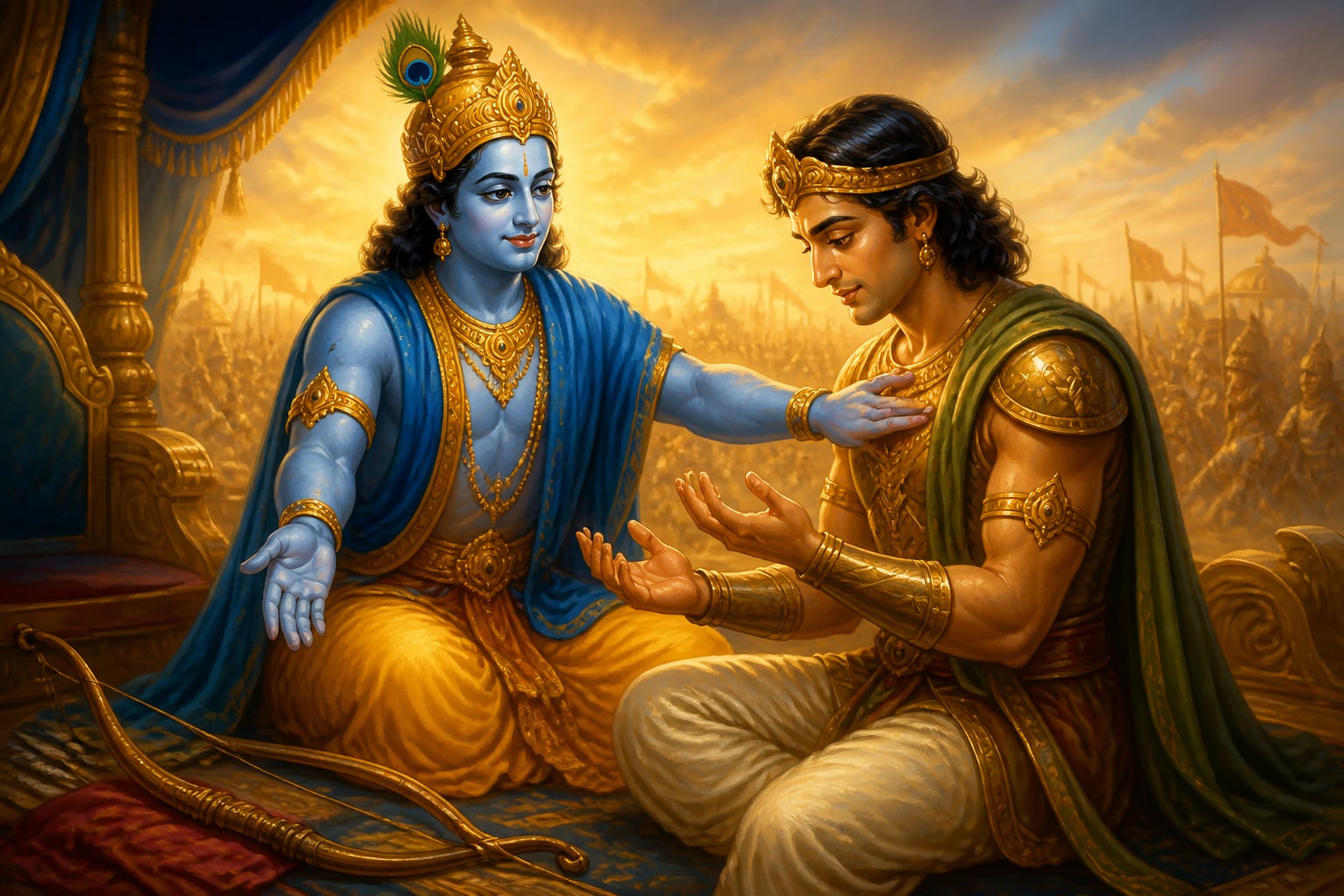
Krishna distinguishing the field from the knower with two gestures

"This body, Arjuna, is called the field. And the one who knows this field, the wise call that the knower of the field."

Think about what this means. Your body is not you. Your thoughts are not you. Your emotions are not you. They are the field, the content of your experience. You are the one who knows them, who experiences them, who watches them arise and pass away.

This isn't just philosophy. It's a practical tool for freedom.

What Is the Field?

Krishna is very specific about what constitutes the field. It includes:

The body, this physical form with its senses, its pleasures and pains, its aging and changing.

The mind, the stream of thoughts that flows constantly, commenting, judging, planning, remembering.

The emotions, happiness and sadness, fear and excitement, love and anger, all the feelings that color our experience.

The ego, the sense of "I" and "mine," the identification with a particular name, story, and set of characteristics.

The objects of experience, sounds, sights, smells, tastes, touches, all the data that flows through our senses.

All of this together is the field, kshetra in Sanskrit. It's everything you can possibly experience or observe.

And Who Is the Knower?

Now here's the crucial question: Who is it that knows all these things?

When you notice that your body is tired, who is noticing? When you observe that your mind is racing, who is observing? When you feel an emotion arise, who is the one feeling?

There's always a "you" that is aware of what's happening. This awareness doesn't come and go like thoughts do. It doesn't change like emotions do. It doesn't age like the body does. It simply is, the constant backdrop against which all experience appears.

This is what Krishna calls the kshetrajna, the knower of the field. And understanding the difference between the field and its knower is, according to the Gita, true knowledge.

The Sun That Illuminates Everything

Krishna offers a beautiful image to explain this:

"Just as the one sun illuminates this entire world, so does the knower of the field illuminate the entire field."

A luminous rising sun illuminating a wide landscape of forests, rivers, mountains and villages equally in golden light

Think about the sun. It lights up mountains and valleys, cities and forests, beautiful scenes and ugly ones. The sun doesn't become any of these things, it simply makes them visible. Without the sun, there would be no seeing at all.

Consciousness works the same way. It illuminates everything you experience, every thought, every feeling, every sensation, but it is not itself any of these things. Your awareness makes experience possible, but awareness itself is not an experience. It's more fundamental than that.

Why This Matters

So what? Why does this distinction between the field and the knower matter for everyday life?

Because most of our suffering comes from confusing the two.

When a thought arises, "I'm not good enough", we believe we ARE that thought. When an emotion arises, anxiety, anger, sadness, we believe we ARE that emotion. When the body feels pain, we believe we ARE the pain.

But what if that's a case of mistaken identity?

What if you are the one who notices the thought, not the thought itself? What if you are the one who feels the emotion, but you're not the emotion? What if the knower is different from the known?

This simple shift changes everything.

A Practical Example

A young person stepping back from anxiety to recognize the witness within

Imagine you're feeling intense anxiety about an upcoming test. Your heart is racing. Your mind is spinning with worst-case scenarios. Your stomach is tight.

In the usual way of experiencing this, you ARE anxious. The anxiety is you, and you are the anxiety. There's no separation, no space, no choice about how to relate to what you're feeling.

But now imagine stepping back and recognizing: "There is a body experiencing physical symptoms. There is a mind producing fearful thoughts. There is an emotion called anxiety present in my experience. And there is a 'me' who is aware of all this, a me that is not itself anxious, but is simply witnessing anxiety."

This isn't denial. The anxiety is still there. But your relationship to it has changed. You're no longer drowning in it; you're watching it. And what you can watch, you can work with. What you can observe, you can choose how to respond to.

The Freedom in Seeing Clearly

Krishna says that whoever truly understands the difference between the field and the knower of the field attains liberation.

This isn't a promise about some distant afterlife. It's a description of what happens right now, in this moment, when you see clearly.

When you know you are the knower and not the known, you stop being tyrannized by your thoughts. A negative thought arises, you notice it, and you don't have to believe it or act on it. You stop being overwhelmed by your emotions. A wave of anger comes, you feel it, and you can choose your response rather than being hijacked by the feeling.

This is freedom, not freedom from experience, but freedom in the midst of experience.

You Are Not Your Story

Here's another way to think about it. Each of us has a story, a narrative about who we are, where we came from, what has happened to us, what we're capable of. This story is part of the field. It's something you can observe, think about, tell others.

But are you the story? Or are you the one who knows the story?

Stories can be rewritten. Identities can shift. The narrative you believed at fifteen is probably different from the one you believe now. But the "you" who believed both stories, the awareness that experienced both versions of yourself, that hasn't changed.

Realizing this is incredibly freeing. It means your past doesn't define you. Your current thoughts don't trap you. Your emotions, however intense, are visitors in the house, not the homeowner.

The Journey Continues

The field and the knower teaching prepares us for everything that comes next in the Gita. When Krishna talks about action, he'll explain how to act from this knowing place. When he talks about devotion, he'll show how love transforms when we're no longer lost in the field. When he talks about the three gunas (qualities), we'll see that even those are part of the field, observed by the unchanging knower.

But for now, the invitation is simple: Start noticing the difference. Start recognizing that you are not your thoughts, your emotions, or your body. You are the one who knows them.

And that one, according to Krishna, is something vast, eternal, and ultimately free.


The Gita's most liberating teaching may be the simplest: You are not what you experience. You are the one who experiences. Learning to live from that truth is the beginning of wisdom.

Case studies

J. Krishnamurti: The Observer Is the Observed

In 1929, Jiddu Krishnamurti stunned the world by dissolving the organization that had been built around him, the Order of the Star, and rejecting his role as the expected 'World Teacher.' For the next 60 years until his death in 1986, he traveled the world asking people one deceptively simple question: 'Can you observe your thoughts without the observer?' His dialogues in places like Ojai, Brockwood Park, and Varanasi challenged thousands to investigate the nature of consciousness directly, without relying on any authority, including his own. His central teaching was radical: there is no fixed 'observer' separate from observation. What we call the 'self' is itself a thought, part of the field, not something apart from it.

Krishnamurti's inquiry mirrors and extends the Gita's teaching. Where Krishna distinguishes field from knower, Krishnamurti pushed further: even the sense of being a 'knower' is itself part of the field when it becomes a fixed identity. The true witness has no characteristics to observe. This doesn't contradict Krishna, it deepens the inquiry. The Gita asks us to distinguish the knower from the known; Krishnamurti asks us to investigate whether the 'knower' we usually identify with is itself something known. Both point toward pure awareness that cannot be made into an object.

Krishnamurti's teachings influenced scientists, educators, philosophers, and spiritual seekers worldwide. The Krishnamurti schools he founded continue to educate children in the art of self-inquiry. His dialogues with physicist David Bohm explored the intersection of consciousness and physics. Most importantly, he demonstrated that the field/knower distinction isn't just doctrine to believe but an investigation anyone can conduct.

The Gita's teaching on field and knower isn't meant to create a new identity ('I am the witness') but to dissolve false identification. True freedom comes not from clinging to the role of 'knower' but from seeing clearly, moment to moment, without a fixed sense of self.

The modern self-help industry often replaces one identity trap with another, swapping 'I am my job title' for 'I am an awakened being.' Krishnamurti's radical dissolution reminds us that true self-knowledge is not about finding a better label but about seeing through the need for labels altogether. This applies to anyone who has traded one rigid identity for a spiritually branded one.

J. Krishnamurti dissolved the Order of the Star in the East on August 3, 1929, before 3,000 members at Ommen, Netherlands, renouncing the role of World Teacher. He went on to give public talks for 57 years across 60 countries. The Krishnamurti Foundation operates six schools in India and one in England, educating over 2,000 students annually.

The Many Faces of Maya

Maya is fifteen and has four different Instagram accounts. One shows her as a fashion influencer, carefully curated outfits, filters, confident poses. Another is her 'finsta' (fake Instagram) where she posts memes and complaints with close friends. A third is for art she's embarrassed to show anyone who knows her. The fourth is abandoned, an old version of herself she no longer wants to be. At school, she's quiet and studious. At dance class, she's outgoing. At home, she's often irritable with her parents. One night, scrolling through her own posts, she has a strange feeling: 'Which one is actually me?' She realizes she could create or delete any of these personas. They're all her, and none of them are her. So who is she really?

Maya has stumbled onto the kṣetra-kṣetrajña distinction through lived experience. Each Instagram account, each social role, is part of her 'field', these are personas she can observe, create, modify, or discard. But who is the one observing all these versions of herself? Who is the 'Maya' who scrolls through 'Maya's' posts and feels disconnected from them? That observer, the awareness that can witness all the personas without being any of them, is what the Gita calls the kṣetrajña. Her confusion is actually the beginning of clarity: she's discovering that she is not identical to any of her self-presentations.

Maya doesn't need to choose one 'authentic' persona and discard the rest. Instead, she begins to rest in the awareness that watches all the personas. She can be playful on one account, serious on another, artistic on a third, while knowing that none of these is her complete identity. She becomes more relaxed about how she presents herself, less anxious about 'being authentic,' because she knows that her true self isn't any particular presentation. It's the presence that is aware of them all.

In the age of curated identities and multiple online selves, the Gita's teaching is more relevant than ever. We are not our profiles, not our personas, not even our 'authentic' presentation. We are the awareness that witnesses all self-presentations, and that awareness cannot be captured in any post.

The average person now manages multiple digital identities across platforms, each curated for a different audience. The psychological cost is real: research links identity fragmentation to anxiety, depression, and chronic comparison. The Gita's invitation to find the awareness behind all personas is not philosophy for monks. It is a survival skill for the social media generation.

A 2021 Pew Research study found that 97% of American teens aged 13 to 17 use at least one social media platform. Research published in the Journal of Experimental Social Psychology (2019) showed that people maintain an average of 5.2 distinct self-presentations across different social platforms. A University of Montreal study found that teens who reduced social media to 30 minutes daily reported 25% lower depression symptoms after three weeks.

Living traditions

The Gita's field/knower teaching has directly influenced modern psychology and therapy. ACT (Acceptance and Commitment Therapy) teaches 'cognitive defusion', separating from thoughts, which is essentially recognizing thoughts as part of the field. IFS (Internal Family Systems) distinguishes 'parts' from the 'Self' that witnesses them. Corporate mindfulness programs at Google, Intel, and Goldman Sachs teach employees to observe thoughts and emotions without identification, the Gita's ancient wisdom in modern dress.

Reflection

More in The Eternal Self

All lessons in The Eternal Self · The Bhagavad Gita course