UPI: Digital Hundi for the 21st Century

India's Gift to Global Finance

On November 8, 2016, India's currency became worthless overnight. Yet within months, street vendors who had never touched a smartphone were accepting digital payments. This wasn't Western fintech imported to India, it was the revival of an ancient Indian innovation: the hundi. This lesson explores how UPI embodies the trust-based, interoperable, low-cost principles that made India's indigenous financial instruments work for a thousand years.

The Night Everything Changed
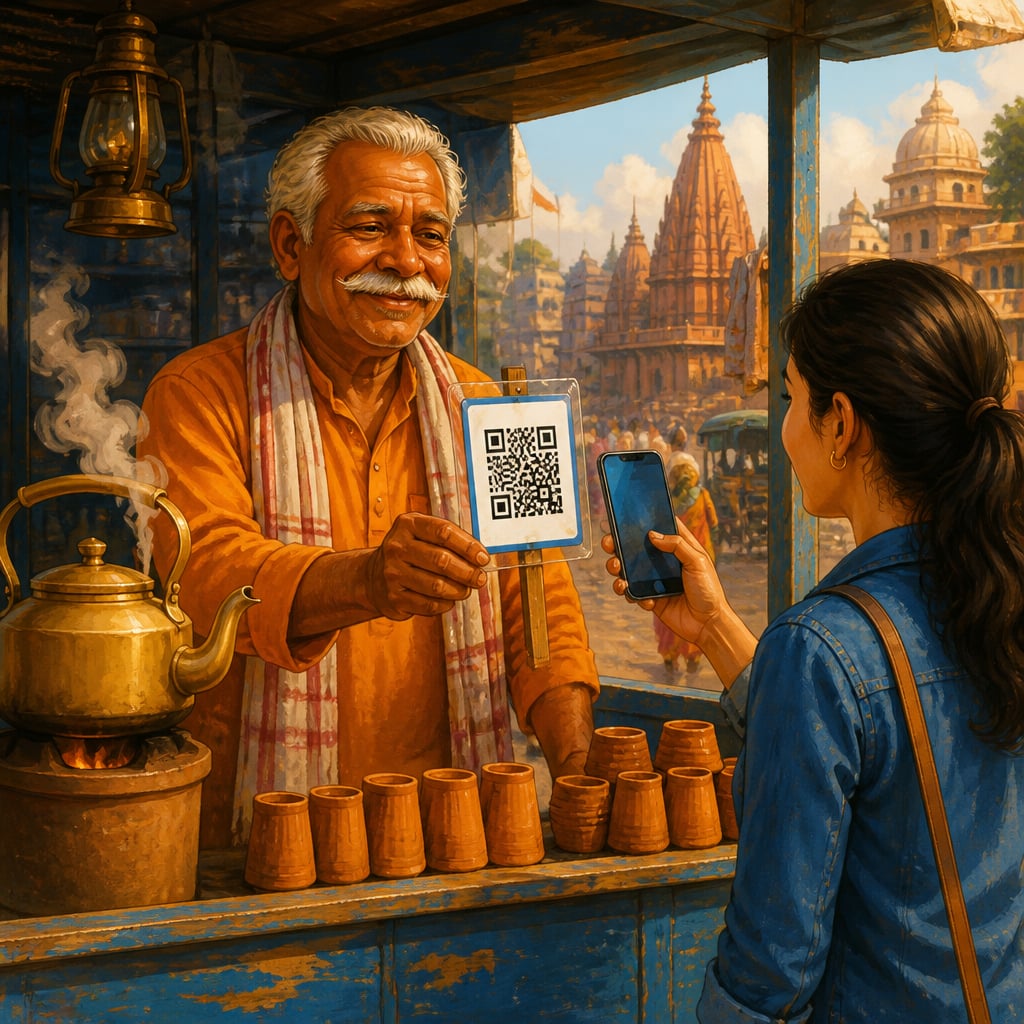
Ramu the Varanasi chaiwala accepting a UPI payment

Ramu Yadav had been selling chai at the same corner in Varanasi's Godowlia crossing for thirty-two years. On the evening of November 8, 2016, he heard Prime Minister Modi's voice crackling from a customer's phone: all ₹500 and ₹1000 notes were worthless from midnight. Ramu counted the notes in his tin box, ₹4,700 that was about to become paper.

The next morning, chaos. Customers had no cash; Ramu had no way to accept anything else. His business, built on decades of trust with neighborhood regulars, ground to a halt. Then, three weeks later, his son showed him something on a smartphone: a square pattern that customers could scan. "Baba, they send money directly to your bank account. No cash needed."

Ramu was skeptical. How could money travel through the air? But he remembered his grandfather's stories about hundis, those pieces of paper that merchants used to move money across the country without carrying gold. "Your great-grandfather trusted a paper signed in Jodhpur to receive silver in Varanasi," his father had told him. "It worked because everyone in the network trusted each other."

That QR code, Ramu realized, was the same thing, a symbol of trust that moved money instantly across any distance. By 2024, Ramu's chai stall processes ₹50,000 monthly through UPI. He still can't explain exactly how it works, but he knows why it works: vishwasa, trust.

The Hundi Legacy: A Thousand Years of Trustless Trust
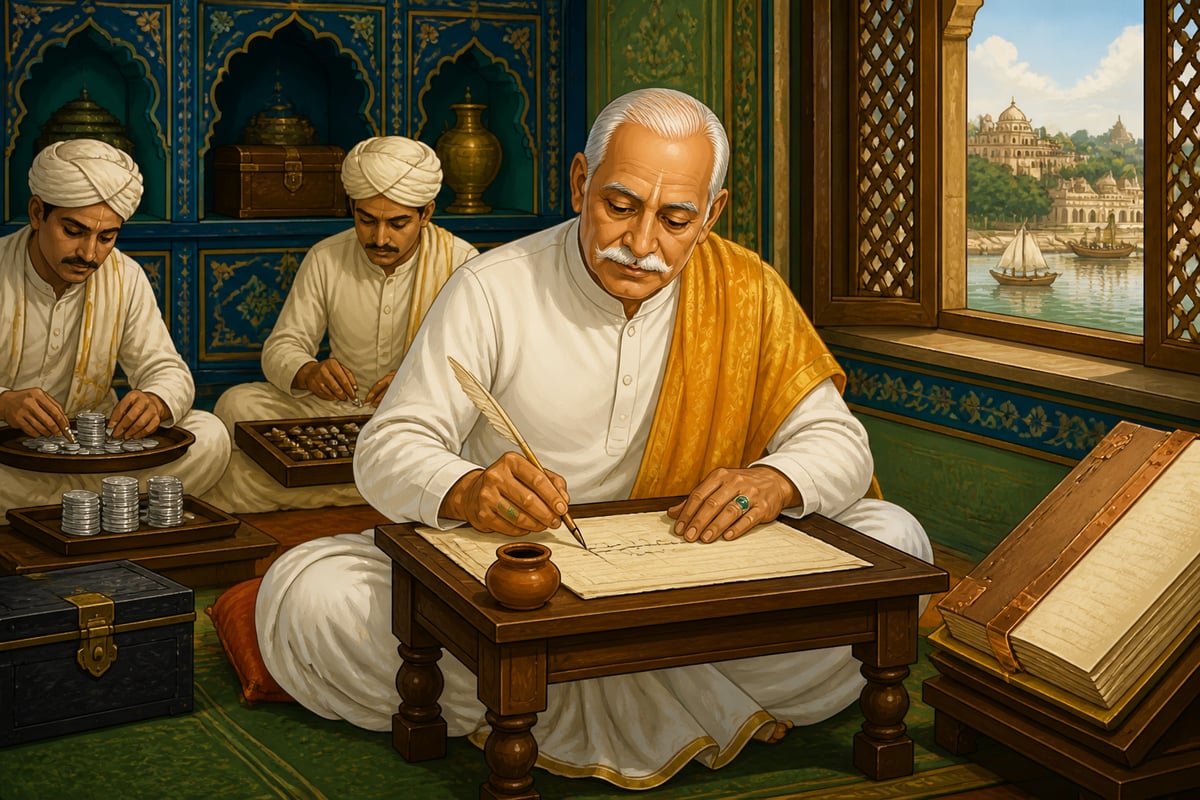
A Jagat Seth banker writing a hundi in Murshidabad

Long before electronic payment systems, India had solved the problem of moving money across vast distances without physically transporting it. The hundi (from Sanskrit hund, meaning "to collect") was a bill of exchange that allowed merchants to deposit money with a shroff (banker) in one city and collect it from another shroff hundreds of kilometers away.

The system worked through interconnected networks of trust. A merchant guild in Surat could issue a hundi that would be honored in Dhaka because both cities' shroffs belonged to the same network, the Nagarsheth system. This network had no central authority, no government backing, no legal enforcement mechanism. It worked purely on reputation and mutual obligation.

हुण्डिका विश्वासमूला, न तु राजाज्ञया बद्धा

Huṇḍikā vishvāsamūlā, na tu rājājñayā baddhā

"The hundi is rooted in trust, not bound by royal command."

This medieval banking maxim captures what made hundis revolutionary: they were interoperable (accepted across merchant networks), low-cost (no physical gold transport), and trust-based (reputation was the only collateral). Sound familiar?

The Hundi's Architecture: Principles That Endured

The Arthashastra describes the role of shrenis (guilds) in facilitating long-distance trade through financial instruments:

दूरदेशे धनं प्रेषयितुं लिखितमेव प्रमाणम्

Dūradeśe dhanaṃ preṣayituṃ likhitameva pramāṇam

"For sending wealth to distant lands, the written instrument is the proof."

Kautilya recognized that written commitments, backed by network trust, could substitute for physical money. This insight, articulated 2,300 years ago, is precisely what UPI implements digitally.

The hundi system had three critical design principles:

  1. Interoperability (Anyonya-Svīkṛti): A hundi issued by any trusted shroff would be accepted by any other shroff in the network
  2. Instant Settlement (Tatkāla-Samādhāna): Once verified, the receiving shroff would pay immediately, settling accounts later through the network
  3. Near-Zero Cost (Alpamūlya): Fees were minimal because no physical transport was needed; the system ran on trust infrastructure

UPI's architects didn't consciously copy hundis, but they reinvented the same principles for the digital age.

Global Perspectives: Why the West Built Differently

While India developed trust-based instruments, Western finance evolved differently, and the contrast illuminates why UPI succeeded where Western systems faltered.

Jack Dorsey, founder of Square (now Block) and co-founder of Twitter, visited India in 2019 and publicly declared: "India's UPI is the most impressive payment system in the world." This wasn't flattery. Dorsey had spent a decade trying to solve payment problems in America, where the system remained fragmented, expensive, and slow.

Why couldn't America build UPI? The answer lies in history. American payments evolved from card networks (Visa, Mastercard) created by banks to profit from interchange fees. Every swipe generates 2-3% for intermediaries. This model resists interoperability because fragmentation is profitable.

Alexander Hamilton (1755-1804), America's first Treasury Secretary, designed the US financial system around chartered banks with exclusive privileges, the opposite of India's distributed trust networks. This legacy persists: in 2024, sending money between American banks still takes 2-3 days and often costs fees.

Satya Nadella, speaking at Davos 2023, called India's digital public infrastructure "the most sophisticated in the world." Microsoft's CEO, born in Hyderabad, understood what Western observers often miss: UPI wasn't just technology; it was a cultural achievement built on centuries of trust-based commerce.

System Philosophy Cost Speed Interoperability
Indian Hundi (medieval) Trust network Near-zero Days (physical) High (guild networks)
UPI (2016-) Trust network Zero Instant Universal
US Card Networks Profit extraction 2-3% 2-3 days settlement Limited (competing networks)
SWIFT (international) Bank mediation $25-50 3-5 days High (but expensive)

The comparison reveals something profound: India's indigenous financial architecture was more advanced in principle than Western systems, it just lacked the technology to scale. UPI provided that technology.

NPCI's control room monitoring live UPI traffic

Modern Resonance: The UPI Revolution in Numbers

In April 2016, UPI processed 92,000 transactions worth ₹7.8 crore. In December 2024, it processed 16.7 billion transactions worth ₹23.4 lakh crore (approximately $280 billion), in a single month. This is the fastest adoption of any payment system in human history.

But the numbers tell only part of the story. What matters is who is using UPI:

Dilip Asbe, CEO of NPCI (National Payments Corporation of India), describes UPI as "financial inclusion on steroids." In 2023, he revealed that 70% of UPI transactions are under ₹500, meaning the system serves small merchants and daily transactions, not just big business.

The hundi served merchants; UPI serves everyone. But the underlying principle remains: trust networks, not profit-extracting intermediaries, create the most efficient financial systems.

Your Turn: The Hundi Principle in Your Life

The next time you scan a QR code to pay a street vendor, you're participating in a financial tradition older than most nations. The hundi principle, that trust networks can move value more efficiently than physical transfer, runs through your smartphone.

But here's a deeper question: What trust networks do you belong to? The shroffs who honored hundis across India weren't just businessmen; they were members of communities bound by reputation, mutual obligation, and shared values. Their "collateral" wasn't property, it was their word.

In an age of anonymous digital transactions, we risk losing something the hundi system preserved: the understanding that finance is ultimately about human relationships. When you pay that chaiwala through UPI, you're not just moving electrons, you're participating in a system that, like the hundi networks of old, works because millions of people trust each other.

In our next lesson, we'll explore the JAM Trinity, the three pillars (Jan Dhan, Aadhaar, Mobile) that made UPI possible. You'll discover how India built the world's largest financial inclusion infrastructure in less than a decade, reaching 500 million people who had never touched a bank.

Oliver Williamson's transaction cost economics and Douglass North's institutional economics both emphasize that trust reduces transaction costs. But these theories emerged in the 20th century; Indian merchants had operationalized them for a millennium. Western payment systems, built on legal enforcement rather than network trust, remain expensive and slow.

India's indigenous financial systems were 'network-native', they assumed interconnection rather than isolation. This made them inherently scalable once digital technology arrived. UPI's architects didn't have to convince Indians that trust-based networks work; they just had to digitize an existing cultural understanding.

UPI's transaction cost to merchants is effectively zero, while American card networks charge 2-3% per transaction. Over $280 billion monthly UPI volume, this represents $5-8 billion in fees that Indian merchants and consumers don't pay.

Western payment systems (Visa, Mastercard, PayPal, Venmo) deliberately resist interoperability because fragmentation is profitable. Each creates a 'walled garden' where fees can be extracted. India's regulators mandated interoperability for UPI, a policy choice that Western regulators have been unwilling to make against powerful card network lobbies.

India's merchant guild heritage created a cultural expectation that payment systems should work across boundaries. When NPCI designed UPI as an open protocol that any app could use, this matched existing cultural intuitions about how financial systems should work. The 'right' design felt natural.

India has 300+ banks and 40+ UPI apps, yet any user of any app can pay any merchant using any other app instantly. In America, you cannot send money from Venmo to Cash App directly, they are deliberately incompatible.

Key terms

Hundi
A traditional Indian financial instrument, a bill of exchange that allowed money to be deposited in one location and collected in another through trusted merchant networks.
Shroff
A traditional Indian banker or money-changer who facilitated hundis, currency exchange, and credit. Shroffs operated in networks across India, honoring each other's instruments.
Anyonya-Svīkṛti
Mutual acceptance or interoperability, the principle that instruments issued by one trusted party will be honored by all other parties in the network.
Nagarsheth
The chief merchant or banker of a city, who headed the local guild and whose endorsement guaranteed the creditworthiness of other merchants.

Key figures

The Jagat Seth Bankers of Bengal

Perfected the pan-Indian hundi network, demonstrating that trust-based financial systems could operate at continental scale. Their correspondent banking relationships with shroffs across India created the infrastructure that allowed merchants to trade anywhere with just a paper instrument. They proved that private financial networks could be more reliable than state systems.

Dilip Asbe

Architected UPI's open, interoperable design that allows any bank or fintech to participate while maintaining security and reliability. Made the critical decision to keep UPI free for users and merchants, rejecting the Western model of extracting fees from every transaction. Built NPCI into an institution that processes more real-time transactions than any other payment system globally.

Jack Dorsey

Square revolutionized American small-business payments by enabling anyone to accept card payments via smartphone. However, Dorsey recognized that his system, still dependent on card networks charging 2-3% per transaction, was fundamentally inferior to India's approach. His public endorsement of UPI helped shift global fintech conversation toward open, interoperable systems.

Case studies

PhonePe: From Flipkart Spin-off to UPI Giant

In December 2015, Sameer Nigam and two co-founders left Flipkart to start PhonePe, betting everything on a payment system that didn't yet exist: UPI. At the time, mobile payments in India meant 'wallets', closed systems where users loaded money and could only spend it within that ecosystem. Paytm dominated with over 100 million users. PhonePe's bet was contrarian: they believed that once UPI launched, open interoperable payments would destroy closed wallets. But UPI was unproven, banks were skeptical, and Paytm's wallet model was generating billions in transactions. Nigam convinced Walmart (which had acquired Flipkart) to back PhonePe's UPI-first strategy. The team faced brutal challenges. In early 2017, UPI barely worked, bank servers crashed constantly, success rates were below 50%, and customer complaints piled up. PhonePe's engineers worked directly with bank tech teams to fix issues, building reliability transaction by transaction. They offered cashbacks to drive adoption, losing money on every user acquired. By 2018, the bet was paying off. UPI transaction volumes exploded post-demonetization. PhonePe's decision to go all-in on UPI (rather than maintaining a wallet fallback) meant they were perfectly positioned. Paytm, weighted down by wallet infrastructure, struggled to pivot.

PhonePe's success illustrates the Arthashastra's teaching on *yukti* (strategic timing) and *shakti* (capability building). Kautilya advises: 'He who understands the changing times and adapts his strategy accordingly, he alone succeeds.' Nigam's team understood that UPI would change the game, and they built capabilities for the new game rather than optimizing for the old one. This is dharmic entrepreneurship: aligning business strategy with the direction of systemic change, rather than fighting it. The contrarian element is also significant. When everyone else was building wallets, PhonePe built for UPI. This reflects the Gita's teaching on *svadharma*: following your own path based on your own analysis, even when the crowd goes elsewhere.

By 2024, PhonePe processes over 5 billion UPI transactions monthly, more than any other app. The company achieved an $12 billion valuation and captured 47% of UPI market share. Paytm, despite its head start and massive funding, never recovered its wallet-era dominance. More significantly, PhonePe proved that betting on open infrastructure beats betting on proprietary systems. Their success attracted Google (GPay) and others to UPI, creating a competitive ecosystem that drove adoption across India. The chaiwala in Varanasi accepting UPI payments today does so in part because PhonePe's early bet forced the entire ecosystem to improve.

In technology and finance, betting on open, interoperable systems, even when they seem weaker than proprietary alternatives, often wins long-term. The hundi principle scales: trust networks grow; walled gardens eventually fall.

PhonePe's bet on open infrastructure over proprietary systems predicted the broader tech industry's shift toward interoperability. The EU's Digital Markets Act (2024) now mandates the kind of openness UPI was built with from day one, validating the hundi principle that open networks outlast walled gardens.

PhonePe's merchant network grew from zero to 35 million in seven years, largely through zero-cost UPI acceptance. This rivals what Visa and Mastercard built in India over three decades.

The Demonetization Stress Test: How UPI Proved Its Worth

On November 8, 2016, Prime Minister Modi announced that 86% of India's currency, all ₹500 and ₹1000 notes, would be worthless from midnight. The stated goal was fighting black money; the effect was immediate economic chaos. UPI had launched just five months earlier, in April 2016. It processed barely 100,000 transactions that month. The infrastructure was untested, bank servers were shaky, and most Indians had never heard of it. Within weeks of demonetization, UPI transaction volumes multiplied 10x. But this growth nearly killed the system. Bank servers crashed repeatedly. Transaction failure rates spiked above 40%. Customer complaints flooded NPCI. Dilip Asbe and his team at NPCI worked around the clock. They coordinated with 30+ bank tech teams simultaneously, identifying bottlenecks and forcing upgrades. They implemented new server architectures that could scale dynamically. They created backup routing so transactions could succeed even if one bank's system failed. By January 2017, success rates had climbed to 95%+. By December 2017, UPI processed 145 million transactions monthly. The crisis had forced the system to become robust.

The Bhagavad Gita teaches that true strength is revealed in crisis: 'It is in difficulty that the brave show their nature.' Demonetization was UPI's agni-pariksha (trial by fire). NPCI's response demonstrated dharmic crisis management: instead of making excuses or blaming banks, they took ownership of the entire ecosystem's success. Asbe's team worked with competitors (banks and apps that were nominally rivals) because they understood that the system's credibility mattered more than any single player's advantage. This is the shroff tradition reborn: the Jagat Seths didn't succeed by defeating other shroffs but by making the network trustworthy for everyone.

Demonetization, despite its immediate economic disruption, catalyzed India's digital payments revolution. UPI grew from 100,000 transactions monthly (April 2016) to 919 million monthly (December 2018), a 9,000x increase in two years. More importantly, the crisis forced UPI to become reliable. The infrastructure investments made during the demonetization stress test enabled UPI to later handle billions of monthly transactions without degradation. The system that emerged from crisis was stronger than what existed before.

Crises reveal and accelerate underlying capabilities. UPI's potential existed before demonetization, but the crisis forced rapid adoption and infrastructure hardening that might have taken years otherwise. Sometimes the fire that threatens to destroy is the same fire that forges strength.

Every major tech platform, from AWS to Shopify, can point to a crisis that forced premature scaling and ultimately strengthened the system. The principle that stress tests build resilience faster than gradual optimization is now standard thinking in distributed systems engineering.

UPI transaction success rates improved from ~60% pre-demonetization to 99.5%+ by 2020, directly due to infrastructure investments forced by the demonetization crisis.

Historical context

13th Century CE to Present

India's indigenous banking system, centered on hundis and shroff networks, was one of the world's most sophisticated until colonial disruption. The British replaced it with Western-style banking that served colonial extraction rather than Indian commerce. For 200 years, India used systems designed elsewhere. UPI represents the first major Indian-designed payment system since the fall of indigenous banking, a return to principles that Indian merchants understood centuries ago.

While India developed trust-based interoperable hundis, Europe developed letter of credit systems that required legal enforcement and bank mediation. The Western approach was costlier and slower but survived colonialism because it was backed by European state power. UPI's success suggests that once technology enables scaling, India's indigenous principles outperform Western alternatives.

Before colonialism, Indian shroffs handled trade finance worth an estimated 10-15% of global GDP. The hundi system's geographic reach, from Central Asia to Southeast Asia to East Africa, exceeded even the reach of modern banking networks.

Understanding UPI as a digital hundi, not just as 'Indian Venmo', reveals why it succeeded where Western exports failed. India didn't copy foreign payment systems; it reinvented indigenous principles for the digital age. This heritage explains UPI's unique characteristics: interoperability, zero cost, and trust-based architecture.

Living traditions

UPI is not just technology; it's the resurrection of indigenous financial principles. When Dilip Asbe's team at NPCI designed UPI as an open, interoperable, zero-cost system, they were, consciously or not, rebuilding what colonialism destroyed. The chaiwala accepting a ₹10 payment via smartphone is participating in a financial tradition that his ancestors would recognize: trust-based, network-mediated, accessible to all.

Reflection

More in UPI Revolution: Dharmic Finance Reborn

All lessons in UPI Revolution: Dharmic Finance Reborn · Banking & Finance Heritage of Bharat course