NPCI: The Architecture of Digital Finance

Building Payment Rails for 1.4 Billion

In 2008, ten rival banks sat in a room and agreed to do something unprecedented: build shared payment infrastructure that would benefit all Indians, including their competitors' customers. The result was NPCI, a non-profit that now processes more real-time transactions than any organization on Earth. This lesson explores how India created the technical architecture for UPI, why the 'shared infrastructure' model succeeded where proprietary systems failed, and what ancient guild federations can teach us about building for collective benefit.

The Room Where It Happened
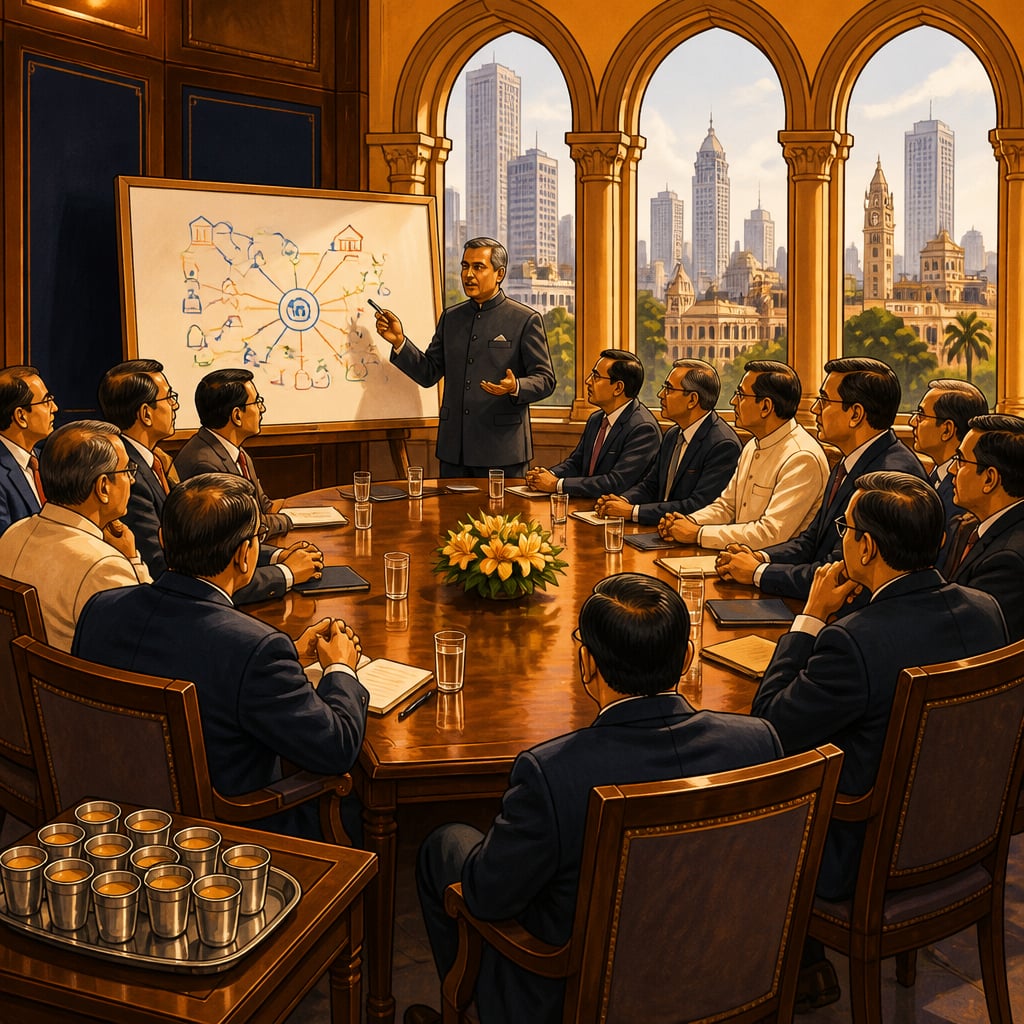
Bankers' summit at RBI Mumbai December 2008

In December 2008, representatives from ten of India's largest banks gathered in a conference room at the Reserve Bank of India's Mumbai headquarters. They were competitors, State Bank of India, ICICI, HDFC, and seven others, who spent their days fighting for the same customers. Now RBI Governor Y.V. Reddy was asking them to do something counterintuitive: build shared infrastructure together.

The problem was clear. India's payment systems were fragmented, expensive, and dependent on foreign networks. Every time an Indian swiped a debit card, Visa or Mastercard extracted a fee that left the country. Interbank transfers took days. The poor couldn't access digital payments at all. Each bank had built its own systems, incompatible with others, a tower of Babel where money couldn't flow freely.

"What we need," said one RBI official, "is not ten payment systems. We need one payment system that serves everyone."

The banks were skeptical. Why should HDFC invest in infrastructure that would help SBI's customers? Why should private banks subsidize public sector inefficiency? The incentives seemed wrong.

But then someone invoked an older model, one that Indian merchants had used for centuries. "Think of the shreni federations," suggested a veteran banker. "Competing guilds built shared roads, rest houses, and warehouses. They understood that infrastructure benefits everyone more than it costs anyone."

On December 2008, the National Payments Corporation of India (NPCI) was incorporated, a non-profit company owned jointly by banks, governed collectively, and mandated to build payment infrastructure for all Indians. Sixteen years later, NPCI processes 16+ billion transactions monthly, more than Visa and Mastercard combined in India.

The Shreni Federation: Ancient Wisdom on Shared Infrastructure

The idea that competitors should build shared infrastructure isn't modern, it's deeply rooted in Indian commercial history.

Medieval India's shrenis (merchant and artisan guilds) competed fiercely in the marketplace. Weavers undercut each other's prices; traders fought for customers; smiths guarded their techniques. But they also understood that certain investments benefited everyone: roads that connected markets, sarais (rest houses) where traveling merchants could sleep safely, warehouses where goods could be stored securely.

Medieval shreni federation pooling road funds

These were built through shreni-sanghata, guild federations that pooled resources for common infrastructure.

श्रेणी-सङ्घाता मार्ग-निर्माणे, सर्वेषां लाभाय व्ययं कुर्युः

Śreṇī-saṅghātā mārga-nirmāṇe, sarveṣāṃ lābhāya vyayaṃ kuryuḥ

"Guild federations shall spend on road-building for the benefit of all."

This principle, that competitors can cooperate on infrastructure while competing on services, is exactly what NPCI embodies. Banks compete for customers, but they share the payment rails.

The Arthashastra explicitly recognizes this model:

सामान्य-मार्गाः सर्वेषां, न कस्यचित् स्वकीयाः

Sāmānya-mārgāḥ sarveṣāṃ, na kasyacit svakīyāḥ

"Common roads belong to all, not to any one party."

Kautilya understood that transportation infrastructure, whether physical roads or financial rails, should be shared. Privatizing roads would fragment commerce; shared roads multiply trade. NPCI's founders, consciously or not, implemented this ancient insight.

The Architecture of NPCI: Design Choices That Mattered

NPCI's success wasn't inevitable. Many countries have tried to build unified payment systems and failed. What made India's approach work?

1. Non-Profit Structure

NPCI is a Section 8 company (non-profit) owned by banks but not run for their profit. This removed the incentive to extract fees from every transaction. Unlike Visa or Mastercard, which exist to maximize shareholder returns, NPCI exists to maximize transaction volume and inclusion.

2. Neutral Governance

No single bank controls NPCI. The board includes representatives from public sector banks, private banks, and RBI. This prevents any player from skewing the system to their advantage. The shreni federations worked the same way, no single guild dominated; decisions required consensus.

3. Open Standards

NPCI built UPI as an open protocol, not a proprietary system. Any bank or fintech can build on UPI without paying licensing fees. This is why PhonePe, GPay, Paytm, and dozens of others can all interoperate, they're all speaking the same language.

4. Domestic Processing

Before NPCI, even domestic Indian transactions were often routed through servers in the US (for Visa) or UK (for Mastercard). NPCI built entirely domestic infrastructure, transactions between two Indians in India are processed in India. This reduces latency, cost, and dependency.

स्वदेशे स्वयं प्रक्रिया, परदेशे न निर्भरता

Svadeśe svayaṃ prakriyā, paradeśe na nirbharatā

"Process domestically; depend not on foreign lands."

This principle of swadeshi infrastructure, self-reliance in critical systems, echoes through Indian economic thought from Kautilya to Gandhi to Atmanirbhar Bharat.

Global Perspectives: Why Other Countries Struggle

If shared payment infrastructure is so obviously beneficial, why haven't other countries built it?

Dee Hock, founder of Visa in 1968, actually envisioned something similar, a cooperative owned by member banks. But Visa eventually converted to a for-profit corporation (IPO in 2008), prioritizing shareholder returns over universal access. The original cooperative vision was abandoned.

The US Federal Reserve launched FedNow in 2023, America's first real-time payment system, nearly a decade after India's UPI. Why so late? American banks, comfortable with profitable card networks, had no incentive to build cheaper alternatives. Without an RBI-like mandate, collective action failed.

The European Union has tried for years to create a unified payment system to rival American card networks. The European Payments Initiative (EPI), launched in 2020, has struggled with competing national interests and bank reluctance. What India achieved in 8 years, Europe hasn't managed in 20.

Region Real-Time Payment System Launch Status
India UPI (NPCI) 2016 16B+ monthly transactions
USA FedNow 2023 Early adoption, limited scale
EU EPI (attempted) 2020 Struggling, fragmented
UK Faster Payments 2008 Works, but not interoperable with EU
China Alipay/WeChat Pay 2013 Huge, but proprietary duopoly

The key difference: India's RBI had the authority and will to mandate cooperation. NPCI wasn't a market outcome, it was a regulatory creation that then enabled market innovation. This is the Kautilyan model: state creates infrastructure; private enterprise builds on it.

Modern Resonance: NPCI's Growing Empire

A 2012 RuPay card launch at NPCI

NPCI didn't stop at UPI. The organization now operates a suite of payment systems that together form India's financial nervous system:

A.P. Hota, NPCI's founding MD (2009-2017), set the organizational culture: "We are not a business. We are infrastructure. Our success is measured not in profit but in reach." Under his leadership, NPCI grew from a small team processing cheque clearing to the organization that would build UPI.

Dilip Asbe, who succeeded Hota and led UPI's explosive growth, maintained the philosophy: "Every Indian should be able to pay and be paid digitally, regardless of which bank they use or which app they prefer. That's interoperability. That's what we built."

In 2023, NPCI processed transactions worth ₃₀₀+ lakh crore (approximately $3.6 trillion), more than India's GDP. The pipes they built now carry the economy's lifeblood.

Your Turn: The Infrastructure Mindset

NPCI's story offers a powerful lesson: the most valuable things are often shared things.

When banks built proprietary systems, they created fragmentation. When they built shared infrastructure, they created an ecosystem where everyone, including themselves, prospered more than before. SBI didn't lose by helping HDFC customers use UPI; both gained from a larger digital payments market.

This is counterintuitive in a competitive worldview. We're taught that success means beating others, capturing market share, building moats. But the shreni federations knew better: some investments create positive-sum outcomes where everyone's pie grows.

Consider your own life: What "shared infrastructure" do you benefit from? Roads, internet, language itself, these are commons that enable individual success. And what could you help build? Study groups that help all members, professional networks that share opportunities, community resources that lift everyone.

The competitive instinct says: "If I build it, others will benefit, so why should I?" The infrastructure mindset says: "If we build it together, we all benefit more than the cost to each."

NPCI proved this at national scale. The shrenis proved it centuries ago. The principle is timeless.

In our next lesson, we'll explore Vishwasa-Antarkriyashilata, the design philosophy of trust and interoperability that made UPI's open architecture possible. Why did NPCI choose to let competitors build on their rails? And what can ancient guild trust networks teach us about designing for openness?

Economist Mancur Olson's 'Logic of Collective Action' (1965) argued that rational individuals won't contribute to public goods because they can free-ride on others' contributions. But Elinor Ostrom (Nobel Prize 2009) showed that communities often solve this through governance mechanisms, exactly what shreni federations and NPCI demonstrate. Indian practice preceded Western theory by centuries.

India's guild tradition provided a cultural template for bank cooperation that didn't exist in the individualist West. When RBI proposed NPCI, banks had a mental model, the shreni-sanghata, for how competitors could cooperate on infrastructure. This cultural inheritance made NPCI's founding easier than equivalent efforts in America or Europe.

NPCI's total investment to build UPI was approximately ₹100-200 crore. The system now processes ₹300+ lakh crore annually, a return on infrastructure investment exceeding 1,000,000%. This is the power of shared infrastructure: small collective investment, massive collective benefit.

After Russia invaded Ukraine in 2022, Western countries cut Russia off from SWIFT (international payment messaging). This demonstrated that payment infrastructure can be weaponized. Countries that depend entirely on foreign systems are vulnerable to such actions. India's domestic NPCI infrastructure provides insulation from such risks.

India learned from history. Colonial rule meant economic dependence, Indian wealth extracted through British-controlled systems. Post-independence policy emphasized self-reliance in critical sectors. RuPay and NPCI extend this to payments: Indian transactions processed on Indian infrastructure, fees staying in the Indian economy.

Before RuPay, Visa and Mastercard collected an estimated ₹3,000-5,000 crore annually in fees from Indian transactions. With RuPay capturing 60%+ of debit card market share, most of these fees now stay in India. That's thousands of crores annually retained in the domestic economy.

Key terms

NPCI
National Payments Corporation of India, a non-profit company established by RBI and Indian Banks' Association to operate retail payment systems in India, including UPI, RuPay, IMPS, and others.
Shreni-Sanghata
A federation or consortium of guilds (shrenis) that pooled resources for shared infrastructure like roads, rest houses, and warehouses, investments that benefited all member guilds.
Antar-Sanchalaniyata
Interoperability, the ability of different systems, organizations, or applications to work together, exchanging information and services seamlessly.
RuPay
India's domestic card payment network, operated by NPCI as an alternative to Visa and Mastercard. The name combines 'Rupee' (Indian currency) and 'Payment.'

Key figures

The Manigramam and Nanadesi Guild Federations

Pioneered the 'coopetition' model, cooperation on infrastructure while competing on services. Their inscriptions at temples across South India record sophisticated cost-sharing arrangements and governance structures that ensured no single guild dominated the federation. They proved that competitors could build shared infrastructure without losing their competitive edge.

A.P. Hota

Established NPCI's culture as infrastructure-provider rather than profit-seeker. Insisted on interoperability as a non-negotiable design principle, any system NPCI built had to work for all banks, not advantage any subset. Navigated the political complexities of getting rival banks to cooperate, using his RBI credibility to build trust across factions.

Dee Hock

Proved that competitor cooperation on payment infrastructure could work at massive scale. Visa's original cooperative model, member banks owning the network collectively, directly influenced payment system design worldwide. However, Visa's 2008 IPO and conversion to a for-profit corporation represented a departure from Hock's original vision.

Case studies

RuPay vs Visa/Mastercard: Breaking the Duopoly

In 2012, India's debit card market was entirely controlled by two American companies: Visa and Mastercard. Every time an Indian used a debit card, even for a transaction between two Indian banks in India, a fee flowed to these foreign networks. The numbers were staggering: approximately 300 million debit cards, billions of transactions annually, and an estimated ₹3,000-5,000 crore in fees leaving India every year. NPCI launched RuPay in March 2012 with a seemingly impossible goal: create a domestic card network that could compete with two of the world's most powerful financial companies. The challenges were immense: **Technical**: Build infrastructure that could match Visa/Mastercard reliability (99.99% uptime) **Commercial**: Convince banks to issue RuPay cards when merchants already accepted Visa/Mastercard **Acceptance**: Build a merchant network from scratch when incumbents had decades of relationships NPCI's strategy was clever: start where incumbents were weakest. Jan Dhan accounts, the 500+ million new bank accounts for the poor, would come with RuPay cards by default. These customers had never had cards before; they had no Visa/Mastercard loyalty. Simultaneously, NPCI kept fees dramatically lower than international networks, making RuPay attractive for price-sensitive segments.

RuPay's success illustrates the Arthashastra's teaching on strategic positioning: 'Enter where the enemy is absent, strengthen where they are weak.' NPCI didn't attack Visa/Mastercard's strength (premium cards, international acceptance). Instead, they built dominance in a segment the duopoly had neglected: financial inclusion. By the time the international networks recognized the threat, RuPay had captured the fastest-growing segment of the market. This is also an example of swadeshi in action, not as xenophobic rejection of foreign products, but as strategic building of domestic capability. RuPay didn't succeed by blocking Visa/Mastercard; it succeeded by being better for Indian needs.

**Market Share**: RuPay grew from 0% (2012) to 60%+ of debit cards issued (2024) **Volume**: Over 800 million RuPay cards in circulation **Savings**: Estimated ₹2,000-3,000 crore annually kept in India through lower fees **Infrastructure**: RuPay now accepted at 100% of PoS terminals and ATMs in India **International**: RuPay cards now accepted in Singapore, UAE, Bhutan, Nepal, India exporting payment infrastructure Visa and Mastercard remain strong in credit cards and premium segments, but the debit card market, the mass market, now belongs to RuPay. More importantly, India proved it could build world-class financial infrastructure domestically.

Competing with entrenched incumbents requires strategic entry points, not frontal assault. RuPay succeeded by dominating a segment (financial inclusion) that Visa/Mastercard had neglected, then expanding from that base. The lesson: find the underserved segment, build dominance there, and grow outward.

RuPay's playbook, entering through an underserved segment and expanding upward, is the classic disruptive innovation pattern that Clayton Christensen described. Domestic payment networks in Brazil (Pix), Thailand (PromptPay), and Nigeria (NIP) are now following the same strategy against Visa and Mastercard.

In 2012, 0% of Indian debit cards were RuPay. In 2024, 60%+ are RuPay. This market share shift happened in 12 years against two of the world's most powerful financial incumbents, a testament to what focused domestic infrastructure building can achieve.

IMPS to UPI: Learning Through Iteration

Before UPI, there was IMPS (Immediate Payment Service), launched by NPCI in November 2010. IMPS was revolutionary for its time, India's first 24x7 real-time interbank transfer system when most countries still took days for bank transfers. But IMPS had limitations: - Required knowing the recipient's bank account number and IFSC code - Needed MMID (Mobile Money Identifier) registration, a cumbersome process - Transaction limits were low - User experience was clunky, multiple steps, multiple codes IMPS succeeded technically but struggled with adoption. By 2015, it processed about 50 million transactions monthly, impressive, but nowhere near mass adoption. NPCI's team, led by Dilip Asbe, studied what worked and what didn't. The insight: technical capability wasn't the bottleneck, user experience was. People didn't want to memorize account numbers and IFSC codes. They wanted to pay as easily as sending a text message. This insight drove UPI's design: - **Virtual Payment Address (VPA)**: Pay to yourname@bank instead of account numbers - **QR Codes**: Scan to pay, no typing required - **Single-click authentication**: Simplified security without complexity - **Open APIs**: Let private apps innovate on user experience while NPCI handled the rails

IMPS-to-UPI illustrates the principle of *parinama* (transformation through learning). NPCI didn't abandon IMPS when it didn't achieve mass adoption; they studied it, learned from it, and evolved. This reflects the Gita's teaching: 'Yoga is skill in action.' The skill isn't just in building systems, it's in learning from what you build and improving continuously. NPCI's willingness to iterate, rather than defend their first attempt, enabled the leap from IMPS (50 million monthly transactions) to UPI (16 billion monthly transactions). The shreni guilds demonstrated similar adaptability, their trade routes and practices evolved over centuries based on what worked. Institutional learning, not rigid adherence to original designs, drives long-term success.

**IMPS (2015)**: ~50 million transactions/month **UPI Year 1 (2016-17)**: ~18 million transactions/month (slow start) **UPI Year 8 (2024)**: 16+ billion transactions/month The same underlying infrastructure (real-time interbank settlement) delivered 300x more transactions when wrapped in better user experience. IMPS still operates, handling about 500 million transactions monthly, but UPI became the mass-market product. Critically, IMPS wasn't a failure, it was a stepping stone. The technical capabilities built for IMPS (24x7 operation, real-time settlement, bank connectivity) became the foundation for UPI. Learning compounds.

First versions are rarely final versions. NPCI's willingness to learn from IMPS's limitations and radically reimagine user experience, while preserving technical foundations, enabled UPI's success. The lesson: build, learn, iterate. Don't defend first attempts; evolve them.

The IMPS-to-UPI evolution mirrors how successful tech products iterate: preserve backend infrastructure while radically simplifying the user experience. Apple's evolution from Mac to iPhone followed the same pattern. The lesson for fintech builders is that backend capability without frontend simplicity is wasted potential.

IMPS required 7-8 steps to complete a transaction. UPI reduced this to 2-3 steps. This seemingly small UX improvement drove a 300x increase in transaction volume. User experience isn't decoration, it's the difference between niche adoption and mass adoption.

Historical context

9th Century CE to 2024

India's payment infrastructure before NPCI was fragmented and foreign-dependent. Each bank had its own systems; interbank transfers took days; card payments enriched Visa and Mastercard. NPCI represented the first systematic effort to build unified, domestic payment infrastructure since independence. The organization drew on both modern cooperative models and ancient guild federation principles.

Most countries' payment systems are either fragmented (US until 2023) or dominated by for-profit networks (Visa/Mastercard globally). India's non-profit, bank-owned, government-mandated model is unusual, and unusually successful. Countries from Singapore to France are now studying the NPCI model for potential replication.

NPCI processes more real-time transactions than any organization on Earth. In December 2024, UPI alone handled 16.7 billion transactions worth ₹23.4 lakh crore ($280 billion), in a single month. For comparison, Visa processes about 700 million transactions daily globally.

Understanding NPCI as infrastructure, not just technology, explains why India's digital payments revolution succeeded where other countries struggled. NPCI solved the collective action problem that prevents competitors from building shared systems. This organizational innovation was as important as any technical innovation.

Living traditions

NPCI represents the institutionalization of the shreni-sanghata principle, competitors cooperating on infrastructure for collective benefit. The organization's success has inspired similar initiatives globally. India's G20 presidency (2023) showcased NPCI's model as a template for Digital Public Infrastructure worldwide. The guild federation tradition, updated for the digital age, is now being exported.

Reflection

More in UPI Revolution: Dharmic Finance Reborn

All lessons in UPI Revolution: Dharmic Finance Reborn · Banking & Finance Heritage of Bharat course