Vishwasya-Vyapara: Trust Networks in Indigenous Banking
The Power of Community Trust
How indigenous banking operated on trust networks spanning continents without modern communication, creating financial infrastructure that enabled trade from Arabia to Southeast Asia.
A Letter Worth Thousands
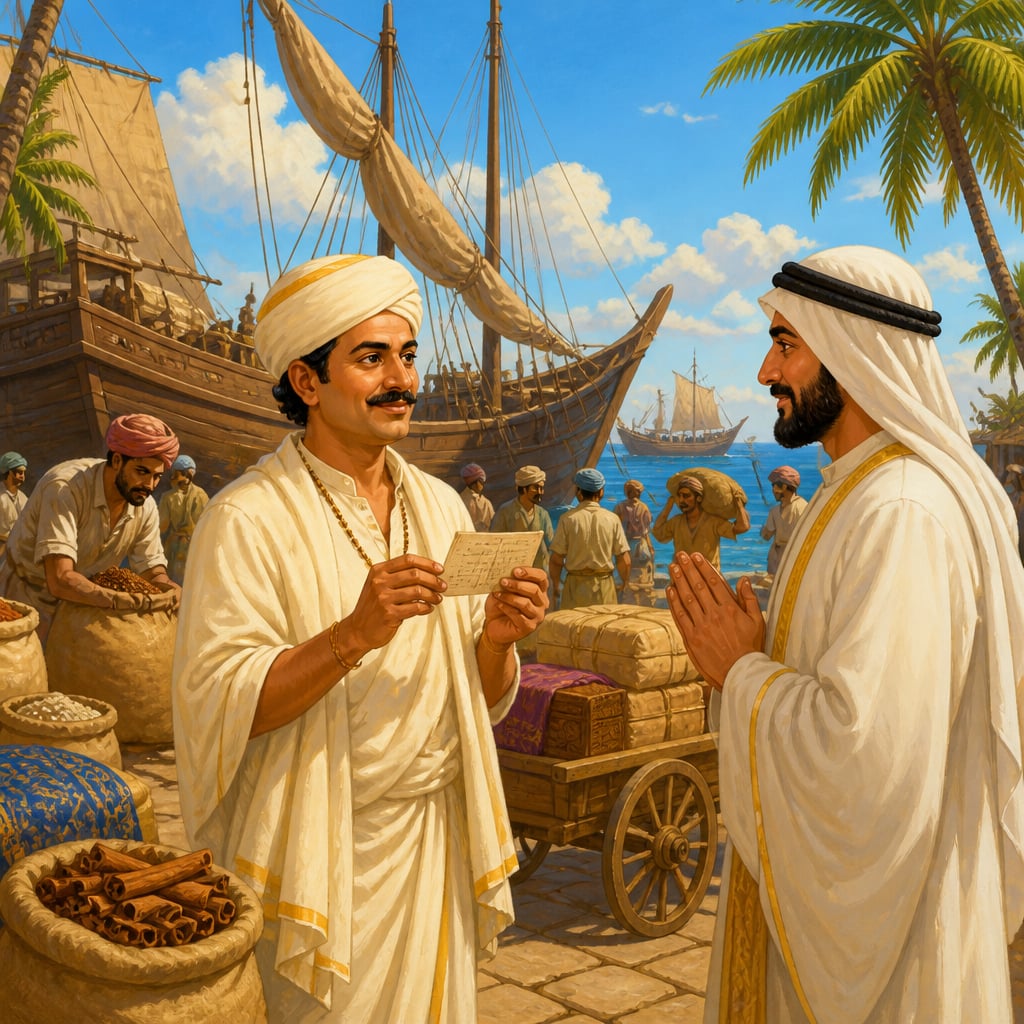
In 1680, a Gujarati merchant named Vallabhdas stood in the port of Surat, holding a small piece of paper. The document, written in a mix of Sanskrit numerals and Gujarati script, bore the seal of a Marwari banking house in Jodhpur. With this single piece of paper, a hundi, Vallabhdas could collect 10,000 silver coins in Malacca, 4,000 miles away, from a banker he had never met.
How was this possible without telegraphs, without banks with international branches, without any of the infrastructure we consider essential for modern finance?
The answer lies in one word: Vishwasa, trust. The indigenous Indian banking system operated on networks of trust so robust that they handled larger volumes and longer distances than contemporary European banking.
The Architecture of Trust
Indigenous Indian banking rested on three pillars:
1. Community Trust (Jati-Vishwasa)

The Marwari Network: Originating from Rajasthan, Marwari merchants and bankers spread across India and beyond. A Marwari in Calcutta could trust a Marwari in Rangoon because:
- Shared community identity created accountability
- Family connections could be traced and verified
- Community reputation affected family honor
- Disputes could be adjudicated by community elders
The Nattukotai Chettiars: Built a banking empire from Chettinad to Singapore through:
- Temple affiliations providing identity verification
- Marriage alliances creating business networks
- Community records tracking reputation across generations
2. Personal Trust (Vyakti-Vishwasa)
The Weight of a Word: A banker's verbal commitment was as binding as any written contract. Breaking one's word meant immediate loss of business relationships and disgrace for the entire family.
Gradual Building: Young men entered banking houses as apprentices, slowly building trust over years. A banker's lifetime reputation was his most valuable asset, worth more than any physical wealth.
3. Institutional Trust (Sansthan-Vishwasa)
The House Seal: The seal of a major banking house, Jagat Seth, the Chettiar families, was a guarantee honored across regions. The seal represented generations of reliable dealing.
Global Perspectives: Trust Networks Across Civilizations
Trust-based financial networks emerged independently across the world. Comparing them reveals what made Indian systems distinctive.
The Fugger Family (Augsburg, 15th-16th century) built Europe's most powerful banking dynasty through trust networks strikingly similar to Indian models. Jakob Fugger financed emperors and popes, with operations spanning from Spain to Hungary. Like Marwari bankers, the Fuggers relied on family members stationed across Europe, community reputation (the German merchant community), and long-term relationship building. Their network of correspondents exchanged bills of exchange, functionally identical to hundis. However, the Fuggers were eventually destroyed by a single bad bet: lending too much to the Spanish crown, which defaulted. Indian banking communities, with more diversified networks, proved more resilient.
Lloyd's of London (established 1688) represents institutionalized trust. What began as a coffee house where ship insurers gathered became a global insurance market built entirely on trust. "Names" at Lloyd's personally guaranteed insurance with their entire wealth, unlimited liability backed only by reputation. For three centuries, Lloyd's operated without formal contracts for many transactions, relying instead on the binding nature of a "scratch" (signature) on a slip. This mirrors the hundi system where the banker's seal alone guaranteed payment.
Medieval European Letters of Credit developed by Italian bankers (Medicis, Bardis) enabled trade across Europe. A merchant in Florence could deposit money and collect it in Bruges using a letter of credit honored by correspondent bankers. However, European systems relied more heavily on legal enforcement through church and royal courts. Indian systems, operating across multiple political jurisdictions without unified legal authority, depended more purely on trust, making them in some ways more sophisticated.
The SWIFT Network (established 1973) is the modern successor to trust-based banking. SWIFT doesn't move money, it moves messages that banks trust. When Bank A sends a SWIFT message to Bank B, Bank B pays out based on trust that the message is genuine and that Bank A will settle. The network works because member banks have been vetted and can be expelled for misbehavior, the same mechanism that disciplined Marwari bankers centuries earlier.
| System | Era | Trust Mechanism | Enforcement |
|---|---|---|---|
| Indian Hundis | 500 BCE onwards | Community + Family + Seal | Social exclusion |
| Fugger Network | 1400-1600 | Family + Reputation | Social + Legal |
| Lloyd's of London | 1688 onwards | Personal guarantee + Market | Market exclusion |
| Medieval Letters of Credit | 1200-1500 | Correspondent relationships | Church + Royal courts |
| SWIFT | 1973 onwards | Vetted membership + Messages | Network exclusion |

The Indian innovation was operating purely on social trust across the largest geographic and political scope, from Kabul to Canton, without relying on any unified legal framework.
The Hundi System in Practice
Types of Hundis
| Type | Payment Condition | Use Case |
|---|---|---|
| Darshani (Sight Draft) | On demand | Immediate transfers |
| Muddati (Term Draft) | After specified period | Trade finance |
| Shah-jog | Only to specified banker | High-value secure transfers |
| Dhani-jog | To bearer/holder | Flexible but higher risk |
Security Features
Hundis incorporated sophisticated anti-fraud measures:
- Specific scripts known only to banking communities
- Secret marks identifying authentic documents
- Numbering systems allowing verification
- Physical features (paper quality, folding methods) difficult to replicate
The 'Pedi' System: India's Ancient Credit Score
The pedi was an informal credit rating, centuries before FICO or CIBIL:
- Payment history tracked informally across the merchant network
- Family background considered as predictor of reliability
- Business conduct observed and communicated
- Community standing affected creditworthiness
A merchant with good pedi could obtain credit without collateral. Bad pedi meant exclusion from the network, financial death.
Trust Across Cultures
Remarkably, trust networks crossed religious and ethnic boundaries:
- Hindu Marwari bankers worked closely with Muslim traders
- Indian networks connected with Arab traders in the Middle East
- Chinese merchants in Southeast Asia participated in Chettiar networks
- European trading companies depended on indigenous credit
Commerce created its own community, transcending other divisions.
Your Turn
Reflect on your own trust networks:
Map your 'pedi' network: Who would vouch for you financially? Who would you vouch for? This network is your informal credit score.
Assess your reputation capital: How many people would do business with you on a handshake? If the number is low, you're operating on borrowed trust.
Think generationally: Banking families thought in decades, not quarters. What decisions would you make differently if you considered impact on your children's reputation?
In the next lesson, we'll explore how colonial disruption challenged these trust networks, and how they adapted to survive.
Signaling theory and relationship-specific investment
Modern credit scoring tries to assess trustworthiness instantly through algorithms. But algorithmic assessment misses the relationship dimension, CIBIL can't tell if someone keeps promises to friends.
Indian business culture still values relationship-building before major transactions. The 'getting to know you' phase in Indian business isn't inefficiency, it's trust assessment that algorithms can't replicate.
Research shows Indian family businesses spend 40% more time on relationship-building before deals than multinational counterparts, and report 30% fewer contract disputes (ISB study, 2020).
Intergenerational capital and long-term orientation
Quarterly capitalism optimizes for 90-day results. Family business cultures optimize for 30-year results. Research shows family businesses consistently outperform on long-term metrics.
Key terms
- Viśvāsa
- Trust or faith; the foundational principle enabling indigenous banking to function across vast distances without formal legal enforcement.
- Peḍhī
- Informal credit rating or standing within the merchant community; a banker's assessment of a trader's reliability based on history and reputation.
- Havāla
- Informal value transfer system operating purely on trust between operators; enables money transfer without physical movement of cash.
- Śreṇī-bandha
- Guild bond or community guarantee; the collective responsibility of a trading community for the conduct of its members.
Verses
विश्वासो व्यापारस्य मूलं धनस्य रक्षणम्
Viśvāso vyāpārasya mūlaṁ dhanasya rakṣaṇam
Trust is the root from which commerce grows, and the shield that guards all wealth.
Modern transaction cost economics (Coase, Williamson) shows that trust reduces costs. But Indian bankers went further: trust didn't just reduce costs, it enabled transactions that legal enforcement couldn't support across multiple political jurisdictions.
Traditional Merchant Wisdom, Vaishya Dharma oral tradition (Community transmission)
यत्र विश्वासः तत्र विजयः
Yatra viśvāsaḥ tatra vijayaḥ
Where trust takes residence, success makes its home.
Empirical research confirms this: high-trust societies have higher GDP growth, more entrepreneurship, and better financial development. The ancient proverb anticipated modern findings.
Traditional Saying, Merchant community wisdom (Oral tradition)
Key figures
M.V. Subbiah (Chettiar)
Late 19th - Early 20th century
Dhirubhai Ambani
1932-2002
Jakob Fugger ('The Rich')
1459-1525
Case studies
The Chettiars of Southeast Asia: Trust Networks Across Oceans
Between 1850 and 1930, the **Nattukotai Chettiars** from a small region in Tamil Nadu (Chettinad) built Southeast Asia's most extensive indigenous banking network. **The Scale:** - Operations spanning Burma, Malaya, Ceylon, Singapore, Indochina, and Java - Peak lending estimated at **₹800 crore** (1930s value, roughly $500 million then, $10+ billion today) - Financed **75% of Burma's paddy trade** and significant portions of Malayan rubber and tin - Operated without branch banking, central coordination, or formal legal agreements across jurisdictions **How It Worked:** A Chettiar banker in Madras could issue a hundi honored in Rangoon because: - Temple affiliations provided identity verification (Chettiars maintained elaborate temple records) - Marriage networks created business alliances (marriages were strategic business decisions) - The **Nakarattar** (clan council) maintained reputation records and adjudicated disputes - Generational relationships meant your grandfather's partner's grandson was your trusted correspondent
The Chettiar system embodied vishwasa-vyapara principles: **Community Trust (Jati-Vishwasa)**: The Nakarattar system maintained informal but binding standards. A Chettiar who cheated would be ostracized, unable to arrange marriages, excluded from temple functions, effectively dead to the community. **Temple as Trust Infrastructure**: Unlike Western banking built on legal structures, Chettiar banking used temple infrastructure. Temple records tracked births, marriages, and reputation. Temple festivals doubled as business conferences. **Generational Thinking**: Chettiars invested in relationships for decades. A loan to a Burmese rice farmer's father would be honored by the son, because the Chettiar banker's son would be the one collecting. **Dharmic Lending**: Chettiars practiced graduated interest similar to Dharmashastra prescriptions, lower rates for productive agricultural loans, higher for speculative ventures. They also provided emergency credit during famines at concessional rates.
**Pre-WWII Peak:** - Chettiars controlled more capital in Burma than all European banks combined - Financed Burma's transformation into world's largest rice exporter - Built palatial homes in Chettinad (still visible today) from Southeast Asian profits **Collapse and Transformation:** - WWII Japanese occupation devastated Southeast Asian operations - Post-independence nationalization (Burma 1962, others following) eliminated overseas assets - Estimated **₹500+ crore** in assets nationalized without compensation **Legacy:** - Chettiars pivoted to Indian industry, founding companies like TVS, Murugappa Group, and Chettinad Cement - **Murugappa Group** (2024: $7.5 billion) and **TVS Group** (2024: $10 billion) trace origins to Chettiar banking wealth - Chettinad's palatial mansions remain as physical testament to trust-based wealth creation
Trust networks can build wealth across continents, but are vulnerable to political disruption. The Chettiars' greatest strength (operating outside formal legal systems across jurisdictions) became weakness when those jurisdictions nationalized their assets. The survivors adapted by formalizing wealth into industrial assets within India.
The Chettiar model maps directly onto modern diaspora business networks, from Chinese guanxi networks in Southeast Asia to Indian IT services firms operating across time zones. Their vulnerability to political disruption is echoed today by sanctions regimes that can overnight sever established business relationships.
At their 1930s peak, Chettiar banking families controlled more capital in British Burma (₹800 crore) than the total capital of all British banks operating in India at the time.
UPI's Trust Architecture: Rebuilding Vishwasa for the Digital Age
In 2016, the **National Payments Corporation of India (NPCI)** launched UPI, a payment system that would process **12 billion transactions** worth **₹18 lakh crore** monthly by 2024. The challenge was unprecedented: How do you build trust for instant, irreversible payments between strangers? **The Traditional Problem:** Digital payments require trust that: - Your money reaches the intended recipient - The recipient won't dispute receiving it - The intermediary (bank) won't fail or cheat - The system will be available when needed In traditional banking, these problems were solved through legal contracts, dispute resolution, and delayed settlement (giving time to reverse errors). UPI needed instant, irreversible transactions, requiring trust infrastructure, not legal infrastructure. **UPI's Trust Architecture:** - **Interoperability**: Any bank account can pay any other, removing the need to trust specific banks - **Instant confirmation**: Both parties see the same confirmation, eliminating dispute potential - **Virtual Payment Addresses**: UPI IDs replaced account numbers, reducing fraud risk - **Transaction limits**: Started small (₹1 lakh), built trust, then expanded (₹5 lakh for certain transactions)
UPI unconsciously replicated ancient vishwasa principles: **Gradual Trust Building**: Like Marwari bankers starting with small transactions, UPI began with low limits (₹1 lakh), proving reliability before expanding. Trust was earned, not assumed. **Network Exclusion as Enforcement**: Banks that fail compliance are excluded from UPI, exactly how the Nakarattar excluded cheating Chettiars. The threat of exclusion ensures good behavior. **Institutional Trust Over Personal Trust**: UPI shifted trust from 'I trust my bank' to 'I trust the system.' This mirrors the evolution from personal (vyakti-vishwasa) to institutional (sansthan-vishwasa) trust. **Simplicity Enabling Trust**: The UPI interface is deliberately simple, pay to a phone number or ID. Like the hundi's standardized format, simplicity reduced error and fraud. **The 'Pedi' Parallel**: UPI's transaction history creates a digital pedi, a record of reliable transacting that could (and increasingly does) inform credit decisions. CIBIL now incorporates UPI data, formalizing what was informal.
**By 2024:** - **12+ billion transactions monthly** (40% of all retail digital payments globally) - **500 million unique users** - **99.97% success rate**, reliability that builds trust - **Average transaction value**: ₹1,500 (small amounts, high volume, trust-based mass adoption) **Trust Metrics:** - 78% of UPI users say they trust UPI more than cash (RBI survey, 2023) - Dispute rate: 0.003%, lower than credit card chargebacks - Adoption in rural India: 45% of transactions, trust extending beyond urban elites **Global Recognition:** - Singapore, UAE, France exploring UPI adoption - Recognized as world's most successful real-time payment system - Proof that trust-based systems can scale in the digital age
UPI proves that vishwasa principles scale in the digital age. Gradual trust-building (low limits first), network exclusion (compliance requirements), and institutional trust (system over individual banks) replicate ancient patterns. India's indigenous banking heritage, operating trust networks across diverse regions, prepared the ground for UPI's success.
Every digital platform faces UPI's trust-building challenge. Progressive disclosure of features (low transaction limits growing over time) is now standard UX practice at companies like Robinhood and Coinbase, directly mirroring how Shroff networks gradually extended credit to new participants.
UPI's adoption rate (500 million users in 8 years) exceeds credit cards (which took 50+ years to reach similar penetration globally). Trust-based systems, designed correctly, can outpace legal-contract-based systems.
Historical context
500 BCE - Present
Trust-based banking networks developed over millennia in India, reaching peak sophistication during the Mughal period when stable governance enabled long-distance trade. The Marwari, Chettiar, Multani, and other communities built networks that moved values exceeding European banking volumes. These systems operated without formal legal frameworks, demonstrating that social trust could substitute for, and sometimes exceed, legal enforcement.
Indian trust networks operated across the largest geographic scope (Arabia to Southeast Asia) and the most diverse political jurisdictions (multiple kingdoms, colonial powers, independent states) without unified legal authority. European systems (Fuggers, Medicis) operated within Christian legal frameworks; Islamic hawala operated within Sharia principles. Indian systems uniquely transcended both.
At their peak (c. 1900), indigenous Indian banking networks (Marwari, Chettiar, Multani combined) handled more annual transaction volume than the formal banking sectors of most European countries. Angus Maddison estimates Indian financial networks moved ~15% of Asian trade value.
Understanding trust networks reveals that India possessed sophisticated financial infrastructure before colonialism, that trust-based systems can exceed legal-contract systems in certain contexts, and that modern Indian innovations (UPI, digital payments) unconsciously draw on indigenous principles.
Living traditions
Trust networks continue operating in various forms, from informal hawala to formal digital payments, proving the enduring relevance of vishwasa principles.
India's financial inclusion success (500+ million bank accounts opened through Jan Dhan, 500 million UPI users) builds on cultural comfort with trust-based systems. Where Western models require legal literacy, Indian systems can operate on relationship trust.
- Hawala Networks: Informal value transfer still operates globally, particularly for migrant remittances. Estimated $200+ billion annually moves through hawala, testament to trust-based finance's persistence.
- Marwari Business Networks: Marwari business communities maintain trust-based practices: verbal commitments honored, community mediation of disputes, preference for relationship over contract. Major Indian conglomerates (Birla, Goenka) operate partly on these principles.
- UPI Payments: India's digital payment system operates on updated vishwasa principles: trust in the network, gradual limit expansion as trust builds, exclusion of non-compliant participants.
- Chettinad Mansions, Karaikudi: The palatial homes of Chettiar banking families, built with wealth from Southeast Asian operations. Now partly heritage hotels, they offer tours explaining Chettiar banking history and trust network operations.
- Marwari Havelis, Shekhawati Region: Elaborately painted mansions of Marwari merchant-bankers. The region's havelis feature frescoes depicting trade, banking, and the families' business journeys across India.
- Chettinad Temples: The elaborate temples built by Chettiar banking families demonstrate how vishwasa-vyapara wealth was channeled into religious and community institutions, temple records also served as trust registries for the banking network.
- Marwari Temples in Shekhawati: The ornate temples and havelis of Shekhawati, built by Marwari merchant-bankers, showcase how trust-based commerce generated wealth that was invested in community religious infrastructure.
Reflection
- Modern digital transactions are often anonymous, neither party knows the other. Indigenous banking was deeply personal, reputation was everything. What is gained and lost in the shift from personal to anonymous transactions?
- Map your own 'pedi' network: List 5 people who would vouch for your financial reliability. Then list 5 people for whom you would vouch. How strong is your trust network? What would strengthen it?