Shroff: The Ancient Money Changers and Bankers
India's Original Financial Gatekeepers
Long before Western banks existed, Indian Shroffs were running sophisticated financial operations, assessing coin purity, exchanging currencies, and facilitating trade across continents. This lesson explores how these 'quality controllers of money' built the trust infrastructure that made India the world's wealthiest economy for millennia.
The Coin That Could Kill a Dynasty
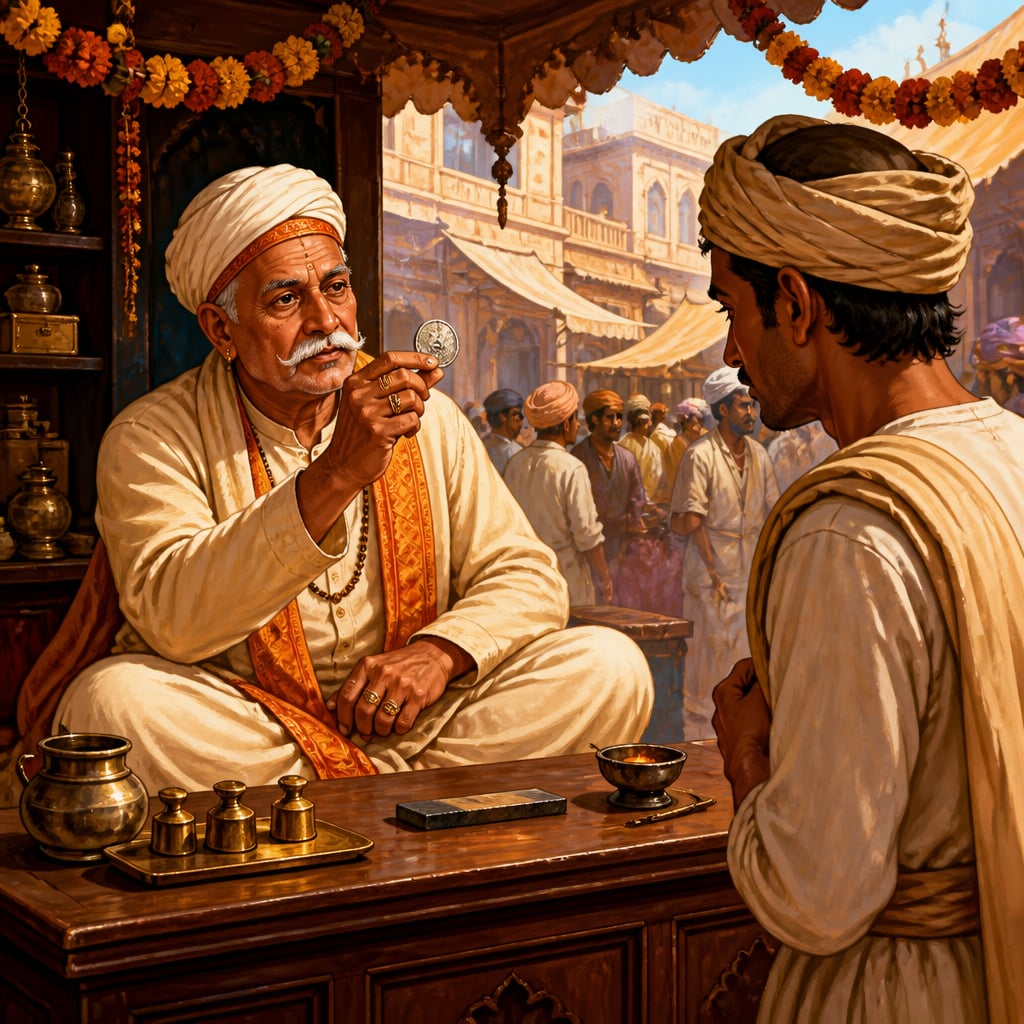
The year was 1719. In a dimly lit chamber in Murshidabad, Bengal's capital, a weathered Shroff named Manik Chand held a Mughal mohur up to the lamplight. His practiced fingers traced the coin's edge. His thumb pressed its surface. He sniffed it, yes, Shroffs could literally smell debased metal.
"Khotā," he pronounced. Counterfeit.
The merchant presenting the coin went pale. This wasn't just an embarrassing moment, presenting bad coins could mean imprisonment, even death. But Manik Chand wasn't ordinary. He was the chief Shroff of the Jagat Seths, the legendary banking house that financed the Mughal Empire itself.
What the merchant didn't know: this single judgment was part of a system that had operated across the Indian subcontinent for over two thousand years, a system so sophisticated that when British bankers arrived centuries later, they would copy its methods wholesale.
Who Were the Shroffs?
The word Shroff (श्राफ) comes from the Sanskrit shrāpha, meaning "one who tests" or "examiner." But this etymology barely hints at their importance. Shroffs were not mere money-changers, they were the gatekeepers of India's monetary system.
In an age before standardized currency, every kingdom minted its own coins. A merchant traveling from Gujarat to Bengal might encounter dozens of different currencies. Gold mohurs, silver rupees, copper paisas, cowrie shells, each needed verification. Was the gold pure? Had the coin been clipped? Was it counterfeit?
"सत्यं वद धर्मं चर। हिरण्यं देवताऽर्पितम्।"
"Speak truth, practice dharma. Gold is an offering to the divine."
This principle, recorded in the Dharmasutras, governed the Shroff's profession. To falsely certify a coin was to commit adharma, a spiritual crime, not just a commercial one. The Shroff's word was his dharmic bond.
The Science of Money-Testing
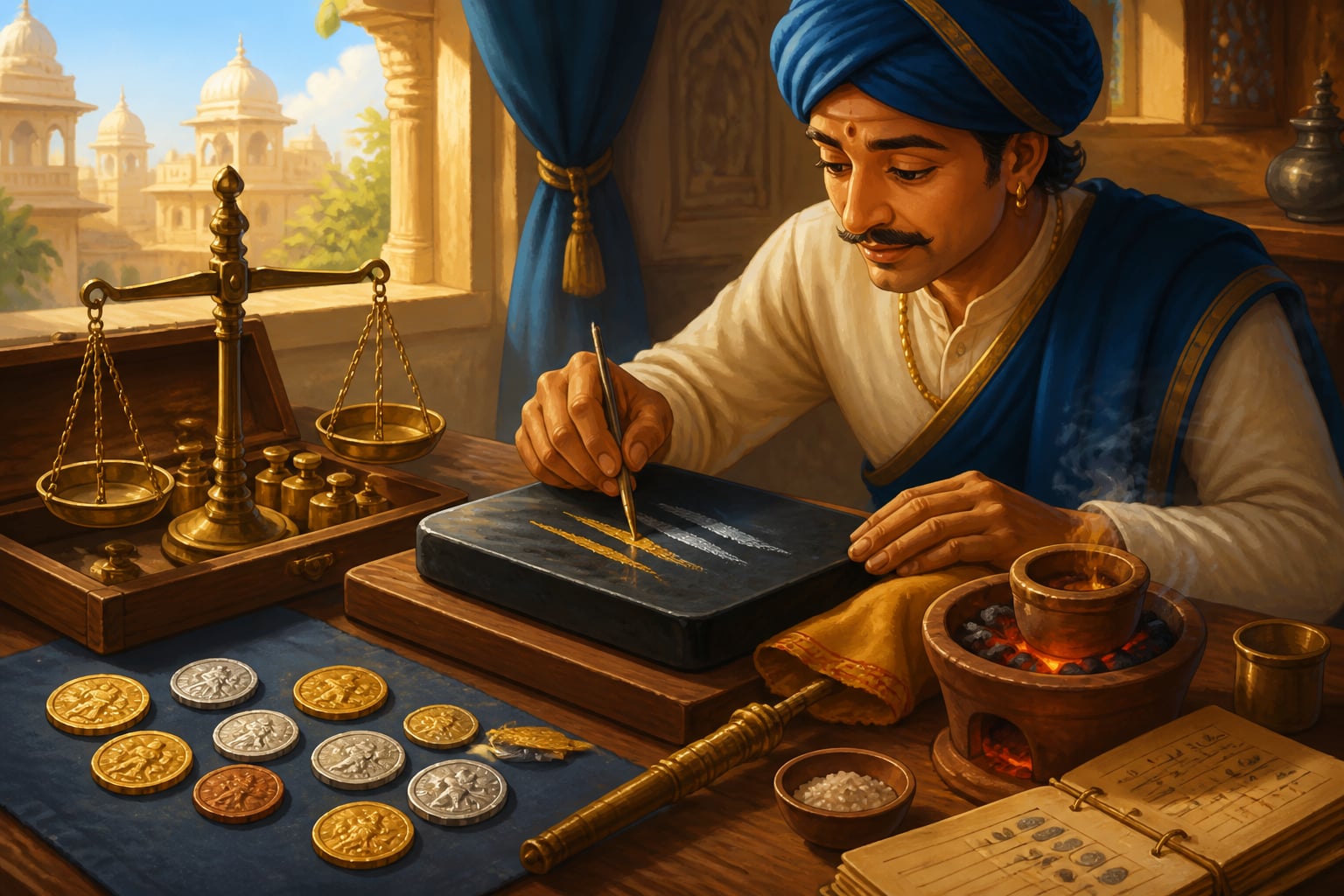
How did Shroffs verify coins? Their methods were remarkably scientific:
1. Weight Testing (Tula-Pariksha) Every Shroff maintained precision scales. A genuine gold mohur weighed exactly 11.66 grams in the Mughal system. Deviation by even a fraction indicated tampering.
2. Touch Testing (Sparsha-Pariksha) Experienced Shroffs could detect impurities through touch. Gold mixed with copper feels different, slightly rougher, less "buttery."
3. Sound Testing (Shabda-Pariksha) A pure silver coin produces a distinct ring when dropped. Debased coins sound duller. Shroffs could identify the metal composition from sound alone.
4. Acid Testing (Kasauti) The touchstone (kasauti) method used acidic substances to test purity. The streak left by rubbing a coin on the stone revealed its true composition.
5. Fire Testing (Agni-Pariksha) For large transactions, coins were heated. Gold's response to fire differs from gilded base metals.
These weren't arbitrary traditions, they were proto-chemistry, developed centuries before Western assaying methods.
The Shroff's Business Model
Shroffs earned through batta, the premium or discount charged for exchange. A Bengali rupee might be worth 98 paisas in a Gujarati rupee. The Shroff's skill lay in knowing these rates across dozens of currencies and maintaining mental calculations faster than any abacus.
But exchange was just the beginning. Successful Shroffs evolved into:
Deposit Takers: Merchants deposited funds with trusted Shroffs rather than risk carrying gold on dangerous trade routes.
Credit Providers: Shroffs lent against collateral, charging interest within dharmic limits (we'll explore these in Lesson 4).
Hundi Writers: They issued hundis, bills of exchange that could be cashed thousands of miles away (detailed in Chapter 2).
Trade Facilitators: The largest Shroffs financed entire trade expeditions, taking a share of profits.
| Shroff Function | Modern Equivalent |
|---|---|
| Coin verification | Central bank certification |
| Currency exchange | Forex trading |
| Deposit holding | Commercial banking |
| Credit provision | Lending/microfinance |
| Hundi issuance | Wire transfers/SWIFT |
Why India Needed Shroffs
Unlike China, which maintained a centralized currency system, or medieval Europe, which relied on fewer standardized coins, India's monetary landscape was extraordinarily complex.
Economist Tirthankar Roy estimates that pre-colonial India had over 150 distinct currency systems operating simultaneously. The Mughals issued coins, but so did regional nawabs, local rajas, temple authorities, and even trading companies. Without Shroffs, commerce would have collapsed.
The Greek ambassador Megasthenes, writing in the 3rd century BCE, noted with amazement that Indian markets functioned smoothly despite this currency chaos. The secret? A network of Shroffs in every major bazaar, their reputations staked on honest assessment.
The Shroff Castes and Communities
Shroff work wasn't open to everyone. Specific communities developed specialized expertise over generations:
Gujarati Shroffs: Dominated western India and Indian Ocean trade routes. Their networks extended from Aden to Malacca.
Multani Shroffs: Originally from Multan (now Pakistan), they specialized in overland trade to Central Asia and Persia.
Marwari Shroffs: From Rajasthan's Shekhawati region, they spread across North India and eventually to Calcutta, where they would dominate colonial-era finance.
Chettiar Shroffs: Tamil Nadu's Nattukotai Chettiars built banking empires across Southeast Asia.
These weren't mere job descriptions, they were jati identities. A Shroff's son was trained from childhood in the family art. The 16th-century merchant manual Dādūpanthi Vaṇik Granthmālā records that Shroff apprentices spent seven years learning before they could practice independently.
Global Perspectives on Money-Changing and Trust Banking
Were Indian Shroffs unique, or did other civilizations develop similar systems? The comparison reveals both parallels and crucial differences.
The Medici of Florence (1397-1494) built Europe's most powerful banking dynasty. Like the Jagat Seths, they combined financial expertise with political influence, financing popes and kings. Giovanni di Bicci de' Medici established the bank; his descendants ruled Florence for centuries. Yet the Medici operated through formal contracts and church dispensations to circumvent usury laws. The Shroff system, by contrast, ran on vishwasa (trust) alone, no contracts, no legal enforcement, just reputation.
Nathan Rothschild (1777-1836) transformed European finance by building an information network faster than governments. His famous coup during the Battle of Waterloo, knowing the outcome before London did, made the Rothschild name synonymous with financial intelligence. Like the Shroffs, Rothschild understood that information asymmetry creates value. But while Rothschild built a family dynasty, the Shroff system was a network of competing families bound by shared professional dharma.
The Templars (1119-1312) pioneered European credit transfer, pilgrims could deposit funds in London and withdraw in Jerusalem. This proto-banking collapsed when the French king destroyed the order. The Shroff-Hundi system survived precisely because it had no central authority to destroy.
| System | Trust Mechanism | Survived Political Upheaval? | Network Type |
|---|---|---|---|
| Indian Shroffs | Jati reputation, dharmic oath | Yes (2000+ years) | Decentralized |
| Medici Bank | Contracts, papal backing | No (collapsed 1494) | Centralized |
| Rothschild | Family secrecy, information control | Yes (but as single family) | Family-centered |
| Templars | Religious authority | No (destroyed 1312) | Centralized |
The Indian advantage? Decentralization. No single Shroff house could bring down the system. When the Jagat Seths fell after Plassey (1757), thousands of other Shroff families continued operating. The network was antifragile.
The Shroff's Decline and Resurrection
British colonial rule systematically dismantled indigenous banking. The Currency Act of 1835 imposed a single standardized rupee, eliminating much of the Shroff's currency-testing role. The Paper Currency Act of 1861 further centralized monetary control.
But here's what's remarkable: Shroffs didn't disappear. They adapted.

Today, in Mumbai's Zaveri Bazaar, India's largest gold market, you can still find families who have been assaying precious metals for 400 years. The Jhaveri and Modi families continue practices their ancestors perfected under Mughal emperors.
And in 2025, as RBI Governor Shaktikanta Das expands the digital rupee to retail users and UPI crosses 15 billion monthly transactions, the underlying architecture still depends on what he calls "trust infrastructure", the same function Shroffs provided for millennia.
Your Shroff Moment
Every time you check a currency conversion rate on your phone, you're doing what Shroffs did, just faster and less skillfully. Every time you trust a bank's certification of funds, you're relying on institutions that replaced (but learned from) the Shroff system.
The deeper lesson? Financial systems don't run on technology alone. They run on trust. The Shroffs understood this: their reputation was their capital. One false judgment could destroy generations of goodwill.
As India builds UPI, digital rupee, and fintech infrastructure that the world envies, the Shroff principle remains relevant: technology enables transactions, but dharmic trust makes them work.
In our next lesson, we'll meet the Shroff's cousin, the Sahukar, the money-lender whose dharmic principles governed credit across the subcontinent.
Reputation capital / Trust as economic infrastructure
Modern economics recognizes 'reputation effects' in game theory, actors cooperate because future reputation matters. But Shroffs operationalized this millennia earlier, building multi-generational reputation capital.
The jati-based Shroff system made reputation hereditary. A family's reputation was an asset passed down like gold itself. This created incentives for honest dealing that individual-based Western systems lacked.
Some Shroff families in Mumbai's Zaveri Bazaar can trace their lineage and continuous operation for 400+ years, longer than the Bank of England (founded 1694).
Adam Smith's famous pin factory example (1776) is often cited as the first recognition of specialization benefits. But Indian Shroff guilds had specialized for centuries, some families tested only gold, others only silver.
The jati system, often criticized for rigidity, created extreme specialization. A gold-testing Shroff family accumulated centuries of know-how that no training program could replicate. This 'knowledge moat' was a competitive advantage.
Key terms
- Shrāph/Shroff
- Traditional Indian money-changer and banker who specialized in assessing coin purity, currency exchange, and financial intermediation. The Shroff's certification made trade possible across India's fragmented monetary landscape.
- Baṭṭā
- The premium, discount, or exchange differential charged by Shroffs for currency exchange. Batta varied by coin type, purity, distance from issuing authority, and supply-demand conditions.
- Kasauṭī
- The touchstone, a piece of dark stone (typically basalt or slate) used to test gold and silver purity by examining the color of the streak left when metal is rubbed against it.
- Huṇḍī
- A bill of exchange or promissory note issued by Shroffs that could be encashed at a distant location. The hundi was India's indigenous financial instrument for transferring money across vast distances without physically moving coins or gold.
Verses
कूटं हिरण्यं रजतं ताम्रं वा यः करोति वै। स चोरवद्वध्यः प्रोक्तः स्वामिनश्च धनं हरेत्॥
kūṭaṃ hiraṇyaṃ rajataṃ tāmraṃ vā yaḥ karoti vai | sa coravadvadhyaḥ proktaḥ svāminaśca dhanaṃ haret ||
He who counterfeits gold, silver, or copper shall be punished as a thief, and must forfeit his wealth to the wronged party.
The harsh punishment for counterfeiting reflects how seriously ancient India took monetary integrity. Unlike modern fines, the penalty was existential, demonstrating that currency fraud was seen as attacking the social contract itself.
Narada Smriti, Vyavahara Prakarana, Chapter 1 (Translated from Julius Jolly edition)
रूपं सुवर्णस्य च रूप्यस्य च ताम्रस्य च विधाय लक्षणाध्यक्षो निवर्तयेत्।
rūpaṃ suvarṇasya ca rūpyasya ca tāmrasya ca vidhāya lakṣaṇādhyakṣo nivartayet |
The Superintendent of the Mint shall establish and enforce standards for gold, silver, and copper coinage.
This reveals a public-private partnership model: the state set standards, but Shroffs enforced them daily. This is remarkably similar to modern central banking where private banks implement monetary policy set by central authorities.
Arthashastra, Book 2, Chapter 12 (Lakshanadhyaksha - Superintendent of Mint) (R.P. Kangle translation)
Key figures
Manik Chand
Founder of the Jagat Seth banking dynasty, Bengal's most powerful financier · Late 17th - Early 18th century (d. 1714)
R. Vaidyanathan
Professor Emeritus of Finance at IIM Bangalore; expert on India's indigenous financial systems · Contemporary (born 1949)
Nathan Mayer Rothschild
Founder of N M Rothschild & Sons, London's dominant merchant bank; financial powerhouse of 19th-century Europe · 1777-1836
Case studies
UPI: The Digital Hundi That Conquered the World
In 2016, India launched the Unified Payments Interface (UPI), a system that seemed impossibly ambitious. The goal: enable anyone with a smartphone to transfer money to anyone else, instantly, for free. No bank visits, no forms, no fees. Critics called it naive. International payment networks like Visa and Mastercard had spent decades building infrastructure that still charged 2-3% per transaction. By December 2024, UPI had processed over 16 billion transactions in a single month, more than Visa and Mastercard combined globally. The value: ₹23 lakh crore ($275 billion) monthly. Countries from Singapore to France began adopting UPI. The IMF called it 'the most sophisticated payment system in the world.' How did a developing country leapfrog the financial giants? The answer lies in understanding what UPI's architects, NPCI's Dilip Asbe and Nandan Nilekani, actually built: not just technology, but trust infrastructure.
UPI succeeded because its architects, consciously or not, replicated the Shroff model's key principles: **Decentralization**: Like the Shroff network, UPI has no single point of control. Any bank can participate. No bank can dominate. If one bank fails, the system continues, exactly like how the fall of Jagat Seth didn't collapse the Shroff network. **Reputation-based trust**: UPI IDs are tied to mobile numbers and bank accounts, modern *vishwasa*. Your payment history builds a digital reputation that functions like a Shroff family's generational credibility. **Interoperability**: A Shroff's hundi worked across regions because different Shroff houses honored each other's paper. UPI works because all banks honor all other banks' transactions, the same principle, digitized. **Near-zero friction**: The Shroff sat in the bazaar, accessible to every merchant. UPI sits on every smartphone. Both democratized access to financial infrastructure.
UPI didn't just succeed, it created a new model of financial inclusion that Western systems cannot replicate. By 2025, over 300 million Indians use UPI monthly, including vegetable vendors, auto-rickshaw drivers, and tea sellers who never had bank accounts before. Small merchants who couldn't afford Visa/Mastercard terminal fees now accept digital payments for free. The international response has been remarkable: Singapore, UAE, France, and Sri Lanka have integrated with UPI. Google Pay and WhatsApp Pay, products of American tech giants, run on Indian rails. The student has become the teacher. Crucially, this succeeded without abandoning the underlying human trust networks. UPI works through existing relationships, your phone contacts, your local shopkeeper, rather than replacing them with anonymous institutional interfaces.
Financial technology succeeds when it digitizes trust, not when it tries to replace it. UPI's architects understood what the Shroffs knew: the software is just the medium, the trust infrastructure is the message. India's fintech revolution isn't despite its traditional financial culture; it's because of it.
Every fintech startup today faces the same choice UPI's architects made: build a walled garden or an open network. Companies like Stripe and Square succeed precisely when they digitize trust rather than replace it, and the ones that forget this lesson (like many crypto exchanges) collapse spectacularly.
UPI's transaction value in 2024 exceeded India's entire GDP from 1991, the year economic liberalization began. In 33 years, India went from 'developing country banking' to operating the world's largest real-time payment system, processing more transactions daily than all US payment networks combined.
Historical context
Ancient to Pre-Colonial India (500 BCE - 1857 CE)
The Shroff system thrived precisely because India was not a monetary monoculture. While empires like Rome and China imposed centralized currencies, India's political fragmentation preserved monetary diversity. This created the market for specialists who could navigate complexity. The Shroff was a product of India's pluralism.
Medieval Europe had money-changers, but they operated under church prohibition on usury and state suspicion. Chinese qianzhuang (money shops) emerged later and with less geographic reach. Only India developed a continent-spanning trust network that operated independently of political authority.
Historian Tirthankar Roy estimates that in 1800, India had over 9,000 active Shroff houses, more than the number of bank branches in Britain at the time.
Understanding Shroffs reveals that sophisticated finance is not a Western invention imported to India. India had indigenous solutions that worked for millennia. Modern financial inclusion efforts succeed when they build on, rather than replace, these trust networks.
Living traditions
The Shroff's core principle, that trust verification is essential infrastructure, lives on in modern systems. RBI's KYC (Know Your Customer) norms, SEBI's certification requirements, and even UPI's trust architecture reflect the same insight: someone must verify, and that verification must be trusted. The Shroff's kasauti has become the digital certificate.
- Zaveri Bazaar Assayers: Mumbai's Zaveri Bazaar, India's largest gold market, still houses families who have been assaying precious metals for centuries. The Jhaveri, Modi, and Mehta families continue to use traditional kasauti methods alongside modern spectrometers. Their certification remains trusted for major transactions.
- Temple Gold Verification: Major temples like Tirupati employ traditional Shroff-style verification for donated gold. The TTD (Tirumala Tirupati Devasthanams) processes over 4,000 kg of gold annually, using methods that would be recognizable to 18th-century Shroffs.
- Zaveri Bazaar, Mumbai
- Johri Bazaar, Jaipur
- Sarafa Bazaar, various cities
- Tirumala Tirupati Devasthanams: The world's richest temple employs traditional Shroff-style gold verification for the 4,000+ kg of gold donated annually. The TTD's treasury management represents the continuation of temple-based financial expertise that predates modern banking.
- Padmanabhaswamy Temple: Home to India's largest temple treasury (estimated $20+ billion), this temple demonstrates how dharmic institutions accumulated and preserved wealth across centuries using Shroff-like verification and record-keeping systems.
Reflection
- The Shroff's word was trusted across continents without legal contracts or enforcement mechanisms. In your own life, how do you build the kind of reputation that makes your word as reliable as a Shroff's certification? What actions erode such trust, and what builds it?
- The Shroff families invested seven years in apprenticeship before practicing independently. Identify one skill in your career or studies where you could benefit from such deep, focused development. What would a 'seven-year mastery plan' look like for that skill?