Sahukar: Dharmic Foundations of Money Lending

Ethics of Traditional Finance

Understanding how Dharmasutras governed lending practices and interest rates in ancient India, exploring the ethical framework that made the Sahukar a trusted pillar of community finance.

The Sahukar's Sacred Calling
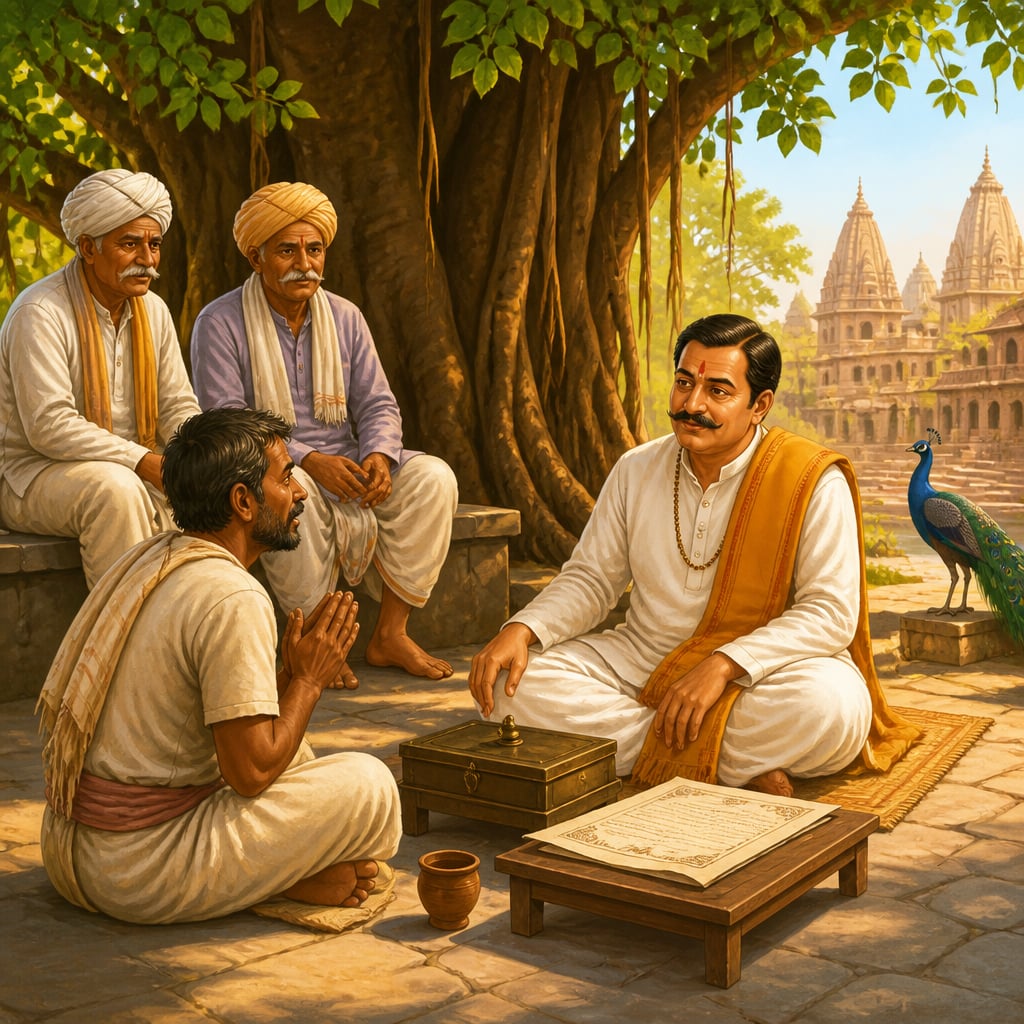
Sahukar Ramlal counseling farmer Govind under a Varanasi banyan

In a village near Varanasi, circa 1750, a farmer named Govind faced a crisis. His oxen had died before the planting season, and without new animals, his family would starve. He approached the local Sahukar, Ramlal Seth, at his modest haveli near the temple.

Ramlal did not immediately discuss money. First, he inquired about Govind's family, his land, and his situation. Then he opened an ancient palm-leaf manuscript, a family copy of lending guidelines derived from the Dharmasutras.

"Govind-bhai," he said, "lending you money for productive purposes is my dharma. Let us find a way that serves both our families."

This scene, repeated across thousands of villages for millennia, illustrates the dharmic foundation of the Sahukar system, India's indigenous money lending institution that operated on principles vastly different from modern predatory lending.

The Meaning of Sahukar

The word Sahukar derives from Sanskrit Sadhu-kara, one who does good work, or one who acts righteously. This etymology reveals the foundational concept: money lending was not merely a business but a form of seva (service) to the community.

Unlike the negative connotations attached to moneylenders in many cultures, the traditional Sahukar occupied a respected position in Indian society. They were expected to follow dharmic principles that balanced their own livelihood with community welfare.

Dharmasutras: The Ethical Framework

The Dharmasutras and Smritis provided comprehensive guidelines for money lending. These weren't arbitrary rules but a sophisticated understanding of fair economics.

Graduated Interest Rates

The Manusmriti (8.140-142) prescribes different interest rates based on the borrower's varna and the purpose of the loan:

Varna Monthly Rate Annual Rate
Brahmins 2% 24%
Kshatriyas 3% 36%
Vaishyas 4% 48%
Shudras 5% 60%

Modern scholars like Bibek Debroy explain this wasn't discrimination but risk-based pricing combined with social responsibility. Brahmins typically had fewer assets for collateral but were considered low-risk due to their community standing.

Damdupat: The Doubling Limit

One of the most remarkable principles was Damdupat, the rule that total interest could never exceed the principal amount. As the Yajnavalkya Smriti (2.39) declares:

"Kusīda-vṛddhir dviguṇā na ca kāla-viparyaye" "Interest on a loan may at most double the principal, regardless of how much time passes."

This meant that no matter how long a loan remained unpaid, a person who borrowed 100 coins could never owe more than 200 coins in total. This principle effectively prevented the debt spirals that destroy families in modern predatory lending systems.

Purpose-Based Lending

Dharmic texts distinguished between different types of loans:

Global Perspectives on Ethical Lending

The ethical concerns that shaped the Sahukar system appeared independently across civilizations, though with different solutions.

Thomas Aquinas drafting his treatise on usury in a monastery study

Thomas Aquinas (1225-1274) developed the medieval Christian doctrine of "just price" and condemned usury as sinful. His Summa Theologica argued that charging interest on money was inherently unjust because money, unlike land, doesn't naturally produce fruit. While Aquinas sought to prohibit interest entirely, the Dharmashastra approach was more pragmatic, permitting interest but with strict ethical limits like Damdupat.

Benjamin Franklin (1706-1790) took a different approach in colonial America. His Poor Richard's Almanack preached "Neither a borrower nor a lender be," yet he helped establish the Philadelphia Contributionship (1752), America's first mutual insurance company, based on community risk-sharing. This mirrors the Sahukar's role in community welfare, though Franklin focused on insurance rather than lending.

Hernando de Soto (contemporary Peruvian economist) argues in The Mystery of Capital (2000) that the poor remain poor because they lack formal property rights to use as collateral. His insight echoes what the Sahukar system understood intuitively: community trust and social capital can substitute for formal collateral. The Sahukar lent based on reputation and relationships, not just assets, a principle de Soto advocates for modern development economics.

Thinker Key Insight Sahukar Parallel
Aquinas Interest is unjust; prohibit it Interest permitted but capped (Damdupat)
Franklin Community mutual aid over individual lending Sahukar as community welfare provider
de Soto Social capital can replace formal collateral Trust networks enabled lending without assets

The Sahukar's Responsibilities

A Sahukar's dharma extended beyond merely following interest rate guidelines:

Assessing Capacity: Before lending, the Sahukar evaluated whether the borrower could reasonably repay. Lending to someone who clearly couldn't repay was considered adharma.

Community Welfare: Sahukars funded temples, dharamshalas (rest houses), and educational institutions. This wasn't mere charity but a dharmic obligation tied to their profession.

Maintaining Records: Loan documents called Rahinamas recorded all terms clearly, witnessed by respected community members.

Colonial Disruption and Modern Revival

British courts, unfamiliar with dharmic principles, enforced loan contracts literally. The Damdupat protection was often ignored, allowing interest to compound indefinitely. Colonial economic policies, land revenue demands in cash, destruction of local industries, forced farmers into distress borrowing, creating the negative "village moneylender" stereotype.

Indian self-help-group women pooling savings in a community circle

Yet today, India witnesses a revival of ethical community finance. The Self-Help Group (SHG) movement, with over 120 million women members as of 2024, echoes Sahukar principles of community-based lending. Small Finance Banks like Equitas and Ujjivan consciously blend modern banking with community trust networks.

Your Turn

The next time you consider borrowing, whether for education, business, or a purchase, ask yourself the questions a Sahukar would ask:

  1. Is this kushida (productive) or upabhoga (consumption) debt?
  2. Can I realistically repay without distress?
  3. What is my personal "Damdupat limit", the point beyond which debt becomes destructive?

These ancient questions remain remarkably relevant. In the next lesson, we'll explore how the Sahukar's community-based trust evolved into the sophisticated hundi system, India's ingenious contribution to global finance.

Debt-to-income ratio and creditworthiness assessment

Modern credit scoring (FICO, CIBIL) attempts to quantify what Sahukars assessed through community knowledge, but algorithms miss the human context.

The Sahukar model included moral obligation on the lender not to extend credit that would harm the borrower, a responsibility absent in modern 'buyer beware' lending.

In 2023, Indian household debt reached 40% of GDP, with credit card defaults rising 25% YoY, suggesting modern lending ignores capacity assessment.

Total cost of credit caps and debt relief mechanisms

The EU's Consumer Credit Directive caps APR disclosure but not total cost. US student loans can exceed 3-4x principal. Damdupat would eliminate these debt spirals.

Key terms

Sāhūkār
An indigenous money lender who operated according to dharmic principles, providing credit while maintaining community welfare.
Damdupat
The dharmic principle that limits total interest to equal the principal amount, preventing perpetual debt cycles.
Kusīda
Interest-bearing loan for productive purposes; one of the recognized forms of legitimate lending in Dharmasutras.
Ṛṇa-mukti
Liberation from debt; the state of being free from financial obligations, considered essential for spiritual progress.

Verses

कुसीदवृद्धिर्द्विगुणा न च कालविपर्यये

Kusīda-vṛddhir dviguṇā na ca kāla-viparyaye

Let interest grow, but only to match what was lent, time itself cannot breach this sacred limit.

The Damdupat rule addresses the mathematical reality that compound interest grows exponentially while human earning capacity doesn't. By capping total debt at 2x principal, the Dharmashastra created an automatic 'debt ceiling' that modern student loans and credit cards lack.

Yajnavalkya Smriti, 2.39 (Patrick Olivelle (2019))

धर्मेण निर्वहेदृणं यथाशक्ति यथाक्रमम्

Dharmeṇa nirvahēd ṛṇaṁ yathāśakti yathākramam

Repay your debts as dharma guides, by what you can, in the order you should.

This principle anticipates modern income-based repayment plans and debt restructuring. It balances creditor rights with debtor welfare, recognizing that extracting payments beyond capacity destroys the borrower's productive ability and ultimately harms the lender too.

Arthashastra, 3.11.1 (R.P. Kangle (1965))

Key figures

Yajnavalkya

circa 3rd-5th century CE

Ela Bhatt

1933-2022

Thomas Aquinas

1225-1274

Case studies

India's Self-Help Group Revolution: 120 Million Women and the Sahukar Revival

In 1992, NABARD launched the SHG-Bank Linkage Programme, connecting informal women's savings groups to formal banking. By 2024, the programme had grown to encompass **120 million women** across **12 million SHGs**, with cumulative bank credit exceeding **₹6 lakh crore** ($72 billion). The model works simply: 10-20 women form a group, save small amounts weekly, lend to each other first, and then access bank loans as a collective. Repayment rates consistently exceed **96%**, higher than commercial lending. The magic lies in what economists call 'social collateral.' Like the traditional Sahukar who lent based on community knowledge rather than formal assets, SHGs use peer pressure, mutual support, and intimate knowledge of each member's situation to ensure repayment. A woman borrowing for her child's education knows her neighbors are guaranteeing her loan, she won't default and shame them.

The SHG model embodies multiple Sahukar principles: **Purpose-based lending**: Groups typically approve productive loans (livestock, sewing machines, inventory) over consumption loans. **Capacity assessment**: Members know each other's true financial situation, no algorithm needed. **Community welfare**: Profits stay within the group, funding emergency needs and community projects. **Graduated approach**: Women start with tiny loans (₹500), proving creditworthiness before accessing larger amounts, echoing the Sahukar practice of building trust over time. Conventional banking would deem these women 'unbankable', no collateral, irregular income, no credit history. The dharmic lens sees them as ideal borrowers when embedded in the right community structure.

The SHG movement has become the world's largest microfinance programme. Beyond credit, it has driven measurable social change: **70% of SHG members report increased household income**, women's participation in local governance (panchayats) has risen, and domestic violence rates in SHG-intensive areas have declined. The model has been replicated in Bangladesh, Nepal, and Africa. Critically, despite operating with the poorest populations, SHG lending has remained sustainable without the exploitative interest rates that plagued commercial microfinance. The Sahukar's balance of profit and welfare, lost during colonialism, has been rediscovered.

Trust networks and community knowledge can substitute for formal collateral, the Sahukar knew this millennia ago. When lending is embedded in relationships rather than extracted through algorithms, both repayment rates and social outcomes improve.

Peer-to-peer lending platforms like LendingClub and Kiva attempt what SHGs do naturally: use community knowledge to assess creditworthiness. The 96% SHG repayment rate challenges the assumption that algorithm-driven credit scoring is always superior to relationship-based lending.

96% repayment rate among SHG loans vs. 85% for commercial microfinance and 78% for agricultural loans (NABARD 2023).

Small Finance Banks: Equitas and Ujjivan's Dharmic Banking Experiment

In 2015, the RBI granted 'Small Finance Bank' licenses to ten institutions, including **Equitas** (Chennai) and **Ujjivan** (Bangalore). These weren't traditional banks but microfinance institutions asked to transform into full banks while maintaining their focus on underserved populations. **Equitas**, founded by **P.N. Vasudevan** in 2007, explicitly drew on indigenous finance traditions. Its name means 'fairness' in Latin, but Vasudevan frequently cites dharmic principles in interviews. The bank focuses on used commercial vehicle loans for first-time buyers, typically auto-rickshaw drivers stepping up from being employees to owners. Average loan size: ₹5 lakh. **Ujjivan** (meaning 'upliftment' in Sanskrit), founded by **Samit Ghosh** in 2005, began as an MFI serving urban migrants and slum dwellers, populations ignored by mainstream banks. Its transformation to Small Finance Bank in 2017 required maintaining 75% of loans below ₹25 lakh. Both faced a core challenge: How do you remain profitable while serving customers that traditional banks reject?

Both banks echo Sahukar principles: **Community-embedded lending**: Equitas and Ujjivan use local staff who understand borrower contexts. Loan officers visit homes, assess genuine capacity, and build relationships, mimicking the Sahukar's personal knowledge. **Productive purpose focus**: Equitas's vehicle loans create income-generating assets. Ujjivan prioritizes business and education loans. Like the Sahukar's preference for *kushida* over *upabhoga*, these banks prefer debt that generates returns. **Graduated trust**: Both use 'credit staircases', borrowers start small and earn access to larger loans through repayment history, building trust over time. However, unlike traditional Sahukars, these banks face regulatory constraints and investor expectations that sometimes conflict with dharmic ideals. Interest rates (18-26% APR) remain high by Western standards, though lower than moneylenders (36-60%).

By 2024, Equitas had grown to **₹35,000 crore** in assets with **7 million customers** and maintained gross NPAs below 3%. Ujjivan reached **₹29,000 crore** in assets serving **7.5 million customers**. Both banks went public, Equitas in 2016, Ujjivan in 2020, demonstrating that ethical, inclusive banking could generate market returns. Equitas's stock delivered 200%+ returns in 2020-21. Critically, both maintained mission focus despite IPO pressures. Equitas's vehicle loans have helped create an estimated **1 million micro-entrepreneurs**, auto drivers who became owners. Ujjivan's urban focus brought banking to populations invisible to traditional finance.

The Sahukar model can be institutionalized at scale. Equitas and Ujjivan prove that dharmic principles, know your borrower, lend for productive purposes, build trust over time, create sustainable, profitable businesses while serving those excluded from conventional finance.

The rise of neobanks like Niyo, Fi, and Jupiter shows the market still craves the Sahukar's personal touch. Small Finance Banks prove that knowing your borrower personally, rather than relying solely on CIBIL scores, creates more resilient lending portfolios.

Equitas: 93% of customers are first-time borrowers from formal banking; average income increase of 42% within 3 years of first loan (company data, 2023).

Historical context

500 BCE - 1857 CE

The Sahukar system operated within the jajmani framework where economic relationships were embedded in social obligations. Sahukars typically belonged to specific communities (Agarwals, Maheshwaris, Chettiars, Marwaris) who maintained professional standards and internal dispute resolution. Lending rates, while seemingly high by modern standards, operated in an economy with different risk profiles and no central banking.

While European Christianity prohibited usury entirely (leading to Jewish specialization in banking), and Islamic societies developed profit-sharing alternatives, India permitted regulated interest, arguably a more pragmatic approach that avoided both prohibition's economic costs and unregulated lending's social harms.

Angus Maddison's research shows India maintained 22-25% of world GDP from 1 CE to 1700 CE, this economic prosperity was financed substantially through the Sahukar system.

Understanding the Sahukar system reveals that India had sophisticated, ethical financial institutions that were deliberately dismantled by colonialism, not primitive arrangements awaiting Western modernization.

Living traditions

The Sahukar's dharmic principles survive in multiple modern forms, from rural chit funds to digital lending platforms.

India's Priority Sector Lending rules require banks to direct 40% of credit to agriculture, small business, and underserved sectors, institutionalizing the Sahukar's obligation to serve community needs, not just profitable clients.

Reflection

More in Indigenous Banking: Shroffs, Seths & Sahukars

All lessons in Indigenous Banking: Shroffs, Seths & Sahukars · Banking & Finance Heritage of Bharat course