Swayam Sahayata Samuh: Self-Help Groups as Modern Jajmani

Women-Led Financial Revolution

When 10-20 women decide to save ₹50 per week together, something extraordinary happens. The Self-Help Group movement has organized 9 crore Indian women into financial collectives, creating the world's largest network of women-led financial institutions. This lesson explores how an ancient tradition of women's mutual aid became a Nobel Prize-validated model of development.

The Meeting Under the Neem Tree
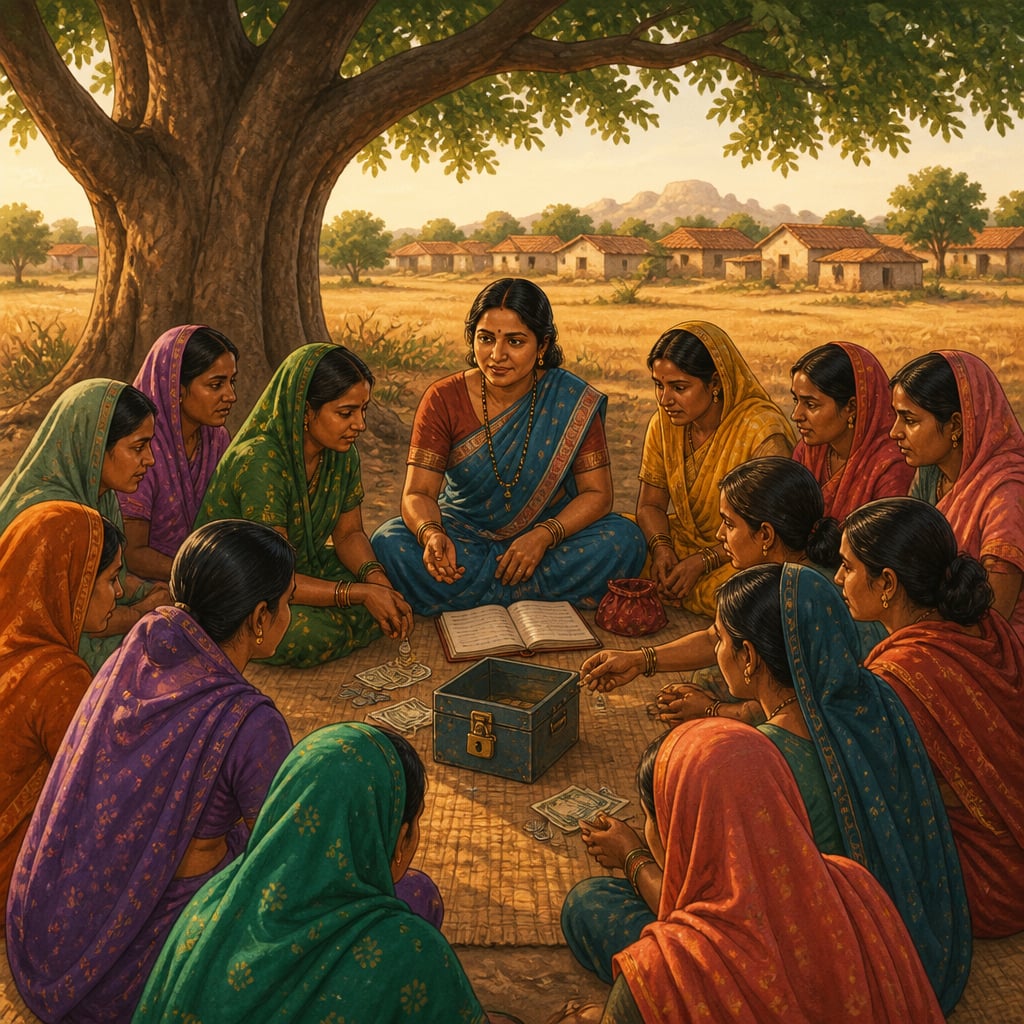
Yellamma founding the first SHG under a neem tree

In 1992, in a village outside Raichur, Karnataka, something quietly revolutionary happened. Fifteen women, landless laborers, small farmers' wives, and a widow, gathered under a neem tree. Each brought ₹10, their weekly savings. A young field worker from MYRADA, an NGO, showed them how to keep a simple register: who contributed, who borrowed, who repaid.

That first meeting lasted 45 minutes. By the end, Yellamma, an agricultural laborer, had borrowed ₹200 at 2% monthly interest to buy medicine for her sick child. The previous month, she'd paid 10% monthly to the local moneylender for the same sum.

"We were doing for each other what banks refused to do for us," Yellamma later recalled. "We knew each other. We knew who would repay. The bank didn't know us, didn't want to know us. But we knew ourselves."

Thirty years later, Yellamma's granddaughter manages a federation of 150 SHGs with ₹15 crore in savings. The revolution that started under that neem tree now encompasses 9 crore women across India.

The Ancient Roots of Stree-Sangha

While SHGs emerged in their modern form in the 1980s, women's financial collectives have ancient roots in Indian tradition. The stree-sangha (women's association) appears in various forms across dharmic literature and social practice.

The Dharmashastra tradition recognized women's right to stri-dhana (women's wealth), property that belonged exclusively to women, including savings, jewelry, and gifts. This wealth was often managed collectively. The Manusmriti, despite its other restrictions on women, explicitly protects stri-dhana:

स्त्रीधनं न हरेत् कश्चित् स्त्रीधनं रक्षणीयम्

Strīdhanaṃ na haret kaścit strīdhanaṃ rakṣaṇīyam

"None shall take a woman's wealth; women's wealth must be protected."

This recognition created space for women's autonomous financial activity, managed among women, by women's rules.

The stree-sangha tradition manifested in various forms:

These weren't formally registered or documented, but anthropologists have found their traces across India. When modern SHGs emerged, they weren't creating something new, they were formalizing something ancient.

The Narada Smriti provides principles for such associations:

संघे कृतः स्वधर्मो यः सर्वेषां हितकारकः

Saṅghe kṛtaḥ svadharmo yaḥ sarveṣāṃ hitakārakaḥ

"That dharma which is practiced in sangha (collective) benefits all."

The modern SHG is a stree-sangha that has found institutional recognition, a dharmic tradition that discovered legal form.

The Five Principles of SHG Success

What makes SHGs work? Decades of research and experience have identified five essential principles:

1. Small Size (10-20 members)

2. Voluntary Homogeneity

3. Regular Meetings (weekly)

4. Mandatory Savings First

5. Democratic Governance

These principles map remarkably onto the Dharmashastra's requirements for effective sangha: equality among members, regular assembly, collective decision-making, and mutual accountability.

Global Perspectives: The Science of SHGs

Esther Duflo presenting J-PAL findings on SHGs at MIT

Esther Duflo (b. 1972), the French-American economist who won the 2019 Nobel Prize in Economics (with Abhijit Banerjee and Michael Kremer) for their experimental approach to alleviating poverty, has extensively studied SHGs through randomized controlled trials (RCTs).

Duflo's research, conducted through the Abdul Latif Jameel Poverty Action Lab (J-PAL), found nuanced results:

What SHGs definitely do:

What SHGs don't automatically do:

Duflo's conclusion wasn't that SHGs fail, but that expectations should be calibrated: "Microcredit is not a miracle cure for poverty, but it is a useful tool that provides value to those who use it."

Abhijit Banerjee, Duflo's co-laureate and spouse, compared SHGs to other development interventions:

"The effect size of SHGs on most outcomes is modest but positive. However, the cost per beneficiary is so low that the cost-effectiveness is actually quite high. SHGs deliver real benefits at minimal cost."

Research Finding Implication for SHGs
Modest income gains Not a poverty cure, but genuine improvement
Strong financial discipline effects Savings behavior changes permanently
Social capital building Non-financial benefits may exceed financial
Empowerment varies by context Design matters; one size doesn't fit all

The Nobel recognition validated what millions of Indian women already knew: SHGs work, not as miracles, but as practical tools for collective advancement.

The Andhra Pradesh Revolution: IKP/Velugu

In 2000, the state of Andhra Pradesh (undivided) launched the Indira Kranthi Patham (IKP), later known as Velugu (meaning "light"), the most ambitious SHG program ever attempted. The goal: organize every poor woman in the state into an SHG within a decade.

The scale was unprecedented:

What made IKP different:

  1. Saturation approach: Don't select villages, cover all villages. Don't select women, reach all poor women.

  2. Federated structure: SHGs weren't isolated units but building blocks of larger organizations. A VO might coordinate 15-20 SHGs; a Mandal Samakhya might coordinate 100 VOs.

  3. Bank linkage at scale: IKP negotiated with banks for bulk SHG lending. A bank branch that previously ignored poor women now saw a VO representing 1,000 organized savers.

  4. Community professionals: Instead of government staff, IKP trained local women as "community resource persons" who facilitated new SHGs. These women knew the context, spoke the language, and lived with the consequences.

  5. Beyond credit: IKP expanded SHGs into nutrition programs (eggs and milk for children), health interventions (TB detection, immunization), livelihood development (agriculture, dairy), and social action (addressing domestic violence, alcoholism).

By 2010, IKP had achieved what no other program had:

The human impact: In 2000, when Lakshmi Devi of Anantapur district needed ₹500, she paid 10% monthly interest to the local moneylender. By 2010, she borrowed ₹50,000 from her VO at 12% annual interest to buy a milk buffalo, the moneylender had left the village entirely.

DAY-NRLM: Scaling to National Level

The success of IKP inspired national replication. In 2011, the Government of India launched the Deendayal Antyodaya Yojana - National Rural Livelihoods Mission (DAY-NRLM), essentially, IKP for all of India.

DAY-NRLM adopted IKP's key innovations:

DAY-NRLM by 2024:

Metric Achievement
Women organized 9+ crore
SHGs formed 90+ lakh
Bank linkage credit ₹6+ lakh crore (cumulative)
Community professionals 5+ lakh
States covered All states and UTs

The leadership of DAY-NRLM, including Mission Director Charanjit Singh, Joint Secretary Nita Kejriwal, and state mission directors, has focused on three priorities:

  1. Saturation of poorest: Ensure the most marginalized women (SC, ST, PWD, widows) are reached, not just the "easy to organize"

  2. Financial inclusion: Move beyond basic savings to bank accounts, insurance, pensions, and formal credit

  3. Livelihoods: Connect SHGs to agriculture value chains, skill training, and enterprise development

The mission's tagline captures its ambition: "No woman left behind."

Modern Resonance: SHGs in the Digital Age

Community resource person leading a digital-era SHG meeting

In 2024, Priya, a DAY-NRLM community resource person in Madhya Pradesh, conducts her weekly SHG meeting with tools her predecessors couldn't imagine:

The meeting still happens under a tree, starts with a prayer, and runs on trust. But the records are in the cloud, the money moves instantly, and the data helps the mission identify which SHGs need support.

Data point: In 2023-24, SHGs under DAY-NRLM disbursed over ₹1.5 lakh crore in bank-linked credit, more than many commercial banks' entire retail portfolio.

The digital layer doesn't replace the human layer, it amplifies it. The stree-sangha now has a smartphone.

Your Turn: The SHG Principle in Your Life

You may not join a rural SHG, but the principles apply universally:

1. Find your sangha: A group of 10-15 people with shared circumstances and goals

2. Meet regularly: Weekly or monthly, consistency matters more than frequency

3. Start with commitment: Everyone contributes before anyone withdraws (time, money, or effort)

4. Keep transparent records: What gets measured gets managed

5. Make collective decisions: Democratic process builds ownership

Examples in professional life:

The ancient wisdom of stree-sangha, collective action among equals, works in boardrooms as well as under neem trees.

In our next lesson, we'll explore the formal microfinance industry, what happened when the SHG principle met venture capital, regulations, and the challenge of scale.

Labor economics demonstrates that collective bargaining increases workers' negotiating power. Social capital research shows that networks create value beyond individual relationships. SHGs combine both: they create bargaining power (with banks, moneylenders, husbands) and social capital (information sharing, mutual support, collective identity).

India's SHG movement has achieved scale that comparable programs elsewhere have not. With 9+ crore women organized, Indian SHGs represent collective power unprecedented in grassroots finance. This scale itself becomes power: banks now compete for SHG lending; politicians court SHG federations; programs are designed around SHG delivery.

Research shows SHG membership increases women's participation in household financial decisions by 15-25% and reduces acceptance of domestic violence by 20-30%, non-financial benefits of collective organization.

Development economics research consistently shows that assets in women's names have different effects than family assets: more spending on children's health and education, better nutrition outcomes, improved household resilience. Women's asset ownership isn't just fair, it produces better development outcomes.

The cultural concept of stri-dhana made it socially acceptable for women to hold separate assets. SHGs leveraged this: savings aren't family property but women's property. This creates a protected space for women's financial agency within traditional family structures, evolution rather than revolution.

Studies show that households where women have SHG savings spend 10-15% more on children's education and 20% more on healthcare compared to similar households without women's separate savings.

Key terms

Swayam Sahayata Samuh (SHG)
Self-Help Group, a small group of 10-20 people (typically women) who save together, lend to each other, and build collective financial and social capacity.
Stri-Dhana
Women's property, assets that belong exclusively to a woman, protected from claims by husband or family. Includes savings, jewelry, gifts, and earnings from personal enterprise.
Sangha/Samuh Sangathan
Group formation, the process of organizing individuals into a collective with shared purpose, rules, and identity. In SHG context, the careful process of forming a cohesive group.
Bank Sambandhan (Bank Linkage)
The process of connecting SHGs to formal banking services, enabling groups to access institutional credit, savings accounts, and other financial services.

Key figures

Stree-Sangha Tradition (Women's Collectives in Dharmic Practice)

Established the social acceptability of women meeting, saving, and managing money collectively. Created practices of mutual accountability, rotating roles, and collective decision-making that SHG methodology later codified. Demonstrated that women's financial collectives could operate within traditional social structures without threatening them.

DAY-NRLM Leadership (Mission Directors and State Teams)

Scaled the SHG-Bank Linkage model from state-level successes (Andhra Pradesh, Kerala) to all-India coverage. Introduced the 'community professional' model, training local women to facilitate SHGs rather than relying on government staff. Integrated SHGs with government welfare delivery (DBT, pensions, insurance) making SHGs the last-mile infrastructure for multiple programs.

Esther Duflo

Demonstrated through rigorous research that SHGs and microfinance create real but modest benefits: improved access to credit, reduced moneylender dependence, better financial discipline. Equally importantly, showed what SHGs don't automatically do: transform poverty overnight or guarantee business success. Her nuanced findings have shaped realistic expectations and program design worldwide.

Case studies

Andhra Pradesh: Building the World's Largest Women's Network

In 2000, Andhra Pradesh faced a crisis: high rural indebtedness, farmer distress, and widespread moneylender exploitation. The state government, with World Bank support, launched an audacious experiment: organize every poor woman in the state into a Self-Help Group. The **Indira Kranthi Patham (IKP)** program, later called **Velugu** ('light'), took a different approach from previous SHG programs: 1. **Universal coverage**: Don't select promising villages, saturate all villages 2. **Federated structure**: Build SHGs into Village Organizations (15-20 SHGs), then Mandal Samakhyas (80-100 VOs), then district federations 3. **Community professionals**: Train local women (CRPs) to facilitate new SHGs rather than using government staff 4. **Bank linkage at scale**: Negotiate bulk agreements with banks for SHG lending 5. **Beyond credit**: Integrate nutrition, health, education, and livelihoods into SHG platform The scale was unprecedented. By 2010, IKP had organized 1.1 crore women into 9.6 lakh SHGs, approximately 75% of all poor households in the state.

IKP embodied the dharmic principle of universal inclusion, sarva-jana-hitaya (for the welfare of all people). Rather than selecting the 'deserving' or 'capable' poor, IKP committed to reaching every poor woman. This wasn't charity but recognition of universal dignity and potential. The federated structure reflects the sangha principle: individuals organizing into groups, groups organizing into larger collectives, collectives building permanent institutions. A woman in a remote tribal hamlet became connected to state-level advocacy through the federation structure. The use of community professionals, local women facilitating SHGs, operationalized the teaching that empowerment must come from within. Government provided support, but transformation came through peer leadership.

IKP transformed rural Andhra Pradesh: **Financial metrics:** - ₹8,000+ crore in cumulative bank credit to SHGs - 96% repayment rate (exceeding commercial bank portfolios) - Average household debt to moneylenders fell 60% **Social metrics:** - Child malnutrition reduced 15% in intensive blocks - Girls' school enrollment increased 12% - Women's participation in gram sabhas doubled **Institutional metrics:** - 9.6 lakh SHGs functioning as permanent institutions - 35,000+ community professionals trained and employed - Mandal Samakhyas managing ₹100+ crore portfolios independently When the 2009 Andhra Pradesh farmer suicides crisis hit, IKP areas had significantly lower incidence, the SHG safety net provided alternatives to moneylender debt.

Scale is possible without sacrificing quality. IKP proved that grassroots programs can reach crore-level coverage while maintaining community ownership. The key: invest in federated structures and community professionals rather than government bureaucracy. Let women own the institutions they build.

India's SHG model, born in Andhra Pradesh, has been adopted by the World Bank as a best practice for women's economic empowerment. Similar federated women's networks are now operating in Bangladesh, Ethiopia, and Peru, each adapting the IKP architecture to local contexts.

IKP's success inspired DAY-NRLM, essentially, IKP scaled to all of India. The Andhra model became India's model, now reaching 9+ crore women nationally.

From Savings to Enterprise: Lakshmi Devi's Journey

Lakshmi Devi joined an SHG in Anantapur district, Andhra Pradesh, in 2003. She was a landless agricultural laborer, widow, and mother of three, among the most marginalized categories in rural India. Her initial contribution: ₹20 per week. **Year 1-2: Building the Foundation** - Attended 100+ weekly meetings - Saved ₹2,000 in SHG account - Took small loans (₹1,000-2,000) for consumption, always repaid on time - Learned to sign her name, read basic numbers **Year 3-5: First Enterprise** - SHG linked to bank; Lakshmi accessed ₹10,000 loan - Bought two goats, began rearing - Repaid loan from goat sales, built savings to ₹5,000 - Became SHG secretary, managing records for 15 women **Year 6-10: Scaling Up** - Village Organization (VO) formed; Lakshmi elected treasurer - Accessed ₹50,000 loan for milk buffalo - Daily milk income transformed household economics - All three children in school (first generation) **Year 11-20: Leadership** - Became Mandal Samakhya board member - Trained as Community Resource Person (CRP) - Now facilitates new SHGs, earning ₹8,000/month - Owns two buffaloes, one acre of land, pucca house

Lakshmi Devi's journey embodies the dharmic concept of gradual transformation through sustained practice, like the river that shapes stone not by force but by persistence. The weekly meeting (abhyasa, regular practice) built discipline; the small savings built confidence; the collective built capability. Her evolution from beneficiary to leader reflects the dharmic teaching that every person contains untapped potential (atma-shakti). The SHG didn't give Lakshmi capability, it created conditions where her existing capability could emerge and grow. The intergenerational impact, three children in school, breaking the cycle of illiteracy, fulfills the dharmic obligation to future generations. Lakshmi's stri-dhana will become her children's foundation.

Lakshmi Devi's transformation metrics: **Economic:** - Annual income: ₹20,000 (2003) → ₹2,40,000 (2023) - Assets: Nil → ₹8 lakh (house, land, livestock) - Debt: Moneylender at 10% monthly → Bank at 7% annual **Social:** - All children completed Class 12 (first in family history) - One daughter became a nurse; one son a government employee - Village leadership: Gram Panchayat member **Ripple effects:** - As CRP, Lakshmi has facilitated 50+ new SHGs - Those groups have ~750 women members - Cumulative credit accessed through her facilitation: ₹5+ crore

Individual transformation and systemic change reinforce each other. Lakshmi benefited from the SHG system; she then strengthened the system by facilitating others. This is sustainable development: creating more leaders, not more dependents.

Microfinance programs globally are shifting from measuring loan disbursement to measuring borrower transformation, following the Lakshmi Devi pattern. The realization that creating leaders, not just borrowers, delivers 5x greater impact is reshaping how development agencies design financial inclusion programs.

Research shows that women like Lakshmi, who transition from member to leader to CRP, have 5x greater economic impact than those who remain passive beneficiaries. Investment in leadership development multiplies program returns.

Historical context

Ancient Traditions to Present

The SHG movement represents a rare case of grassroots innovation scaling through government support without losing community ownership. The model emerged from NGO experimentation (MYRADA, PRADAN), was validated by research (NABARD studies), proven at scale by states (Andhra Pradesh, Kerala), and finally adopted nationally (DAY-NRLM). This bottom-up scaling preserves the flexibility that makes SHGs effective.

While microfinance exists globally, India's SHG model is distinctive in several ways: emphasis on savings (not just credit), federated structures, community professional model, and government integration. Bangladesh's Grameen model is more MFI-centric; African VSLAs are more informal. India's approach, structured but community-owned, has achieved unmatched scale.

India's SHG-Bank Linkage Program is the world's largest microfinance program by number of beneficiaries: 9+ crore women accessing ₹6+ lakh crore cumulative credit.

The SHG model demonstrates that financial inclusion can emerge from community organization, not just technology or banking expansion. In policy debates about 'fintech vs. community,' SHGs show these aren't opposites, digital tools can amplify community-based finance rather than replacing it.

Living traditions

The SHG platform is evolving beyond finance. DAY-NRLM now uses SHGs for nutrition programs (poshan abhiyan), TB detection (nikshay mitras), COVID vaccination, and voter awareness. The weekly meeting has become a delivery point for government services, making SHGs the last-mile infrastructure of welfare delivery. Meanwhile, digital integration, Aadhaar-linked accounts, mobile banking, real-time MIS, is modernizing operations while preserving the human core.

Reflection

More in Community Finance: Chit Funds, Cooperatives & NBFCs

All lessons in Community Finance: Chit Funds, Cooperatives & NBFCs · Banking & Finance Heritage of Bharat course