Sukshma-Vitta: Microfinance and Financial Inclusion
Small Loans, Big Impact
When formal banks ignored the poor, a new industry emerged to serve them. Microfinance, sukshma-vitta, promised to prove that the poor are bankable. This lesson explores the microfinance revolution in India: its triumphs, its crises, and the dharmic questions it raises about profit, purpose, and the true meaning of financial inclusion.
The Promise and the Paradox
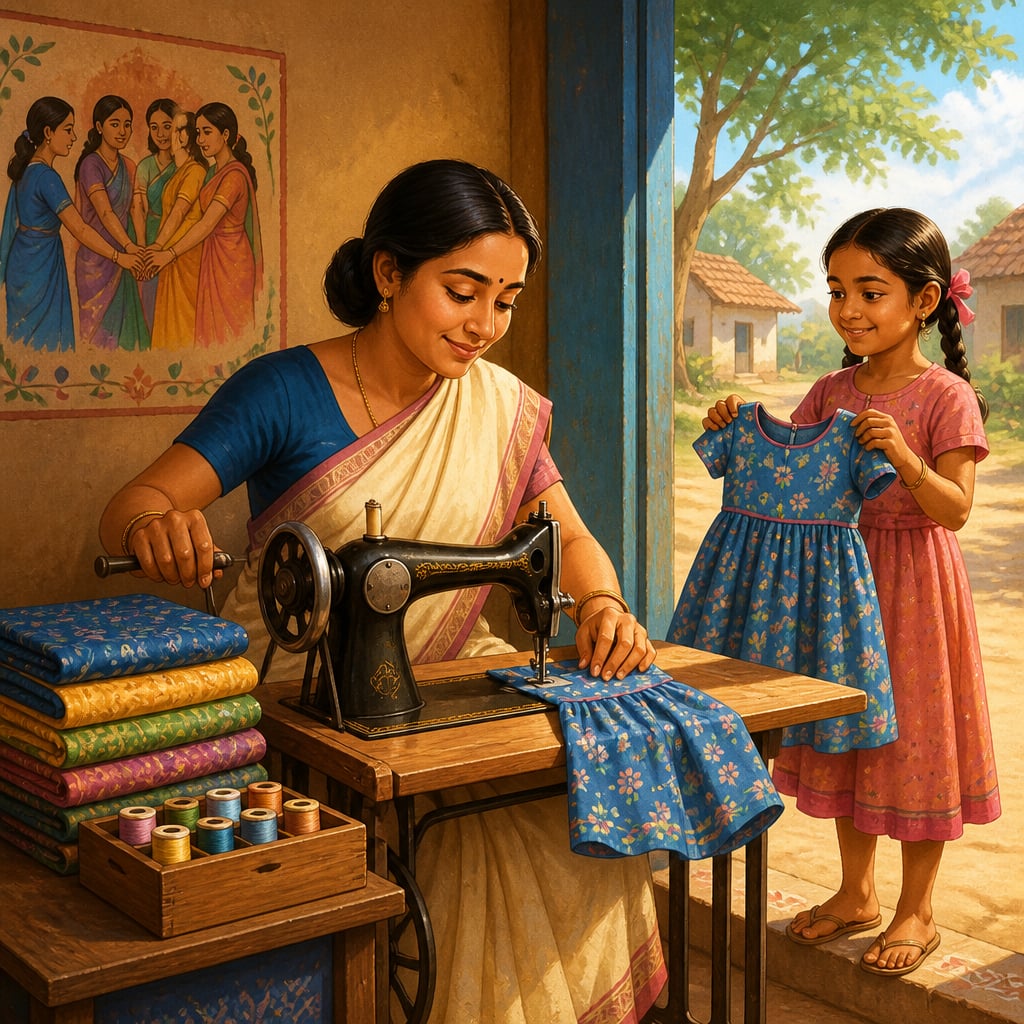
In 2007, Lalitha Kumari of Warangal district, Andhra Pradesh, was the poster child of Indian microfinance. A former agricultural laborer, she had taken a ₹10,000 loan from an MFI (Microfinance Institution), bought a sewing machine, and started a tailoring business. Three years later, she employed two other women and had paid off her loan. "The MFI gave me a chance when no bank would look at me," she told visiting journalists.
In 2010, the same Lalitha Kumari was part of a different story. Her neighbor, unable to repay multiple MFI loans, had committed suicide. The village blamed aggressive collection practices. The state government passed emergency ordinances restricting MFI operations. The industry that had promised to liberate the poor from moneylenders was now being accused of becoming the new moneylender.
This is the paradox of microfinance: an industry born from noble intentions, achieving genuine good, yet capable of causing harm when growth outpaces ethics. Understanding this paradox requires understanding both the economics and the dharma of lending to the poor.
The Dharmic Framework of Lending
The question of lending to the poor, and on what terms, is ancient. The Arthashastra addresses it directly:
ऋणं दत्त्वा धर्मेण वृद्धिं गृह्णीयात्
Ṛṇaṃ dattvā dharmeṇa vṛddhiṃ gṛhṇīyāt
"Having given a loan, one should take interest according to dharma."
Kautilya didn't prohibit interest, he recognized that lenders need returns to sustain lending. But he placed ethical constraints on the practice:
Maximum interest rates:
- Secured loans: 15% annual
- Unsecured loans (to traders): 60% annual
- Unsecured loans (to cultivators): Lower rates during distress
Prohibited practices:
- Compounding interest beyond one year
- Interest exceeding principal (the loan doubling through interest alone)
- Harsh collection from those facing genuine hardship
The Narada Smriti adds:
न शक्यते यद्दातुं तदृणं न ग्राहयेत्
Na śakyate yad dātuṃ tad ṛṇaṃ na grāhayet
"One should not accept as debt what the borrower cannot repay."
This verse anticipates the modern concept of "responsible lending", the lender has a duty to assess the borrower's repayment capacity, not just their desperation.
The dharmic framework sees lending as a necessary economic activity but insists it must be bounded by ethics: fair rates, honest assessment, compassionate collection. When microfinance worked well, it honored these principles; when it failed, it violated them.
Understanding the Poor's Financial Lives
Stuart Rutherford, the British development economist whose book Portfolios of the Poor (2009, co-authored with Daryl Collins, Jonathan Morduch, and Orlanda Ruthven) revolutionized understanding of how poor people manage money, discovered something that challenged conventional assumptions:
"Poor people are not poor because they don't know how to manage money. They're actually very good at it, they have to be, because they have so little margin for error. What they lack is the right financial tools."
Rutherford's research, conducted through detailed "financial diaries" with hundreds of households in India, Bangladesh, and South Africa, revealed:
The poor are active money managers:
- Average poor household used 8-10 different financial instruments
- They save regularly, often daily, in small amounts
- They borrow for productive purposes (business, education) and consumption smoothing (medical emergencies, festivals)
Their core problem is "lump sum accumulation":
- Income is small and irregular
- Major expenses come in lumps (wedding, hospitalization, education fees, business inventory)
- They need mechanisms to convert small flows into occasional large sums
What they need from financial services:
- Reliable: Available when needed, without arbitrary delays
- Convenient: Close to home, simple procedures
- Flexible: Accommodating irregular income patterns
- Safe: Protecting savings from theft, inflation, and family claims
Rutherford's insight: the poor don't need charity, they need appropriate financial products. Microfinance, at its best, provides this. The tragedy occurs when microfinance ignores these realities in pursuit of scale and profit.
| Research Finding | Implication for Microfinance |
|---|---|
| Poor manage multiple instruments | Don't force single-product approach |
| Need lump sums from small flows | Savings products may matter as much as credit |
| Income is irregular | Rigid repayment schedules cause stress |
| They know their own needs | Listen to clients, don't impose solutions |
The Rise of Indian Microfinance
India's formal microfinance sector emerged in the 1990s from two streams:
Stream 1: NGO-led SHG promotion (covered in previous lesson)
- Non-profit, savings-first approach
- Government and donor funded
- Slower growth but strong community roots
Stream 2: Grameen-inspired MFIs
- Professional organizations lending directly to groups
- Initially non-profit, later commercialized
- Faster growth, external capital

Vikram Akula exemplifies the second stream's trajectory. McKinsey-trained, returned to India inspired by Muhammad Yunus's Grameen Bank, he founded SKS Microfinance in 1998 with a simple proposition: use business discipline to scale poverty alleviation.
SKS grew explosively:
- 1998: 1 branch, 1,000 clients
- 2005: 100 branches, 500,000 clients
- 2010: 2,000+ branches, 7+ million clients, ₹7,000+ crore loan portfolio
The growth attracted venture capital: Sequoia Capital, Sandstone, and others invested hundreds of millions. In 2010, SKS listed on the stock exchange, India's first microfinance IPO, raising ₹1,653 crore.
Akula's pitch was compelling: "Profit is not a dirty word. If microfinance is profitable, capital will flow to it, and millions more will be served. If it remains charity, it will always be small."
The question was: could profit-seeking and poverty-alleviation remain aligned?
The Andhra Pradesh Crisis
The answer came in October 2010, when the Andhra Pradesh government, the same state that pioneered SHG-based microfinance, passed an ordinance essentially shutting down MFI operations.
The trigger: a reported wave of suicides linked to MFI debt collection. The underlying causes were complex:
Over-lending:
- Multiple MFIs competed for the same clients
- Same woman might have 4-5 loans from different MFIs
- Total debt exceeded repayment capacity
Aggressive collection:
- Weekly repayments regardless of income fluctuations
- Group pressure (joint liability) became coercive
- Reports of public shaming, harassment
Misaligned incentives:
- Loan officers paid on disbursement, not repayment quality
- MFIs focused on growth to attract investors
- Client welfare became secondary to portfolio metrics
The crisis devastated the industry:
- ₹7,000+ crore in loans defaulted
- Major MFIs nearly collapsed
- Investors lost billions
- Legitimate borrowers lost access to credit
The dharmic lesson: The Narada Smriti's warning, "don't lend what cannot be repaid", had been violated systematically. The drive for growth overrode the responsibility to assess borrower capacity. The ancient principles weren't obsolete; they had been ignored.
The Transformation: From Crisis to Regulation
The Andhra crisis forced a reckoning. The RBI constituted the Malegam Committee (2011), which created a new regulatory framework:
Key regulations:
- Maximum interest rate cap (initially 26%, later adjusted)
- Limit on number of MFIs per borrower (2 maximum)
- Limit on total MFI debt per borrower (₹1 lakh)
- Mandatory credit bureau reporting
- Client protection norms
Industry self-reform:
- Sa-Dhan (industry association) developed code of conduct
- Independent client grievance mechanisms
- Emphasis on savings alongside credit
- Greater investment in financial literacy
The result: a chastened but more sustainable industry. By 2024:
- MFI sector serves 7+ crore unique borrowers
- Gross loan portfolio exceeds ₹4 lakh crore
- Default rates below 2% (down from crisis peaks of 30%+)
- Many MFIs converted to Small Finance Banks (SFBs)
The Bandhan Transformation
The best illustration of post-crisis evolution is Bandhan, founded in 2001 by Chandra Shekhar Ghosh in Kolkata.
Ghosh, a former BRAC (Bangladesh) employee, built Bandhan differently:
Conservative growth:
- Grew steadily but resisted hyper-scaling
- Focused on West Bengal and Northeast (less competitive than AP)
- Never took equity capital that demanded aggressive returns
Client-centric design:
- Flexible repayment schedules
- Savings products alongside loans
- Strong relationship with borrower groups
Ethical foundation:
- Staff trained on responsible lending
- Compensation not purely disbursement-linked
- Long-term client relationships over transaction volume

The transformation:
- 2001: Founded as NGO-MFI
- 2014: Received universal banking license from RBI
- 2015: Launched as Bandhan Bank, India's first MFI to become a full bank
- 2024: 60+ million customers, ₹1.5+ lakh crore deposits, profitable and stable
Bandhan's success challenges the narrative that microfinance must choose between scale and ethics. Ghosh's approach, patient capital, conservative growth, client focus, delivered both impact and sustainability.
Chandra Shekhar Ghosh's philosophy:
"We are not in the business of lending money. We are in the business of changing lives. If you remember that, the money takes care of itself."
This echoes the dharmic principle: artha (wealth) should serve dharma (righteous purpose), not the reverse.
Modern Resonance: Financial Inclusion Today
In 2024, India's financial inclusion landscape has transformed:
Jan Dhan Yojana:
- 50+ crore bank accounts opened since 2014
- Basic banking access nearly universal
Digital payments (UPI):
- 10+ billion monthly transactions
- Mobile-based finance reaching villages
Small Finance Banks:
- 11 SFBs serving underbanked populations
- Many (like Bandhan, Ujjivan, Equitas) originated as MFIs
MFI sector matured:
- Better regulated, better governed
- Integrated with formal banking system
- Focus shifting from credit to comprehensive financial services
The microfinance revolution succeeded, not by replacing formal finance but by proving that the poor are bankable, forcing traditional banks to take notice, and eventually integrating into the mainstream financial system.
Your Turn: Evaluating Financial Services
Whether evaluating an MFI, a fintech app, or a traditional bank, apply the dharmic framework:
1. Is the lending responsible?
- Does the lender assess capacity to repay?
- Are loan sizes appropriate to income?
- Is there protection against over-indebtedness?
2. Are terms transparent?
- Is the effective interest rate clearly stated?
- Are there hidden fees or charges?
- Is the total cost of the loan understandable?
3. Are collection practices ethical?
- Is there flexibility for genuine hardship?
- Are borrowers treated with dignity?
- Is there a grievance mechanism?
4. Is the purpose aligned?
- Does the institution serve client welfare or just extract profit?
- Is growth sustainable or reckless?
- Would you trust them with your own family's finances?
The ancient wisdom remains relevant: lending is legitimate, interest is acceptable, but both must be bounded by dharma. The best financial institutions, whether traditional or modern, honor this balance.
In our next lesson, we'll see this balance achieved in two remarkable Indian cooperatives: Amul in dairy and SEWA in women's empowerment, organizations that built billion-dollar impact while staying true to community purpose.
Modern consumer protection regulations (like the US Dodd-Frank Act's 'ability to repay' rule for mortgages) require lenders to assess borrower capacity. This emerged after the 2008 financial crisis, when predatory lending contributed to mass defaults. India's post-Andhra microfinance regulations embody similar principles.
The dharmic framework provides deeper grounding than regulatory compliance alone. When lenders internalize that over-lending is adharma, not just illegal but ethically wrong, it shapes behavior beyond what rules can mandate. The best MFIs post-crisis adopted this mindset.
Pre-crisis, some MFI borrowers had 5+ loans from different institutions. Post-regulation, with credit bureau checks, average is 1.4 loans per borrower, implementation of the ancient 'don't lend beyond capacity' principle.
Business school literature discusses 'mission drift', when social enterprises lose sight of purpose in pursuit of financial metrics. The SKS story is a textbook case. Muhammad Yunus warned against equity investments that create 'profit pressure' incompatible with social mission.
The dharmic framework provides clearer guidance: profit should serve dharmic purpose, not vice versa. Organizations like Bandhan, SEWA, and Amul show that sustainable scale is possible without sacrificing mission. The key: patient capital and governance aligned with purpose.
Pre-crisis MFIs averaged 40%+ ROE (return on equity), higher than most banks. Post-crisis, regulated returns are moderate (15-20% ROE), sustainable, and compatible with client welfare. Lower returns can mean better alignment.
Key terms
- Sukshma-Vitta (Microfinance)
- Small-scale finance, lending and financial services designed for the poor who are excluded from traditional banking due to lack of collateral, credit history, or formal income documentation.
- Kusida
- Money-lending, the practice of lending money at interest. In Dharmashastra, kusida is recognized as a legitimate economic activity but subject to ethical constraints on rates and practices.
- Uttaradayi Rin (Responsible Lending)
- Lending that assesses borrower capacity, provides transparent terms, and avoids practices that lead to over-indebtedness or harm.
- Vittiya Samaveshan (Financial Inclusion)
- The process of ensuring access to appropriate financial services for all, particularly those traditionally excluded from formal banking.
Key figures
Dharmic Principles on Lending (Arthashastra and Dharmashastra Traditions)
Established the principle that lending must be bounded by dharma, that profit-seeking in finance must coexist with ethical constraints. The framework anticipated modern concepts like interest rate caps, responsible lending, and borrower protection by over two millennia.
Vikram Akula
Demonstrated that microfinance could achieve massive scale through commercial approaches: standardized products, technology-enabled operations, and professional management. SKS served 7+ million clients at its peak. However, also demonstrated the risks: growth-at-all-costs mentality, misaligned incentives, and loss of client focus.
Stuart Rutherford
Challenged the assumption that poor people need to be 'taught' financial management. His research showed they're already skilled managers who lack appropriate tools. Shifted microfinance focus from just credit to comprehensive financial services including savings, insurance, and flexible products that match irregular income patterns.
Case studies
Bandhan: From Microfinance to Universal Bank
In 2001, when Chandra Shekhar Ghosh founded Bandhan in Kolkata, the Indian microfinance sector was entering its boom phase. Venture capitalists were pouring money into MFIs; growth rates of 100%+ annually were celebrated. Ghosh took a different path. **The Bandhan Approach:** 1. **Patient growth**: Ghosh grew at 40-50% annually while competitors grew 100%+. "We are building for decades, not for an exit," he said. 2. **Regional focus**: Rather than racing for national coverage, Bandhan concentrated on West Bengal and Northeast, building deep relationships before expanding. 3. **Savings emphasis**: Unlike credit-only MFIs, Bandhan (as an NBFC-MFI and later bank) prioritized savings collection, building client assets alongside providing loans. 4. **Flexible products**: Recognizing Stuart Rutherford's insight about irregular income, Bandhan designed products with flexible repayment options. 5. **Staff culture**: Loan officers were trained as 'development workers,' not just salespeople. Compensation wasn't purely disbursement-linked. **The crisis test (2010):** When the Andhra crisis hit, most MFIs suffered massive defaults. Bandhan, with minimal Andhra exposure and stronger client relationships, emerged relatively unscathed, a validation of its approach.
Bandhan's journey embodies the dharmic principle of sustainable progress over explosive growth. Ghosh's patience, accepting slower growth for deeper impact, reflects the teaching that dharmic action considers long-term consequences, not just immediate results. The savings emphasis respects client autonomy: rather than just extracting repayments, Bandhan helped clients build assets. This is the difference between kusida (extractive lending) and vittiya samaveshan (true financial inclusion). Most significantly, when given the opportunity to become a universal bank (2014), Bandhan didn't abandon microfinance, it integrated poor clients into mainstream banking. This is inclusion in its fullest sense: not a separate system for the poor, but the same system serving all.
Bandhan's transformation metrics: **2001 (founding):** - 1 branch, Kolkata - NGO-MFI model - Few thousand clients **2014 (banking license):** - India's first microfinance institution to receive universal banking license - RBI recognition of sustainable, client-focused model **2024:** - 60+ million customers - ₹1.5+ lakh crore in deposits - 5,600+ banking outlets - Profitable and stable - India's 8th largest private bank by market cap **Client outcomes:** - Average client relationship: 7+ years (vs. 2-3 years for crisis-era MFIs) - Graduation from microloans to MSME loans to full banking services - First-generation bank account holders becoming savings and investment customers
The Bandhan story proves that purpose and profit can align when governance prioritizes the former. Ghosh didn't reject commercial approaches, he used them differently. Patient capital, regional depth, savings focus, and client-centric products created sustainable scale. The dharmic lesson: when artha serves dharma, both flourish; when artha abandons dharma, both eventually fail.
Bandhan's journey from NGO to universal bank challenges the prevailing Silicon Valley assumption that disruption requires moving fast and breaking things. Patient, purpose-driven scaling, with governance preceding growth, is now recognized as a viable alternative path to institutional scale.
Bandhan's founder Chandra Shekhar Ghosh was named on Fortune's 'World's 50 Greatest Leaders' list (2016) and received the Ernst & Young Social Entrepreneur of the Year award, recognition that ethical finance can achieve global recognition.
Historical context
Ancient Principles to Modern Practice
India's microfinance sector evolved through distinct phases: NGO experimentation (1980s-90s), commercial growth (2000s), crisis and regulation (2010-2015), and integration/maturation (2015-present). The sector served as a laboratory for understanding how to finance the poor, with both successful innovations (group lending, credit bureaus) and costly failures (over-lending, aggressive growth).
India's microfinance sector is the largest in the world by client numbers. However, the Andhra crisis distinguished India's experience from more gradual evolution elsewhere. The regulatory response, RBI oversight, interest caps, credit bureau mandates, became a model for other countries. India also led in MFI-to-bank conversions, showing a path from specialized to mainstream finance.
India's MFI sector serves 7+ crore unique borrowers with ₹4+ lakh crore in outstanding loans, larger than the entire banking sectors of many countries.
The microfinance story illustrates broader principles: markets serving the poor can work but require ethical constraints; growth without guardrails causes harm; profit motive can scale impact but must be subordinated to purpose. These lessons apply beyond microfinance to technology, healthcare, education, any sector where commercial approaches engage vulnerable populations.
Living traditions
Microfinance's legacy extends beyond the surviving institutions. The sector proved that poor people are creditworthy, forcing traditional banks to take notice. Jan Dhan Yojana, Small Finance Banks, and priority sector lending requirements all build on this proof. The crisis taught equally valuable lessons: about the need for regulation, the dangers of growth without ethics, and the importance of client focus. These lessons inform fintech regulation today.
- Weekly Group Meetings: Despite digitization, most MFI lending still happens through group meetings where 10-20 women gather, make repayments, and access new loans. The social collateral of group solidarity remains the foundation of microfinance methodology.
- Credit Bureau Integration: Post-crisis, all MFI loans are reported to credit bureaus (CRIF High Mark, Equifax). Before disbursing, MFIs check borrower history, preventing the over-lending that caused the 2010 crisis. This invisible infrastructure protects borrowers from themselves and from aggressive lenders.
- Financial Literacy Programs: Many MFIs now include financial education as part of their service: explaining interest calculations, importance of savings, avoiding over-indebtedness. This addresses Stuart Rutherford's insight that the poor need appropriate tools, not just access.
- Bandhan Bank Head Office, Kolkata: The headquarters of India's largest MFI-turned-bank. The building symbolizes the transformation from NGO to mainstream financial institution while serving the same client base.
- Sa-Dhan (Microfinance Industry Association), New Delhi: The self-regulatory organization that developed ethical codes post-crisis. Sa-Dhan's office houses archives of industry evolution, from boom through crisis to current regulated state.
- MFIN (Microfinance Institutions Network): The industry body representing NBFC-MFIs. Visitors can understand how the sector organizes for self-regulation, data sharing, and coordinated advocacy.
- Dharmasthala Rural Development Project: The Dharmasthala temple trust operates one of India's most successful ethical microfinance programs, providing interest-free loans and demonstrating temple-based community finance
- Mahalakshmi Temple: As the abode of the goddess of wealth, this temple's philosophy of 'wealth with dharma' resonates with ethical microfinance; local SHGs and MFIs invoke her blessing for financial ventures
Reflection
- The microfinance story reveals tension between scaling impact and preserving ethics. SKS reached millions but lost its mission; Bandhan grew slowly but sustained its purpose. In your own life and career, how do you navigate similar tensions? When growth opportunities arise, how do you assess whether they align with your core values? Is there a dharmic framework that helps you make such decisions?
- Apply the dharmic lending framework to evaluate a financial product you use or are considering: a credit card, personal loan, investment platform, or fintech app. Does the provider assess your capacity to repay? Are terms transparent? Are collection practices ethical? Would you recommend it to a family member with limited financial sophistication? What changes would make the product more dharmic?