Rashtriyakaran: The 1969 Bank Nationalization

A Midnight Decision That Transformed Indian Banking

On July 19, 1969, Prime Minister Indira Gandhi nationalized 14 major private banks in a dramatic midnight announcement. The move extended SBI's developmental mandate to the entire banking system, but sparked debates about state control, efficiency, and political interference that continue today. This lesson offers a balanced assessment: what nationalization achieved, what problems it created, and what lessons it offers for governance.

The Midnight Stroke
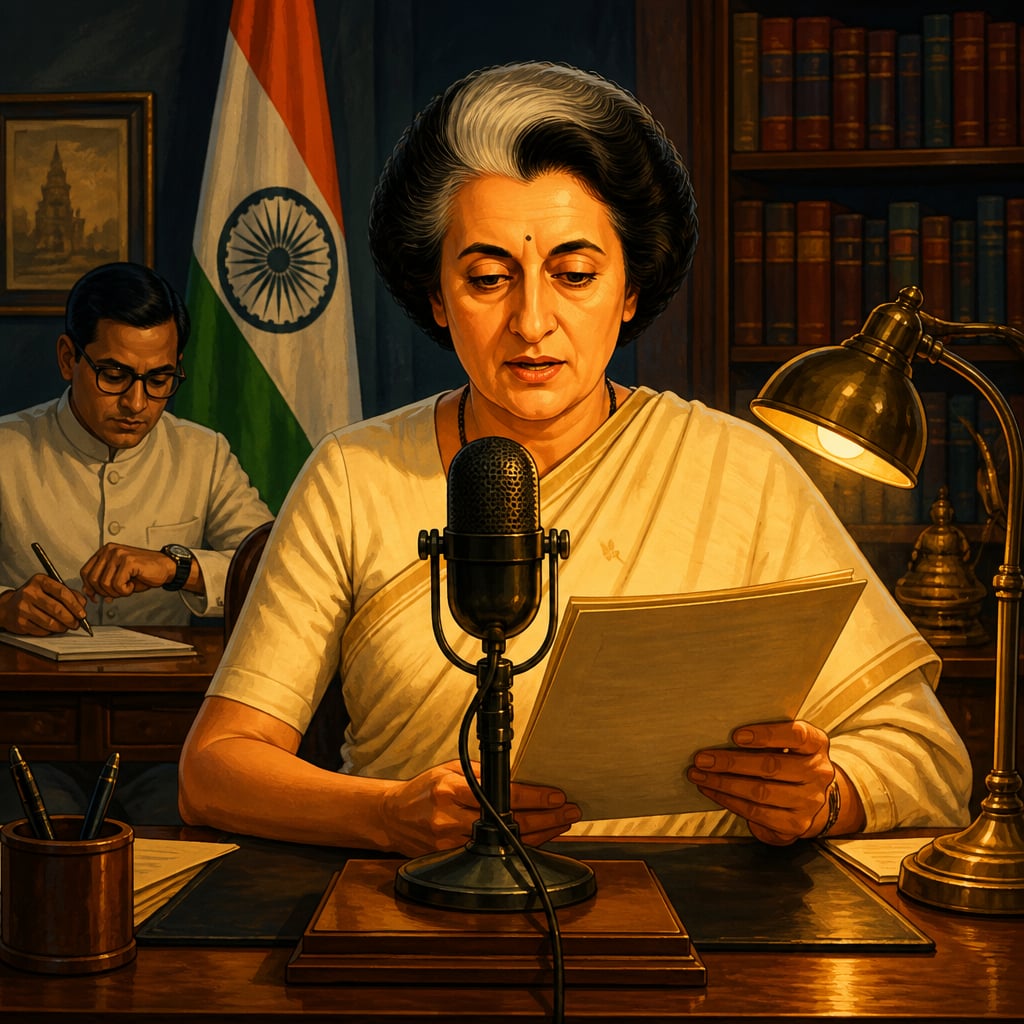
Indira Gandhi reading the bank nationalization ordinance on All India Radio on July 19 1969

July 19, 1969, 8:30 PM. All India Radio interrupted its regular programming for a special announcement. Prime Minister Indira Gandhi's voice came through: "The nation has decided that the fourteen major banks should be nationalized..."

Across India, bank managers learned from radio broadcasts that their institutions now belonged to the government. The President's ordinance was signed; legal challenges were anticipated; the announcement came first.

The decision had been made in secrecy. Even Deputy Prime Minister Morarji Desai, who opposed nationalization, learned of it only hours before the announcement. The political drama was deliberate: Indira Gandhi was fighting for control of her own party against the Congress "Syndicate" of senior leaders. Bank nationalization was both economic policy and political masterstroke.

But beyond the politics lay a genuine question: Could private banking, left to market forces, ever serve India's developmental needs? Or did inclusion require state ownership?

The Context: Why Private Banking Failed Inclusion

To understand the 1969 nationalization, we must understand what private banking looked like before it.

The Numbers of Exclusion:

The Banking Concentration: Five banking groups controlled over 50% of deposits: Tata-affiliated banks, Birla-affiliated banks, and other industrial house banks. Credit flowed to affiliated industries, not to developmental priorities.

"यत्र योगेश्वरः कृष्णो यत्र पार्थो धनुर्धरः। तत्र श्रीर्विजयो भूतिर्ध्रुवा नीतिर्मतिर्मम॥" "Where there is Krishna, the Lord of Yoga, and Arjuna the wielder of the bow, there is fortune, victory, prosperity, and sound policy." , Bhagavad Gita 18.78

The nationalization advocates argued that banking without developmental purpose was banking without niti (sound policy). Private banks served their owners; the nation needed banks that served its people.

The Failed Voluntary Measures:

Before nationalization, the government had tried regulation: social control mechanisms (1967) required banks to lend to priority sectors. But compliance was weak, enforcement difficult. Banks found ways around requirements while maintaining lending to affiliated industries.

As Indira Gandhi told Parliament: "We tried persuasion. We tried regulation. Private banking would not change. The only option left was ownership."

The Political Drama: Indira vs. The Syndicate

The 1969 nationalization cannot be understood without understanding Indira Gandhi's political situation.

After the 1967 elections, Congress lost eight states. Party elders, the "Syndicate" led by Kamaraj, Nijalingappa, and Morarji Desai, blamed Indira's leadership. They sought to reduce her to figurehead Prime Minister.

Indira fought back. Bank nationalization was her weapon:

The Political Logic:

The Syndicate's Opposition: Morarji Desai called nationalization "a fraud on the people." He argued it would breed inefficiency, political interference, and corruption. The party split: Indira's Congress (R) versus the Syndicate's Congress (O).

The Legal Battle: R.C. Cooper, a bank shareholder, challenged nationalization in court. The Supreme Court initially struck down the ordinance on procedural grounds (Cooper case, 1970). Indira responded with constitutional amendments enabling nationalization. The battle demonstrated her political will, and set precedent for executive-judicial tensions.

Actor Position Argument
Indira Gandhi For nationalization Private banking serves private interests; developmental needs require state ownership
Morarji Desai Against Nationalization breeds inefficiency; regulation can achieve inclusion
R.C. Cooper Legal challenge Property rights violated; compensation inadequate
Industrial houses Against (privately) Loss of captive credit sources; reduced influence

What Nationalization Actually Did

The Banking Companies (Acquisition and Transfer of Undertakings) Act, 1970 (after the constitutional amendment) transferred ownership of 14 banks to the government. A second round in 1980 nationalized six more.

The Structural Change:

The Mandate Change: Nationalized banks were explicitly directed to:

The Cultural Change: Bank officers, previously oriented toward urban, industrial lending, were reoriented toward rural, agricultural, small-business lending. Training programs, performance metrics, and promotion criteria all shifted.

The Achievements: What Nationalization Got Right

A balanced assessment requires acknowledging nationalization's genuine achievements:

Rajasthan farmer receiving his first crop-loan passbook at a 1972 nationalized branch

Branch Expansion:

Credit Reorientation:

Deposit Mobilization:

The Inclusion Effect: Millions of Indians, farmers, small traders, first-generation entrepreneurs, accessed formal credit for the first time. The moneylender's grip weakened; formal finance entered villages.

As economist Vijay Joshi notes: "Whatever the efficiency costs, nationalization achieved what private banking never would: taking banking to rural India."

The Problems: What Nationalization Got Wrong

A balanced assessment must also acknowledge the problems nationalization created or failed to solve:

Efficiency Decline:

Political Interference:

The NPA Accumulation:

Loss of Autonomy:

Dimension Achievement Problem
Inclusion Dramatic branch expansion; credit to priority sectors Quality of credit; many "fake" accounts
Efficiency Deposit mobilization succeeded Operating costs rose; technology lagged
Governance Democratic control of credit Political interference in decisions
Sustainability Short-term expansion achieved Long-term NPAs accumulated

Indira Gandhi: The Architect's Vision and Limitations

Indira Priyadarshini Gandhi (1917-1984) made bank nationalization her signature economic policy. Understanding her reveals both the vision and limitations.

Her Vision: Indira genuinely believed that private capital would never serve India's poor. Her slogan "Garibi Hatao" (Remove Poverty) required institutions that served the poor, not profits. Nationalization was instrument of this vision.

She was influenced by socialist thinking, Fabian socialism, Soviet planning, and Indian leftist economists. But she was also pragmatist: nationalization served political purposes even as it expressed ideological conviction.

Her Limitations: Indira's approach embedded the problems that would plague nationalized banks:

Her Legacy: Indira's bank nationalization achieved inclusion at the cost of efficiency and sustainability. The trade-off was real, not imaginary. Whether it was worth it depends on how you weight inclusion versus efficiency, a question with no objectively correct answer.

The Long-Term Consequences: NPAs and Resolution

The problems accumulated during nationalization era eventually became crisis. The NPA story illustrates long-term consequences of short-term political choices.

The NPA Buildup:

The Crisis Point (2015-2018):

NCLT bench hearing an Insolvency and Bankruptcy Code resolution plan in Delhi

The Resolution Mechanisms:

Modern Resonance: The Nationalization Debate Today

The 1969 nationalization debate continues in different forms:

The Ongoing Trade-off: India retains significant public sector banking (PSBs hold ~60% of deposits). Critics argue for privatization to improve efficiency; defenders argue that inclusion requires continued public ownership.

The 2019 Merger Logic: PM Modi's merger of 10 PSBs into 4 large banks echoed 1921's Imperial Bank consolidation, but with different purpose. Scale for efficiency, not extraction; consolidation to reduce fragmentation, not to concentrate extraction.

The Privatization Debate: The 2021 budget proposed privatizing two PSBs. Unions oppose; efficiency advocates support; the debate continues. The question remains: can private banking serve inclusion, or does inclusion require public ownership?

The Fintech Challenge: Digital finance may transcend the debate. UPI, payment banks, and digital lending serve inclusion through technology rather than ownership structure. Perhaps nationalization's purpose can be achieved without nationalization's structure.

Your Turn: Assessing Trade-offs

The 1969 nationalization offers lessons about governance trade-offs:

Inclusion vs. Efficiency: Nationalization achieved inclusion that private banking wouldn't have; it also reduced efficiency. Both effects were real. Pretending there's no trade-off, that nationalization was purely positive or negative, misses the complexity.

Short-term vs. Long-term: Political imperatives favored short-term inclusion gains; long-term NPAs accumulated. Governance that ignores long-term consequences creates problems successors must solve.

Control vs. Autonomy: Government control enabled developmental direction; it also enabled political interference. The same instrument served both purposes.

Structure vs. Purpose: Nationalization assumed that ownership structure determines behavior. But structure doesn't guarantee purpose; nationalized banks can still fail their mandate. Perhaps regulating behavior matters more than owning structures.

In our next lesson, we'll examine how post-liberalization reforms attempted to retain nationalization's inclusion benefits while addressing its efficiency costs, a balancing act that continues today.

Economics recognizes trade-offs as fundamental: efficiency vs. equity; growth vs. stability; short-term vs. long-term. The nationalization debate was essentially about which trade-off to accept: inclusion with efficiency loss, or efficiency without inclusion guarantee.

India's post-1991 approach attempts to have both: public sector banks for inclusion guarantee, private banks for efficiency competition, common regulation for both. This isn't perfect synthesis, but it's attempt to minimize trade-offs rather than accept them as binary choice.

Nationalized banks achieved 19x branch expansion (1969-1991) while efficiency (cost/income ratio) deteriorated from 35% to 60%+. The trade-off was real: inclusion up, efficiency down. Acknowledging this enables better policy design.

Management literature extensively studies the 'execution gap', why good strategies fail in implementation. The nationalization case illustrates: good intentions (inclusion) combined with rushed execution (midnight ordinance, inadequate systems) produced mixed outcomes.

India's subsequent reforms learned from nationalization's execution failures. SBI merger (2017) was announced with preparation; IBC (2016) was designed before implementation; UPI rollout (2016) was tested before scale. Patience in execution improves outcomes.

The 1969 nationalization was announced before systems, training, or governance frameworks were ready. The 2019 PSB merger, by contrast, was prepared over 18 months before announcement. Implementation quality improved from learning nationalization's lessons.

Key terms

Rāṣṭrīyakaraṇa
Nationalization, the transfer of private enterprise ownership to the state. The 1969 bank nationalization transferred 14 major banks from private (mostly industrial house) ownership to government ownership, fundamentally restructuring Indian banking.
Prāthamika Kṣetra Ṛṇa
Priority sector lending, the RBI mandate that banks lend a specified percentage (currently 40%) to designated priority sectors: agriculture, MSMEs, education, housing, export credit, and weaker sections. This was nationalization's primary operational mechanism.
Anārjaka Parisampatti
Non-performing asset (NPA), a loan where interest and/or principal payments are overdue beyond 90 days. NPAs accumulated during the nationalization era became systemic crisis decades later, requiring massive recapitalization and institutional reform.
Līḍa Baiṅka Yojanā
Lead Bank Scheme, the 1969 framework assigning each district to a specific bank responsible for banking development in that area. This operationalized nationalization's inclusion mandate, making banks accountable for district-level financial inclusion.

Verses

यत्र योगेश्वरः कृष्णो यत्र पार्थो धनुर्धरः। तत्र श्रीर्विजयो भूतिर्ध्रुवा नीतिर्मतिर्मम॥

yatra yogeśvaraḥ kṛṣṇo yatra pārtho dhanurdharaḥ | tatra śrīrvijayo bhūtirdhruvā nītirmatirmama ||

Where there is Krishna, the Lord of Yoga, and Arjuna the wielder of the bow, there is fortune, victory, prosperity, and sound policy. This is my conviction.

The *niti* dimension of economic policy requires both vision and prudence. Nationalization had vision (inclusion) but lacked prudence (about efficiency, NPAs, political interference). Sound policy requires both, wisdom guiding action, not just action justified by vision. The gap between intention and execution is where policies fail.

Bhagavad Gita, Chapter 18, Verse 78 (Swami Sivananda translation)

षाड्गुण्यमाश्रित्य विगृह्य च सन्धत्ते। विगृह्य च बलवानेव पश्चात्सन्धत्ते॥

ṣāḍguṇyamāśritya vigṛhya ca sandatte | vigṛhya ca balavāneva paścātsandatte ||

Using the six measures of statecraft, one attacks and then makes peace. The strong one attacks first and then makes peace from strength.

Economic policy often operates through power dynamics, not just efficiency logic. Nationalization was politically successful, it consolidated Indira's position and established a new consensus. Whether it was economically successful is separate question. Kautilya reminds us: policy analysis must include power analysis. Who benefits? Who loses? What equilibrium results?

Arthashastra, Book 7, Chapter 1 (R.P. Kangle translation)

दानधर्मप्रशस्तेषु क्षमा दानात्परं स्मृतम्। दानं तु कुपितः कुर्यात् क्षमां कुर्यादकोपितः॥

dānadharmapraśasteṣu kṣamā dānātparaṃ smṛtam | dānaṃ tu kupitaḥ kuryāt kṣamāṃ kuryādakopitaḥ ||

Among the virtues of charitable duty, patience is remembered as superior to giving. An angry person may give, but only one without anger can show patience.

Policy implementation requires patience that political urgency often denies. Nationalization's problems, inadequate systems, unprepared staff, political interference, stemmed partly from speed born of political necessity. The lesson: even correct policies, implemented without patience, generate avoidable costs.

Shanti Parva, Mahabharata, Chapter 56 (K.M. Ganguli translation)

Key figures

Indira Gandhi

Prime Minister of India (1966-1977, 1980-1984); architect of the 1969 bank nationalization · 1917-1984

Morarji Desai

Deputy Prime Minister (1967-1969); opponent of nationalization; later Prime Minister (1977-1979) · 1896-1995

K.V. Kamath

Banker; former CEO of ICICI Bank; first chairman of New Development Bank (BRICS Bank); chaired committee on bank NPA resolution · 1947-present

Case studies

The NPA Crisis and Resolution: Nationalization's Long Shadow

By 2018, India's public sector banks were drowning in bad loans. Gross NPAs exceeded Rs. 10 lakh crore, 11.5% of total advances. Several banks were placed under RBI's Prompt Corrective Action framework, effectively frozen from new lending. Credit growth collapsed; the economy suffered. The roots traced back to nationalization: - **Lending Practices**: Nationalized banks had developed cultures of lending without adequate credit assessment, priority sectors required lending, not repayment - **Political Interference**: Bank appointments remained political; lending decisions sometimes reflected political pressure rather than creditworthiness - **Recovery Reluctance**: Recovering loans from farmers, small businesses, or politically connected borrowers was practically difficult and politically costly - **Ever-greening**: Rather than recognizing bad loans, banks often lent more to cover interest, postponing recognition, not solving problems **The Resolution Mechanisms:** - **Insolvency and Bankruptcy Code (2016)**: Created time-bound resolution framework; removed political discretion from resolution process - **RBI's Asset Quality Review (2015)**: Forced honest recognition of NPAs; ended ever-greening - **Recapitalization (2017-2021)**: Government injected Rs. 3.5+ lakh crore to restore bank health - **NARCL/Bad Bank (2021)**: Created to absorb legacy NPAs, cleaning bank balance sheets - **PSB Mergers (2019)**: Consolidated 10 banks into 4, creating larger, theoretically more efficient entities

The NPA crisis and resolution illustrate dharmic principles in institutional context: **Satya (Truth)**: The Asset Quality Review forced honest recognition of problems that had been hidden. Ever-greening was untruth; honest NPA recognition was painful satya. Resolution began when truth was acknowledged. **Kshama (Patience)**: Resolution took years, IBC processes, recapitalization, mergers. Quick fixes weren't possible; patient institutional work was required. The crisis couldn't be solved with the same urgency that created it. **Danda (Enforcement)**: IBC created consequences for default that political considerations had previously prevented. Without credible enforcement, credit discipline couldn't exist. Danda enabled dharmic lending. **Karma and Consequences**: The NPA crisis demonstrated that actions (nationalization-era lending) have consequences (decades-later crisis). Ignoring long-term consequences doesn't eliminate them; it transfers them to successors.

By 2024, the NPA crisis had substantially resolved: **NPA Reduction**: Gross NPAs fell from 11.5% (2018) to ~3% (2024) **Bank Health**: PSB profitability restored; most banks removed from PCA framework **Credit Revival**: Bank credit growth resumed, though below pre-crisis levels **Institutional Change**: IBC became established; resolution mechanisms institutionalized **The Lessons:** - Problems created over decades require years to resolve - Honest recognition (satya) is precondition for resolution - Enforcement mechanisms (danda) are necessary for credit discipline - Recapitalization treats symptoms; institutional reform addresses causes **The Ongoing Work:** Nationalization's shadow hasn't entirely lifted. PSB governance remains political; efficiency lags private banks; the debate about privatization continues. Resolution of crisis doesn't mean resolution of underlying structural questions.

Institutional problems accumulate gradually and resolve slowly. The NPA crisis, rooted in nationalization-era practices, took decades to build and years to address. Honest recognition (not denial or ever-greening) was precondition for resolution. Patient institutional work (not quick political fixes) achieved resolution. Consequences of past decisions shape present possibilities.

China's current real estate debt crisis (Evergrande, Country Garden) mirrors India's NPA crisis almost exactly: politically-driven lending, delayed recognition, and eventual taxpayer-funded resolution. India's IBC framework is now being studied as a model for China's own resolution process.

Resolution took massive resources: Rs. 3.5+ lakh crore in recapitalization; Rs. 2.5+ lakh crore in IBC resolutions; Rs. 50,000+ crore for NARCL. The cost of delayed honesty was borne by taxpayers. Earlier truth-telling would have been cheaper.

Historical context

Post-Independence India (1969)

The 1969 nationalization occurred amid political crisis (Congress split), economic challenges (food shortages, industrial stagnation), and ideological ferment (socialist vs. market debates). Indira Gandhi used nationalization to consolidate power while addressing genuine developmental failures of private banking. The move was genuinely popular, seen as action against industrial monopolies that controlled banks. But it was also politically calculated, positioning Indira as champion of the poor against 'capitalist' party elders. Both dimensions were real and intertwined.

India's bank nationalization was neither unique nor extreme by global standards. France nationalized banks in 1945 and 1982; UK nationalized multiple banks; many developing countries pursued similar policies. What distinguished India was the combination of political drama and developmental mandate. Unlike Western nationalizations focused on financial stability, India's explicitly emphasized developmental purpose: credit to priority sectors, branches in rural areas, banking for the masses. This developmental framing shaped how nationalization was implemented, and what problems resulted.

Between 1969 and 1991: bank branches increased from 8,187 to 60,220 (7x); deposits from Rs. 4,646 crore to Rs. 2,00,000+ crore (43x); priority sector lending from 14% to 40%. The numbers show achievement; they don't show the efficiency costs that accompanied them.

Understanding the 1969 nationalization illuminates ongoing debates about public versus private provision of essential services. The trade-offs it exposed, inclusion vs. efficiency, political control vs. commercial autonomy, remain central to policy debates. India's current approach (public banks competing with private banks under common regulation) attempts synthesis, but the underlying tensions persist.

Living traditions

Nationalization's legacy is contested but undeniable: **The Inclusion Achievement**: India's banking network, 150,000+ branches reaching 700+ districts, is nationalization's physical legacy. Private banks alone wouldn't have built this infrastructure; the mandate required public ownership. **The Efficiency Cost**: PSBs continue to lag private banks in cost efficiency, technology adoption, and customer service. The efficiency gap, rooted in nationalization-era structures, persists despite decades of reform. **The Governance Challenge**: PSB appointments, lending decisions, and strategic choices remain influenced by political considerations. The governance problems Morarji Desai predicted have proven real, and persistent. **The Ongoing Debate**: Proposals to privatize PSBs continue nationalization's debate in new form. The underlying question, can markets serve inclusion, or does inclusion require public ownership, remains unresolved.

Reflection

More in Colonial Disruption to Modern Banking

All lessons in Colonial Disruption to Modern Banking · Banking & Finance Heritage of Bharat course