Aupanaveshik Vinash: How Britain Undermined Indigenous Banking
The Systematic Destruction of a 2,000-Year-Old Financial System
When the British arrived, India's indigenous banking system, built on Shroffs, Sahukars, and the legendary Jagat Seths, financed empires and facilitated global trade. Within a century, deliberate colonial policies had dismantled this sophisticated network. This lesson traces how legislative acts, currency manipulation, and institutional displacement destroyed Indian banking, and what this reveals about economic colonialism.
The Night the Jagat Seths Fell
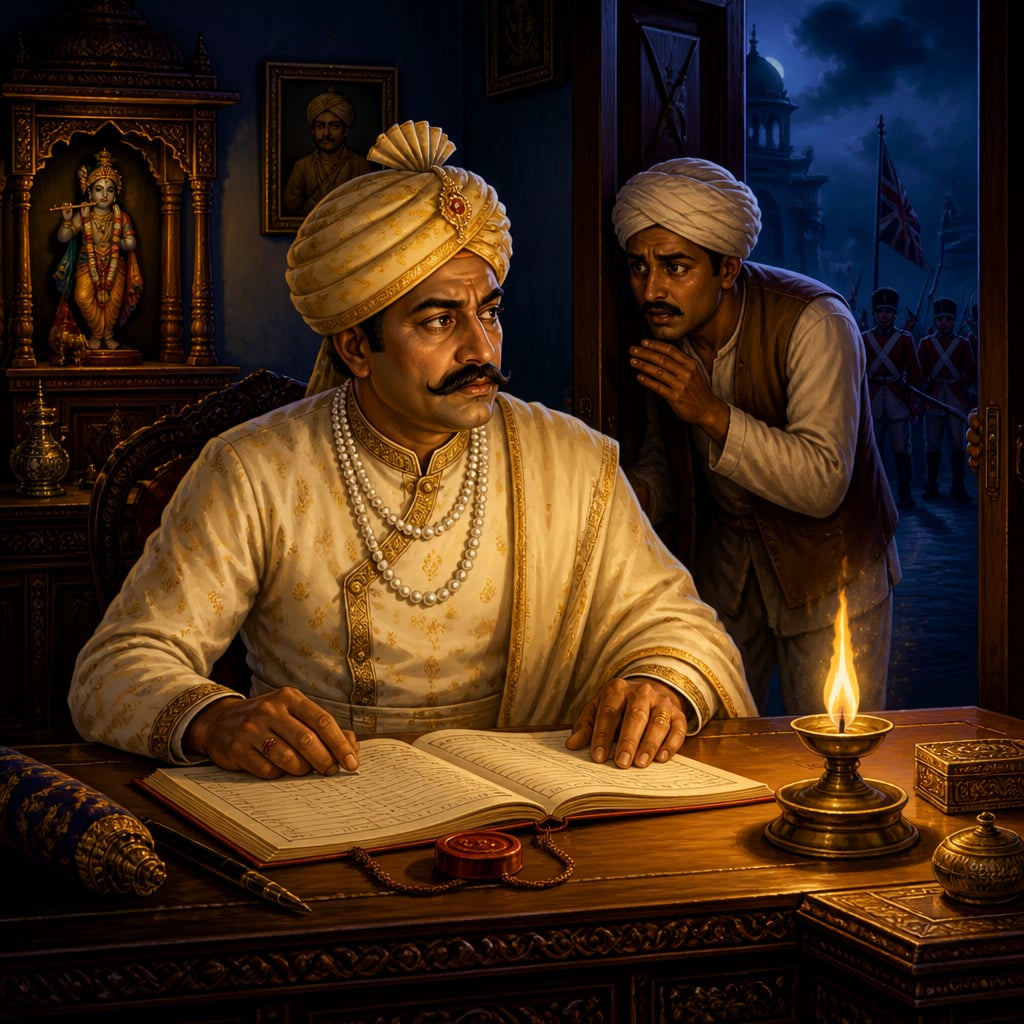
June 24, 1763. In a dimly lit chamber in Murshidabad, Bengal's capital, Mahtab Chand, the reigning Jagat Seth, "Banker to the World", received visitors he knew would kill him. Mir Qasim's assassins had come to eliminate the man whose family had financed the Mughal Empire for three generations.
But this wasn't merely political murder. It was the symbolic death of indigenous Indian banking itself.
Just six years earlier, at the Battle of Plassey (1757), the Jagat Seths had made a fateful choice: they had secretly financed Robert Clive's conspiracy against Nawab Siraj ud-Daulah, believing the British East India Company would be easier to manage than an erratic Nawab. They were catastrophically wrong.
The British didn't need Indian bankers. They would build their own system, and systematically destroy the one that had existed for two millennia.
The System They Destroyed
To understand the magnitude of colonial destruction, we must first grasp what existed before.
By 1750, India possessed arguably the world's most sophisticated decentralized banking network. The Shroffs verified currency across 150+ monetary systems. The Sahukars provided credit at rates that would make modern microfinance jealous. The Hundis, indigenous bills of exchange, moved money from Surat to Dhaka faster than physical transport allowed. And at the apex sat banking houses like the Jagat Seths, whose credit notes were honored from Bengal to Kabul.
This wasn't primitive finance. Economic historian Tirthankar Roy estimates that pre-colonial India had over 9,000 active Shroff houses, more than the number of bank branches in Britain at the time. The Jagat Seth house alone held reserves exceeding £3 million sterling, equivalent to the entire capital of the Bank of England.
"न हि ज्ञानेन सदृशं पवित्रमिह विद्यते।" "There is nothing as purifying as knowledge in this world." , Bhagavad Gita 4.38
The indigenous banking system ran on jnana (knowledge) accumulated over generations and vishwasa (trust) earned through dharmic conduct. A Sahukar's word was literally worth gold, because his reputation was his capital.
The Colonial Assault: Death by a Thousand Acts
The British didn't destroy Indian banking in a single blow. They did it through systematic legislation, each act tightening the noose.
Phase 1: Capture the Currency (1773-1835)
The Regulating Act of 1773 gave the East India Company control over Bengal's finances. By 1793, the Permanent Settlement had transferred land revenue collection from indigenous networks to Company-appointed zamindars, breaking the Sahukar's traditional role as intermediary.
But the decisive blow came with the Coinage Act of 1835. This act imposed a single standardized silver rupee across British India, eliminating the monetary diversity that had sustained Shroff expertise for centuries. Overnight, the Shroff's primary function, navigating between 150+ currency systems, became obsolete.
Phase 2: Control the Paper (1861-1882)
The Paper Currency Act of 1861 gave the British government monopoly over paper currency issuance. The hundi, India's indigenous bill of exchange that had moved millions across continents, was suddenly competing with government-backed notes it could never match.

The Negotiable Instruments Act of 1881 codified British commercial law, making hundis legally inferior to English-style bills of exchange. Indigenous financial instruments weren't banned, they were simply made second-class.
Phase 3: Replace the Institutions (1806-1921)
The British established Presidency Banks, Bank of Bengal (1806), Bank of Bombay (1840), Bank of Madras (1843), as official government bankers. These weren't additions to the system; they were replacements. Government contracts, revenue collection, and official transactions were systematically channeled away from indigenous bankers.
By 1921, when these three merged into the Imperial Bank of India, indigenous banking had been pushed to the margins, surviving only in spaces the colonial system didn't care to occupy.
Colonial Perspectives: The Ideology of Destruction
The destruction wasn't accidental. It was ideological.
Thomas Babington Macaulay (1800-1859), architect of British India's education and legal systems, expressed the colonial mindset clearly. His infamous 1835 "Minute on Education" declared the goal of creating "a class of persons Indian in blood and colour, but English in tastes, in opinions, in morals and in intellect." This cultural replacement extended to economics: indigenous systems were deemed primitive, requiring British "civilization."
James Wilson (1805-1860), founder of The Economist magazine, came to India in 1859 as Finance Member of the Viceroy's Council. He designed the income tax system, paper currency framework, and financial administration that displaced indigenous banking. Wilson died in Calcutta within a year, but his systems outlived him by a century.
John Maynard Keynes (1883-1946), before becoming the 20th century's most influential economist, served in the India Office (1906-1908). His first book, Indian Currency and Finance (1913), analyzed the colonial monetary system he had helped administer. Later, Keynes would acknowledge the extractive nature of colonial economics, but by then, the damage was done.
| Colonial Actor | Role | Impact on Indigenous Banking |
|---|---|---|
| Macaulay | Cultural/Legal policy | Delegitimized indigenous systems as 'backward' |
| James Wilson | Financial architecture | Created competing colonial institutions |
| Keynes | Monetary policy | Administered currency system that displaced hundis |
The Drain: Quantifying the Destruction
Contemporary scholars have calculated the economic impact with devastating precision.
Utsa Patnaik, economist at Jawaharlal Nehru University, calculated that Britain extracted approximately £45 trillion (in 2017 values) from India between 1765 and 1947. This wasn't just taxation, it was systematic de-capitalization of indigenous financial networks.
Sanjeev Sanyal, Principal Economic Advisor to the Government of India, notes that India's share of world GDP fell from 24.4% in 1700 to 4.2% by 1950. The indigenous banking system that had facilitated this wealth creation was deliberately dismantled.
Shashi Tharoor, in Inglorious Empire (2017), synthesizes this research for popular audiences: "Britain's rise was built on India's systematic impoverishment", and the destruction of indigenous banking was central to this extraction.
The numbers are staggering, but they miss the deeper loss: the institutional knowledge accumulated over two millennia. When a Shroff family that had tested coins for 400 years was driven out of business, their expertise died with them. When Sahukar networks that had financed agriculture for generations were replaced by colonial moneylenders, the vishwasa relationships built over centuries evaporated.
Modern Resonance: Why This Matters in 2025
The colonial destruction of indigenous banking isn't merely historical grievance. It explains structural features of India's financial system that persist today.
The Trust Deficit: India's formal banking sector still struggles to reach rural populations, not because of technology gaps, but because the trust networks that once connected villages to financial systems were deliberately destroyed. When RBI Governor Shaktikanta Das emphasizes "financial inclusion," he's addressing a gap colonialism created.

The Cooperative Alternative: Interestingly, India's most successful financial inclusion initiatives have revived indigenous principles. The Self-Employed Women's Association (SEWA) Bank, founded by Ela Bhatt in 1974, explicitly modeled itself on pre-colonial trust-based lending. Amul's cooperative model echoes the Shreni (guild) systems that once governed indigenous commerce.
The Policy Lesson: The 2023 reforms to cooperative banking regulation, bringing urban cooperative banks under RBI supervision, represent India still grappling with the institutional vacuum colonialism created. As Finance Minister Nirmala Sitharaman noted, strengthening cooperatives means rebuilding "the financial infrastructure that serves those formal banking has failed to reach."
Your Turn: Learning from Destruction
The colonial destruction of indigenous banking offers lessons beyond historical awareness.
First, systems of trust take generations to build but can be destroyed in decades. The British didn't need to ban indigenous banking, they simply made it irrelevant through institutional displacement. Watch for similar dynamics in today's economy: which traditional systems are being displaced not by superior alternatives, but by policy choices?
Second, institutional knowledge is a national asset. The expertise of Shroff families, accumulated over centuries, was lost forever. What indigenous knowledge systems today deserve protection and revival?
Third, economic colonialism operates through mundane mechanisms, currency acts, legal codes, institutional preferences. The destruction looked like modernization at the time. Critical analysis requires looking past proclaimed intentions to actual effects.
In our next lesson, we'll examine what rose from the ashes: the Presidency Banks that became the Imperial Bank, and eventually the State Bank of India, institutions that inherited colonial structures while slowly incorporating dharmic principles of inclusion.
Social capital / Institutional trust as economic infrastructure
Robert Putnam's research on social capital shows that trust networks determine economic performance more than formal institutions. Francis Fukuyama's Trust (1995) argues that high-trust societies achieve prosperity that low-trust societies cannot replicate through institutions alone.
The indigenous banking system was a 'high-trust' network embedded in community relationships. Colonial replacement with impersonal institutions destroyed this social capital. The persistent struggle of formal banking to reach rural India reflects not technological failure but the trust deficit colonialism created.
Even in 2024, after decades of financial inclusion efforts, 190 million Indian adults remain unbanked (World Bank Global Findex). Many of these populations were served by indigenous networks before colonialism, the trust infrastructure that connected them to finance was destroyed faster than it could be replaced.
Joseph Schumpeter's 'creative destruction' is often invoked to justify displacing traditional systems. But the colonial case shows that displacement can be merely destructive, replacing sophisticated indigenous solutions with inferior colonial ones that served extraction, not efficiency.
India's post-independence insistence on financial sovereignty, nationalizing banks, maintaining capital controls, building domestic payment systems, reflects lessons learned from colonial displacement. The 'inefficiencies' critics cite are often features preserving what colonialism tried to destroy.
Key terms
- Aupaniveśika Vināśa
- Colonial destruction, the systematic dismantling of indigenous institutions, economies, and knowledge systems by colonial powers. In banking context, refers to the deliberate policy-driven elimination of India's sophisticated indigenous financial networks.
- Viśvāsa
- Trust, faith, confidence, the foundational principle of indigenous Indian banking. Unlike contract-based Western banking, the Shroff-Sahukar system operated on accumulated reputation and community trust that made legal enforcement largely unnecessary.
- Preśiḍensī Baiṅk
- The three banks, Bank of Bengal (1806), Bank of Bombay (1840), Bank of Madras (1843), established by the British East India Company as official government bankers in each Presidency. These institutions systematically displaced indigenous banking from official transactions.
- Dravya-Niṣkāsana
- Drain of wealth, the systematic extraction of capital from India to Britain without equivalent return. First articulated by Dadabhai Naoroji in 1867, this theory explained how colonial financial structures enabled wealth transfer that impoverished India.
Verses
न हि ज्ञानेन सदृशं पवित्रमिह विद्यते। तत्स्वयं योगसंसिद्धः कालेनात्मनि विन्दति॥
na hi jñānena sadṛśaṃ pavitramiha vidyate | tatsvayaṃ yogasaṃsiddhaḥ kālenātmani vindati ||
There is nothing in this world as purifying as knowledge. One who is perfected in yoga finds this knowledge within themselves in due course of time.
Modern economists recognize 'tacit knowledge', expertise that cannot be codified or transferred through manuals. The indigenous banking system embodied centuries of tacit knowledge about local economies, community trust, and financial relationships. When colonialism destroyed these institutions, this knowledge was lost forever, explaining why post-independence banking struggled to reach populations that indigenous systems had served for millennia.
Bhagavad Gita, Chapter 4, Verse 38 (Swami Sivananda translation)
कोशमूलो दण्डः। दण्डमूलाश्चतस्रो विद्याः।
kośamūlo daṇḍaḥ | daṇḍamūlāścatasro vidyāḥ |
Power is rooted in the treasury. The four branches of knowledge are rooted in power.
Modern development economics confirms Kautilya's insight: financial infrastructure determines development capacity. The destruction of indigenous banking wasn't a side effect of colonialism, it was the mechanism. Without autonomous financial institutions, India couldn't retain, invest, or multiply its own wealth. The colonial treasury became a siphon, not a reservoir.
Arthashastra, Book 2, Chapter 9 (R.P. Kangle translation)
निक्षेपस्य न नाशोऽस्ति यत्र विश्वासपूर्वकम्। धर्मस्थानं धनस्थानं विश्वासः परमं धनम्॥
nikṣepasya na nāśo'sti yatra viśvāsapūrvakam | dharmasthānaṃ dhanasthānaṃ viśvāsaḥ paramaṃ dhanam ||
Where trust precedes, deposits are never destroyed. The abode of dharma is the abode of wealth, trust is the supreme treasure.
Modern behavioral economics recognizes 'trust' as economic infrastructure. Harvard economist Stephen Knack's research shows that a 15% increase in trust correlates with 1% higher GDP growth. The colonial destruction of trust networks, replacing *vishwasa*-based Sahukars with impersonal colonial banks, created a trust deficit India still addresses through financial inclusion efforts.
Narada Smriti, Vyavahara Prakarana, Interest and Deposits (Julius Jolly edition)
Key figures
Mahtab Chand (Jagat Seth)
Last effective head of the Jagat Seth banking dynasty; the most powerful indigenous banker at the moment of colonial conquest · 1718-1763
Thomas Babington Macaulay
British politician, historian, and architect of colonial India's education and legal systems; member of the Supreme Council of India (1834-1838) · 1800-1859
John Maynard Keynes
Economist; served in India Office (1906-1908); later became the 20th century's most influential economic theorist · 1883-1946
Case studies
SEWA Bank and Amul: Reviving Indigenous Banking Principles
In 1974, Ela Bhatt faced a problem that colonial banking had created: self-employed women in Ahmedabad, vegetable vendors, garment workers, waste recyclers, could not access formal credit. Banks demanded collateral they didn't have, documentation they couldn't provide, and minimum deposits they couldn't afford. These women had been served by indigenous financial networks before colonialism; now they were 'unbankable.' Bhatt's solution: create a bank that operated on pre-colonial principles. The Self-Employed Women's Association (SEWA) Bank was registered as a cooperative, but its operating principles came from the Sahukar tradition. Loans were guaranteed by community reputation, not collateral. Savings groups (*mandalis*) pooled resources as traditional *chit funds* had done for centuries. Trust, *vishwasa*, replaced legal enforcement. Similarly, Amul, founded in 1946 as a cooperative of milk producers, explicitly rejected the colonial model of corporate extraction. Verghese Kurien designed Amul on principles that echoed the *Shreni* (guild) systems that had governed indigenous commerce: collective ownership, distributed profits, quality controlled by community reputation.
SEWA Bank and Amul succeeded where formal banking failed because they understood what colonialism destroyed: financial inclusion requires *trust infrastructure*, not just financial infrastructure. The dharmic analysis: **Vishwasa over Collateral**: SEWA's group guarantee system, where five women vouch for each other's loans, replicates the Sahukar model where community reputation secured credit. Formal banks externalize trust to legal systems; SEWA internalized it into community relationships. **Seva over Extraction**: Amul's cooperative model, where farmers own the processing, and profits return to producers, reverses colonial extraction. The colonial system drained wealth upward; Amul distributes it outward. **Parampara over Disruption**: Both institutions build on traditional practices rather than displacing them. SEWA's *mandalis* are modern *chit funds*. Amul's quality councils are modern *Shrenis*. This continuity enables trust that 'disruptive' alternatives cannot achieve.
SEWA Bank, by 2024, serves over 500,000 women with cumulative lending exceeding ₹800 crores. More remarkably, repayment rates exceed 96%, higher than most commercial banks achieve with collateralized lending. The bank operates profitably while serving customers formal banking deems 'unbankable.' Amul has become India's largest food brand, with 2024 turnover exceeding ₹72,000 crores ($8.5 billion). Its 3.6 million farmer-members receive roughly 80% of the consumer rupee, compared to 30-40% in corporate dairy models. The cooperative has been replicated across India's dairy sector, transforming India from a milk importer to the world's largest producer. Both demonstrate that indigenous principles aren't 'backward', they're sophisticated adaptations that formal systems cannot replicate. The colonial destruction of indigenous banking created problems that indigenous principles, revived, solve better than colonial successors.
Financial inclusion succeeds when it rebuilds what colonialism destroyed, not through nostalgic revival but through principled adaptation. SEWA and Amul don't reject modernity; they refuse to accept that colonial institutions are the only form modernity can take. The path forward lies through recovering what was lost, not imitating what replaced it.
The global cooperative banking sector (credit unions, mutual banks, cooperative banks) serves over 375 million members worldwide. These institutions consistently show lower failure rates than commercial banks during crises, validating the indigenous trust-based model that SEWA and Amul revived.
India's cooperative banking sector, institutions operating on indigenous trust principles, now serves 300 million members with deposits exceeding ₹16 lakh crores ($190 billion). These aren't relics; they're the fastest-growing segment of India's financial system, reaching populations that a century of 'modern' banking could not serve.
Historical context
Colonial India (1757-1947)
At the moment of colonial conquest, India's indigenous banking system was among the world's most sophisticated. The Jagat Seth house alone held reserves exceeding the Bank of England's capital. Hundi networks moved money from Surat to Patna faster than physical transport. Shroffs navigated 150+ currencies with expertise developed over centuries. This system financed not just commerce but empires, no Mughal administration functioned without Sahukar credit. Within a century, this system was systematically dismantled, not through market competition but through policy displacement. Each colonial act narrowed the space for indigenous banking until only margins remained.
The destruction of Indian indigenous banking had no parallel in other colonized regions. African traditional finance was informal and local; Indian banking was institutionalized and continental. China's qianzhuang survived into the 20th century because China was never fully colonized. Only India experienced the systematic dismantlement of a sophisticated financial system that had operated successfully for millennia. The contrast with Japan is instructive. During the Meiji restoration (1868-1912), Japan modernized its banking system by adapting Western methods while preserving indigenous practices. India had no such choice, its 'modernization' was imposed by colonizers who sought extraction, not development.
According to economic historian Angus Maddison, India's share of world GDP fell from 24.4% in 1700 to 4.2% by 1950. This collapse correlates precisely with colonial control. The destruction of indigenous banking wasn't incidental to this decline, it was the mechanism that enabled wealth extraction.
Understanding colonial destruction of indigenous banking reveals that India's financial challenges aren't signs of inherent backwardness but scars of deliberate destruction. The struggle for financial inclusion is a struggle to rebuild what was systematically dismantled. Policy approaches that ignore this history, treating India as a blank slate requiring Western financial transplants, repeat colonial assumptions and achieve colonial results.
Living traditions
The Reserve Bank of India's 2023 reforms bringing cooperative banks under unified regulation represent ongoing attempts to address the institutional vacuum colonialism created. PM Modi's Jan Dhan Yojana, opening 500 million accounts since 2014, explicitly aims to rebuild financial inclusion that existed before colonial destruction. UPI's success (16 billion monthly transactions in 2024) builds on indigenous principles: peer-to-peer trust, low-friction exchange, community networks. India's fintech revolution isn't despite its traditional financial culture, it's a recovery of principles colonialism suppressed.
- Chit Funds (Kuri in Kerala, Chitty in Tamil Nadu): Rotating savings and credit associations that operate on trust-based principles identical to pre-colonial *mandalis*. Participants contribute monthly; one member receives the pool each month. No interest in the dharmic sense, just collective savings and mutual access. Kerala alone has ₹40,000+ crores in registered chit fund circulation.
- Self-Help Groups (SHGs): India's 12+ million SHGs serving 140 million women operate on Sahukar principles: group reputation guarantees loans, community relationships replace collateral, peer accountability substitutes for legal enforcement. The National Rural Livelihoods Mission explicitly builds on indigenous trust networks.
- Informal Hawala Networks: Though often associated with illicit finance, hawala operates on the same principles as the hundi: trust-based value transfer without physical money movement. Legal hawala continues serving legitimate remittances, particularly in regions where formal banking remains inaccessible.
- Murshidabad, West Bengal
- SEWA Bank Headquarters, Ahmedabad
- Anand, Gujarat (Amul HQ)
- Jagannath Temple Treasury, Puri: One of India's oldest functioning temple treasuries, managing donated wealth for centuries. The temple's financial administration, accepting deposits, managing assets, distributing prasad, embodies pre-colonial financial principles that survived colonialism through religious protection.
- Murshidabad Katra Mosque and Jagat Seth Ruins: The ruins of the Jagat Seth mansion and nearby Katra Mosque mark where India's most powerful indigenous bankers operated before colonial destruction. The site is a memorial to what colonialism destroyed, a banking system that financed empires and facilitated trade across continents.
Reflection
- The Jagat Seths believed they could manage the British as they had managed previous rulers, and their miscalculation proved fatal. In your own life and career, how do you distinguish between partners who seek genuine collaboration and those who seek displacement? What warning signs might the Jagat Seths have missed, and what equivalent signs should you watch for?
- SEWA Bank and Amul succeeded by reviving indigenous principles rather than copying Western models. Identify one domain in your professional or personal life where 'modern' solutions have failed. What traditional or indigenous approach might work better? Design a small experiment to test this hypothesis.