Kautilya and Adam Smith

Markets, Trade, and Wealth Creation

Adam Smith showed how self-interest, channeled through markets, creates prosperity for all. But Kautilya understood this two millennia earlier - his Arthashastra contains sophisticated analysis of trade, taxation, and economic growth. Both saw that wealth comes from exchange, not hoarding.

The Invisible Hand and the Visible State
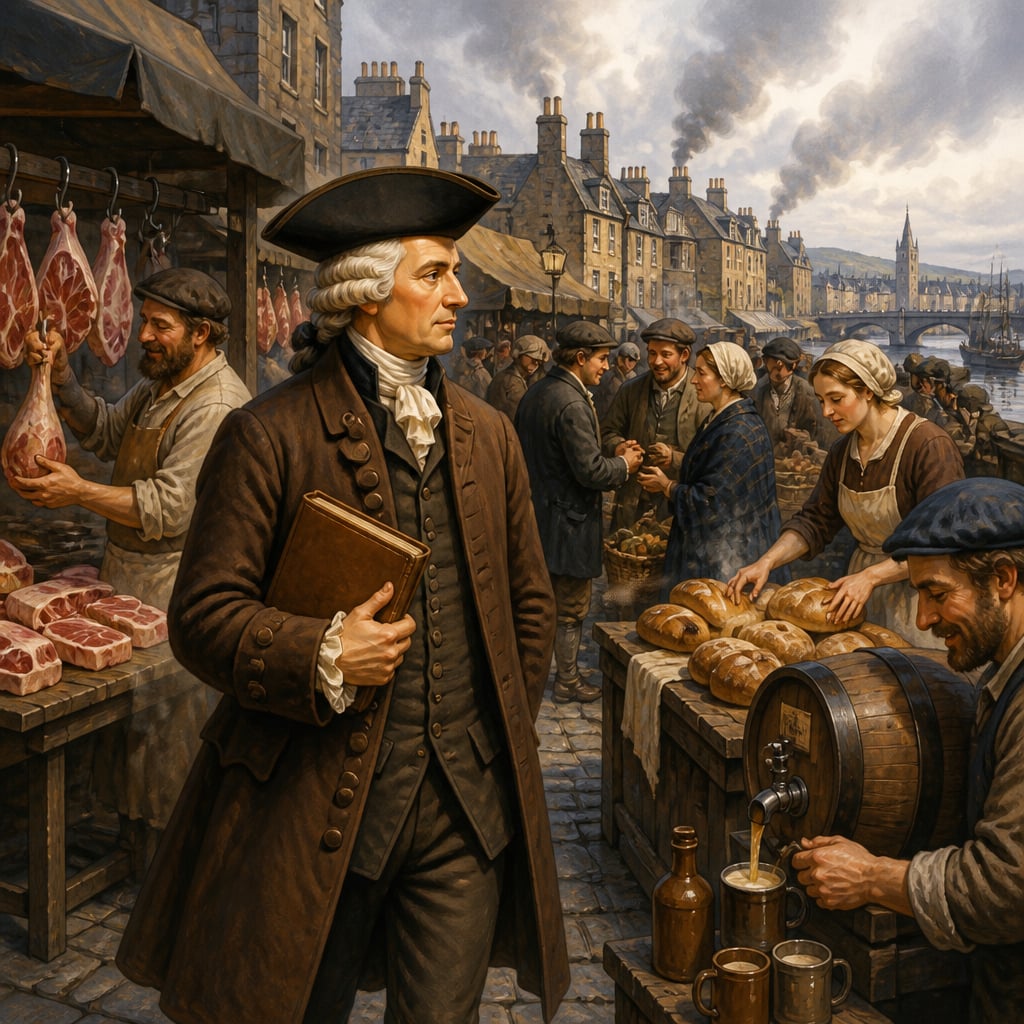
Adam Smith observing tradesmen in a Glasgow market street, 1763

Adam Smith was walking through the streets of Glasgow in 1763 when he noticed something peculiar. The pin factory he'd just visited employed ten workers. Each could make perhaps twenty pins a day working alone. But by dividing labor - one drawing wire, another straightening, another cutting - the factory produced 48,000 pins daily.

From this observation grew The Wealth of Nations (1776), the book that founded modern economics. Smith's central insight: voluntary exchange and specialization create more wealth than any central planner could imagine.

"It is not from the benevolence of the butcher, the brewer, or the baker that we expect our dinner, but from their regard to their own interest."

The invisible hand of the market coordinates millions of self-interested actors into productive cooperation.

Two thousand years earlier, another observer of markets had reached remarkably similar conclusions. Kautilya watched traders move goods across the Mauryan Empire and understood that commerce creates wealth:

"वाणिज्यं कृषिपशुपाल्ये च राष्ट्रस्य वृद्धिकरम्" - Trade, agriculture, and animal husbandry are the sources of the kingdom's growth.

Both understood something revolutionary: prosperity doesn't come from hoarding gold or conquering neighbors. It comes from exchange.

Wealth is Made, Not Found

Before Smith and Kautilya, most rulers thought wealth was a fixed quantity. If you got richer, someone else got poorer. The goal was to accumulate gold, either by mining it or taking it from others.

This mercantilist view dominated European thought until Smith demolished it.

But Kautilya never held it. The Arthashastra treats wealth as something created through productive activity, not just redistributed:

"The treasury has its source in mines and agriculture; with the treasury, the army is maintained; with the treasury and the army, the earth is acquired."

Notice the logic: wealth comes from production (mines, agriculture), not conquest. Conquest requires wealth, not the reverse. The king who wants power must first create prosperity.

The Market as Information System

Smith's invisible hand works because prices communicate information. When demand rises, prices rise, signaling producers to make more. When supply increases, prices fall, telling consumers to buy. No central planner could process this information - but markets do it automatically.

Kautilya understood this too. The Arthashastra contains sophisticated discussion of:

A Mauryan royal trade superintendent recording market prices and quantities

"The superintendent of trade shall know the value of goods according to their quality, the time of year, and the distance traveled."

This isn't central planning - it's using market information to govern wisely. Kautilya wanted officials to understand prices so they could tax fairly and prevent fraud, not to set prices themselves.

Free Trade vs. Protection

Smith was a passionate advocate of free trade. Tariffs and trade barriers harm consumers by raising prices. Countries should specialize in what they do best and trade for the rest.

Kautilya was more pragmatic - but not protectionist. He favored:

"Foreigners who import goods into the country shall be treated with favor; they shall be exempt from lawsuits and from being sued for debts."

This is strikingly liberal for any era - foreign traders receive legal protection and tax benefits. Kautilya understood that attracting commerce requires making your kingdom a good place to do business.

Taxation and Growth

Both Smith and Kautilya grasped the relationship between taxation and economic growth.

Smith argued that taxes should be:

  1. Proportionate to ability to pay
  2. Certain and predictable (not arbitrary)
  3. Convenient to pay
  4. Efficient to collect (not costing more than they raise)

Kautilya had anticipated all four principles:

  1. Proportionality: The famous one-sixth standard, with variations for conditions
  2. Predictability: Fixed rates, publicly known
  3. Convenience: Collection at harvest time when farmers have produce
  4. Efficiency: Professional tax collectors with oversight against corruption

The gardener metaphor captures the economic logic:

"Like a gardener who gathers flowers and fruits without harming the trees, the king should collect revenue without harming the sources."

Overtaxation destroys the productive base. The king who wants revenue should help the economy grow, then take a modest share of a larger pie.

The Role of Government

Here Smith and Kautilya diverge somewhat.

Smith favored minimal government. Beyond defense, justice, and some public works, the state should stay out of the economy. Government intervention usually makes things worse.

Kautilya gave the state a larger role:

But this wasn't socialism. Kautilya's state operated within markets, not against them. State enterprises competed with private ones. Price controls were emergency measures, not permanent policy.

The difference reflects context: Smith wrote for a commercial society with mature markets; Kautilya wrote for an empire being built from fragmented kingdoms.

Division of Labor

Smith's pin factory illustrated how specialization multiplies productivity. Each worker focusing on one task becomes expert, saves time switching, and enables machine use.

Kautilya recognized the same principle, though he described it in terms of occupational castes:

"The four varnas and four ashramas, when they work according to their prescribed duties, maintain the order of the world."

We needn't endorse caste to see the economic insight: specialization creates wealth. Farmers should farm; merchants should trade; warriors should fight. Everyone trying to do everything produces poverty.

Modern economists call this comparative advantage: even if you could do everything, you should do what you do best and trade for the rest.

Money and Currency

Both thinkers understood money's role in facilitating exchange.

Smith explained that money solves the "double coincidence of wants" problem - you need to find someone who has what you want AND wants what you have. Money makes exchange indirect and therefore possible.

Kautilya devoted considerable attention to coinage:

"The superintendent of the mint shall issue currency of known weight and fineness."

Sound money requires trust. Kautilya understood that a reliable currency is public infrastructure, as important as roads.

Modern Applications

The Smith-Kautilya synthesis points toward what works in development:

Trade openness: Countries that trade grow faster. Both East Asian miracles and India's post-1991 growth confirm this.

Property rights: Smith and Kautilya both emphasized that secure property enables investment. Modern development economics agrees.

Limited taxation: The Laffer Curve - that excessive tax rates reduce revenue - is Kautilya's gardener principle with modern data.

Rule of law: Both saw that markets require legal frameworks. Today's strongest economies have the most reliable courts.

Infrastructure: Both supported public investment in roads, bridges, and irrigation. Private commerce needs public foundations.

Where They Converge

Despite different contexts, Smith and Kautilya shared core insights:

  1. Wealth is created through production and exchange, not conquest or hoarding
  2. Self-interest, properly channeled, serves the common good
  3. Trade benefits both parties, or it wouldn't happen
  4. Excessive taxation destroys the tax base
  5. Markets need legal frameworks to function
  6. Specialization multiplies productivity

These insights aren't Western or Eastern - they're human. Different civilizations discovered them because they're true.

Your Turn

Look around you. How many people contributed to what you're using right now?

Your phone involves miners, factory workers, programmers, designers, shippers, retailers - thousands of people who never met you, coordinated through markets to put that device in your hand.

This is the invisible hand - and the visible kingdom - at work. Neither Smith nor Kautilya could have imagined modern supply chains, but both understood the principle: voluntary exchange, specialized labor, and the accumulation of many small gains create abundance that no single mind could plan.

What would happen if those exchanges stopped? That's the world without markets - the world both thinkers wanted to prevent.

Smith's critique of mercantilism made the same point: gold isn't wealth; productive capacity is wealth. Modern economic growth theory confirms that innovation and exchange create new value.

Kautilya provides the state's perspective: if you want a rich treasury, grow the economy. Conquest and extraction are less effective than enabling production. This is counterintuitive but empirically correct.

Finance Minister Manmohan Singh delivering the 1991 liberalization budget

Post-WWII Japan and Germany grew rich through trade, not conquest. Their earlier military approach impoverished them. The positive-sum path worked better than the zero-sum path.

Arthur Laffer drew his famous curve on a napkin in 1974, showing that zero tax and 100% tax both produce zero revenue. Kautilya understood this relationship with his gardener analogy.

Kautilya provides specific guidance: one-sixth as baseline, with adjustments for circumstances. This operationalizes the principle. He also ties tax policy to investment in productive infrastructure.

Ireland's corporate tax cuts in the 1990s attracted foreign investment, grew the economy, and ultimately increased total tax revenue. They harvested flowers without harming the tree.

David Ricardo formalized comparative advantage: even if one country is better at everything, both gain by specializing and trading. Smith understood this intuitively; Kautilya applied it practically.

Kautilya provides the implementation: legal protections for foreign merchants, tax incentives for imports the kingdom needs, infrastructure investment in trade routes. He operationalized pro-trade policy.

Singapore has no natural resources but became wealthy by being the easiest place in Asia to do business. It literally honored foreign merchants - and they made Singapore rich.

Verses

वाणिज्यं कृषिपशुपाल्ये च राष्ट्रस्य वृद्धिकरम्

vāṇijyaṃ kṛṣi-paśu-pālye ca rāṣṭrasya vṛddhikaram

Trade, agriculture, and animal husbandry cause the growth of the kingdom.

Kautilya identifies the sources of prosperity as productive activities, not conquest or gold accumulation. This is Smith's insight two millennia early: wealth comes from economic activity, not from taking it from others.

Book 2, Chapter 16, Verse 1-5 (R.P. Kangle)

यथा माली फलपुष्पं गृह्णीयात् वृक्षं न हिंसयेत्

yathā mālī phala-puṣpaṃ gṛhṇīyāt vṛkṣaṃ na hiṃsayet

As a gardener takes fruits and flowers without harming the tree, so should the king collect revenue.

This is the Laffer Curve in metaphor: there's an optimal tax rate. Too low and the treasury is empty; too high and you destroy the productive base.

Book 2, Chapter 1, Verse 17-19 (L.N. Rangarajan)

आगन्तुकं वणिजं सर्वत्र पूजयेत्

āgantukaṃ vaṇijaṃ sarvatra pūjayet

Foreign merchants should be honored/welcomed everywhere.

This is pro-trade policy avant la lettre. Kautilya understood that attracting foreign commerce requires making your kingdom hospitable.

Book 2, Chapter 16, Verse 10-15 (R. Shamasastry)

Case studies

India's 1991 Liberalization

Facing a balance of payments crisis in 1991, India abandoned four decades of socialist economic policy. Finance Minister Manmohan Singh opened the economy to trade and investment, reduced regulations, and welcomed foreign business - policies that echo both Smith and Kautilya.

The liberalization can be seen as India recovering its Kautilyan heritage. Welcoming foreign merchants, reducing trade barriers, simplifying regulations - all this is in the Arthashastra. The License Raj was the aberration; market-friendly policy was the ancient norm.

India's GDP growth accelerated from 3% to 7%+ annually. Poverty fell dramatically. A middle class of hundreds of millions emerged. India became a major player in global technology and services.

Both Smith and Kautilya would recognize India's liberalization as following their prescriptions: honor merchants, reduce barriers, let trade flourish. The results confirmed their analysis: wealth comes from exchange, not control.

India's continued liberalization, from GST implementation in 2017 to production-linked incentive schemes in 2020, follows the same trajectory. Each reform that reduces barriers and honors productive activity generates measurable GDP growth, confirming that the 1991 opening was not a one-time event but an ongoing validation of these principles.

India's GDP growth rate jumped from an average of 3.5% (the so-called 'Hindu rate of growth') before 1991 to 6.4% in the decade after liberalization. Foreign direct investment rose from $132 million in 1991 to $46 billion by 2008.

Historical context

Comparison across eras (c. 300 BCE and 1776 CE)

The Mauryan economy was remarkably sophisticated - standardized weights and measures, a royal mint, extensive road networks, and trade connections reaching the Mediterranean. Kautilya's economic thought emerged from practical governance needs.

Modern India's economic liberalization can be seen as recovering Kautilyan insights after centuries of colonial and socialist deviation. The convergence of Smith and Kautilya shows that market-friendly policies aren't Western imports but rediscovered truths.

Living traditions

Economic policy worldwide reflects the Smith-Kautilya synthesis: free trade with strategic government investment, low-but-adequate taxation, property rights protection, and infrastructure development. The 'Asian Tiger' economies followed this formula; India's post-1991 liberalization did too. These aren't competing traditions but converging insights.

Reflection

More in Kautilya's Legacy

All lessons in Kautilya's Legacy · Arthashastra: Philosophy of Power course