The Bureaucracy

Adhyakshas - Superintendents

The specialized officials who ran different departments - from treasury to forests to weights and measures.

Thirty Men, One Empire
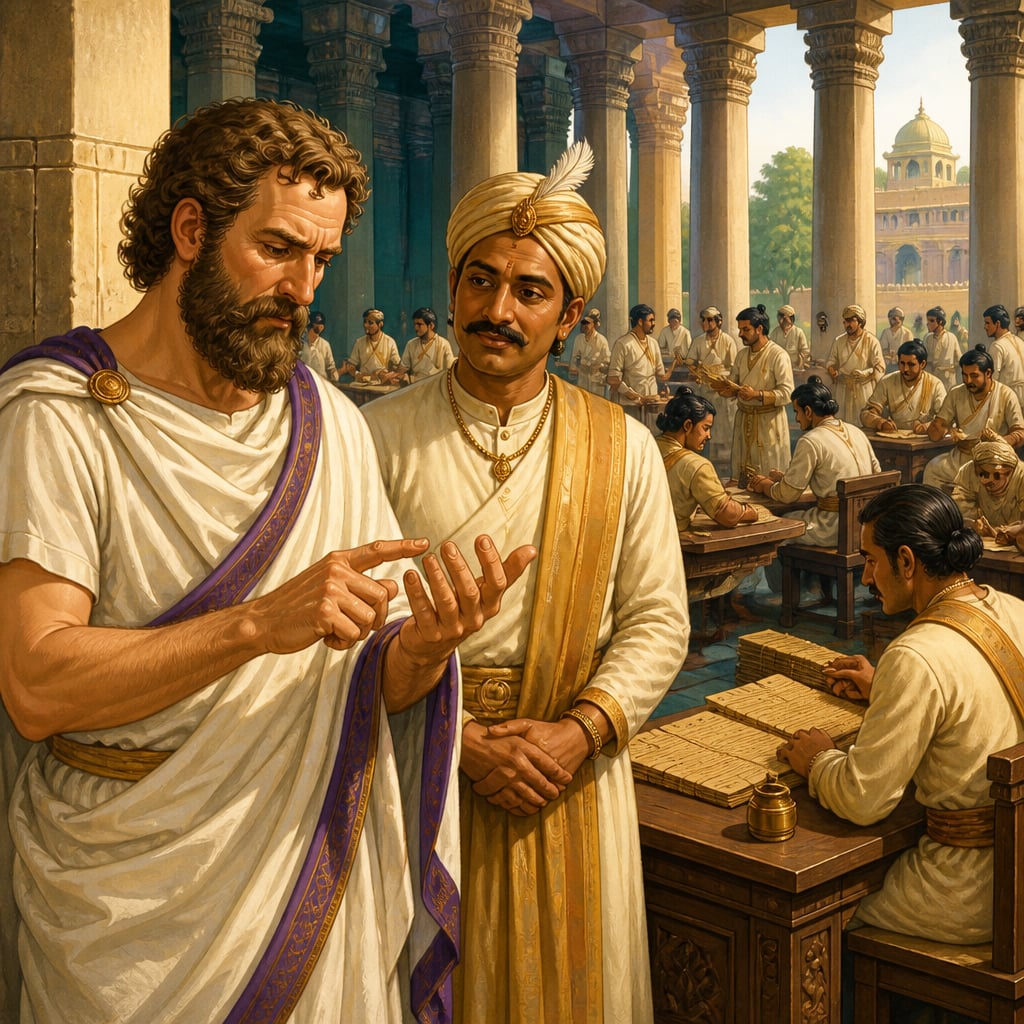
Megasthenes counting officials at the Pataliputra audience hall

Megasthenes, the Greek ambassador, stood in the audience hall at Pataliputra, trying to count the officials. There were men responsible for elephants, others for mines, still others for forests, roads, markets, and ports. Each wore distinct insignia. Each managed a different slice of the empire.

"How many departments?" he asked his guide.

"Thirty major ones," the Mauryan official replied with a slight smile. "Each with its own adhyaksha - superintendent."

Megasthenes had seen Greek and Persian administration. This was different. This was systematic.

"Śāstra-kuśalaṃ karma-dakṣam utsāha-vantam ārjavam analasaṃ ca adhyakṣān kuryāt" - Appoint as superintendents those skilled in knowledge, competent in work, energetic, honest, and free from sloth.

The Adhyaksha System

Kautilya designed the bureaucracy like an organism with specialized organs. Each adhyaksha owned one domain completely:

Economic: Treasury superintendent, commerce superintendent, mint superintendent, textiles superintendent, metals superintendent.

Resources: Mines superintendent, salt superintendent, forest superintendent, agriculture superintendent, granary superintendent.
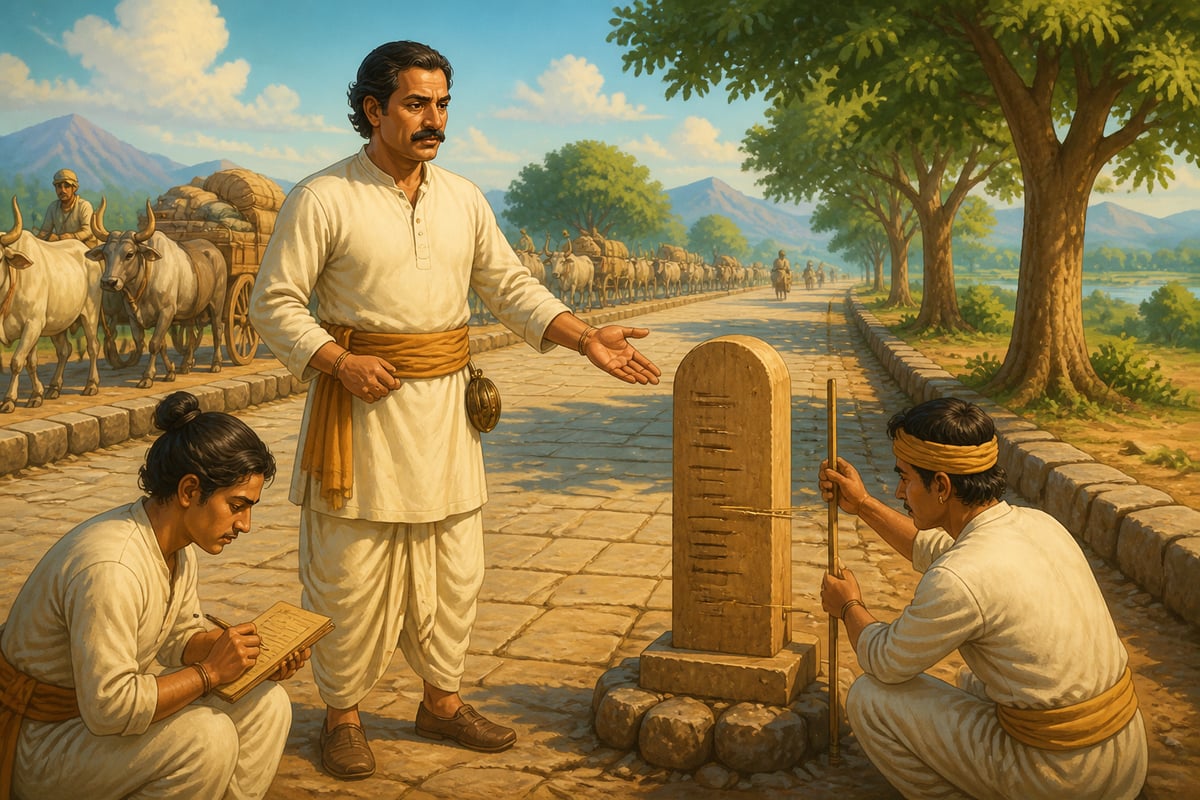
A Mauryan roads superintendent inspecting a trunk-road milestone

Infrastructure: Ships superintendent, city superintendent, roads superintendent, pastures superintendent.

Specialized: Elephant superintendent, horse superintendent, weights and measures superintendent, courtesans superintendent.

Thirty departments. Thirty experts. Zero overlap.

Why Such Extreme Specialization?
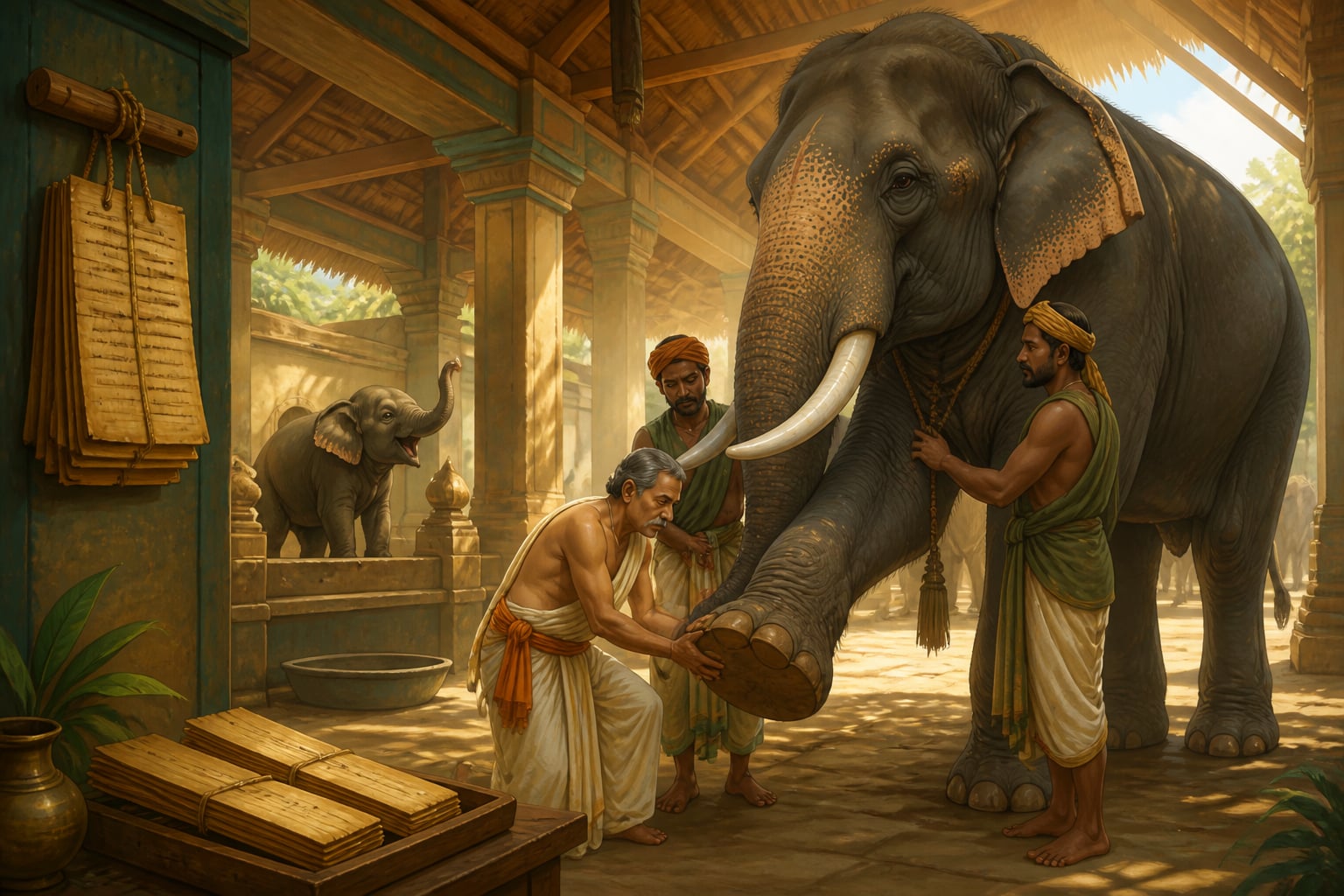
The Hastyadhyaksha attending a war elephant at the royal stables

Consider the Hastyadhyaksha - elephant superintendent. Managing war elephants required:

No generalist could handle this. Kautilya understood: complexity requires expertise.

The same logic applied everywhere. The mining superintendent needed geology, metallurgy, market pricing, quality standards. The agriculture superintendent needed soil science, irrigation engineering, crop rotation, weather patterns.

The Five Qualities

Kautilya was precise about what made a good administrator:

1. Śāstra-kuśala (Knowledge) - Deep expertise in the domain. A mining superintendent understands ore, not just management.

2. Karma-dakṣa (Skill) - Practical competence. Knowing metallurgy theory isn't enough; can you actually run a functional mint?

3. Utsāha (Energy) - Drive and initiative. Bureaucracy needs people who push forward, not just maintain.

4. Ārjava (Honesty) - Integrity when handling public resources. A dishonest expert is worse than an honest amateur.

5. Analasya (Freedom from sloth) - Consistent effort. Not bursts of activity followed by laziness.

Notice what's missing: family connections, caste, wealth. Competence was the criterion.

Clear Responsibilities

For each position, Kautilya specified:

The agriculture superintendent had to: survey land by soil type, allocate plots to farmers, maintain irrigation, track yields, collect the king's revenue share, and report problems requiring intervention.

No ambiguity. No finger-pointing. Everyone knew exactly what success looked like.

Coordination Through Information

With thirty specialized departments, how did the system avoid chaos?

Clear reporting lines: Each adhyaksha reported to higher officials, ultimately to the council of ministers.

Regular accounts: Periodic reports of what happened, what was collected, what was spent, what problems emerged.

Central oversight: The samaharta (accountant-general) monitored all departments' finances.

Inspections: Higher officials verified what adhyakshas reported.

This created transparency without micromanagement. Adhyakshas had autonomy but couldn't hide failures.

The Record-Keeping Foundation

Every adhyaksha maintained:

Records served accountability, planning, coordination, and knowledge transfer. New adhyakshas learned from predecessors' documentation. The center detected patterns across departments.

Records were the nervous system - how information flowed and how leadership stayed connected to reality.

Modern Parallels

Walk into any large company today:

The parallels aren't coincidental. Organizational complexity requires organizational structure. Kautilya understood this 2,300 years before modern management theory.

The Deeper Insight

Kautilya's genius was building systems that don't depend on great leaders.

A brilliant king might rule well for thirty years. But then? If everything depends on personal attention, the empire collapses.

The adhyaksha system created institutional capability - capacity in structures, processes, and documentation rather than individual genius. A mediocre king inheriting good bureaucracy could maintain the empire. A brilliant king without it would struggle.

The Mauryan bureaucracy functioned across three generations - Chandragupta, Bindusara, Ashoka - because the system outlasted individuals.

This is the ultimate test of administration: Does it work even when leadership is average?

Division of labor and specialization - the foundation of productive organization.

Adam Smith's pin factory example shows the same insight: specialists making pins outperform generalists making entire pins. Frederick Taylor's scientific management formalized this.

Kautilya applied specialization to government, not just manufacturing. He understood that administration requires expertise, not just authority.

The Roman Empire's later decline involved bureaucratic generalism - officials handling multiple domains poorly rather than specialized experts handling each well.

Character as a multiplier - integrity amplifies competence while dishonesty weaponizes it.

Warren Buffett: 'In looking for people to hire, look for integrity, intelligence, and energy. If they don't have the first, the other two will kill you.'

Verses

शास्त्रकुशलं कर्मदक्षम् उत्साहवन्तम् आर्जवम् अनलसं च अध्यक्षान् कुर्यात्

śāstra-kuśalaṃ karma-dakṣam utsāha-vantam ārjavam analasaṃ ca adhyakṣān kuryāt

He should appoint as superintendents those who are skilled in knowledge, competent in work, energetic, honest, and free from sloth.

Kautilya establishes five criteria: expertise, practical skill, drive, integrity, and consistency. Technical competence isn't enough - character matters.

Book 2, Chapter 9, Verse 1 (R. Shamasastry)

प्रत्येकं कार्यं प्रत्येकाध्यक्षः कुर्यात्

pratyekaṃ kāryaṃ pratyeka-adhyakṣaḥ kuryāt

Each task should have its own superintendent; each superintendent should handle their specific task.

One department, one focus, one accountable leader. Avoid diffused responsibility where everyone is responsible for everything - which means no one is responsible for anything.

Book 2, Chapter 5, Verse 3 (R.P. Kangle)

आयव्ययौ लेखयेत् गणयेत् च सततम्

āya-vyayau lekhayeta gaṇayeta ca satatam

Income and expenditure should be recorded and calculated continuously.

Documentation isn't occasional but continuous. Every transaction recorded, every calculation maintained.

Book 2, Chapter 7, Verse 2 (L.N. Rangarajan)

Case studies

The Mauryan Road System: Bureaucracy in Action

The Mauryan Empire maintained roads from Pataliputra to the northwest frontier. Megasthenes described distance markers every 10 stades and rest houses at regular intervals. This required multiple coordinating adhyakshas: road construction, maintenance, rest facilities, tree planting for shade.

The road system exemplifies Kautilyan bureaucracy. No single person could manage empire-wide infrastructure. Specialized departments handled specific aspects: one built, another maintained, another managed facilities. Clear standards ensured consistency. Regular inspection verified work. Documentation tracked repairs needed.

The road system functioned for generations. When Ashoka placed his edicts decades after Chandragupta, he used infrastructure that bureaucracy had maintained across changing rulers.

Complex systems require coordinated specialization. Roads weren't built by decree alone but by systematic administration - specialized departments, clear standards, maintenance protocols, documented accountability.

India's national highway system and the U.S. Interstate Highway System both demonstrate this principle. Interstate highways, built through coordinated federal standards with state-level execution, generated an estimated $6 in economic return for every $1 invested because specialized bureaucratic coordination maintained quality at continental scale.

Megasthenes recorded that the Mauryan royal highway from Pataliputra to the northwest frontier stretched over 1,500 miles with distance markers every 10 stadia (approximately 1.8 km). Rest houses were spaced at regular intervals of about 9 miles.

Historical context

c. 4th-3rd century BCE

Pre-Mauryan India had smaller kingdoms with simpler administration. The Mauryan Empire's vast scale required administrative innovation. Kautilya's adhyaksha system enabled effective governance across unprecedented territory.

The Mauryan bureaucracy proved that large-scale governance required administrative capacity, not just military conquest. This principle remains central to state-building today.

Living traditions

Reflection

More in The Adhyakshas: Superintendents

All lessons in The Adhyakshas: Superintendents · Arthashastra: Science of Governance course