Structure of the State

Saptanga - Seven Limbs

Kautilya's model of the state as a body with seven essential parts - each vital, each interconnected.

The Map on the Floor
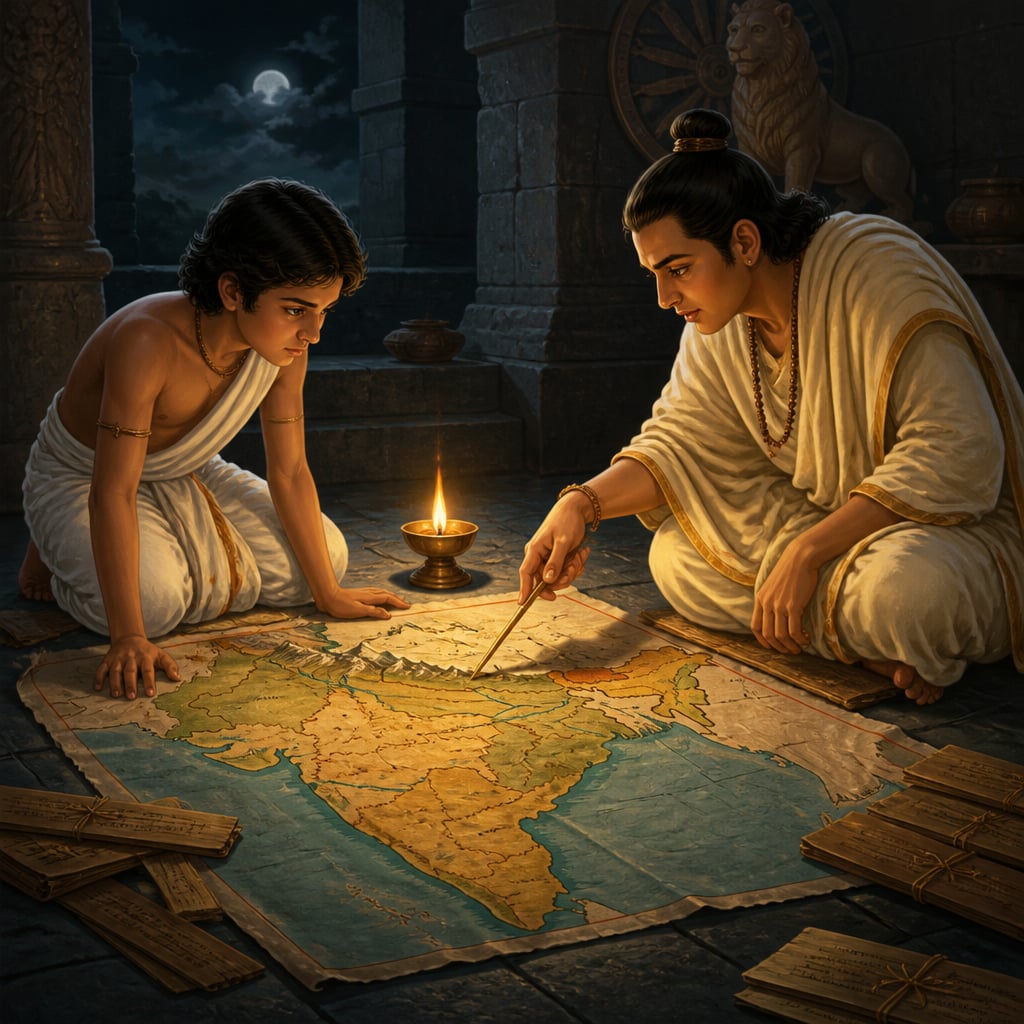
Young Chandragupta and Kautilya planning over the map of Bharat in Taxila

Chandragupta Maurya knelt beside a map spread across the granite floor of a darkened chamber in Taxila. Twenty-three kingdoms. Twenty-three armies. Twenty-three kings who would resist unification. His teacher Kautilya stood behind him, tracing trade routes with a weathered finger.

"Master, the Nandas have 200,000 soldiers. We have barely 10,000. How can we win?"

Kautilya smiled - that thin, knowing smile that always preceded a lesson. "You're asking the wrong question. Don't ask about their army. Ask about their system."

"Svāmy-amātya-janapada-durga-kośa-daṇḍa-mitrāṇi prakṛtayaḥ" - The sovereign, ministers, territory, fortifications, treasury, army, and allies are the constituent elements.

This was the birth of the Saptanga theory - Kautilya's framework for understanding what makes states strong or weak.

The Seven Elements

Kautilya saw the state as a living body with seven essential organs:

1. Swami (Sovereign) - The head. Without effective leadership, nothing functions. The Nanda king was reportedly tyrannical and despised - a fatal weakness despite vast armies.

2. Amatya (Ministers) - The nervous system. They carry information up and commands down. The Nanda ministers were corrupt, more interested in personal gain than state welfare.

3. Janapada (Territory and People) - The body itself. This is the real wealth - the land and its people who generate prosperity. The Nandas had overtaxed their population into resentment.

4. Durga (Fortifications) - The skeleton. Defensive infrastructure that provides refuge and strategic depth. Without it, a state is vulnerable to any blow.

5. Kosa (Treasury) - The fat reserves. Accumulated wealth that sustains operations during crises. But Kautilya warned: "The king should accumulate wealth like a bee collecting pollen - taking a share without destroying the flower."

6. Danda (Army) - The muscles. The capacity for force. Important, but Kautilya ranked it sixth - not first. Force is the last resort, not the first.

7. Mitra (Allies) - The friends who extend your reach. No state succeeds alone. But alliances are based on mutual interest, not sentiment - they shift when interests change.

Why Order Matters

"Notice the sequence," Kautilya told Chandragupta. "We don't start by building an army. We start with you."

The order is deliberate: leadership before ministers, ministers before territory, internal strength before external relationships. Try to build a powerful army before securing popular support, and your soldiers will desert. Accumulate wealth before establishing honest administration, and it will be embezzled.

Build from foundations upward.

The Nanda Diagnosis

Dhana Nanda on his gilded throne with starving farmers waiting at the door

Using this framework, Kautilya analyzed the Nandas:

"They have muscles," Kautilya observed, "but a failing heart. Their apparent strength masks mortal vulnerability."

Modern Applications

The Saptanga framework applies far beyond ancient kingdoms.

For businesses: CEO vision (Swami), executive team (Amatya), employees and customers (Janapada), competitive moats (Durga), capital reserves (Kosa), sales and marketing (Danda), strategic partnerships (Mitra).

For personal life: Your self-discipline (Swami), your advisors (Amatya), your core skills and health (Janapada), your resilience (Durga), your savings (Kosa), your ability to compete (Danda), your relationships (Mitra).

Company failures often trace to Saptanga imbalances: great product but poor leadership, strong sales but no competitive moat, plenty of capital but terrible culture.

The First Law of Statecraft

Chandragupta and his army before the fallen gates of Pataliputra

Chandragupta eventually conquered the Nandas - not by matching their army, but by exploiting their systemic weaknesses. He subverted their corrupt ministers, won over their alienated population, and waited for their weak leadership to make fatal mistakes.

From this emerged Kautilya's first law:

Before any major action, assess all seven elements honestly.

Can your leadership handle the complexity? Do you have capable implementers? Will your people support it? Can you absorb setbacks? Can you afford it? Do you have the force needed? Will allies help?

If multiple elements are weak, fix them first. If all elements are strong, even difficult ventures become possible.

The lesson: See the system, not just the parts. Most failures come from optimizing one element while ignoring effects on others. Kautilya trained generalists who understood how everything connects.

Next, we examine Element 2 in detail - the bureaucracy that makes everything function.

Systems thinking - understanding organizations as integrated wholes rather than collections of parts.

Peter Senge's 'Fifth Discipline' and systems dynamics echo this insight - organizations succeed through reinforcing loops between elements, not isolated optimization.

Kautilya provides a specific framework (seven elements) and explicit ordering, making abstract systems thinking concrete and actionable.

The Nanda dynasty had enormous military and treasury (Elements 5-6) but collapsed due to weak leadership and corrupt ministers (Elements 1-2). Material superiority couldn't compensate for systemic weakness.

Foundation-first development - building infrastructure before scaling operations.

Startup wisdom advises against 'premature scaling' - raising capital before product-market fit. Kautilya would recognize this as building Element 5 (Kosa) before Element 3 (Janapada).

Verses

स्वाम्यमात्यजनपददुर्गकोषदण्डमित्राणि प्रकृतयः

svāmy-amātya-janapada-durga-kośa-daṇḍa-mitrāṇi prakṛtayaḥ

The sovereign, ministers, territory with population, fortifications, treasury, army, and allies are the constituent elements of the state.

This is Kautilya's foundational framework for understanding state power. Just as a body has essential organs, a state has seven essential elements.

Book 6, Chapter 1, Verse 1 (R.P. Kangle)

तासां गुणाधिकेन विशिष्टतरा

tāsāṃ guṇa-adhikena viśiṣṭa-tarā

Among these elements, each succeeding one is superior to the preceding one by virtue of its qualities.

This seems paradoxical - earlier Kautilya said the sovereign comes first, now he says later elements are superior? The resolution: Elements are listed in order of what to develop first (leadership before anything else), but each element has progressively wider impact.

Book 6, Chapter 1, Verse 2 (L.N. Rangarajan)

प्रकृतिभिः सन्धिविग्रहौ

prakṛtibhiḥ sandhi-vigrahau

Peace and war are determined by the condition of the constituent elements.

Kautilya makes strategy contingent on systemic assessment. Don't decide on war or peace based on emotions or provocations.

Book 8, Chapter 1, Verse 40 (R. Shamasastry)

Case studies

The Fall of the Nanda Dynasty: A Saptanga Failure

The Nanda dynasty possessed enormous wealth - reportedly 200,000 infantry, 20,000 cavalry, 2,000 chariots, 3,000 war elephants, and legendary treasury reserves. Yet they fell quickly to Chandragupta's smaller forces.

Saptanga analysis reveals fatal imbalance: Element 1 (Swami) - tyrannical, despised king. Element 2 (Amatya) - corrupt ministers. Element 3 (Janapada) - overtaxed, alienated population. Elements 4-6 - strong materially. Element 7 - few reliable allies. The Nandas had military and financial strength but catastrophic weakness in leadership, governance, and popular support.

The dynasty fell swiftly despite military superiority. Their army deserted rather than fighting for unpopular rulers. Their treasury couldn't buy loyalty without legitimacy. Material advantages proved worthless without systemic integration.

Strength in some elements cannot compensate for catastrophic weakness in others, especially foundational elements. Before pursuing material advantages, ensure leadership, governance, and popular support are sound.

The Soviet Union's collapse mirrors this pattern. Massive military spending and territorial control masked hollowed-out legitimacy, economic stagnation, and popular alienation. When the system cracked, no amount of nuclear weapons could prevent dissolution because the foundational elements had been neglected for decades.

The Nanda army reportedly consisted of 200,000 infantry, 20,000 cavalry, 2,000 chariots, and 3,000 war elephants. Despite this force, Chandragupta overthrew the dynasty around 322 BCE with a substantially smaller but more loyal army.

Historical context

c. 4th century BCE

Before Chandragupta, the Indian subcontinent consisted of numerous small kingdoms and a few larger empires like the Nandas. Most states developed haphazardly - some had wealth but poor administration, others had armies but depleted treasuries. Kautilya's innovation was systematic state-building: consciously developing all seven elements in proper sequence and balance.

The Saptanga framework proved devastatingly effective. States built on this model dominated states with greater resources but poor integration. The framework survived because it worked - later Indian empires all showed awareness of these principles.

Living traditions

Reflection

More in The Adhyakshas: Superintendents

All lessons in The Adhyakshas: Superintendents · Arthashastra: Science of Governance course