Efficiency Without Tyranny
Lean Government
How to make government work well without making it oppressive. The art of effective, limited administration.
The Suffocating Inspector
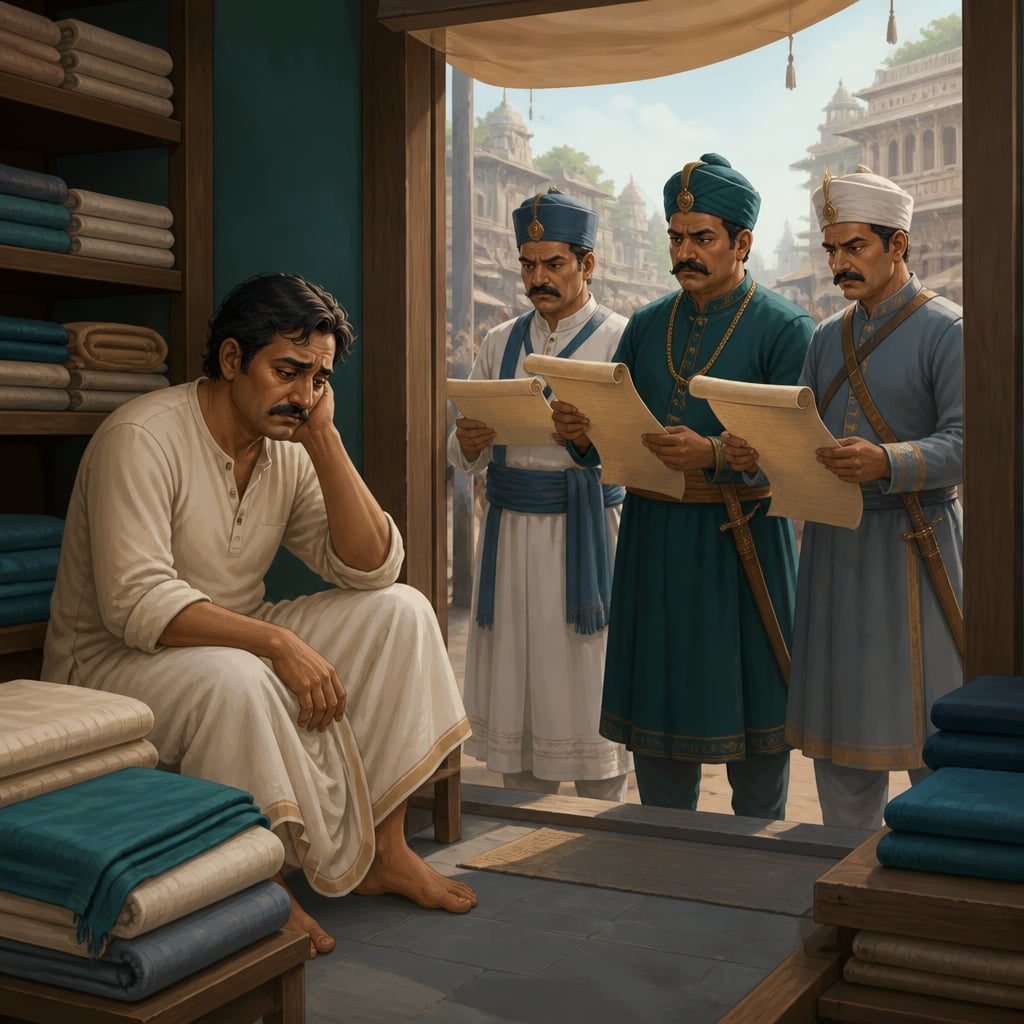
Vasudeva, a cloth merchant of Pataliputra, sat in his empty shop. Three inspectors had visited this month. Each demanded different records. Each found minor violations. Each required "facilitation fees."
His competitor across the street - one with the right connections - saw no inspectors at all.
When Kautilya heard such complaints, he recognized the paradox: the same government that was supposed to protect merchants from fraud was itself becoming the predator.
"Na prajā pīḍayed rājā svārthaṃ sampādayann api" - The king should not harass his subjects, even while accomplishing his own objectives.
"There is a disease," Kautilya wrote, "worse than no government at all: government that claims to serve the people while preying upon them."
The Double Danger
Every state faces two opposing risks:
Weakness: Government too feeble to maintain order, protect property, or enforce justice. The strong prey on the weak; contracts are meaningless.
Oppression: Government too invasive, too demanding, too present in every corner of life. It crushes the prosperity it claims to protect.
Kautilya's genius: these aren't competing values. A state can be simultaneously powerful and restrained, strong and lean.
What Government Must Do
Kautilya identifies essential functions:
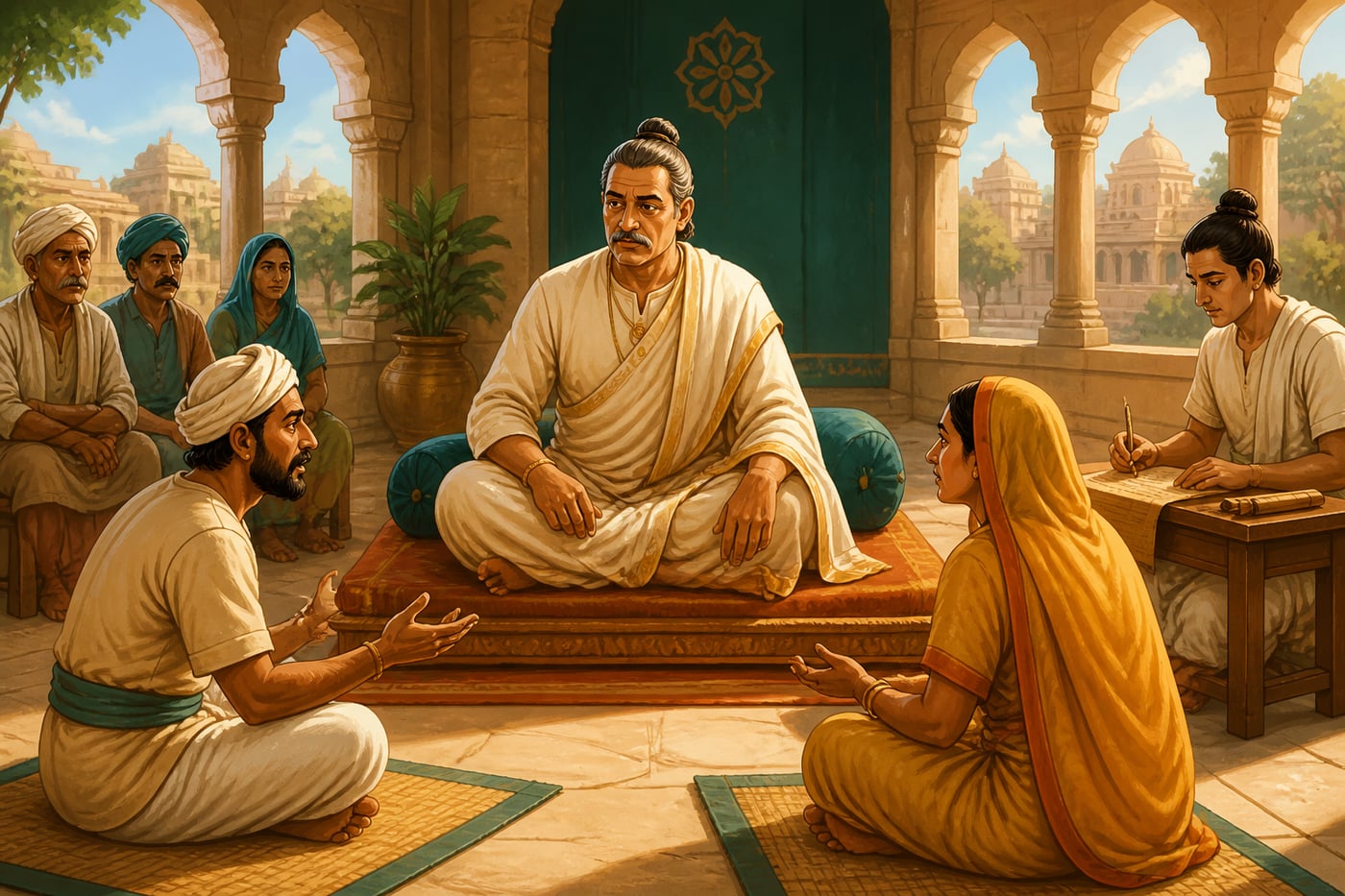
Justice and Law Enforcement: Private actors cannot provide impartial justice. The state must maintain courts and enforcement.
Defense: External security requires coordinated military force beyond private capability.
Infrastructure: Roads, irrigation, and fortifications benefit everyone but individuals cannot effectively provide them.
Fraud Prevention: Standards, weights, measures, and quality enforcement protect honest commerce.
Protection of the Vulnerable: Children, the disabled, and widows need protection from exploitation.
Notice what's missing: Government is not responsible for making people virtuous, wise, or prosperous. It creates conditions where these can emerge.
What Government Should Not Do
Kautilya's regulations target specific problems: fraud, exploitation, public order threats. But vast domains receive no mention:
- Private religious practice? Unregulated.
- Personal consumption choices? Individual discretion.
- Business models and strategies? Free experimentation.
- Agricultural methods? Farmer's choice.
The pattern: intervene where individual action harms others, where information asymmetries enable fraud, where coordination problems prevent voluntary solutions. Leave alone what people can manage themselves.
The Efficiency Principle
"Alpa-vyayena mahatīṃ siddhiṃ rājā samācaret" - The king should accomplish great results with minimal expenditure.
Every unit of resources consumed by government is extracted from productive society. The skilled administrator accomplishes objectives with the minimum necessary resources.
Principle 1: Necessity, Not Comprehensiveness
Every additional official means another salary, another potential corruption point, another layer slowing decisions. Establish only as many departments as are absolutely essential.
Principle 2: Clarity of Purpose
Every official should have precisely defined responsibility. When responsibilities blur, power expands. Clear boundaries enable accountability.
Principle 3: Performance Measurement
How do you know if a function is necessary? Measure its output. The tax collector should collect revenue. The judge should resolve disputes. If an office exists without clear measurable output, it's probably unnecessary.
Principle 4: Periodic Review
Some structures should be temporary. An emergency creates a need, a department forms, but the emergency ends. Without deliberate review, the department persists. Periodically ask: Does this still serve its purpose?
Preventing Government Expansion
Power naturally expands. Officials seek importance. Regulations multiply. How do you prevent mission creep?
Make Costs Visible: When people clearly see what they pay and what they receive, they judge value. Hidden costs enable unlimited growth.
Sunset Provisions: New programs should have expiration dates. If genuinely necessary, renewal is easy to justify.
Cost-Benefit Analysis: Consider whether the benefit from regulation exceeds its cost. If enforcement consumes more than the harm prevented, abandon the regulation.
Competition and Choice: Where possible, allow private alternatives alongside government provision. Competition disciplines both.
The Paradox of Strong Limited Government
Counterintuitively, limited government can be stronger than unlimited government:
Legitimacy: When government stays within proper bounds, citizens cooperate. Oppressive government creates resistance.
Efficiency: Limited scope enables deep competence. The superintendent who focuses exclusively on agriculture becomes expert; one handling everything becomes mediocre.
Resource Conservation: Unlimited government dissipates resources across countless initiatives. Limited government concentrates on essential functions, executing them well.
Private Sector Strength: When government leaves space for private initiative, the economy flourishes. This creates the tax base funding government itself.
"The king who impoverishes his people to enrich his treasury is like a man who cuts his own leg to feed his stomach."
The Test
How do you know if government is properly limited?

Kautilya offers a simple measure: "When the people prosper, the state prospers."
If prosperity is growing, crime is low, disputes are resolved fairly, and threats are deterred - government is succeeding. If the apparatus keeps expanding but these outcomes don't improve, something is wrong.
The ultimate measure is not government activity but social flourishing. Government exists to create space for human flourishing, not to crowd it out.
The art of governance is knowing where to intervene and where to refrain. Both require discipline. The skilled administrator walks the narrow path between chaos and tyranny.
Outcome-based evaluation - measuring results rather than inputs.
Peter Drucker's management by objectives and modern OKR systems focus on outcomes. The principle is ancient.
Kautilya applies this to government itself, not just business. Every function must justify its cost through measurable outcomes.
Singapore's government is small but effective - measured by development outcomes, not bureaucratic activity. This echoes Kautilyan efficiency.
Subsidiarity and minimal intervention - the burden of proof should fall on expansion, not restraint.
The precautionary principle often applies to government action itself - what are the costs of intervention, not just the costs of inaction?
Verses
प्रजासुखे सुखं राज्ञः प्रजानां च हिते हितम्
prajā-sukhe sukhaṃ rājñaḥ prajānāṃ ca hite hitam
In the happiness of his subjects lies the king's happiness; in their welfare lies his welfare.
This fundamentally limits government. The king's purpose is not self-aggrandizement but people's welfare.
Book 1, Chapter 13, Verse 5 (R.P. Kangle)
अल्पव्ययेन महतीं सिद्धिं राजा समाचरेत्
alpa-vyayena mahatīṃ siddhiṃ rājā samācaret
The king should accomplish great results with minimal expenditure.
Efficiency is mandatory. Every resource consumed by government is extracted from productive society.
Book 2, Chapter 1, Verse 18-19 (L.N. Rangarajan)
न प्रजा पीडयेद् राजा स्वार्थं सम्पादयन्नपि
na prajā pīḍayed rājā svārthaṃ sampādayann api
The king should not harass his subjects, even while accomplishing his own objectives.
Ends do not justify oppressive means. Even when pursuing legitimate objectives, the method matters.
Book 3, Chapter 1, Verse 40 (R. Shamasastry)
Case studies
Singapore's Lean Government Model
Singapore maintains small government by international standards while achieving remarkable development outcomes. The civil service is lean, highly paid, and performance-focused. Government intervenes decisively in key areas but leaves most economic activity to private enterprise.
Singapore exemplifies Kautilya's principle: great results with minimal expenditure. Government is strong in essential functions but limited in scope. High civil service salaries reflect Kautilya's principle that officials should be well-compensated to prevent corruption. Performance measurement focuses on outcomes, not bureaucratic activity.
Singapore transformed from developing nation to first world in one generation. GDP per capita ranks among world's highest. Civil service is admired globally for efficiency and integrity.
Effective government and limited government aren't contradictory. Focus on essential functions, execute them well, leave most of life to private initiative. Clarity about what government should and shouldn't do enables both strength and restraint.
Estonia's digital governance model follows the same logic. A tiny country built world-leading e-government services by focusing its small bureaucracy on high-impact digital infrastructure. The result: 99% of government services available online, tax filing in under 5 minutes, and a digital economy attracting global entrepreneurs.
Singapore's civil service employs roughly 86,000 people for a population of 5.9 million (1.5% of population). Its GDP per capita rose from $516 at independence in 1965 to over $82,000 by 2023, placing it among the top 5 globally.
Historical context
c. 4th century BCE
Ancient Indian political thought recognized limits on even absolute monarchy. The concept of raja-dharma established boundaries on legitimate royal action.
Mauryan success derived not from micromanagement but from effective execution of essential functions. This model influenced Indian administration for centuries.
Living traditions
- Regulatory Cost-Benefit Analysis: Systematic evaluation of whether government regulations produce benefits exceeding costs continues Kautilya's emphasis on purposeful governance.
- Sunset Provisions and Program Review: Requirements for periodic program renewal continue Kautilya's insight that governance functions should justify their continued existence.
- Performance-Based Governance: Outcome measurement focusing on results rather than activities applies Kautilya's emphasis on effective rather than merely active government.
- Centre for Civil Society: Policy center focused on limited government and economic freedom
- Mercatus Center: Research center on regulatory analysis and government efficiency
- NITI Aayog: India's policy think tank evaluates government programs for effectiveness, continuing Kautilya's emphasis on purposeful governance. NITI Aayog's outcome-based monitoring ensures that government actions produce intended results rather than merely consuming resources.
- Department of Administrative Reforms and Public Grievances: This department works to simplify government procedures and eliminate unnecessary regulations, continuing Kautilya's principle that government should do only what produces value. The focus on reducing compliance burden implements the Kautilyan insight that excess governance harms citizens.
Reflection
- Where have you seen government (or any organization) expand beyond what's necessary? What drove that expansion?
- How do you balance effective leadership with avoiding micromanagement? Where might you be intervening unnecessarily?
- In your sphere of responsibility, what's the equivalent of 'people's welfare'? How would you measure whether you're achieving it?