When to Fire

Removing the Incompetent

Sometimes people must go. Kautilya's guidance on when and how to remove officials who fail or betray.

The Treasurer Who Couldn't Stop

For three years, Devadatta served as treasury superintendent for the eastern provinces. On paper, his numbers looked excellent. Collections were high, expenses were controlled, and provincial reports glowed with praise for his efficiency.

Then Kautilya sent an auditor.

The auditor, an unremarkable man named Vishnu, spent six months examining records, interviewing merchants, and tracing gold coins that should have reached Pataliputra but hadn't. What he found was systematic: Devadatta had created a parallel accounting system. Official records showed one amount; actual collections were higher. The difference - substantial - had been flowing to Devadatta's private accounts.

When confronted with the evidence, Devadatta offered explanations, then excuses, then bribes. Finally, he threatened: "I have powerful friends. Remove me, and you make enemies."
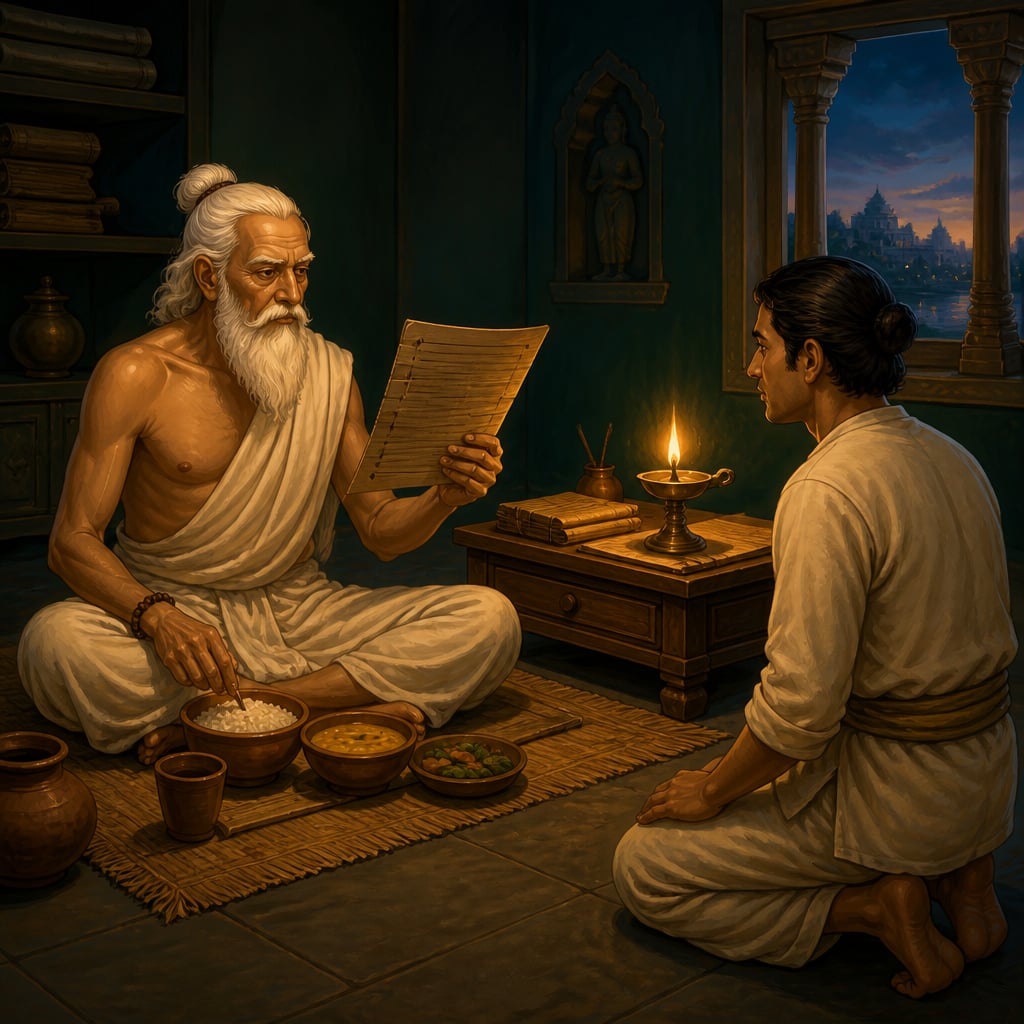
Kautilya reading the auditor Vishnu's report on Devadatta's corruption at his evening meal

Kautilya received the report while eating his simple evening meal. He read it twice, then wrote a single line to Chandragupta: "The treasurer must be removed. Tomorrow."

By sunset the next day, Devadatta was in custody, his assets seized, and a new superintendent was traveling east.

The Four Types of Failure

Kautilya's decision to act immediately came from clear thinking about what he was dealing with. In his framework, official failures fall into four categories, each requiring different responses.

Honest incompetence is the mildest. Someone tries their best but simply lacks capacity for the role. They're not lazy or corrupt - they're mismatched. The response should be quiet reassignment with dignity preserved.

Negligence is more serious. Someone capable of doing the work simply doesn't. They have ability but not discipline. The response involves clear warnings, explicit standards, and removal if improvement doesn't come.

Corruption - Devadatta's category - represents a fundamental breach of trust. The official isn't merely failing; they're stealing. The response must be swift, public enough to deter others, and proportional to the theft.

Treason is the gravest. Someone actively works for your enemies. Here, Kautilya is unambiguous:

"Rāja-drohī sadyo nihantavyaḥ."

"A traitor to the king should be eliminated immediately."

The starkness of this sutra reflects the existential danger. Treason isn't failure - it's active destruction. Delay allows more damage.

Why Delay Compounds Damage

Many leaders know someone is failing but avoid the removal decision. Kautilya considered this one of leadership's most common and costliest failures.

Consider what happened before Kautilya's auditor discovered Devadatta:

Every day Devadatta remained in position, the damage compounded.

Kautilya wrote: "Karma-doṣān karoti yaḥ sa nigṛhyo nivāsanīyaś ca."

"He who commits faults in his duties should be punished and dismissed."

The double prescription - punishment AND dismissal - indicates that serious failures require both accountability and removal. The kingdom cannot afford to keep failing officials in place out of sentimentality.

The Art of Proportional Response

Despite his reputation for ruthlessness, Kautilya emphasized matching the response to the failure. Not every problem requires the same solution.

Two years before Devadatta's removal, Kautilya handled a very different case. A military commander named Suryagupta had failed to anticipate a tribal raid that destroyed three villages under his protection. The evidence showed not corruption or treason, but honest misjudgment. Suryagupta had positioned his forces based on intelligence that proved wrong.

Kautilya quietly demoting Suryagupta in a private side chamber of the Mauryan court

Kautilya met with Suryagupta privately. "You failed," he said simply. "People died who trusted you to protect them."

Suryagupta offered no excuses. "I read the situation wrongly. If you want my resignation, you have it."

"No," Kautilya replied. "I want you to learn. You'll command a smaller garrison for two years. Prove you can protect three villages before I give you responsibility for thirty."

This was demotion without disgrace - a reduced role that acknowledged failure while preserving the possibility of redemption. Suryagupta served competently in his reduced position and eventually earned back his former responsibilities.

"Vibhava-jño daṇḍaḥ syāt na cāpavādaḥ."

"Punishment should be proportionate to capacity, and there should be no exceptions."

Devadatta chose corruption. Suryagupta made an honest mistake. The same response to both would have been unjust and ineffective - too harsh for Suryagupta, too lenient for Devadatta.

The Truman Moment

President Truman signing the order to relieve General MacArthur in the Oval Office, 1951

In 1951, President Harry Truman faced a decision that illustrates Kautilya's principles in modern form. General Douglas MacArthur, America's most celebrated military commander, was publicly contradicting presidential policy during the Korean War. MacArthur advocated expanding the war into China against explicit orders. He gave interviews criticizing his commander-in-chief.

This wasn't incompetence - MacArthur was brilliant. It wasn't corruption - he wasn't stealing. It was insubordination that threatened civilian control of the military, a form of institutional betrayal.

Truman knew that removing MacArthur would be politically devastating. The general was enormously popular; the president was not. Every advisor who focused on politics urged delay, compromise, one more chance.

But Truman understood what Kautilya had codified twenty-three centuries earlier: when someone in a position of trust directly undermines legitimate authority, delay only signals that authority is negotiable.

Truman fired MacArthur. The political backlash was immediate and severe. MacArthur returned to a hero's welcome and addressed Congress to thunderous applause. Truman's approval ratings collapsed.

Yet history has vindicated the decision. Truman preserved civilian control of the military - an institutional principle worth more than any temporary political cost. The removal was decisive, the timing was right, and the principle was protected.

The Communication Challenge

How you explain a removal matters nearly as much as the removal itself. Kautilya recognized that removals send messages to three audiences simultaneously.

To the person being removed: Be clear and direct. Ambiguity is cruelty. State facts rather than character judgments. Acknowledge genuine contributions if you can do so honestly. Be firm - the decision is made, not open for negotiation.

To those who remain: Explain enough that the decision makes sense. Don't share details that serve only to humiliate. Reaffirm your standards and expectations. Make clear you'll act on performance, not favoritism. Then move forward - dwelling on past decisions undermines current work.

To external observers: Provide information proportional to the role's visibility. Don't cover up serious wrongdoing to avoid embarrassment, but don't over-explain to prove your righteousness either.

When Devadatta was removed, Kautilya announced simply that the superintendent had been found guilty of financial irregularities and replaced. He didn't enumerate every theft or humiliate Devadatta's family. But he made clear that corruption had been discovered and addressed - a message to every other official in the empire.

The Emotional Weight

Kautilya acknowledged what modern management books often ignore: removing people is emotionally difficult, and it should be.

The leader who enjoys firing people lacks the judgment to do it well. Such leaders act too quickly, punish too harshly, and create cultures of fear rather than accountability.

But the leader who cannot bring themselves to remove anyone fails differently. They let incompetence fester, corruption spread, and good people become demoralized by watching poor performers face no consequences.

The right emotional stance is reluctance combined with resolve. You don't want to remove people. You recognize the human cost. But when removal becomes necessary, you act - not with pleasure, but with clarity that this is part of your duty.

Chandragupta once asked Kautilya how he could make these decisions so quickly. Kautilya's response: "I don't make them quickly. I make them clearly. Every day I delay costs the kingdom more than it costs me emotionally. That calculation isn't difficult - it's just unpleasant."

The Special Challenge: Powerful Officials

Removing a weak official is straightforward. Removing a powerful one requires additional care.

When Kautilya discovered that a senior general had been in secret communication with the Seleucids, he faced a complex challenge. The general, Mahapadma, commanded fierce loyalty from his troops. His family had connections throughout the court. Moving against him prematurely could trigger civil war.

Kautilya's approach took weeks of preparation:

First, he verified the evidence thoroughly. False accusations against powerful figures destroy credibility and create permanent enemies.

Second, he quietly won over key subordinates who might otherwise follow Mahapadma into rebellion. Some were transferred to other commands. Others were given direct ties to the emperor that bypassed their general.

Third, he prepared a replacement who could assume command immediately, preventing any power vacuum.

Only then did he act - swiftly and completely. Mahapadma was arrested, tried, and executed within days. His supporters, finding themselves isolated and leaderless, submitted to the new command structure.

The lesson: against powerful officials, prepare thoroughly and then act decisively. Don't let preparation become procrastination, but don't act before you're ready either.

Learning from Removal

Every removal should prompt reflection: why did this happen, and how can we prevent similar failures?

After Devadatta's removal, Kautilya examined the selection process that had placed him in the treasury. The auditors reviewed what oversight had existed - or failed to exist - during his tenure. New procedures were implemented: more frequent audits, multiple sign-offs for large transactions, rotation of treasury officials before they could build corrupt networks.

The goal wasn't just to remove one corrupt official but to make the system more resistant to corruption generally.

Similarly, after Suryagupta's demotion, Kautilya examined the intelligence system that had provided wrong information. The failure wasn't just one commander's misjudgment but a breakdown in how information reached decision-makers. Fixing the system mattered more than punishing the individual.

The Modern Application

Netflix CEO Reed Hastings famously said, "We're a team, not a family." The distinction matters. Families don't fire members who underperform. Teams, if they want to win, must sometimes change their composition.

This doesn't mean treating people badly. It means being honest about fit and performance. When someone isn't succeeding in a role, the kindest thing - for them and for everyone else - is often to acknowledge it clearly and help them find a better fit, whether within the organization or elsewhere.

The companies that handle this well share Kautilyan characteristics: they distinguish between types of failure, they match consequences to causes, they act with appropriate speed, and they communicate with clarity and dignity.

The companies that handle it badly either never remove anyone (and slowly fill with underperformers) or remove people arbitrarily (and create cultures where no one feels secure enough to take risks).

The Final Principle

Kautilya's teaching on removal comes down to this: decisive action in service of the larger good.

The king exists to serve the kingdom, not the other way around. Officials exist to serve the kingdom, not their own interests. When an official fails - through incompetence, negligence, corruption, or treason - keeping them in place serves their interests at the kingdom's expense.

Removal, properly executed, isn't punishment for its own sake. It's restoration of proper function. The corrupt official is removed so the treasury can serve its purpose. The incompetent commander is replaced so soldiers don't die needlessly. The treasonous minister is eliminated so the kingdom survives.

This perspective makes the emotional difficulty bearable. You're not destroying someone for your benefit. You're protecting everyone who depends on good governance.

Devadatta was removed not because Kautilya disliked him but because honest taxpayers deserved a treasury that served them. Mahapadma was executed not for vengeance but because the army needed commanders loyal to the empire. Every removal, properly understood, serves those who remain.

The mark of a mature leader isn't enjoying these decisions. It's making them well when necessary, with the right mix of reluctance and resolve, and then learning from them to build systems where such decisions are rarely needed.

Modern HR practices distinguish between performance issues (requiring coaching), behavioral issues (requiring discipline), and ethical breaches (requiring termination). Employment law requires different processes for different failure types. Kim Scott's 'Radical Candor' framework differentiates between 'ruinous empathy' (avoiding hard conversations) and 'obnoxious aggression' (treating all failures harshly). Kautilya's framework provides the nuance both extremes lack.

Kautilya recognized that one-size-fits-all responses fail: treating honest incompetence harshly is unjust and drives away talent, while treating corruption leniently invites more corruption. His framework matches response to cause: reassignment for mismatched skills, warnings for negligence, removal for corruption, immediate elimination for treason. This proportionality creates both justice and effectiveness.

Mauryan administration distinguished between officials who failed despite good faith effort (who might be reassigned), those who neglected duties (who received warnings and fines), those who stole (who were removed and property confiscated), and those who betrayed the state to enemies (who were executed). This calibrated system maintained both standards and morale.

Corporate crisis management emphasizes acting quickly once key facts are established. Jack Welch's philosophy of 'facing reality' included removing underperformers decisively rather than endless process. Research on organizational decline shows that delayed responses to serious problems compound damage exponentially. Kautilya's framework distinguishes between investigation (which should be thorough) and action once conclusion is reached (which should be swift).

Kautilya understood that leaders often delay painful decisions hoping problems resolve themselves. His framework combats this: once you're certain (after proper investigation) that removal is necessary, delay serves no purpose and causes compound damage. Every day a corrupt official remains in place, corruption spreads. Every day a traitor has access, more harm occurs. Act decisively once certainty is achieved.

When Mauryan intelligence confirmed a minister's conspiracy with foreign powers, Kautilya acted within days - arrest, trial, execution. The speed both prevented further damage and sent clear signals about consequences. In contrast, when officials failed from incompetence, extended processes gave them chances to improve or transfer gracefully. Speed was calibrated to threat severity.

Verses

कर्मदोषान् करोति यः स निगृह्यो निवासनीयश्च

karma-doṣān karoti yaḥ sa nigṛhyo nivāsanīyaś ca

He who commits faults in his duties should be punished and dismissed.

Kautilya makes clear that failure in official duties has consequences. The double prescription - both punishment (nigrahya) and removal (nivasaniya) - indicates that serious failures require both accountability and removal from position.

Book 2, Chapter 9, Verse 28 (R.P. Kangle)

विभवज्ञो दण्डः स्यात् न चापवादः

vibhava-jño daṇḍaḥ syāt na cāpavādaḥ

Punishment should be proportionate to capacity, and there should be no exceptions.

This sutra contains two crucial principles. First, punishment must be calibrated to circumstances - someone who had resources and support bears more responsibility than someone set up to fail.

Book 2, Chapter 9, Verse 35 (R. Shamasastry)

राजद्रोही सद्यो निहन्तव्यः

rāja-drohī sadyo nihantavyaḥ

A traitor to the king should be eliminated immediately.

The starkness of this sutra reflects the seriousness of treason. 'Sadyah' (immediately) is key - there is no room for delay, warnings, or second chances when someone has betrayed the state.

Book 1, Chapter 10, Verse 19 (L.N. Rangarajan)

Case studies

Truman and MacArthur

During the Korean War, General Douglas MacArthur, the famous World War II hero, publicly contradicted President Truman's policy and advocated for expanding the war into China. MacArthur had immense popularity and powerful political allies. Truman faced the decision of whether to remove him.

This was a clear case of raja-droha - not exactly treason, but active undermining of civilian authority. MacArthur wasn't incompetent (he was highly skilled) or corrupt. He was insubordinate, believing his judgment superior to his commander-in-chief. Kautilya would classify this as a high official building an independent power base and refusing to implement policy - grounds for immediate removal.

Truman removed MacArthur in April 1951, despite knowing it would be politically costly. MacArthur returned to a hero's welcome, and Truman's popularity plummeted. But Truman had preserved the principle of civilian control of the military. History has largely vindicated the decision.

When someone in a position of trust directly undermines your authority, removal is necessary even if it's politically difficult. Delay signals that authority is negotiable. Truman acted decisively once the insubordination was clear, accepted the political cost, and preserved the institutional principle. Sometimes doing the right thing means accepting that you'll be unpopular.

Corporate boards face this dilemma with star CEOs who publicly defy board strategy. Elon Musk's tweets that contradicted Tesla's official positions forced the board into a similar choice: tolerate insubordination from a popular figure or enforce governance at the cost of short-term market reaction.

Truman's approval rating dropped to 22% after firing MacArthur in April 1951, one of the lowest in presidential history. MacArthur received a ticker-tape parade with an estimated 7.5 million spectators in New York City, yet civilian control of the military was preserved.

Historical context

c. 4th century BCE

The transition from the Nandas to the Mauryas required massive personnel changes. Kautilya couldn't simply take over the existing administration - many officials were incompetent, corrupt, or loyal to the old regime. The early years of Mauryan rule involved systematic evaluation and removal of unsuitable officials, creating a culture of accountability.

Kautilya was writing for builders of new states who would inherit officials from previous regimes and need to identify who could be retained and who must go. His framework provided systematic ways to make these decisions rather than relying on intuition or favoritism. The Mauryan administrative excellence partly resulted from this rigorous personnel management.

Living traditions

Reflection

More in Amatya Pariksha: Testing Ministers

All lessons in Amatya Pariksha: Testing Ministers · Arthashastra: Science of Governance course