Choosing Ministers

Amatya Selection

No leader succeeds alone. Kautilya knew that even the wisest king needs capable ministers. But how do you find people who are both competent and loyal? This lesson explores Kautilya's sophisticated framework for selecting the advisors who can make or break a kingdom.

The Chariot Wheel Lesson

Chandragupta was frustrated. He had just spent a full day handling petitions, reviewing tax reports, and meeting with military commanders. By evening, he was exhausted - and the work wasn't half done.

"How did my predecessors manage?" he asked Kautilya. "How did the Nandas govern an empire of this size?"

"Badly," Kautilya replied. "Which is why you now rule it. But your question reveals something important. You're trying to be the entire chariot."
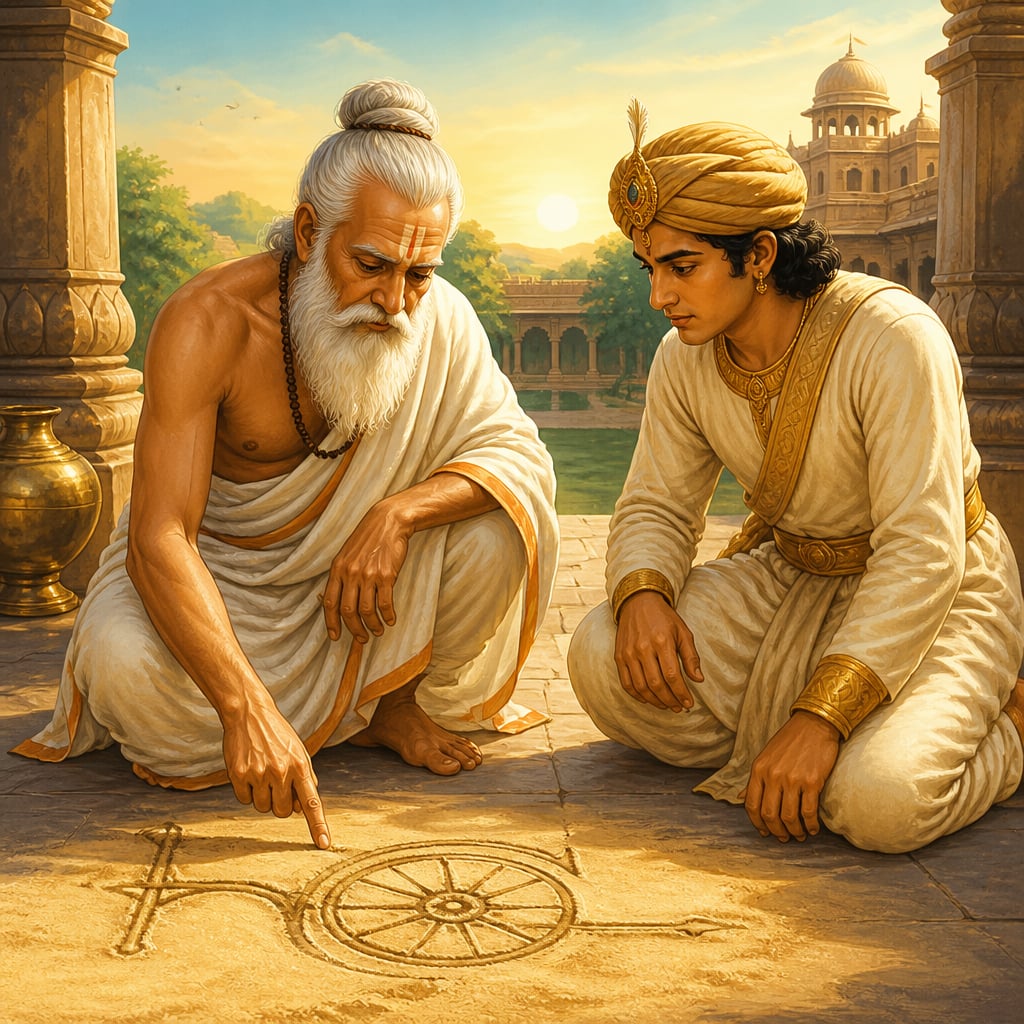
Kautilya drawing the one-wheeled chariot in the sand to teach Chandragupta

He drew a diagram in the sand - a chariot with one wheel.

"Can this move?"

"No," Chandragupta admitted.

"Then why do you imagine you can govern alone?"

"सहायसाध्यं राजत्वं चक्रमेकं न वर्तते" "Kingship is achievable only with assistance; a single wheel does not turn."

Why Ministers Matter More Than The King

Kautilya understood something counterintuitive: the quality of ministers matters more than the quality of the king.

A brilliant king with bad ministers will be poorly informed, badly served, and eventually betrayed. A moderate king with excellent ministers will receive good information, good execution, and good counsel.

This is why Kautilya devoted so much attention to minister selection. Get this wrong, and everything fails. Get this right, and even significant weaknesses can be compensated.

The Qualities That Actually Matter

Kautilya specified eight qualities for ministers - not as abstract virtues but as practical necessities:

Notice what's missing: loyalty. Because loyalty can't be assessed through conversation. It must be tested.

The Selection Mistake Everyone Makes

"Most kings," Kautilya told Chandragupta, "select ministers the way they select horses - by how impressive they look in the courtyard."

The charismatic candidate who interviews brilliantly may be useless under pressure. The quiet candidate who seems unremarkable may be the one who stays when everyone else flees.

Modern parallel: Google discovered through rigorous analysis that their interview process - famous for brain teasers and dazzling conversations - poorly predicted actual job performance. What predicted success? Demonstrated track record and practical tests. Kautilya knew this 2,300 years earlier.

The Inner Circle vs. The Outer Ring

Kautilya distinguished between positions requiring different balances:

For the inner circle (access to secrets, proximity to the king): Prioritize loyalty and character over raw brilliance. A brilliant traitor is more dangerous than a loyal person of moderate ability.

For technical positions (tax administration, military command): Prioritize competence within acceptable character bounds. The general must know strategy. The treasurer must understand economics.

For both: Never accept someone deficient in both. The loyal incompetent wastes resources. The brilliant traitor exploits them.

The Diversity Requirement

Chandragupta's diverse council of ministers deliberating in the Pataliputra hall

Kautilya warned against surrounding yourself with people who all think alike:

"A king with ministers of the same opinions as himself will not discover the right course of action."

If everyone agrees with everything you say, either they're flatterers or you've selected for uniformity. The point of having multiple advisors is getting different perspectives on the same problem.

Effective ministers should:

Lincoln conferring with his Team of Rivals cabinet in the 1862 War Department

The Modern Startup Parallel

Ben Horowitz, the venture capitalist, writes about the "wartime CEO" versus "peacetime CEO" - different situations requiring different skills.

Kautilya anticipated this. He didn't look for one type of minister. He looked for a portfolio - different people with different strengths for different situations. The advisor who's perfect for economic planning may be useless in military crisis. Build a team that covers your weaknesses, not one that mirrors your strengths.

The Ongoing Evaluation

Selecting ministers isn't a one-time event. Kautilya prescribed ongoing assessment:

Past reliability doesn't guarantee future faithfulness. Stay alert.

Your Turn

You may not select ministers, but you build teams, choose collaborators, and decide who to trust.

Kautilya's questions apply:

The king who chooses ministers well has multiplied his capacity many times over. The king who chooses poorly has created his own enemies within.

The chariot needs multiple wheels. Choose them carefully.

Max Weber's bureaucratic theory emphasizes division of labor and specialized expertise. Peter Drucker argued that knowledge work requires teams because no individual can master all necessary domains. Both echo Kautilya's insight that complex organizations require distributed capability.

Kautilya recognized 2300 years earlier what modern management science confirmed: individual capacity has limits. His framework goes further by prescribing not just delegation but systematic selection, testing, and accountability for ministers - creating structures that work even when individuals are imperfect.

Chandragupta Maurya built the largest empire India had yet seen through Kautilya's ministerial system. The Mauryan administration's legendary effectiveness came from structured delegation - governors, superintendents, and officials with clear domains, working under systematic oversight. This enabled governance across unprecedented territory.

Multidimensional assessment of ministerial candidates

Modern organizational psychology emphasizes assessing candidates across multiple dimensions - technical skills, cognitive ability, personality traits, and cultural fit. Google's research found that structured interviews testing diverse criteria predict performance better than unstructured conversations, validating Kautilya's multi-criteria approach.

Kautilya recognized that different situations stress different qualities. A minister might be brilliant but disloyal, or loyal but incompetent. By requiring assessment across all four dimensions, he prevented the common error of hiring based on one impressive quality while ignoring fatal weaknesses in others.

Verses

सहायसाध्यं राजत्वं चक्रमेकं न वर्तते

sahāya-sādhyaṃ rājatvaṃ cakram ekaṃ na vartate

Kingship is achievable only with assistance; a single wheel does not turn.

The wheel metaphor is powerful: a chariot needs multiple wheels to move. No matter how perfect one wheel is, it cannot function alone.

Book 1, Chapter 9, Verse 1 (R.P. Kangle)

अमात्यान् कुलीनान् प्रज्ञानान् अनुरक्तान् कुशलान् नियुञ्जीत

amātyān kulīnān prajñānān anuraktān kuśalān niyuñjīta

One should appoint ministers who are from good families, intelligent, devoted, and skilled.

Note the four criteria: family background (kulina) provides social accountability, intelligence (prajna) provides sound judgment, devotion (anurakta) provides loyalty, and skill (kushala) provides competence. All four are needed - lacking any creates vulnerability.

Book 1, Chapter 9, Verse 3-4 (R. Shamasastry)

एकमन्त्रो हि राजा परैर्हि परिभूयते

eka-mantro hi rājā parair hi paribhūyate

A king with only one counselor is indeed overcome by enemies.

Relying on a single advisor is dangerous: if they're wrong, there's no correction; if they're corrupted, there's no check; if they're lost, there's no backup. Multiple counselors provide redundancy, diverse perspectives, and mutual accountability.

Book 1, Chapter 15, Verse 2 (L.N. Rangarajan)

Case studies

Lincoln's Team of Rivals

When Abraham Lincoln became president, he appointed his primary rivals for the nomination to key cabinet positions: Seward as Secretary of State, Chase as Treasury Secretary, Bates as Attorney General. Many thought this was madness.

Lincoln's choice reflects Kautilya's emphasis on multiple counselors with diverse views. Rather than surrounding himself with agreeable supporters, Lincoln chose capable people who would challenge him. He prioritized prajna (intelligence) and kushala (skill) while working to develop anurakta (loyalty) over time.

Despite initial tensions, the cabinet became highly effective. The diverse perspectives helped Lincoln navigate the Civil War's complexities. Chase eventually left, but Seward became a close ally. The team governed through America's greatest crisis.

Competence and diverse viewpoints can matter more than pre-existing loyalty. A skilled leader can transform rivals into allies by demonstrating respect for their abilities and creating genuine shared purpose. But this requires exceptional leadership - it's not for everyone.

Modern CEOs who build diverse leadership teams consistently outperform those surrounded by loyalists. Research from McKinsey shows that executive teams with diverse perspectives are 35% more likely to outperform competitors, because groupthink is the most expensive risk a leader can take.

Lincoln's 1860 cabinet included three rivals who had received more political experience and higher vote counts in prior elections. William Seward had been favored at 3-to-1 odds for the Republican nomination before Lincoln's surprise victory on the third ballot.

Historical context

c. 4th century BCE

The Mahajanapada period saw various models of governance - some kings ruled with trusted councils, others with single powerful ministers, others nearly alone. The variation in outcomes provided evidence for what worked and what didn't.

Kautilya wrote during the founding of an empire that would need thousands of competent administrators. His selection criteria weren't academic - they were tested in building the Mauryan state's legendary administrative apparatus.

Living traditions

Reflection

More in Amatya Pariksha: Testing Ministers

All lessons in Amatya Pariksha: Testing Ministers · Arthashastra: Science of Governance course