The Inner Circle

Who to Trust

Every leader needs trusted confidants. Learn how to build and maintain your inner circle of advisors.

The Night Kautilya Almost Died

Kautilya reading an urgent midnight message about advisors plotting against the king

It was past midnight when Kautilya received word: three of Chandragupta's closest advisors had been plotting with Seleucus's agents. The conspiracy had been discovered only because one minister's secretary talked after too much wine.

Chandragupta was devastated. "These men have been with me since Taxila. How is this possible?"

"You trusted them without testing them," Kautilya said. "They passed the qualifications: intelligence, competence, family background. But no one verified their character."

"Then how can I ever trust anyone?"

Kautilya's answer became the foundation of Mauryan governance: "You build an inner circle - but you build it correctly."

The Paradox of Power

At the top, you are alone. Everyone wants something from you. Every piece of advice comes with an agenda. Yet no leader can function in complete isolation. You need:

The question isn't whether to have confidants. The question is how to choose them.

"मन्त्रिणः सहायत्वात् सिद्धिः" "Success comes through ministers as helpers."

The Five Qualities That Matter

Kautilya specified what to look for:

Skin in the game: "Ministers should be native-born, with families long established in the land." People whose fate is tied to yours give faithful counsel. Those with exit strategies might not.

Tested character: Only those who've passed all four upadhas should enter the inner circle. Intelligence and credentials aren't enough - integrity must be verified.

Sharp intellect: The inner circle should include your smartest people. Proximity without capability wastes the position.
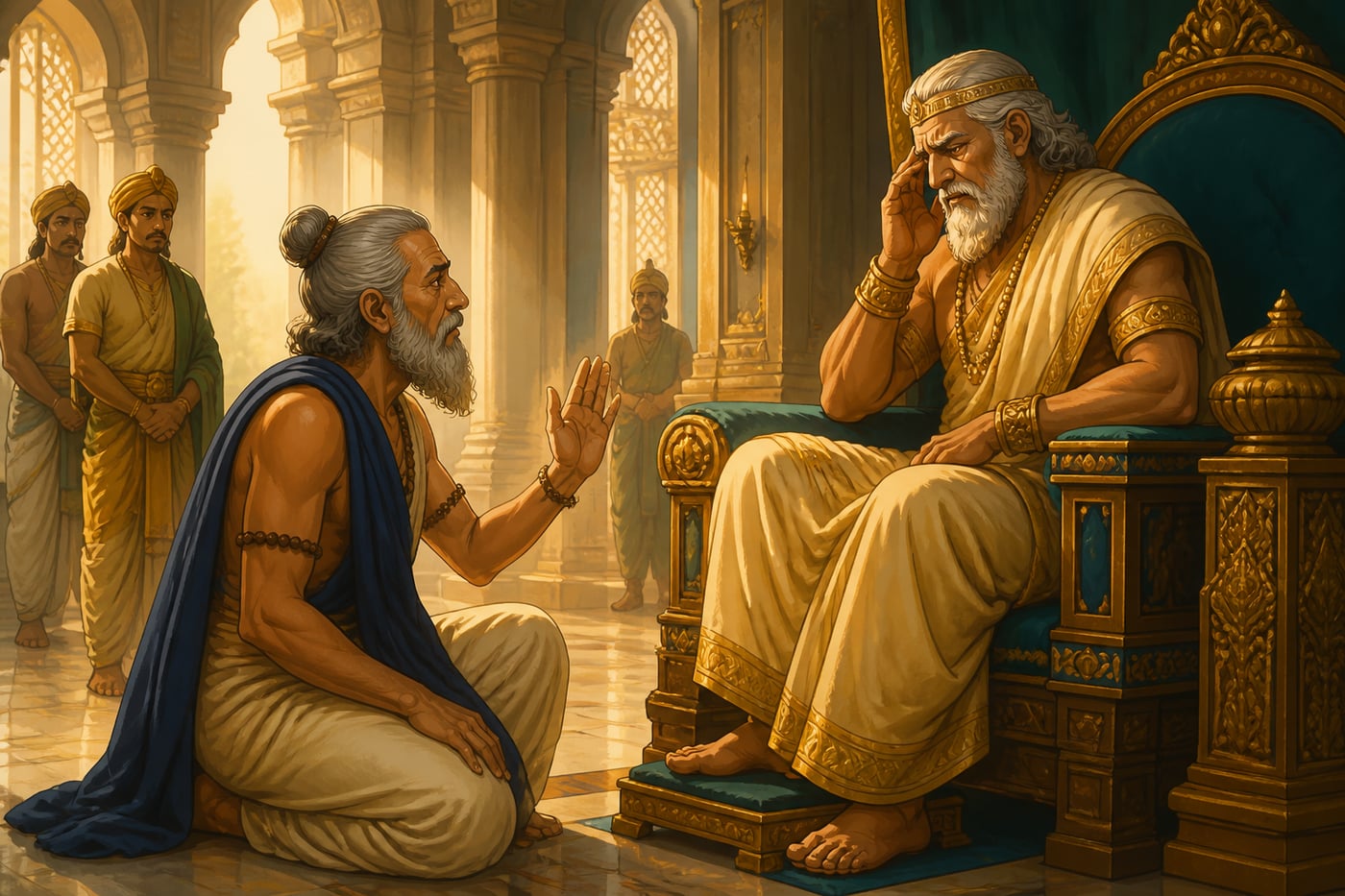
Vidura kneeling to warn the blind King Dhritarashtra in the Hastinapura court

Courage to dissent: "Not timid in the king's presence." Yes-men are useless. You need people who'll say "This plan won't work" when everyone else nods.

Self-mastery: Advisors with vices create vulnerabilities. The minister who drinks talks. The one enslaved to gambling can be pressured.

The Optimal Size

Kautilya recommended 3-12 ministers, depending on the kingdom's size.

Too few (1-2): Creates dangerous dependency. No diversity. No redundancy.

Too many (12+): Leaks multiply. Coordination collapses. Factions form.

The sweet spot (3-7): Diverse perspectives without chaos. Small enough for real trust, large enough for resilience.

Modern executive teams converge on similar numbers. Jeff Bezos famously insisted on the "two-pizza rule" - if a team can't be fed with two pizzas, it's too large.

Building Gradually

The inner circle isn't built overnight:

  1. Test first: No one enters without passing the four tests
  2. Limited access initially: New members see part of the picture
  3. Expand with performance: As they prove discretion, grant more confidence
  4. Watch interactions: Do they build or undermine colleagues?
  5. Grant real authority: Advisors who only advise become disconnected

Rushing this process creates a house of cards.

The Three Dangers

Once established, watch for:

Factionalism: Your advisors competing with each other rather than serving you. Policy debates becoming personal conflicts. Information hoarding. Kautilya's solution: reward cooperation, punish backstabbing, rotate responsibilities.

Dependency: One minister becoming indispensable. "The king should not become dependent on any one minister, however capable." If one advisor controls multiple functions, they control you.

Intimacy without authority: Too close, they lose respect. Too distant, they become political. The balance: "Friendly in disposition but maintaining the dignity of office."

Modern Parallels

Steve Jobs leading his tested Apple executive team in a late-1990s boardroom

Steve Jobs built Apple's executive team with ruthless selectivity. He famously said he'd rather work with a small team of A-players than a large team of B-players. The inner circle was tiny, tested, and empowered.

Contrast with Enron, where Jeffrey Skilling's inner circle became an echo chamber of people afraid to challenge the CEO's assumptions. The lack of dissent enabled a fraud that destroyed the company.

The pattern repeats: successful leaders build small, tested, diverse inner circles. Failed leaders build large, untested, uniform ones.

What to Share

Even within your inner circle, calibrate disclosure:

"Some things," Kautilya told Chandragupta, "even your closest advisors shouldn't know. Not because they're disloyal, but because what they don't know can't be extracted."

Your Turn

Who's in your inner circle? Did they earn the position through testing, or just through proximity and charm?

Kautilya's checklist:

The inner circle is your greatest asset and your greatest vulnerability. Build it correctly, or don't build it at all.

Graduated trust and structural alignment in the inner circle

Jim Collins's research on great companies found that Level 5 leaders get the right people on the bus before deciding where to drive. But 'right people' takes time to identify. Patrick Lencioni's work on cohesive teams emphasizes that trust is built through shared experiences, not instant chemistry. Kautilya's framework of testing plus observation creates this earned trust systematically.

Kautilya understood that proximity creates vulnerability - those closest to power can most easily betray it. His solution wasn't avoiding intimacy but building it slowly through verification. The 'deshiya' (native-born) requirement adds structural safeguard: inner circle members whose families and fortunes are tied to the kingdom have stakes beyond personal loyalty.

Chandragupta's inner circle developed over years, not days. Kautilya himself earned that position through demonstrated commitment. Other ministers joined the core after proving themselves in lesser roles. The mantri-parishad's effectiveness came from this careful composition - each member had been thoroughly tested before gaining full access to secrets and decisions.

The non-negotiable dual requirement of trust and talent

Clayton Christensen noted that many failing companies had loyal executives who couldn't adapt to disruption, while successful startups often imploded from brilliant founders who betrayed each other. Modern governance research shows boards need both independence (similar to competence) and alignment (similar to loyalty). Neither alone suffices.

Verses

राजा मन्त्रिपरिषदं कुर्यात्

rājā mantri-pariṣadaṃ kuryāt

The king should establish a council of ministers.

Leadership requires structured counsel. The inner circle should not be informal or ad hoc, but deliberately constituted with clear roles and responsibilities.

Book 1, Chapter 15, Verse 1 (R.P. Kangle)

सर्वोपधाशुद्धान् देशीयान् मन्त्रिणः कुर्यात्

sarva-upadhā-śuddhān deśīyān mantriṇaḥ kuryāt

One should appoint as ministers those who are native-born and have been purified by all tests.

The inner circle combines character and commitment. Native birth ensures aligned interests; testing ensures verified integrity.

Book 1, Chapter 15, Verse 4-5 (L.N. Rangarajan)

न चैकमन्त्री राजा स्यात्

na ca eka-mantrī rājā syāt

A king should not have only one minister.

Dependence on a single advisor creates catastrophic vulnerability. When that advisor is compromised, dies, or betrays, the entire system collapses.

Book 1, Chapter 15, Verse 38 (R. Shamasastry)

Case studies

Lincoln's Team of Rivals

When Abraham Lincoln became President in 1861, he deliberately appointed his three main rivals for the Republican nomination to his cabinet: William Seward as Secretary of State, Salmon Chase as Secretary of Treasury, and Edward Bates as Attorney General. These men had competed against him and some initially viewed him as inferior. Many observers thought the cabinet would be dysfunctional.

Lincoln applied Kautilya's principles of the inner circle with remarkable sophistication. He chose men of proven capability (they were serious presidential candidates). He ensured they had 'skin in the game' (all were deeply invested in preserving the Union). He balanced their competing perspectives to avoid groupthink. He maintained authority while encouraging vigorous debate. Most importantly, he had the confidence to surround himself with strong personalities rather than yes-men.

The team of rivals became one of the most effective cabinets in American history. Seward evolved from seeing Lincoln as inferior to recognizing his genius. Chase, despite never warming to Lincoln personally, served effectively until his ambition required replacement. The diversity of perspectives helped Lincoln navigate the Civil War's complexity.

The inner circle doesn't require personal friendship or prior loyalty - it requires verified competence, aligned interests, and the leader's ability to synthesize diverse counsel into wise decisions. Lincoln's confidence allowed him to benefit from advisors who might have overshadowed a weaker president.

Startup founders building executive teams face this exact choice. Hiring friends is comfortable but hiring people who challenge your assumptions is more valuable. The best venture capitalists specifically look for founding teams with constructive disagreement because it signals better decision-making under pressure.

Lincoln's cabinet members collectively held over 75 years of political experience. Seward had served 12 years as a senator and 8 as governor. Chase had been a senator, governor, and founding leader of the Republican Party before joining the cabinet.

Historical context

c. 4th century BCE

Ancient Indian texts consistently emphasize the importance of wise counsel. The Ramayana shows Rama surrounded by sage advisors; the Mahabharata's tragedies often stem from poor or ignored counsel. Kautilya systematized this cultural wisdom.

The Mauryan Empire's success at governing unprecedented territory depended on effective ministerial structures. The inner circle wasn't ceremonial; it was the operational core of state administration.

Living traditions

Reflection

More in Amatya Pariksha: Testing Ministers

All lessons in Amatya Pariksha: Testing Ministers · Arthashastra: Science of Governance course