Upabhokta-Raksha: Consumer Protection Principles
The Buyer's Ancient Rights
Beyond catching fraudsters, what positive rights did ancient buyers possess? Discover how Kautilya established return policies, cooling-off periods, seller disclosure obligations, and warranty principles that anticipated modern consumer law by over two millennia, and why his framework for balancing buyer and seller interests remains remarkably relevant.
The Horse That Limped
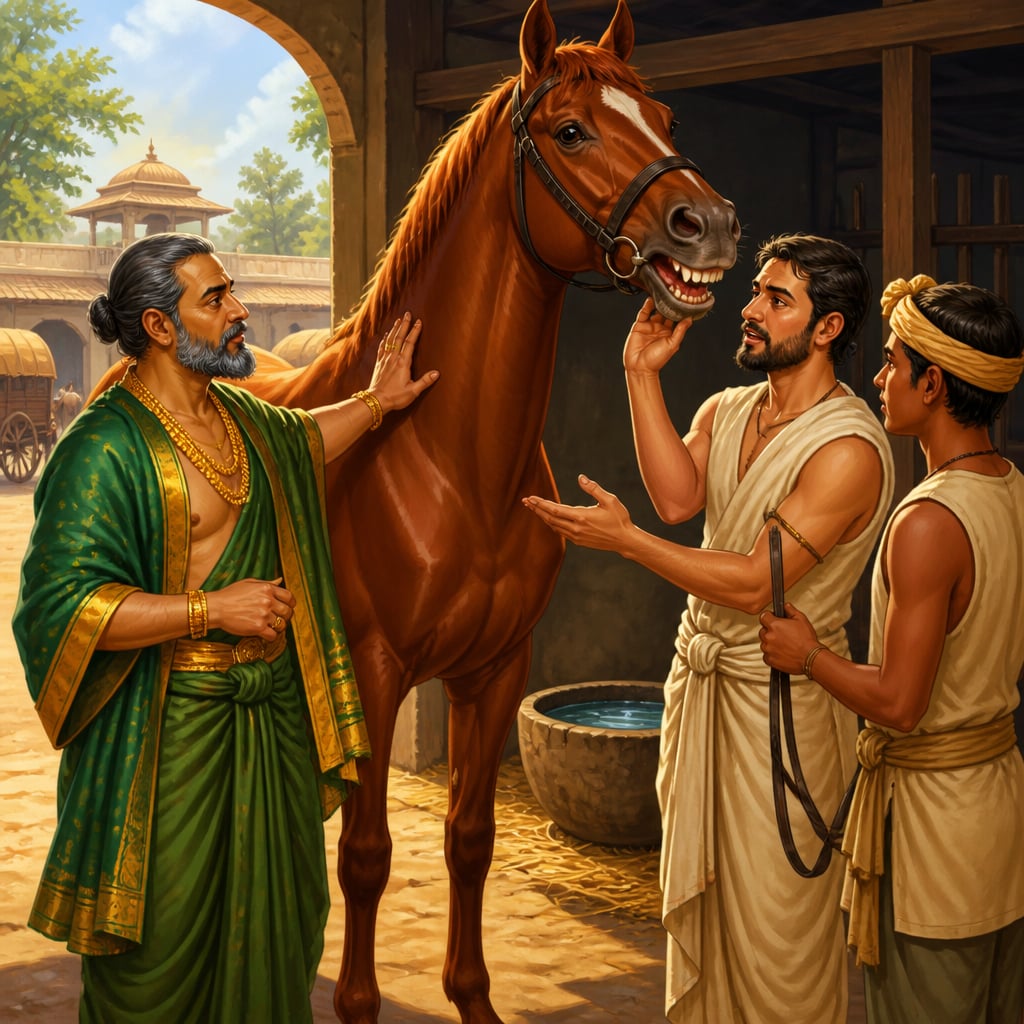
Bhaskara, a prosperous merchant from Vaishali, needed a strong horse for his trading caravans. At Pataliputra's famous horse market, he found exactly what he sought: a magnificent bay stallion, sleek and powerful, offered by Guptaka, a well-known horse dealer.
Guptaka demonstrated the horse's gait, showed its teeth (indicating age), and promised it was in perfect health. Bhaskara paid 500 panas, a substantial sum, and took possession.
Three days later, the horse developed a pronounced limp. A veterinarian diagnosed an old injury, skillfully concealed through temporary treatments. Bhaskara had been sold a damaged animal.
Bhaskara returned to Guptaka demanding his money back. Guptaka refused: "You examined the horse. You paid. The transaction is complete."
Bhaskara appealed to the Panyadhyaksha. What happened next reveals one of history's first codified consumer protection systems.
The Kautilyan Framework: Buyer's Rights
The Arthashastra didn't just punish fraud, it established positive rights for buyers that shifted the balance of commercial power:
The Return Period (Pratyarpana-Kala)
"पण्यं गृहीत्वा प्रत्यर्पयतो...एकाहं द्व्यहं त्र्यहं वा"
"One who returns goods after taking them... within one day, two days, or three days..." , Arthashastra 3.15.1
Kautilya established mandatory cooling-off periods based on the type of goods:
| Category | Return Period | Rationale |
|---|---|---|
| Livestock (horses, cattle) | 3 days | Time needed to observe defects in movement, eating |
| Precious metals/gems | 7 days | Time for expert verification |
| Cloth/garments | 1 day | Visible defects discoverable quickly |
| Grain/food | Same day | Spoilage makes returns impractical |
| Slaves (servants) | 1 year | Character and health defects take time to manifest |
This wasn't optional, sellers could not contract out of these return periods. A buyer who discovered defects within the prescribed period had an absolute right to return.
The Disclosure Obligation (Dosha-Prakashana)

Kautilya imposed affirmative disclosure duties on sellers:
"दोषं प्रकटयेद् विक्रेता पण्यस्य"
"The seller shall disclose defects in the goods." , Arthashastra 3.15.8
Sellers were required to reveal:
- Known defects in the goods
- Hidden conditions that affected value
- Previous ownership if relevant
- Origin if the buyer asked
Failure to disclose was itself a punishable offense, separate from any fraud involved.
The Warranty Principle (Parigraha)
When sellers made specific claims about goods, those claims became enforceable warranties:
- A horse sold as "suitable for war" must perform in battle conditions
- Cloth sold as "waterproof" must resist water
- Metal sold as "pure gold" must be pure gold
If the goods failed to meet stated specifications, the buyer could claim full refund plus damages.
Bhaskara's Case: Justice in Action

Returning to our horse merchant: When Bhaskara brought his case to the Panyadhyaksha, the inquiry proceeded systematically:
1. Examination of Evidence
- The veterinarian testified that the injury was old, not recent
- Witnesses confirmed Guptaka had sold the horse as "in perfect health"
- Other buyers came forward with similar complaints
2. Application of Law
- The complaint was within the 3-day period for livestock
- Guptaka had failed in his disclosure obligation
- His explicit health claim created an enforceable warranty
3. Judgment Guptaka was ordered to:
- Refund the full 500 panas
- Pay 100 panas in damages for Bhaskara's inconvenience
- Pay a 200-pana fine to the treasury
- Announce his fraud publicly in the horse market
The public announcement was crucial, it warned other buyers and damaged Guptaka's reputation, the ultimate commercial punishment.
Global Perspectives on Consumer Rights
The Code of Hammurabi (c. 1754 BCE)
King Hammurabi of Babylon created one of humanity's earliest written legal codes, including provisions protecting buyers, over 1,400 years before Kautilya.
Hammurabi's consumer protections included:
Law 229-232: Builder's Warranty
"If a builder builds a house and the house collapses and kills the owner, the builder shall be put to death."
This extreme penalty enforced quality, builders had powerful incentives to build soundly.
Law 235: Boat Builder's Liability
"If a boat builder builds a boat for someone, and does not make it sturdy, and in that same year the boat develops a leak, the boat builder shall take the boat apart and strengthen it at his own expense."
A clear warranty provision: the builder bears repair costs for defects.
Law 265-266: Shepherd's Accountability
"If a shepherd has been given cattle to tend and through negligence cattle are lost, he shall make good the loss."
Service providers bore responsibility for goods in their care.
| Aspect | Hammurabi's Code | Kautilya's Arthashastra |
|---|---|---|
| Time | ~1754 BCE | ~320 BCE |
| Approach | Severe penalties for defects | Graduated remedies: return, refund, damages |
| Return rights | Not specified | Detailed return periods by category |
| Disclosure duty | Limited | Comprehensive obligation |
| Scope | Specific cases | Systematic framework |
| Warranty | Implied for specific trades | Explicit for all claims |
Both recognized that unequal information between buyer and seller requires legal intervention. But Kautilya's system was more sophisticated, it created a procedural framework rather than just listing penalties.
The Modern Consumer Rights Movement
President John F. Kennedy's Consumer Bill of Rights (1962) is often credited with launching modern consumer protection. He articulated four fundamental rights:
- Right to Safety, protection from hazardous products
- Right to Information, access to accurate product information
- Right to Choose, competitive markets offering alternatives
- Right to be Heard, mechanism for consumer complaints
Kautilya anticipated each of these:
- Safety: Severe penalties for health-harming fraud
- Information: Mandatory disclosure of defects
- Choice: Fair market access through anti-hoarding rules
- Be Heard: Complaint mechanism through the Panyadhyaksha
The conceptual framework existed in ancient India, what changed was scale and implementation.
Modern Resonance: The Lemon Wars
Case Study: The Car That Wouldn't Run
In March 2019, Suresh Kumar purchased a new mid-size SUV from a major automobile manufacturer for ₹18 lakhs. Within three months, the vehicle developed persistent engine problems: stalling at intersections, rough idling, and intermittent power loss.
Kumar brought the car to the authorized service center seven times. Each visit, technicians claimed to have "fixed" the issue. Each time, problems recurred within weeks.
After the seventh failed repair, Kumar requested a replacement vehicle or full refund. The manufacturer refused, arguing:
- The car was under warranty and being serviced
- No single visit revealed a "manufacturing defect"
- The company policy allowed only repairs, not replacements
Kumar filed a complaint with the District Consumer Disputes Redressal Forum.
The Consumer Court Battle
The case turned on a principle Kautilya would have recognized: when does a warranty's repeated failure constitute grounds for rescission?
Kumar's arguments:
- Seven repair attempts for the same problem proved the defect was incurable
- The manufacturer's warranty promised a "trouble-free" vehicle
- His reasonable expectation was reliable transportation, not perpetual repairs
The manufacturer's defense:
- Each repair was successful at the time
- The warranty obligation was only to repair, not replace
- The consumer had no right to a refund under warranty terms
The Forum's Ruling (2021): The manufacturer was ordered to:
- Replace the vehicle with a new one of the same model
- Pay ₹2 lakhs in compensation for mental harassment and inconvenience
- Pay ₹50,000 toward Kumar's legal costs
The key reasoning: A warranty that requires endless repairs is no warranty at all. The repeated failures demonstrated either a fundamental manufacturing defect or an inability to repair, either way, the buyer was entitled to the product he paid for: a functional vehicle.
The Kautilyan Parallel
Kumar's case reflects Kautilyan principles directly:
The Warranty Claim: Just as a horse sold as "healthy" must be healthy, a car sold as "reliable" must be reliable. Claims create enforceable expectations.
The Disclosure Failure: The manufacturer likely knew of the model's engine issues (warranty claims data would show patterns) but didn't disclose to buyers.
The Remedy Principle: Kautilya's graduated remedies, repair first, then replacement, then refund, anticipated the "lemon law" logic that eventually prevails when repairs fail.
The Damage Award: Kautilya imposed damages beyond mere refund for "loss of use and inconvenience", exactly what modern consumer courts award as compensation.
Your Turn: The Empowered Buyer
Consumer protection exists because of information asymmetry, sellers know more about their products than buyers. Your power lies in closing that gap.
First, know your rights. In India:
- The Consumer Protection Act, 2019 covers goods, services, and e-commerce
- You have the right to return defective products
- Misleading advertisements are actionable
- Consumer courts operate with minimal fees and simpler procedures than civil courts
Second, document everything. Kautilya's system worked because buyers could prove their claims:
- Keep receipts, warranties, and communication records
- Document problems with photos, videos, and timestamps
- Save all repair receipts and service records
Third, escalate systematically:
- Complain first to the seller
- Escalate to the manufacturer if unresolved
- File with the consumer forum if still unresolved
- Social media pressure often accelerates resolution
Fourth, remember Kautilya's insight: your vigilance protects not just yourself but the market. Consumer complaints create records that expose patterns. Your case today may protect thousands of buyers tomorrow.
In our next lesson, we'll examine how modern Indian regulators, SEBI, CCI, IRDAI, apply these ancient principles in domains Kautilya couldn't have imagined: stock markets, digital monopolies, and insurance fraud.
Modern securities law requires 'material disclosure', companies must reveal information that would affect investment decisions. Real estate law requires disclosure of known defects. Both follow Kautilya's principle.
Kautilya's blanket disclosure duty was broader than most modern equivalents, which often limit disclosure requirements to specific categories. His approach was: if you know a defect, you must reveal it. Period.
India's Consumer Protection Act, 2019 includes specific disclosure requirements for e-commerce, origin, refund policy, warranty terms, echoing the Arthashastra's insistence that silence can be deception.
Modern 'lemon laws' follow similar graduation: the manufacturer gets opportunities to repair before replacement/refund becomes mandatory. This balances consumer protection with manufacturing reality.
Kautilya recognized that immediate refund demands aren't always fair, sellers should have opportunity to correct. But repeated failure triggers stronger remedies. This balanced approach remains optimal.
Consumer forums in India typically order replacement only after 3+ failed repair attempts, closely following Kautilyan graduation, give sellers fair chance, then escalate.
Key terms
- Upabhoktṛ-rakṣā
- Consumer protection; the framework of rights, remedies, and regulations protecting buyers from exploitation, fraud, and unfair dealing.
- Pratyarpaṇa
- Return or restitution; the right of a buyer to return goods and receive refund within specified periods or when defects are discovered.
- Doṣa-prakāśana
- Disclosure of defects; the seller's affirmative obligation to reveal known faults or problems with goods being sold.
- Parigraha
- Warranty or guarantee; the enforceable promise regarding the quality, specifications, or performance of goods sold.
Verses
पण्यं गृहीत्वा प्रत्यर्पयतो नालमर्थाय एकाहं द्व्यहं त्र्यहं वा
paṇyaṃ gṛhītvā pratyarpayato nālamarthāya ekāhaṃ dvyahaṃ tryahaṃ vā
Having taken goods, one may return them within one, two, or three days, for the buyer deserves time to know what they have bought.
Anticipates modern 'cooling-off period' laws and return policies. The principle: information asymmetry between buyer and seller requires post-purchase protection, not just pre-purchase regulation.
Arthashastra, 3.15.1 (R.P. Kangle)
दोषं प्रकटयेद् विक्रेता पण्यस्य
doṣaṃ prakaṭayed vikretā paṇyasya
Let the seller reveal the defects of his goods, for truth in trade is the foundation of trust.
Distinguishes between fraud (active deception) and non-disclosure (passive concealment). Modern consumer law similarly requires 'material disclosure' for significant defects, sellers cannot hide behind silence.
Arthashastra, 3.15.8 (Patrick Olivelle)
विक्रयानुसारेण पण्यं दद्यात्
vikrayānusāreṇa paṇyaṃ dadyāt
As agreed in the sale, so must the goods be given, a promise made is a debt unpaid.
Creates enforceable warranties from seller's representations. Modern warranty law follows the same principle: specific claims about product performance or quality become contractual obligations.
Arthashastra, 3.15.15 (L.N. Rangarajan)
Key figures
Kautilya (Chanakya)
Author of Arthashastra; architect of consumer protection framework · 4th century BCE
Kautilya created history's first comprehensive consumer protection system, going beyond fraud punishment to establish positive buyer rights: mandatory return periods, disclosure obligations, enforceable warranties, and graduated remedies. His insight that information asymmetry between buyer and seller requires legal intervention anticipated modern consumer protection theory by over two millennia.
Kautilya's consumer protection framework demonstrates that buyer rights are not modern inventions but ancient principles that sophisticated commercial societies recognize as essential.
Justice A.P. Shah
Influential jurist who shaped consumer law interpretation · Present (Former Chief Justice, Delhi High Court; Former Chairman, Law Commission of India)
Justice Shah, during his tenure on the Delhi High Court and as Law Commission Chairman, authored several landmark consumer protection judgments and recommendations. His rulings established principles like 'prolonged defect equals manufacturing defect' and expanded the scope of consumer redressal beyond strict contractual terms. His work helped Indian consumer courts adopt purposive interpretation that protects buyer interests.
Justice Shah represents the judicial tradition of interpreting consumer law liberally in favor of buyers, continuing the Kautilyan principle that the state protects the weaker party in commercial transactions.
Hammurabi of Babylon
King of Babylon; creator of one of humanity's oldest known legal codes · c. 1810-1750 BCE
The Code of Hammurabi (c. 1754 BCE) included provisions protecting buyers and service recipients: builder liability for structural failures, boat-builder warranties, shepherd accountability for entrusted animals. While more focused on severe penalties than systematic rights, the Code demonstrates that consumer protection is among humanity's oldest legal concerns.
Hammurabi provides the earliest known parallel to Kautilya's consumer protection, showing that the need to protect buyers from sellers is a universal challenge that ancient civilizations addressed with legal frameworks.
Case studies
The Lemon That Launched a Precedent
In 2019, **Rajesh Sharma** purchased a premium sedan from a leading European manufacturer's authorized dealer in Mumbai for ₹42 lakhs. Within the first year, the vehicle experienced persistent transmission problems: gear slippage, shuddering during acceleration, and occasional complete failure to engage. Sharma brought the car to the authorized service center nine times. Each visit lasted 3-7 days. Each time, technicians performed repairs under warranty. Each time, problems recurred within weeks. The manufacturer insisted the car was within specifications and that each individual repair was successful. They offered continued warranty service but refused replacement or refund. Sharma calculated his 'lemon' had spent 47 days in the shop during its first year, roughly 13% of his ownership period. He'd missed work, rearranged schedules, and faced constant anxiety about breakdowns. In January 2020, he filed before the Maharashtra State Consumer Disputes Redressal Commission.
Sharma's case mirrors Bhaskara's ancient horse dispute with remarkable precision. The *parigraha* (warranty) principle applies: the manufacturer sold a vehicle with implicit warranty of reliable transportation. Nine failed repairs demonstrated that either the defect was incurable (manufacturing fault) or the manufacturer lacked competence to repair (service failure), either way, the warranty promise was breached. The *dosha-prakashana* (disclosure) issue also applies: if the manufacturer knew this model had transmission issues (warranty claims data would show patterns), continuing to sell without disclosure was concealment. Kautilya would have noted that repeated failure to cure converts repair obligation into replacement obligation, the buyer purchased a functional vehicle, not a project car requiring perpetual service.
In March 2022, the Maharashtra State Commission ruled in Sharma's favor. The order required: (1) replacement with a new vehicle of the same model and specifications; (2) compensation of ₹5 lakhs for mental harassment, inconvenience, and loss of use; (3) ₹1 lakh toward legal costs. The Commission's reasoning established important precedent: 'When a product requires repeated repairs for the same defect, the cumulative failure demonstrates either manufacturing defect or service incompetence. Either way, the consumer is entitled to a product that functions as promised. A warranty that results in perpetual repairs is no warranty at all.' The manufacturer appealed to the National Commission but the order was upheld.
The Sharma case demonstrates that Kautilyan principles operate in modern consumer law, even when not explicitly invoked. The graduated remedy approach, giving the manufacturer nine chances to repair before ordering replacement, reflects the Arthashastra's balance between seller opportunity and buyer protection. The damage award for 'mental harassment' echoes Kautilya's recognition that buyers suffer beyond mere financial loss when sellers breach obligations.
India's consumer protection framework has strengthened significantly since 2019, with the Consumer Protection Act enabling product liability claims, class action suits, and e-commerce regulation. The nine-repair threshold from the Sharma case is now frequently cited in automobile lemon law arguments across Indian courts.
Consumer cases involving automobiles rose 340% between 2015-2023, with the average compensation award increasing from ₹50,000 to ₹3.2 lakhs. The Sharma precedent has been cited in over 50 subsequent cases, establishing 'repeated repair failure' as grounds for replacement across multiple manufacturers.
Historical context
4th-3rd century BCE (Mauryan Period) compared with 18th century BCE (Old Babylonian Period)
The Mauryan economy's integration created new consumer protection challenges. When goods traveled from Gujarat to Bengal, how could buyers verify quality or seek redress? Kautilya's framework addressed this through standardized rights applicable across the empire, a buyer in Taxila had the same protections as one in Pataliputra. This uniformity was essential for long-distance trade confidence.
Hammurabi's Code preceded Kautilya by ~1,400 years and included consumer protections. But Hammurabi's approach was penalty-focused: kill the negligent builder, force the boat-maker to repair. Kautilya's system was more sophisticated: graduated remedies, procedural mechanisms, and positive rights beyond mere punishment. Both recognized the problem; Kautilya's solution was more complete.
Hammurabi's builder warranty (Law 229) prescribed death for fatal structural failures. Kautilya's equivalent prescribed financial penalties and reputation damage, achieving deterrence without irreversibility. The shift from corporal to financial penalties reflects increasing commercial sophistication.
Understanding that consumer protection is among humanity's oldest legal concerns, present in both Babylonian and Indian ancient law, counters the narrative that buyer rights are modern Western innovations. India's Consumer Protection Act builds on indigenous tradition, not foreign import.
Living traditions
Kautilyan consumer protection principles persist in India's consumer courts, return policies, and commercial customs that protect buyers.
India's Consumer Protection Act, 2019; District, State, and National Consumer Commissions; and the Consumer HELPLINE (1915) directly implement Kautilyan principles: accessible dispute resolution, graduated remedies, and protection of the weaker party in commercial transactions.
- Jeweler's Exchange Guarantee: Traditional jewelers offer exchange guarantees on gold purchases, allowing buyers to return within specified periods, continuing the pratyarpana tradition for precious goods.
- Village Panchayat Commercial Disputes: In rural areas, panchayats still arbitrate commercial disputes including quality complaints, following informal procedures that echo Kautilya's accessible dispute resolution.
- National Consumer Disputes Redressal Commission, Delhi: India's apex consumer court, the modern institutional successor to Kautilya's Panyadhyaksha, handling appeals and landmark consumer cases.
- Consumer HELPLINE Office: The 1915 helpline's operations center, handling 100,000+ consumer complaints monthly, modern implementation of accessible complaint mechanisms.
- Consumer Courts and Dharma Sabha Tradition: India's tiered consumer court system (District, State, National) echoes the traditional dharma sabha structure for dispute resolution. Just as religious assemblies resolved disputes according to dharmic principles, consumer courts apply consumer protection law to commercial conflicts, accessible justice for the weaker party.
- Temple Trust Dispute Resolution: Temple trusts historically resolved commercial disputes among vendors, artisans, and service providers operating in temple precincts. The trust's moral authority enabled resolution without formal legal proceedings, an informal consumer protection mechanism that Kautilya's Panyadhyaksha paralleled in state administration.
Reflection
- Kautilya established that sellers must disclose known defects, not just avoid active lies. In your experience, as buyer, seller, or professional, where have you seen disclosure fail? When is silence deception, and when is it merely privacy?
- Have you ever felt wronged as a consumer but didn't pursue a complaint? What stopped you, inconvenience, cost, skepticism about outcomes? What would make consumer redress more accessible to you?