Mulya-Niyamana: Price Controls and Fair Markets
When to Intervene, When to Restrain
Explore Kautilya's sophisticated approach to price regulation, neither laissez-faire nor crude price-fixing, but intelligent intervention that prevented exploitation while preserving market incentives. Learn why ancient India's nuanced framework offers wisdom that modern policymakers still struggle to match.
The Famine That Changed Everything
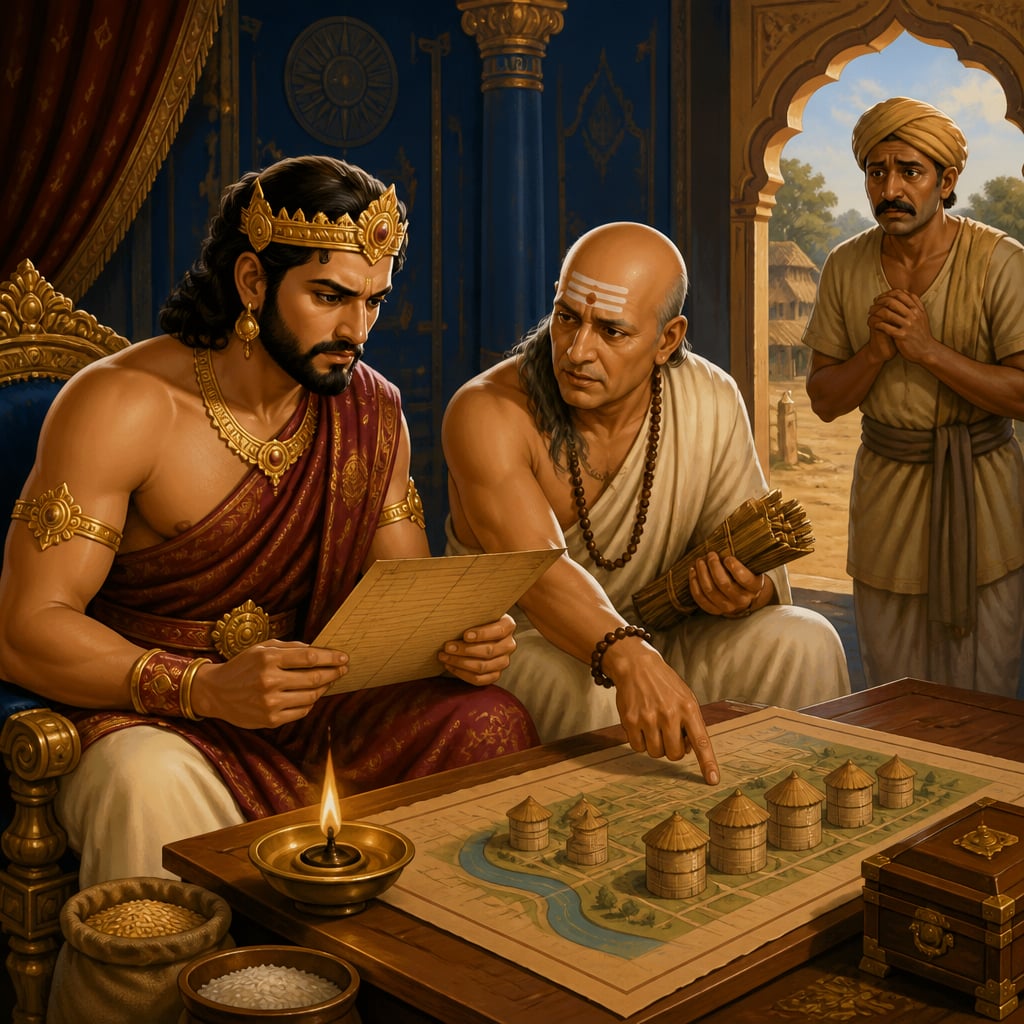
In 322 BCE, a drought struck eastern Magadha. The rice crop failed. Within weeks, grain prices in Pataliputra doubled. Within a month, they tripled. Merchants with stored grain saw an opportunity, why sell now when prices might rise further?
The new emperor Chandragupta Maurya faced his first economic crisis. His advisor Kautilya watched as common people began hoarding whatever grain they could find, worsening the shortage. Hungry crowds gathered outside granaries. The situation was spiraling.
Kautilya's response would become one of history's most sophisticated frameworks for price intervention, neither the heavy hand of Soviet-style price-fixing nor the invisible hand of pure market economics, but something more intelligent.
The Kautilyan Framework: Three Tiers of Intervention
Kautilya distinguished between three categories of goods, each requiring different regulatory approaches:
Tier 1: Nitya-Panya (Essential Commodities) Grains, salt, oil, ghee, goods without which ordinary life becomes impossible. For these, Kautilya prescribed active price monitoring and intervention:
"नित्यपण्यानां मूल्यं स्थापयेत्। क्रयविक्रयाभावे स्वयं कारयेत्"
"For essential commodities, he should establish prices. If buying and selling cease, he should arrange it himself." , Arthashastra 4.2.28
This wasn't rigid price-fixing. The state would enter the market as buyer or seller to stabilize prices, what modern economists call "market operations" or "buffer stock management."
Tier 2: Sthavara-Panya (Standard Goods) Cloth, metals, household items, important but not survival-critical. Here, Kautilya prescribed profit margin limits rather than fixed prices:
"देशजपण्यानां पञ्चमं भागं...परदेशजपण्यानां दशमं भागं लाभं कारयेत्"
"On local goods, a profit of five percent... on foreign goods, ten percent should be allowed." , Arthashastra 2.16.10-11
Notice the sophistication: foreign goods could carry higher margins because they involved greater transport costs and risks. Kautilya wasn't imposing arbitrary limits, he was ensuring reasonable returns while preventing gouging.
Tier 3: Vilasa-Panya (Luxury Goods) Jewelry, perfumes, fine textiles, goods the wealthy purchased. Here, Kautilya largely let markets operate freely. Why regulate what only the rich can afford?
The Anti-Hoarding Intelligence Network
Kautilya knew that price controls without enforcement are meaningless. His system included remarkable intelligence operations:

The Samsthaniya (Market Informants) Undercover agents posed as ordinary buyers, noting which merchants were charging above permitted prices or withholding stock.
The Gudha-Purusha (Secret Agents) These operatives infiltrated merchant networks, identifying hoarding before it could distort markets. When they found warehouses stockpiling grain during shortages, the Panyadhyaksha could act before prices spiked.
The Punishment Gradient Penalties scaled with the severity of manipulation:
- First offense: Fine equal to price differential
- Repeated offense: Double fine plus confiscation
- Deliberate hoarding during famine: Severe corporal punishment
Kautilya's system recognized that information asymmetry was the root of market manipulation. His solution? Make the state's information superior to manipulators'.
Global Perspectives on Price Controls
Milton Friedman (1912-2006), perhaps history's most influential critic of price controls, famously declared: "We economists don't know much, but we do know how to create a shortage. If you want to create a shortage of tomatoes, just pass a law that retailers can't sell tomatoes for more than two cents a pound."
Friedman's critique was grounded in rigorous analysis of 20th-century failures, Nixon's wage-price controls in 1971, Venezuela's price caps that created empty shelves, Zimbabwe's interventions that accelerated hyperinflation. His conclusion was unambiguous: price controls always fail.
Kautilya would have partially agreed. Crude price-fixing, setting arbitrary prices disconnected from supply-demand realities, does create the distortions Friedman described. Sellers exit markets, black markets emerge, quality deteriorates.
But Kautilya's system was fundamentally different:
| Friedman's Critique | Kautilyan Response |
|---|---|
| Fixed prices ignore supply/demand | Prices adjusted based on market intelligence |
| Controls create shortages | State buffer stocks filled gaps |
| Black markets inevitable | Intelligence network detected evasion |
| Producers exit markets | Reasonable profit margins preserved incentives |
Jean-Baptiste Colbert (1619-1683), Louis XIV's finance minister, implemented extensive price controls across France. Unlike Kautilya's targeted approach, Colbert regulated everything, the width of cloth, the number of threads, the price of bread. The result? French industry stagnated under bureaucratic weight while English competitors, freer to innovate, surged ahead.
Amartya Sen (1933-), the Indian Nobel laureate, noted that famines occur not from absolute food shortage but from entitlement failures, when people lack the purchasing power to buy available food. Kautilya anticipated this, directing that during crises, the state should not just control prices but ensure supply through royal granaries.
| Thinker | Position on Price Controls | Kautilyan Comparison |
|---|---|---|
| Friedman | Always counterproductive | Agreed on crude controls; differed on intelligent intervention |
| Colbert | Control everything | Kautilya: Control essentials, free luxuries |
| Sen | Focus on access, not just price | Kautilya combined both: price stability + supply assurance |
Modern Resonance: India's Onion Wars
Few commodities have toppled more Indian governments than the humble onion. In October 2019, onion prices in Delhi touched ₹165/kg, up from ₹30 just months earlier. Maharashtra's crop had failed due to unseasonal rains. Kharif stocks were depleted. And suddenly, a vegetable that forms the base of virtually every Indian dish became unaffordable for millions.
The government's response was a textbook study in what Kautilya would recognize, and critique:
Phase 1: Export Ban (September 2019) India banned onion exports. Classic supply-side intervention. But domestic prices kept rising because the fundamental shortage remained.
Phase 2: Stock Limits (October 2019) Traders were prohibited from holding more than 25 quintals for retailers, 500 quintals for wholesalers. Classic anti-hoarding. But enforcement was patchy, without Kautilya's intelligence network, officials couldn't locate hidden stocks.
Phase 3: Import Scramble (November 2019) India imported onions from Egypt, Turkey, and Afghanistan. Classic buffer operation. But by the time ships arrived, the rabi crop was coming to market, and imported onions rotted in warehouses, bought at ₹60/kg, sold at ₹20/kg.
Phase 4: Price Collapse (January 2020) Prices crashed to ₹5/kg. Farmers, who had expanded planting in response to high prices, faced devastating losses. Many couldn't recover their input costs.
The pattern repeated in 2020, 2023, and 2024, a yo-yo of crisis, intervention, overshoot, and farmer distress.
What would Kautilya have done differently?
- Permanent buffer stock: Maintained year-round reserves to dampen volatility, not scramble during crises
- Price band, not price cap: Allow fluctuation within a range that rewards farmers during scarcity but prevents exploitation
- Information superiority: Real-time data on stocks across the supply chain to detect hoarding early
- Graduated intervention: Start with information disclosure, escalate to operations only if markets don't self-correct
The PM Garib Kalyan Anna Yojana (free grain distribution since 2020) represents a more Kautilyan approach, ensuring access to essentials during crisis rather than just controlling prices.
Your Turn: The Price of Wisdom
The price control debate isn't abstract economics, it affects your daily life.
First, notice price volatility in essentials you purchase. When tomato prices tripled in 2023, or onions became expensive, observe government responses. Are they sophisticated (buffer operations, targeted subsidies) or crude (blanket price caps)?
Second, understand Kautilya's key insight: the goal isn't controlling prices but ensuring fair access. Price is just a signal. What matters is whether people can afford necessities.
Third, for professionals in any field: recognize that Kautilya's tiered approach applies beyond commodities. Some things (healthcare, education) warrant intervention; others (luxury goods, entertainment) can be left to markets. The wisdom lies in distinguishing which is which.
In our next lesson, we'll examine Mana-Parimana, Kautilya's system for standardizing weights and measures, the foundation upon which all fair trade depends.
Differential regulation and necessity-based intervention
Friedman opposed all price controls equally. Keynes supported intervention during crises. Neither developed Kautilya's nuanced categorization system.
The tiered approach focuses regulatory energy where it matters most, essentials that affect survival, while allowing markets to operate freely elsewhere, avoiding bureaucratic overreach.
India's Essential Commodities Act covers only ~8 categories (grains, pulses, edible oils, sugar, etc.), a modern application of Kautilya's tiered principle.
Market-maker of last resort; buffer stock operations
The US Federal Reserve acts as 'lender of last resort' in financial markets, a monetary parallel to Kautilya's commodity market principle.
Key terms
- Mūlya-niyamana
- Price regulation or price control; the state's intervention in market pricing to ensure fairness, prevent exploitation, and maintain essential commodity access.
- Nitya-paṇya
- Essential or daily-use commodities; goods necessary for ordinary life that warrant price regulation and supply assurance.
- Saṃcaya-nirodha
- Anti-hoarding measures; regulations preventing merchants from stockpiling goods to create artificial scarcity and price spikes.
- Lābha-maryādā
- Profit limits or margin caps; the maximum profit percentage merchants may charge above their costs.
Verses
नित्यपण्यानां मूल्यं स्थापयेत्। क्रयविक्रयाभावे स्वयं कारयेत्
nitya-paṇyānāṃ mūlyaṃ sthāpayet | kraya-vikrayābhāve svayaṃ kārayet
For essential goods, establish fair prices; when trade fails, let the state itself ensure supply.
Anticipates modern concepts of 'market failure' and government intervention as market-maker. The Public Distribution System and buffer stock operations reflect this ancient principle.
Arthashastra, 4.2.28 (Patrick Olivelle)
देशजपण्यानां पञ्चमं भागं विंशतिभागं वा परदेशजपण्यानां दशमं भागं लाभं कारयेत्
deśaja-paṇyānāṃ pañcamaṃ bhāgaṃ viṃśati-bhāgaṃ vā paradeśaja-paṇyānāṃ daśamaṃ bhāgaṃ lābhaṃ kārayet
For local goods, five to twenty percent profit; for foreign goods, ten percent, fair return without exploitation.
This 'cost-plus' pricing approach is more sophisticated than rigid price controls. It preserves market signals while limiting exploitation, a principle still used in regulated industries like pharmaceuticals.
Arthashastra, 2.16.10-11 (R.P. Kangle)
अपण्यं वा पण्यमुपगृह्णीयात् पण्यं वा अपण्यं कुर्यात्
apaṇyaṃ vā paṇyam upagṛhṇīyāt paṇyaṃ vā apaṇyaṃ kuryāt
What cannot be traded may be opened to commerce; what is traded may be restricted, the state shapes markets to serve the people.
Markets are not natural given but socially constructed. The state determines what is tradeable (commodities) versus what is protected (strategic reserves, prohibited items). Modern parallels: spectrum licensing, drug scheduling, export controls.
Arthashastra, 4.2.22 (L.N. Rangarajan)
Key figures
Kautilya (Chanakya)
Author of Arthashastra; Chief Advisor to Chandragupta Maurya · 4th century BCE
Kautilya developed history's most sophisticated framework for price regulation, distinguishing between essential, standard, and luxury goods; implementing profit margin limits rather than rigid prices; creating intelligence networks to detect hoarding; and establishing the state as market participant of last resort. His system avoided the failures that plague crude price controls while protecting vulnerable populations from exploitation.
Kautilya's tiered approach to price intervention offers a middle path between laissez-faire and command economics, recognizing both market wisdom and market failures.
Ashok Dalwai
Agricultural economist; Expert on commodity pricing and farmer welfare · Present (Served 2016-2023 as CEO, National Rainfed Area Authority)
Ashok Dalwai chaired the Committee on Doubling Farmers' Income (2017), which recommended price stabilization mechanisms including buffer stocks, price bands, and market intelligence systems for agricultural commodities. His work highlighted how price volatility, not just low prices, devastates farmers, echoing Kautilya's concern with stability over mere control.
Dalwai's recommendations for agricultural price stabilization reflect Kautilyan principles, using information and buffer operations rather than rigid controls to ensure fair prices for both producers and consumers.
Milton Friedman
American economist; Nobel laureate (1976); leader of Chicago School monetarism · 1912-2006
Friedman was the 20th century's most influential critic of price controls. His analysis of Nixon's wage-price controls, rent control failures, and agricultural price supports demonstrated how well-intentioned interventions create shortages, black markets, and economic distortions. His famous statement, 'Inflation is always and everywhere a monetary phenomenon', shifted policy focus from price controls to monetary policy.
Friedman's critique applies powerfully to crude price-fixing but less to Kautilya's sophisticated system. The comparison reveals that 'price controls' encompasses vastly different approaches, from failed rigidity to intelligent intervention.
Case studies
India's Onion Wars: A Study in Price Intervention Complexity
In October 2019, onion prices in Delhi markets touched ₹165/kg, a 500% increase from ₹30/kg just three months earlier. The trigger: unseasonal rains destroyed the kharif crop in Maharashtra, which supplies 40% of India's onions. Within weeks, the 'onion crisis' dominated national headlines. Finance Minister Nirmala Sitharaman admitted she doesn't eat much onion (sparking ridicule), while opposition parties accused the government of apathy. The political stakes were real: state governments had fallen over onion prices before (Maharashtra, 1998; Delhi, 1980). The government's response evolved through distinct phases: September 2019, export ban (failed to reduce domestic prices); October 2019, stock limits on traders (enforcement proved difficult without real-time inventory data); November-December 2019, emergency imports from Egypt, Turkey, Afghanistan (arrived too late; quality inferior); January 2020, prices crashed to ₹5/kg as rabi crop flooded markets, devastating farmers who had expanded acreage expecting high prices. The cycle repeated in 2020 (COVID disruptions), 2023 (climate events), and 2024.
Through Kautilya's framework, the onion crisis reveals multiple failures. First, lack of *mūlya-jñāna* (price intelligence), the government lacked real-time data on stocks across the supply chain, making intervention reactive rather than anticipatory. Second, absence of permanent *kosha* (buffer), unlike grains (where FCI maintains stocks), onions had no systematic buffer, forcing crisis-time scrambles. Third, crude intervention tools, blanket export bans and stock limits are blunt instruments compared to Kautilya's nuanced approach of margin limits and targeted operations. A Kautilyan response would maintain year-round onion reserves (perishability makes this hard but not impossible with cold storage); implement price bands rather than caps, allowing ₹40-80/kg range that rewards farmers during scarcity without exploiting consumers; deploy *gudha-purusha* (intelligence) to detect hoarding early; and intervene gradually, first through information disclosure, then through buffer releases, only then through restrictions.
As of late 2025, India's onion price management remains crisis-driven rather than systematic. However, lessons are slowly being implemented. The government has expanded cold storage capacity under PM Kisan SAMPADA Yojana. e-NAM (electronic National Agriculture Market) provides better price transparency. The Operation Greens scheme (launched 2018, expanded 2024) attempts to build tomato-onion-potato value chains with storage and transport support. The 2024 budget allocated ₹500 crore for price stabilization of horticulture crops. Progress is incremental, moving toward, though not yet reaching, Kautilyan sophistication.
The onion crisis demonstrates that the choice isn't between 'intervention' and 'no intervention' but between crude and sophisticated intervention. Kautilya's approach, permanent buffers, price bands, intelligence networks, graduated response, would likely have prevented both the consumer crisis and the subsequent farmer distress. Modern India is slowly rediscovering this ancient wisdom.
India's onion price volatility recurs almost annually, revealing that crisis-driven intervention has not been replaced by permanent buffer stock infrastructure. Countries like China maintain strategic reserves for key commodities, stabilizing prices without banning exports. India's move toward Kautilyan permanent reserves remains incomplete.
India is the world's second-largest onion producer (26 million tonnes/year) yet experiences annual price swings of 300-500%. Stable systems like Kautilya envisioned require permanent reserves of roughly 500,000-750,000 tonnes, less than 3% of production but currently absent.
Historical context
4th-3rd century BCE (Mauryan Period)
The Mauryan empire managed prices across an unprecedented geographic and demographic scale. From Taxila to Pataliputra, from Kashmir to Karnataka, standardized approaches to essential commodity pricing enabled unified governance. Megasthenes noted that while prices varied by region, the regulatory principles were consistent empire-wide.
Rome during this period (republic era) had no systematic price controls, occasional edicts during crises but no permanent framework. China under the Qin standardized weights and currency but not commodity prices. The Mauryan price regulation system was unmatched in sophistication until perhaps Byzantine Constantinople's price controls on bread and strategic goods.
Kautilya specified different profit margins for different goods: 5% for essential local goods, 10% for imported goods, higher for luxuries. This graduated approach recognized that a single price control formula couldn't fit all commodities, a sophistication not seen in Western economics until the 20th century.
Understanding that sophisticated price intervention is indigenous to Indian governance challenges the narrative that market regulation is a Western or socialist import. India's price control debates have local roots stretching back millennia.
Living traditions
Kautilyan price regulation principles persist in India's essential commodities framework, public distribution system, and agricultural market interventions.
India's Essential Commodities Act (1955), National Food Security Act (2013), and PM Garib Kalyan Anna Yojana (2020-ongoing) all reflect Kautilyan principles: state responsibility for essential commodity access, buffer operations to stabilize prices, and targeted intervention rather than universal controls.
- Public Distribution System (PDS): Government procurement at Minimum Support Price and distribution through Fair Price Shops at subsidized rates directly implements Kautilya's principle of state-as-market-participant for essential commodities.
- FCI Buffer Stock Operations: Food Corporation of India maintains grain reserves and conducts Open Market Sale Scheme (OMSS) to stabilize prices, precisely the buffer mechanism Kautilya prescribed.
- Azadpur Mandi, Delhi: Asia's largest wholesale fruit and vegetable market; witness real-time price discovery and the volatility that Kautilya's systems sought to moderate.
- FCI Grain Silo Complex, Sangrur: Modern implementation of Kautilyan kosha (treasury/storage) principles; one of India's largest grain storage facilities.
- Annadanam Tradition at Major Temples: Major temples like Tirupati Balaji and Harmandir Sahib (Golden Temple) operate massive free food distribution programs. These annadanam traditions parallel Kautilya's essential commodity framework, ensuring food access regardless of ability to pay. Tirupati feeds 100,000+ daily; Golden Temple serves 100,000+ daily in its langar.
- Akshaya Patra Foundation Kitchens: ISKCON's Akshaya Patra serves 2+ million school meals daily, implementing Kautilya's principle that essential food access supports human flourishing. The centralized kitchen model enables quality control and cost efficiency that parallels FCI's buffer operations.
Reflection
- Friedman argued price controls always fail; Kautilya prescribed nuanced intervention. In your experience, have you seen price interventions that worked versus those that created shortages or black markets? What distinguished the successful from the failed approaches?
- Kautilya distinguished between essential, standard, and luxury goods, each warranting different regulatory approaches. In your personal finances, what are your 'essential' expenses that deserve careful price-sensitivity versus 'discretionary' spending where you're more flexible? How might this distinction guide your budgeting?