Panyadhyaksha: The Market Superintendent
Guardian of Fair Commerce
Discover how ancient India's Panyadhyaksha, the Superintendent of Commerce, wielded sophisticated regulatory powers to ensure fair markets, prevent exploitation, and balance merchant freedom with consumer protection, offering lessons that resonate with modern market oversight debates.
The Morning Inspection
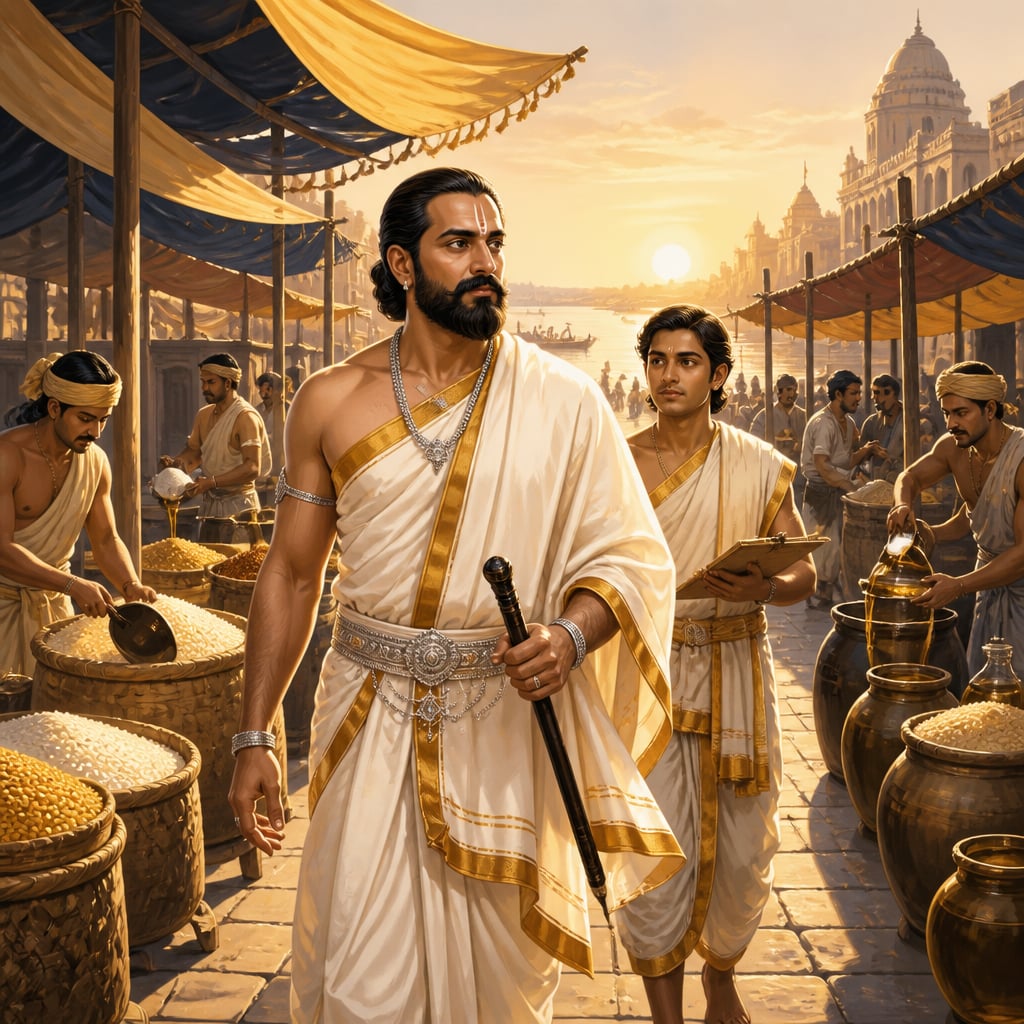
The sun had barely risen over Pataliputra when Vardhana, the city's Panyadhyaksha, entered the sprawling marketplace near the Ganga waterfront. Merchants were arranging their wares, silk from Varanasi, pepper from Kerala, iron from Magadha's mines. But Vardhana wasn't here to shop. He was here to enforce the most sophisticated market regulation system the ancient world had ever seen.
His eyes scanned for the telltale signs: scales that tilted slightly in the seller's favor, grain mixed with chaff, silk dyed to appear finer than it was. In his hand, he carried the official tula, the standardized weight that every transaction in the Mauryan Empire was measured against. Today, as every day, the market's honesty would be tested.
This was 321 BCE, and Kautilya's vision of regulated commerce was being enforced across an empire stretching from Afghanistan to Bengal.
The Architect of Market Order
The Panyadhyaksha (पण्याध्यक्ष) was not merely an inspector, he was the chief architect of market order. Kautilya devoted an entire chapter of the Arthashastra (Book 2, Chapter 16) to this office, revealing just how seriously ancient India took commercial regulation.
The role combined what today would require multiple agencies: the Competition Commission, Food Safety Authority, Bureau of Standards, and Consumer Protection Council, all in one powerful official.
Kautilya laid out the Panyadhyaksha's core mandate with characteristic precision:
"पण्याध्यक्षो देशकालवित् प्रभवस्थानान्तरप्रचारमूल्यवृद्धिह्रासविभावी क्रयविक्रयकालज्ञः स्यात्"
"The Superintendent of Commerce should know the geography and timing of trade, the sources and destinations of goods, their price fluctuations, and the optimal moments for buying and selling." , Arthashastra 2.16.1
This wasn't bureaucratic bean-counting. The Panyadhyaksha needed to understand supply chains, where goods originated, how they traveled, what affected their prices. Only with this knowledge could he distinguish legitimate price increases from manipulative hoarding.
The Seven Duties of the Guardian
Kautilya enumerated specific responsibilities that formed a comprehensive market oversight framework:
1. Price Intelligence (Mūlya-Jñāna) The Panyadhyaksha maintained registers of prevailing prices for all commodities. When a merchant charged significantly above market rate, he needed justification, transport costs, scarcity, quality, or faced penalties.
2. Quality Surveillance (Guṇa-Parīkṣā) Official inspectors tested goods for adulteration. Mixing cheap grains with expensive rice? Diluting ghee with cheaper fats? These weren't just cheating, they were crimes against dharma itself.
3. Hoarding Prevention (Saṃcaya-Nirodha) Merchants caught stockpiling essential goods to create artificial scarcity faced severe penalties. Kautilya understood that food security required market liquidity.
4. Weights and Measures (Māna-Sthāpana) Standardized measurements were distributed and enforced. The drona for grain, the pala for precious metals, deviation from these standards was punishable.
5. Foreign Trade Management (Vaideśika-Vyavahāra) Goods from other kingdoms required documentation. The Panyadhyaksha ensured foreign merchants paid appropriate duties and didn't dump inferior goods.
6. Market Infrastructure (Āpaṇa-Vyavasthā) Marketplaces were organized by commodity, cloth sellers in one area, grain dealers in another, jewelers in designated zones. This clustering facilitated comparison shopping and regulatory oversight.
7. Dispute Resolution (Vivāda-Nirṇaya) When buyer and seller disagreed, the Panyadhyaksha arbitrated. His decisions were binding, ensuring swift commercial justice.
Global Perspectives on Market Regulation
How does this ancient system compare to other civilizations' approaches to markets?
Friedrich Hayek (1899-1992), the Austrian economist and Nobel laureate, would later argue that markets are "spontaneous orders" that emerge from human interaction without central planning. In his view, bureaucrats inevitably lack the dispersed knowledge that market prices encode. Government intervention, Hayek believed, distorts price signals and leads to misallocation of resources.
Kautilya would have partially agreed, and partially dissented. He recognized markets as natural (svabhāva) phenomena, not state creations. But he also observed that without oversight, the strong devour the weak:

"मत्स्यन्यायं उपेक्षेत् न राजा"
"A king should never allow the law of the fish", where big fish eat small fish.
Ibn Khaldun (1332-1406), the Arab historian, documented how market manipulation destroyed dynasties. He observed that when merchants gained monopoly power, prices rose, populations suffered, and regimes fell. Kautilya's preventive measures anticipated this by two millennia.
Adam Smith (1723-1790) famously advocated for limited government intervention in The Wealth of Nations. Yet even Smith acknowledged that certain "public works", including market infrastructure and enforcement of contracts, required state action. Kautilya went further, recognizing that asymmetric information between buyer and seller required active state balancing.
| Thinker | Core Position | Kautilyan Parallel |
|---|---|---|
| Hayek | Markets self-regulate; intervention distorts | Agreed markets are natural; but added "law of fish" protection |
| Ibn Khaldun | Monopolies destroy societies | Prevention through anti-hoarding rules |
| Adam Smith | Limited government, enforce contracts | Extended to quality control, fair pricing |
The key Kautilyan insight: markets need guardians, not controllers. The Panyadhyaksha didn't set prices, he prevented manipulation. He didn't restrict trade, he ensured fair access.
Modern Resonance: The CCI Awakens
Fast forward to January 2024. India's Competition Commission (CCI) launched its most significant e-commerce investigation in history. The targets? Amazon India and Flipkart.
The allegations read like a Kautilyan indictment:
- Preferential treatment to select sellers (violating marketplace neutrality)
- Deep discounting that destroyed competing small retailers
- Exclusive arrangements that prevented brands from selling elsewhere
- Algorithm manipulation that disadvantaged new entrants
The Confederation of All India Traders (CAIT), representing 80 million small retailers, argued these practices were creating artificial market power, the digital equivalent of hoarding. Foreign e-commerce giants, they claimed, were using capital reserves to subsidize losses and eliminate competition.
CCI Chairman Ravneet Kaur's investigation invokes principles Kautilya would recognize. The mūlya-sthāpana (price-setting) concern: Are deep discounts predatory pricing designed to eliminate competition? The saṃcaya (hoarding) parallel: Is exclusive inventory access the modern form of cornering markets?
The January 2025 Supreme Court ruling allowing the CCI investigation to proceed, despite corporate resistance, echoed Kautilya's insistence that market guardians must have teeth. Without enforcement power, oversight becomes theater.
Your Turn: The Eternal Vigilance
What does this mean for you as a consumer, entrepreneur, or citizen?
First, understand that "free markets" have never meant unregulated markets. From Mauryan Pataliputra to digital India, markets function because someone ensures the scales are honest. When you use UPI, SEBI ensures your broker doesn't cheat you. When you buy food, FSSAI standards protect you. These are the modern Panyadhyakshas.
Second, recognize your role. Kautilya emphasized that citizens should report market manipulation. Seen counterfeit goods? Report to the Consumer Helpline (1915). Suspect price gouging? Document and complain. Market integrity requires collective vigilance.
Third, for entrepreneurs: the Panyadhyaksha model suggests that ethical businesses should welcome regulation. Honest merchants in Pataliputra prospered precisely because the dishonest were punished. Level playing fields favor those who compete on quality, not manipulation.
In our next lesson, we'll examine Mulya-Niyamana, Kautilya's sophisticated approach to price controls, and why his nuanced system avoided the disasters that plague crude price-fixing even today.
Information-based regulation and regulatory intelligence
George Stigler's 'regulatory capture' theory warns that uninformed regulators become tools of the industries they regulate. Hayek argued information asymmetry makes regulation futile.
Kautilya's solution: make regulators information-equal to market participants. The Panyadhyaksha's requirement to 'know price fluctuations' ensures competent oversight.
CCI's 2024 e-commerce investigation required 3 years of data analysis to understand algorithmic pricing, the modern equivalent of 'knowing the sources and destinations of goods.'
The Sherman Antitrust Act (1890) was America's response to railroad and oil monopolies, similar intent to Kautilya's matsya-nyaya prevention, but 2,200 years later.
Kautilya's metaphor captures the moral dimension Western antitrust lacks. It's not just about 'efficiency', it's about protecting the vulnerable from predation.
Key terms
- Paṇyādhyakṣa
- The Superintendent of Commerce; the chief market regulatory official in the Mauryan administration responsible for overseeing trade, prices, weights, measures, and market fairness.
- Matsya-nyāya
- The 'law of the fish', a metaphor for anarchic conditions where the powerful devour the weak, like big fish eating smaller fish. The state exists to prevent this.
- Mūlya-sthāpana
- Price determination or price-setting; the process by which market prices are established, monitored, and regulated to ensure fairness.
- Āpaṇa
- A marketplace or commercial establishment; the designated area where trade occurs under regulatory oversight.
Verses
पण्याध्यक्षो देशकालवित् प्रभवस्थानान्तरप्रचारमूल्यवृद्धिह्रासविभावी क्रयविक्रयकालज्ञः स्यात्
paṇyādhyakṣo deśakālavit prabhava-sthānāntara-pracāra-mūlya-vṛddhi-hrāsa-vibhāvī kraya-vikraya-kālajñaḥ syāt
The Guardian of Commerce must master geography and timing, trace goods from source to destination, discern the rise and fall of prices, and know the perfect moment to trade.
Anticipates modern regulatory economics, effective regulation requires information parity with market participants. Ignorant regulators create worse outcomes than no regulation.
Arthashastra, 2.16.1 (R.P. Kangle)
मत्स्यन्यायमभावयन् प्रजाः सु रक्षेद् राजा
matsya-nyāyam abhāvayan prajāḥ su rakṣed rājā
Preventing the law of fish, where the strong devour the weak, the king must protect his people.
Provides the philosophical foundation for antitrust law and consumer protection. Markets without oversight tend toward monopoly and exploitation, a recognition predating modern economics by millennia.
Arthashastra, 3.12.20 (Patrick Olivelle)
देशकालानतिक्रमेण पण्यानि विक्रेयाणि
deśa-kālā-natikrameṇa paṇyāni vikreyāṇi
Goods must be sold in proper places and times, commerce thrives within order, not chaos.
Anticipates modern market infrastructure requirements, stock exchanges, commodity markets, and regulated trading hours all reflect this principle of organized commerce.
Arthashastra, 2.16.5 (L.N. Rangarajan)
Key figures
The Panyadhyaksha (Office)
Superintendent of Commerce; Chief Market Regulator in Mauryan Administration · 4th century BCE onwards
The Panyadhyaksha represented the world's first institutionalized market regulatory authority. This official combined functions that modern nations distribute across multiple agencies: price monitoring, quality control, anti-hoarding enforcement, weights and measures standardization, foreign trade management, and commercial dispute resolution. The position demonstrated that ancient India understood markets require institutional oversight to function fairly.
The Panyadhyaksha embodies Kautilya's vision that markets need guardians, not controllers, regulatory intelligence rather than bureaucratic interference. This office model influences India's regulatory institutions today.
Ravneet Kaur
Chairperson, Competition Commission of India; former IAS officer · Present (Appointed CCI Chairperson 2023)
Ravneet Kaur leads India's primary market regulatory body during its most significant phase of e-commerce investigations. Under her chairmanship, CCI has pursued cases against Amazon and Flipkart for alleged anticompetitive practices, investigated Google for search manipulation, and examined digital platform monopolies. Her tenure represents the modern application of market oversight principles to platform economics.
Kaur represents the contemporary Panyadhyaksha, tasked with preventing matsya-nyaya in digital markets where algorithmic power replaces physical hoarding but achieves similar monopolistic effects.
Friedrich Hayek
Austrian-British economist; Nobel laureate (1974); author of 'The Road to Serfdom' · 1899-1992
Hayek developed the concept of markets as 'spontaneous orders' encoding dispersed knowledge through prices. He argued that central planners inevitably lack information that markets aggregate automatically, making intervention counterproductive. His work influenced global movements toward deregulation and free-market economics, particularly through the Chicago School and Thatcher-Reagan era policies.
Hayek provides the sharpest intellectual contrast to Kautilyan market oversight. While both recognized markets as natural phenomena, Kautilya added protection against 'law of the fish' that Hayek's pure market approach doesn't address. The comparison illuminates the debate between market freedom and market fairness that continues today.
Case studies
Amazon-Flipkart vs. India's Small Retailers: The Digital Matsya-Nyaya
In 2020, the Confederation of All India Traders (CAIT), representing 80 million small retailers, filed a complaint with the Competition Commission of India. Their target: Amazon India and Flipkart (Walmart-owned). The allegations were damning. First, both platforms allegedly gave preferential treatment to select 'preferred sellers', many with suspected ties to the platforms themselves, through better search rankings, exclusive deals, and priority delivery. Second, they allegedly offered deep discounts funded by foreign capital reserves, selling products below cost to eliminate competition. Third, exclusive brand arrangements prevented products from being sold through competing channels. By January 2024, CCI launched formal investigations. Amazon and Flipkart challenged this in courts, arguing CCI lacked jurisdiction. In January 2025, the Supreme Court rejected their appeals, ruling the investigations could proceed. The case continues as of late 2025, with potential penalties reaching billions of rupees.
Through the Kautilyan framework, this case represents textbook matsya-nyaya, large fish (foreign-funded e-commerce giants with unlimited capital) consuming small fish (local kirana stores with limited resources). The alleged practices mirror ancient manipulations: preferential seller treatment is modern version of rigging the marketplace; deep discounting is predatory pricing to eliminate competition; exclusive arrangements are market cornering by contract rather than physical hoarding. A Panyadhyaksha would recognize the pattern immediately. The dharmic question isn't whether e-commerce is legitimate, it clearly is, but whether practices designed to eliminate competition serve society or merely transfer wealth to foreign shareholders while destroying local livelihoods.
As of December 2025, the investigations continue. However, the Supreme Court's January 2025 ruling established crucial precedent: digital platforms are subject to competition law, and claims of 'marketplace model' don't exempt them from antitrust scrutiny. CAIT reports that since investigations began, some predatory practices have reduced, platforms appear more cautious about blatant preferential treatment. Small retailers continue organizing politically, with several state governments implementing e-commerce-specific regulations. The outcome remains uncertain, but the principle is established: India will not allow digital matsya-nyaya without resistance.
The Panyadhyaksha's role wasn't to prevent large businesses from existing, it was to prevent them from using size to destroy competition unfairly. Modern antitrust serves the same purpose. When foreign capital enables indefinite loss-making to eliminate Indian retailers, regulatory intervention isn't protectionism, it's preventing the law of the fish. Kautilya would recognize CCI's investigation as exactly what market guardians exist to do.
India's Competition Commission continues to investigate Amazon and Flipkart for alleged anti-competitive practices, with the Supreme Court confirming in 2025 that digital platforms are subject to antitrust law. The global pattern is similar: the EU, US, and India are all grappling with how to prevent platform monopolies from destroying smaller competitors.
Amazon India reported cumulative losses of over ₹28,000 crore from 2013-2023 while continuing operations, a strategy impossible for any Indian competitor to match. This capital asymmetry is the modern equivalent of market-cornering resources.
Historical context
4th-3rd century BCE (Mauryan Period)
The Mauryan period saw India as the world's most sophisticated administrative state. Pataliputra (modern Patna) was likely the world's largest city with over 400,000 residents. Markets required systematic oversight to feed, clothe, and supply this population. The Panyadhyaksha system emerged from practical necessity, codified by Kautilya into transferable administrative science.
Contemporary Rome (then a republic of ~300,000 people) had the Aediles who supervised markets, but with far less systematic approach. Chinese Qin dynasty standardized weights and measures around 221 BCE, slightly after Mauryan India. Greek city-states had agoranomoi (market supervisors) but limited to individual cities, not empire-wide systems.
Megasthenes recorded that the Mauryan army (600,000 soldiers) was administered by a 30-member war council, while market oversight had dedicated superintendents for every commodity category, suggesting commercial regulation received administrative attention comparable to military organization.
Understanding that sophisticated market regulation is indigenous to India, not imported from colonial or Western sources, reframes contemporary debates about regulation versus free markets.
Living traditions
The Panyadhyaksha's market oversight principles persist in Indian regulatory institutions, marketplace organization, and commercial customs.
India's regulatory architecture reflects Panyadhyaksha principles: CCI handles competition and anti-hoarding, FSSAI manages food quality, Bureau of Indian Standards certifies weights and measures, Consumer Courts resolve disputes. The principle of market guardians, not market controllers, continues.
- APMC Mandi System: Agricultural Produce Market Committees organize markets by commodity type, license traders, and resolve disputes, directly descended from Kautilyan āpaṇa organization.
- BIS Hallmarking: Bureau of Indian Standards gold hallmarking continues the Panyadhyaksha's quality verification role, protecting consumers from adulterated precious metals.
- Jama Masjid Market Area, Delhi: One of India's oldest continuously operating organized marketplaces, still organized by commodity zones (cloth, electronics, spices) as Kautilya prescribed.
- Khari Baoli Spice Market: Asia's largest wholesale spice market, operating for centuries with guild-like organization and quality standards, a living example of traditional market organization.
- Kashi Vishwanath Temple Marketplace: Varanasi's temple complex has been surrounded by organized markets for millennia. The traditional organization by commodity, silk in one area, brass in another, flowers elsewhere, reflects the āpaṇa principles Kautilya codified. The Panyadhyaksha's oversight enabled commerce that supported temple activity.
- Khari Baoli Spice Market: Asia's largest wholesale spice market, operating for centuries adjacent to religious sites. Guild-like organization, quality standards, and traditional weighing practices continue āpaṇa traditions. The market's proximity to Fatehpuri Masjid reflects the historical integration of commerce and sacred geography.
Reflection
- Hayek argued markets self-correct; Kautilya argued they need guardians. Reflecting on your own experiences as consumer or business person, which perspective matches reality? Are there areas where you've seen unregulated markets harm the vulnerable?
- The Panyadhyaksha needed expertise equal to market participants. How can you become a more informed consumer or citizen regarding market fairness? What specific knowledge would help you identify manipulation versus legitimate business practice?