Shuchi-Shasan: Clean Governance Principles

When Technology Meets Kautilyan Vision

How JAM trinity (Jan Dhan-Aadhaar-Mobile), Direct Benefit Transfer, and digital governance fulfill Kautilya's transparency principles - making corruption structurally impossible rather than merely punishable.

The Ghost Who Disappeared
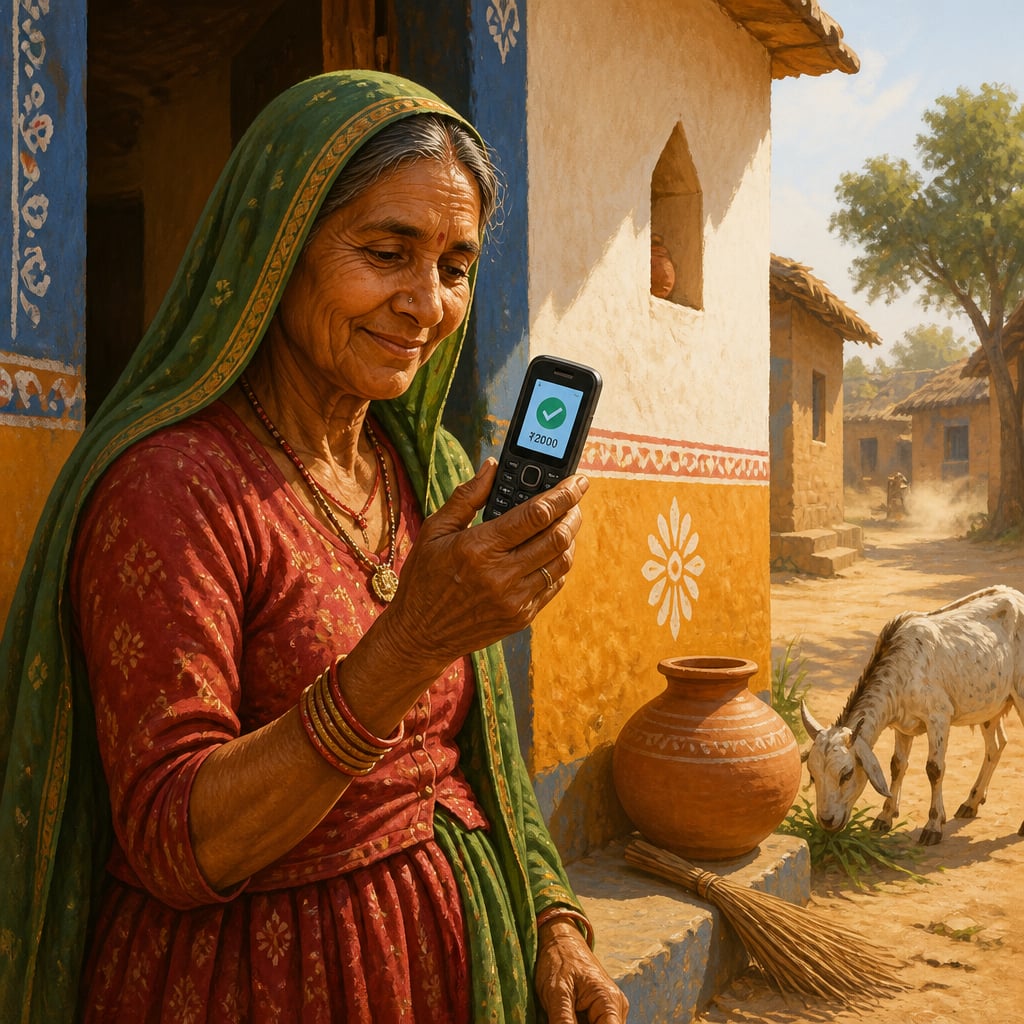
Rajasthani village woman receiving a Jan Dhan DBT confirmation SMS on her phone

In 2014, Rameshwar Prasad was a prosperous man. He received LPG subsidies at three different addresses in Uttar Pradesh, collected cooking gas cylinders meant for five different families (including two who didn't exist), and drew pensions in the names of two deceased relatives. All perfectly legal - or at least, undetectable.

By 2016, Rameshwar Prasad was considerably poorer. Aadhaar verification revealed that his 'family members' at different addresses all shared the same fingerprints. The deceased pensioners couldn't authenticate. The ghost beneficiaries simply... vanished.

Rameshwar's story isn't exceptional - he was one of 30 million 'ghost beneficiaries' eliminated when India's subsidy system went digital. What manual verification couldn't catch in decades, biometric identity solved in months.

Shuchi-Shasan: The Vision

Shuchi (शुचि) means purity, cleanliness, integrity. Shasan (शासन) means governance. Together, Shuchi-Shasan represents governance so clean that corruption doesn't just get punished - it becomes structurally difficult.

Kautilya understood this principle:

"यत्र न स्पर्शः तत्र न दोषः।"

"Where there is no touch, there is no fault." , Arthashastra 2.6.10

In modern terms: if intermediaries never touch the benefit, intermediary corruption becomes impossible. This is the core insight behind India's digital governance revolution.

The JAM Trinity

JAM stands for Jan Dhan - Aadhaar - Mobile - three pillars that together enable the most ambitious anti-corruption infrastructure in history.

Jan Dhan (जन धन) Launched in 2014, the Pradhan Mantri Jan Dhan Yojana created bank accounts for the unbanked. Over 53 crore accounts opened - giving every Indian a financial address.

Without bank accounts, benefits had to be delivered physically - through ration shops, post offices, village officials. Each touchpoint was a corruption opportunity. Jan Dhan eliminated the need for physical delivery of most benefits.

Aadhaar (आधार) The 12-digit unique identity linked to biometrics. Over 138 crore Indians enrolled - making this the world's largest biometric database.

Aadhaar solved the identity problem. Before, the same person could claim benefits in multiple identities at multiple locations. Ghost beneficiaries flourished. Aadhaar's fingerprint and iris scans made impersonation nearly impossible.

Mobile (मोबाइल) Over 120 crore mobile connections enabled real-time verification, instant notification of transfers, and grievance redressal. When money arrives, beneficiaries get SMS confirmation - they know if someone diverted their payment.

Together, JAM creates a pipeline from government to citizen that bypasses all intermediaries who historically extracted their 'cut.'

Direct Benefit Transfer: Kautilyan Design

DBT (Direct Benefit Transfer) uses JAM infrastructure to send money directly to beneficiary accounts. The logic is pure Kautilya:

Before DBT:

After DBT:

This is Kautilya's "where there is no touch, there is no fault" operationalized at scale. The intermediary doesn't become honest - they become irrelevant.

Global Perspectives: Estonia's Digital Transformation

Toomas Hendrik Ilves, President of Estonia (2006-2016), transformed his small Baltic nation into the world's most digital society. Estonia's e-governance system - built on the X-Road platform - enables:

Estonia's philosophy: every citizen should be able to see exactly who accessed their data and when. Transparency isn't just for officials - it's for citizens monitoring officials.

Ilves argued: "We didn't digitize to save money. We digitized because paper-based systems are inherently corruptible. Digital systems create audit trails that make corruption visible."

Country Approach Kautilyan Parallel
India JAM + DBT Eliminate intermediary touchpoints
Estonia X-Road + e-ID Complete transparency and audit trail
Singapore High salaries + digital Reduce motive + reduce opportunity
Denmark Open data Citizen monitoring of government

Estonia built transparency; India built direct delivery. Both reduce corruption by changing the structure, not just the punishment.

Nandan Nilekali and the Aadhaar Architecture

Nandan Nilekani conferring with architects in the UIDAI control room

In 2009, when Prime Minister Manmohan Singh asked Nandan Nilekali to chair the Unique Identification Authority of India (UIDAI), skeptics were many. Could a country of 1.3 billion people be biometrically enrolled? Would privacy be protected? Would the technology work at India's scale?

Nilekali brought software architecture thinking to governance. His approach was Kautilyan in spirit:

Design for scale: The system had to work for a billion users from day one. No pilots that couldn't scale.

Design for abuse: Assume the system will be attacked. Build defenses into the architecture, not as add-ons.

Design for inclusion: The poorest, most marginalized person should benefit most. If the system only works for the literate and connected, it fails.

Nilekali's principle: "Make it simpler to be honest than to be corrupt." When authentication is easy and instant, the incentive to fake identity disappears.

Aadhaar now enables over ₹7 lakh crore in annual DBT across 300+ schemes - the world's largest cash transfer program.

Case Study: PAHAL and PM Garib Kalyan

PAHAL (Pratyaksha Hastaantarit Laabh) - The LPG Story

Before 2014, LPG (cooking gas) subsidy was embedded in the cylinder price. Subsidized cylinders meant for poor households were diverted to restaurants, hotels, and black market resale. Estimates suggested 40% of subsidy reached unintended recipients.

LPG delivery confirmed at a Patna doorstep by biometric thumb scan

PAHAL changed this:

  1. All consumers pay market price for cylinders
  2. Subsidy amount transfers directly to Aadhaar-linked bank accounts of eligible households
  3. Diversion becomes pointless - you can't resell a bank transfer

Results:

PM Garib Kalyan: Stress Test During Crisis

When COVID-19 lockdown began in March 2020, 80 crore Indians faced immediate hunger. The government announced free ration and cash transfers. But could the system deliver under crisis conditions?

The JAM-DBT infrastructure proved its worth:

The pandemic became an unintended experiment: could India's digital infrastructure deliver at crisis speed? The answer was yes - something impossible under the old physical distribution system.

The Privacy-Transparency Trade-off

Digital governance raises legitimate concerns. If the government knows everyone's identity, can it be trusted with that power?

Kautilya would answer: the alternative is worse. Anonymous beneficiaries mean ghost beneficiaries. Unverified identities mean stolen identities. The choice isn't between privacy and surveillance - it's between verified systems that work and opaque systems that leak.

But safeguards matter:

The principle: collect only what's necessary for verification, protect what's collected, and give citizens visibility into their own data.

Your Turn

Think about Rameshwar Prasad from our opening story. His ghost beneficiaries weren't possible because he was particularly clever - they were possible because the system was designed to be exploitable.

DBT didn't make Rameshwar more honest. It made his dishonesty unprofitable and detectable. This is the essence of Shuchi-Shasan: change the structure, and behavior follows.

In your own context, where do systems enable exploitation simply because verification is difficult? Where could technology make honesty easier than corruption?

In our next lesson, we'll explore how Digital India extends these principles beyond cash transfers - to procurement, taxation, and the entire citizen-government interface.

Electronic payment systems globally reduce cash handling and associated theft. The US Social Security direct deposit eliminated check theft. But India's DBT operates at unprecedented scale - 7+ lakh crore annually across 300+ schemes.

India leapfrogged from manual distribution directly to biometric verification + electronic transfer. Countries with established physical infrastructure had to retrofit; India built digital-first.

DBT has saved ₹2.73 lakh crore (as of 2023) by eliminating duplicates, ghosts, and intermediary leakage - approximately 15% of what was previously lost.

Blockchain technology emerged partly to create immutable records. Estonia uses blockchain for government records. But digital transactions create automatic records without needing blockchain - every DBT logs automatically.

India's Public Financial Management System (PFMS) tracks every DBT from allocation to receipt. This creates a national audit trail that manual systems could never provide.

PFMS processes over 30 crore transactions annually, each automatically logged and auditable. This is Kautilya's lekhya at digital scale.

Key terms

Śuci-Śāsana
Clean governance; administration characterized by purity, transparency, and freedom from corruption. Governance where the structure itself prevents rather than merely punishes wrongdoing.
Pratyakṣa
Direct, visible, before one's eyes. In governance, refers to benefits reaching beneficiaries without intermediaries.
Jana Dhana
People's wealth or financial inclusion for all people. The name of India's massive bank account opening program.
Ādhāra
Foundation, support, base. India's 12-digit unique identity number linked to biometrics - the foundation of verified identity.

Verses

यत्र न स्पर्शः तत्र न दोषः। अस्पृश्यं धनं न चोर्यते।

yatra na sparśaḥ tatra na doṣaḥ | aspṛśyaṃ dhanaṃ na coryate |

Where there is no touch, there is no fault. Wealth that cannot be touched cannot be stolen.

This is the foundational principle of DBT: remove the physical touchpoint, remove the corruption opportunity. When benefits flow electronically from source to recipient, intermediary corruption becomes structurally impossible.

Arthashastra, 2.6.10 (Patrick Olivelle (2013))

सर्वेषां कार्याणां लेख्यं कार्यम्। लेख्यं प्रमाणम्।

sarveṣāṃ kāryāṇāṃ lekhyaṃ kāryam | lekhyaṃ pramāṇam |

All transactions must be recorded in writing. The written record is the evidence.

Digital systems create automatic, immutable records. Every DBT transaction logs sender, recipient, amount, and timestamp. This 'lekhya' at scale enables real-time audit that manual systems could never achieve.

Arthashastra, 2.5.6 (R.P. Kangle)

प्रत्यक्षं दानं श्रेष्ठम्। परोक्षे चौर्यम्।

pratyakṣaṃ dānaṃ śreṣṭham | parokṣe cauryam |

Direct transfer is best. In indirect transfer, there is theft.

DBT is the ultimate 'pratyaksha dana' - direct transfer visible to both government and beneficiary. The ₹2.73 lakh crore saved through DBT represents the 'cauryam' that indirect systems enabled.

Arthashastra, 2.7.1-2 (L.N. Rangarajan)

Key figures

Kautilya (Chanakya)

Author of Arthashastra; Chief Advisor to Chandragupta Maurya · 4th century BCE

Kautilya's principle 'where there is no touch, there is no fault' anticipated the logic of digital governance by 2,300 years. His insistence on comprehensive record-keeping (lekhya), direct transfers (pratyaksha dana), and elimination of intermediary touchpoints laid the conceptual foundation for what JAM-DBT achieves technologically.

The entire DBT philosophy - remove intermediaries, create audit trails, make verification automatic - operationalizes Kautilyan principles. He would recognize India's digital infrastructure as fulfilling his vision of shuchi-shasan.

Nandan Nilekani

Co-founder of Infosys; Chairman of UIDAI (2009-2014); author of 'Imagining India' · 1955-present

Nilekani designed and implemented Aadhaar - the world's largest biometric identity system with 138+ crore enrollments. His software architecture approach to governance created the digital infrastructure that enables DBT. He championed the 'India Stack' - open APIs that allow any government or private service to use identity, payment, and data exchange rails. His principle: 'Make it simpler to be honest than to be corrupt.' Post-Aadhaar, he chairs the committee redesigning India's digital commerce architecture.

Nilekani is the architect of the technological infrastructure that realizes Kautilya's vision. Without Aadhaar, there's no verified identity; without verified identity, there's no DBT; without DBT, there's no elimination of intermediary corruption.

Toomas Hendrik Ilves

President of Estonia (2006-2016); architect of Estonian e-governance · 1953-present

Ilves transformed Estonia into the world's most digitally advanced government. His X-Road platform enables real-time data exchange between all government agencies; citizens can vote, file taxes, and access 99% of government services online; blockchain technology ensures data integrity. His innovation was transparency for citizens: every Estonian can see exactly who accessed their data and when. He proved that small countries can lead in governance innovation, and that digital systems aren't just efficient - they're structurally less corruptible than paper.

Estonia represents the transparency dimension of digital governance; India represents the direct delivery dimension. Ilves shows that when citizens can monitor their own data, government accountability increases. Both approaches implement Kautilyan principles: comprehensive records (lekhya) and verified transactions (pratyaksha).

Case studies

PAHAL to PM Garib Kalyan: DBT in Peace and Crisis

**PAHAL (2014-2020):** Before 2014, India's LPG subsidy system was spectacularly leaky. Subsidized cylinders meant for poor households were diverted to restaurants, hotels, and black market resale. Estimates suggested 30-40% reached unintended recipients. 'Ghost' consumers - fake registrations - numbered in millions. PAHAL (Pratyaksha Hastaantarit Laabh) transformed this: consumers now pay market price; subsidy amount transfers directly to Aadhaar-linked bank accounts. You can't resell a bank transfer. Over 30 million fake/duplicate connections were eliminated; savings exceeded ₹70,000 crore by 2020. **PM Garib Kalyan (March 2020):** When COVID-19 lockdown began, 80 crore Indians faced immediate food insecurity. Traditional distribution would have taken weeks and lost significant amounts to leakage. The government announced: (1) ₹500/month for 3 months to 20 crore Jan Dhan accounts (prioritizing women); (2) 3 free LPG cylinders to 8 crore Ujjwala beneficiaries; (3) ₹1,000 to 3 crore pensioners and widows. Within weeks, ₹31,000 crore reached 42 crore bank accounts directly. MGNREGA wages continued via DBT even as offices closed.

These cases demonstrate Kautilya's principles at national scale: (1) **Pratyaksha dana** - Direct transfer eliminated intermediary leakage; (2) **Lekhya pramana** - Every transaction logged and auditable; (3) **Asprishya dhana** - Digital money cannot be 'touched' by middlemen; (4) **Crisis resilience** - Systems designed for normal times proved essential in crisis. Kautilya's insight was that good systems work when tested. PM Garib Kalyan was an unplanned stress test - and the system held.

PAHAL saved ₹70,000+ crore over 5 years while ensuring legitimate beneficiaries received full subsidy. PM Garib Kalyan delivered ₹31,000 crore in weeks rather than months, reaching the poor before starvation rather than after. The combined experience proved: (1) DBT works at scale (300+ schemes, 7+ lakh crore annually); (2) Crisis delivery is possible when infrastructure exists; (3) Structural anti-corruption is more robust than procedural anti-corruption.

PAHAL shows that DBT eliminates systemic leakage in normal times. PM Garib Kalyan shows that the same infrastructure enables rapid response in crisis. Both prove Kautilya's core insight: design systems that make corruption structurally impossible, and they work better in every circumstance.

India's DBT infrastructure now covers 300+ government schemes, saving Rs. 2.73 lakh crore cumulatively by eliminating intermediary leakage. The JAM trinity (Jan Dhan, Aadhaar, Mobile) that enables this is being studied by developing nations as a template for direct welfare delivery that bypasses corruption.

India's DBT savings (₹2.73 lakh crore cumulative) exceed the GDP of many countries. This represents corruption prevented, not just detected.

Historical context

2009-present (Digital India transformation)

India's digital governance transformation is historically unprecedented in scale. No country has attempted biometric enrollment of 1.3+ billion people, universal banking inclusion, and digital benefit transfer simultaneously. The JAM trinity represents a decade of infrastructure building that fundamentally changed the citizen-government interface.

Estonia pioneered e-governance but for a population of 1.3 million. China has digital payment systems but not Aadhaar-style universal ID. Brazil has Bolsa Familia (conditional cash transfer) but without biometric verification. India uniquely combined all three elements at billion-person scale.

India's UPI processed over 10,000 crore transactions worth ₹200+ lakh crore in 2023 - more than all card transactions in many countries combined.

India has demonstrated that developing countries can leapfrog to advanced digital governance without passing through the corruption-prone physical infrastructure stage. This is a model for the Global South.

Living traditions

Shuchi-shasan principles are embedded in India's digital public infrastructure - a living, evolving system that continues to expand.

India's digital public infrastructure - dubbed 'India Stack' - is being studied and adopted globally. The principles of universal identity, interoperable payments, and direct benefit transfer are being implemented in Africa, Southeast Asia, and Latin America.

Reflection

More in Economic Ethics & Anti-Corruption

All lessons in Economic Ethics & Anti-Corruption · Arthashastra: Economic Principles course