Kara-Apahara: The Forty Ways Officials Embezzle

Kautilya's Corruption Typology

Discover how Kautilya identified forty distinct methods of official corruption over 2,300 years ago - a taxonomy so comprehensive that modern scandals from 2G spectrum to electoral bonds fit neatly within it.

The Treasury Official's Dilemma
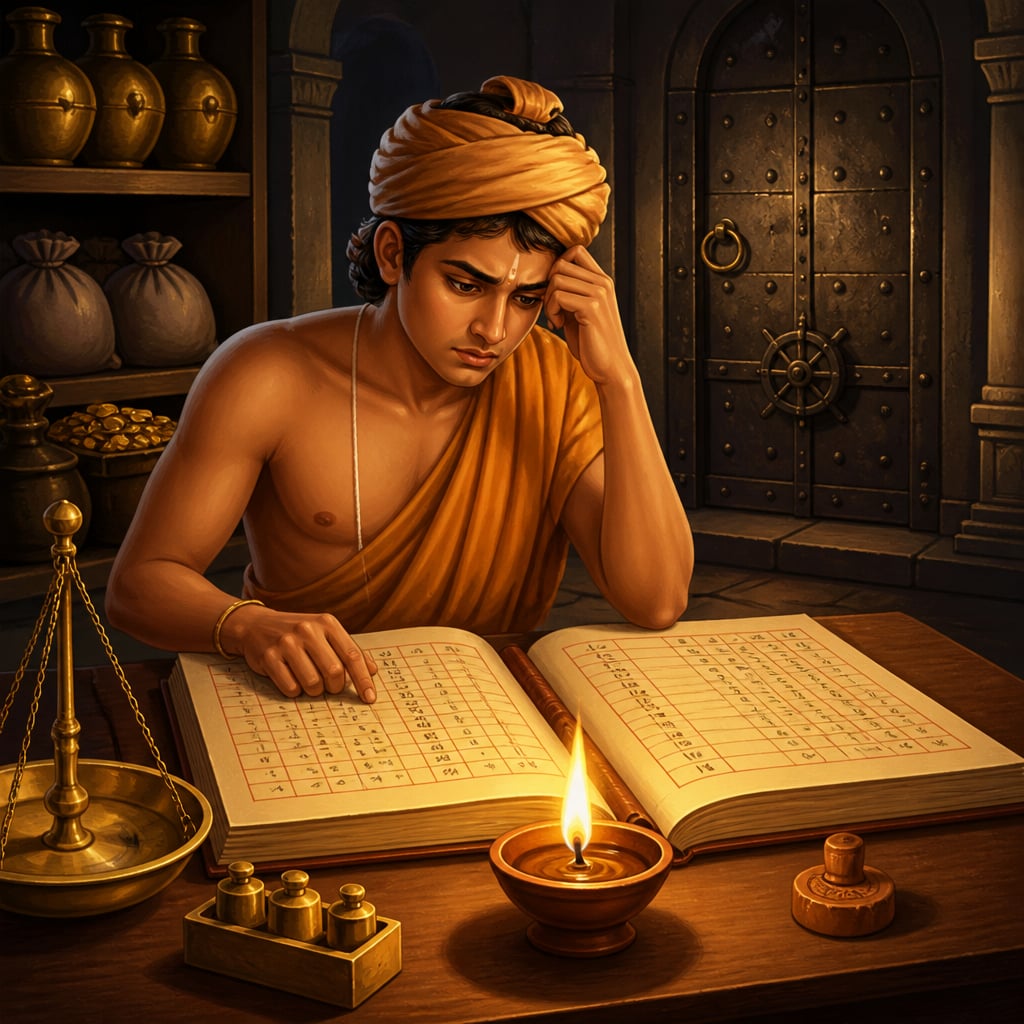
Devadatta the Mauryan treasury clerk staring at two ledgers at night

In 305 BCE, a treasury official named Devadatta sat in the Mauryan kosha-griha (treasury house) at Pataliputra, staring at the accounts before him. The kingdom's wealth flowed through his hands daily - gold coins, silver ingots, grain receipts from distant provinces. His official salary was modest. His family's expectations were not.

Devadatta had discovered what countless officials before and after him would learn: the gap between handling wealth and owning it creates an almost irresistible temptation. But what Devadatta didn't know was that his every potential scheme had already been anticipated, catalogued, and guarded against by a brilliant mind watching from the shadows - Kautilya himself.

The Forty Thieves Within

Kautilya devoted an entire chapter of the Arthashastra (Book 2, Chapter 8) to what he called kara-apahara - literally "revenue embezzlement." But his genius wasn't just in recognizing corruption. It was in systematizing it.

He identified forty distinct methods by which officials steal from the state treasury. Not one or two - forty. This wasn't paranoia; it was precision engineering of accountability.

"सर्वे चोराश्चतुर्विंशतिः।"

"All who handle state wealth are potential thieves." , Arthashastra 2.9.1

This sounds cynical until you realize Kautilya's logic: assume human weakness, design systems that make corruption difficult, and you protect both the treasury AND the officials from their own temptations.

The Forty Methods: A Taxonomy of Theft

Kautilya's classification system remains astonishingly relevant. Here are the major categories:

1. Timing Frauds (Kala-Apahara)

2. Quantity Frauds (Parimana-Apahara)

3. Quality Frauds (Guna-Apahara)

4. Price Frauds (Mulya-Apahara)

5. Documentation Frauds (Lekhya-Apahara)

Customs clerk accepting a pouch of gold from a wealthy merchant

The remaining methods cover conspiracy with merchants, manipulation of weights and measures, bribery networks, and systematic undervaluation of assets.

Global Perspectives on Corruption

How does Kautilya compare to other thinkers on corruption?

Niccolò Machiavelli (1469-1527) wrote extensively on political corruption in Discourses on Livy, arguing that republics corrupt over time unless actively renewed. However, Machiavelli focused on political corruption - the decay of civic virtue - rather than administrative corruption. He saw corruption as inevitable, recommending that rulers use it strategically rather than eliminate it.

Aristotle (384-322 BCE), Kautilya's near-contemporary, identified corruption in his Politics as rulers serving private rather than public interest. He classified it by regime type (tyranny, oligarchy, democracy corrupted) but didn't develop operational detection methods.

Robert Klitgaard (1946-), modern anti-corruption economist at Claremont Graduate University, developed the famous formula: C = M + D - A (Corruption equals Monopoly plus Discretion minus Accountability). His work validates Kautilyan insight: corruption isn't about bad individuals but bad system design.

Thinker Era Focus Approach
Kautilya 4th c. BCE Administrative corruption Systematic typology + detection systems
Aristotle 4th c. BCE Political corruption Regime classification
Machiavelli 16th c. CE Political decay Acceptance and strategic use
Klitgaard 20th c. CE Institutional design Mathematical formula

Kautilya's advantage: he didn't just theorize about corruption - he built systems to catch it. Two millennia before Klitgaard's formula, he was designing accountability mechanisms.

The Modern Echo: 2G to GST

CAG officer presenting bound spectrum-allocation report in Parliament library

In 2010, the Comptroller and Auditor General of India released a report that shook the nation. Former Telecom Minister A. Raja had allegedly caused losses of ₹1.76 lakh crore by manipulating spectrum allocation. The methods? Almost textbook Kautilyan:

The 2G scam fit neatly into categories Kautilya had identified 2,300 years earlier. Human ingenuity in theft, it seems, is remarkably consistent.

Today's anti-corruption framework - from the Central Vigilance Commission to the Lokpal - implements Kautilyan principles. The JAM trinity (Jan Dhan-Aadhaar-Mobile) and Direct Benefit Transfer (DBT) reduce corruption by eliminating intermediary discretion - exactly what Kautilya prescribed when he insisted on multiple verification layers.

Finance Minister Nirmala Sitharaman's push for faceless assessment in taxation echoes Kautilya's insight: remove human discretion, remove human temptation.

Your Turn

You might wonder: why should I care about ancient corruption taxonomy? Because understanding how corruption works is the first step to preventing it - whether in government, business, or your own organization.

Kautilya wasn't a pessimist about human nature. He was a realist who designed for it. His message to Devadatta and every official since: we know your schemes before you've thought them. Build honesty not on appeals to virtue, but on systems that make theft unprofitable.

In our next lesson, we'll explore how Kautilya detected corruption once it occurred - the remarkable Gudhapurusha (secret service) network that made Mauryan accountability legendary.

Michael Jensen and William Meckling formalized the 'principal-agent problem' in 1976 - agents (employees) have information and incentives principals (owners) can't fully observe. Kautilya understood this 2,300 years earlier.

Kautilya didn't just identify the problem - he built solutions: multiple verification layers, rotating assignments, competitive information sources (gudhapurusha). Modern corporate governance still struggles to implement such comprehensive controls.

India's Direct Benefit Transfer (DBT) has saved ₹2.73 lakh crore (as of 2023) by eliminating intermediary discretion - a Kautilyan principle in action.

The Association of Certified Fraud Examiners (ACFE) classifies occupational fraud into three categories with multiple subcategories - similar to Kautilya's approach. Modern compliance relies on comprehensive risk taxonomies.

Kautilya's forty-method system was more detailed than anything Europe developed until the 20th century. Indian administrative sophistication is often underestimated.

ACFE's 2024 Report to the Nations found that organizations with anti-fraud controls detected fraud faster (median 8 months) vs. those without (18 months). Taxonomy enables targeted control.

Key terms

Kara-Apahāra
Revenue embezzlement; theft of state income by officials. 'Kara' refers to taxes/revenue, 'apahara' means theft or taking away. Kautilya's term for systematic corruption.
Kośa
The state treasury; one of the seven essential elements (saptanga) of the state. More than a storehouse - represents the accumulated economic power of the nation.
Chhadma-Krayam
Fraudulent purchase; buying at inflated prices with kickbacks to the purchasing official. One of Kautilya's forty embezzlement methods.
Amātya
Minister or high official; member of the king's council with administrative authority. From the same root as 'mother' - one who nurtures the state.

Verses

अर्थस्य मूलमुपायः। उपायस्य मूलं भवन्ति मन्त्रिणः। मन्त्रिणां मूलमनुरागः।

arthasya mūlam upāyaḥ | upāyasya mūlaṃ bhavanti mantriṇaḥ | mantriṇāṃ mūlam anurāgaḥ |

The root of wealth is proper methods; the root of methods is capable ministers; the root of ministers is their loyalty.

This anticipates modern principal-agent theory - the fundamental problem of ensuring agents (employees) act in principals' (owners'/state's) interest. Loyalty reduces agency costs.

Arthashastra, 2.8.1-2 (R.P. Kangle)

मत्स्या इव जले गूढचारा न विज्ञायन्ते जलं पिबन्तः। अमात्या अर्थं चोरयन्तो न विज्ञायन्ते।

matsyā iva jale gūḍhacārā na vijñāyante jalaṃ pibantaḥ | amātyā arthaṃ corayanto na vijñāyante |

Just as fish swimming in water cannot be detected drinking that water, so officials handling state wealth cannot be easily caught embezzling it.

This is an early statement of information asymmetry in governance - officials have private knowledge about their actions that supervisors cannot directly observe. Modern audit theory addresses the same problem.

Arthashastra, 2.9.2-3 (Patrick Olivelle (2013))

चत्वारिंशदपहारप्रकारा भवन्ति।

catvāriṃśad apahāra-prakārā bhavanti |

There exist forty distinct methods of embezzlement.

Classification enables targeted prevention. Modern compliance programs similarly categorize fraud types (asset misappropriation, corruption, financial statement fraud) to design specific controls.

Arthashastra, 2.8.20 (L.N. Rangarajan)

Key figures

Kautilya (Chanakya)

Author of Arthashastra; Chief Advisor to Chandragupta Maurya · 4th century BCE

Kautilya created the world's first comprehensive anti-corruption framework. His enumeration of forty embezzlement methods, coupled with detection systems (gudhapurusha network), audit mechanisms, and graduated punishments, established principles still used in modern governance. He understood that corruption is systemic, not individual - and designed accordingly.

Kautilya's forty-method taxonomy (kara-apahara prakaras) forms the foundation of this lesson. His insight that officials are like 'fish in water' - impossible to catch unless actively monitored - drives his entire anti-corruption architecture.

T.N. Seshan

10th Chief Election Commissioner of India (1990-1996) · 1932-2019

Tirunellai Narayana Iyer Seshan transformed India's Election Commission from a rubber-stamp body to a powerful institution. He enforced the Model Code of Conduct, cancelled elections where fraud occurred, and implemented photo voter ID cards. His tenure reduced electoral corruption dramatically - booth capturing declined by over 90%. He proved that one determined individual, wielding institutional authority correctly, could transform systems.

Seshan exemplifies Kautilya's principle that anti-corruption requires both systemic design AND committed enforcers. He used the Election Commission's constitutional authority (dormant for decades) exactly as Kautilya would have - to make corruption unprofitable rather than relying on moral appeals.

Niccolò Machiavelli

Florentine diplomat and political philosopher; author of 'The Prince' and 'Discourses on Livy' · 1469-1527

Machiavelli analyzed political corruption in Renaissance Florence, arguing in 'Discourses' that republics naturally corrupt over time unless actively reformed. Unlike Kautilya, he saw corruption as partly inevitable and advised rulers to use it strategically. His focus was political decay rather than administrative fraud. He's often compared to Kautilya as a 'realist' political thinker.

Comparing Machiavelli and Kautilya reveals important differences: Machiavelli accepted corruption as political reality to be managed; Kautilya designed systems to actively prevent it. Both were realists, but Kautilya was more optimistic about institutional design. This comparison shows Indian economic thought's practical sophistication.

Case studies

The 2G Spectrum Scam: Kautilya's Forty Methods in Action

In 2008, India's Department of Telecommunications under Minister A. Raja allocated 2G spectrum licenses worth an estimated ₹1.76 lakh crore for just ₹10,772 crore - using 2001 prices in 2008. The allocation process was manipulated: application deadlines were changed after submissions, eligibility criteria were altered retroactively to favor certain companies, first-come-first-served replaced auction, and licenses went to firms with questionable credentials who immediately sold equity stakes at massive premiums. The Comptroller and Auditor General (CAG) under Vinod Rai exposed the scandal in 2010, leading to cancellation of 122 licenses by the Supreme Court in 2012.

Through Kautilya's framework, the 2G scam employed at least four of his forty embezzlement methods: (1) **Chhadma-krayam** - selling at artificially suppressed prices; (2) **Atyaya** - allocation to favored parties below market value; (3) **Asatpratijnapti** - false representation of eligibility criteria; (4) **Pratirodha** - creating artificial scarcity by blocking auction process. Kautilya would have recognized the fundamental violation: discretionary power without accountability. When one minister controlled a process worth lakhs of crores with no auction, no transparency, and no oversight, corruption was not just possible but structurally inevitable.

The Supreme Court cancelled all 122 licenses in February 2012, and re-auction generated ₹62,162 crore. Multiple officials and executives faced prosecution (though most were later acquitted due to evidentiary issues). More importantly, the scandal transformed India's resource allocation: spectrum is now mandatorily auctioned, coal blocks follow transparent bidding, and discretionary allocations face constitutional scrutiny. The CAG's role was vindicated - exactly the independent audit function Kautilya prescribed.

The 2G case proves Kautilya's central insight: corruption is structural before it is personal. A. Raja exploited a system designed for exploitation - no auctions, discretionary allocation, minimal oversight. Post-2G reforms eliminated those structural vulnerabilities. Design for human weakness, not human virtue.

Post-2G, India institutionalized auction-based allocation for all natural resources. The Coal Mines (Special Provisions) Act 2015 and Mineral Laws Amendment Act 2020 applied the same principle: transparent competitive allocation prevents the discretionary corruption that Kautilya's forty methods describe.

After mandatory auctions were implemented, subsequent spectrum sales generated ₹1.1 lakh crore (2015 auction alone: ₹1.09 lakh crore) - demonstrating the scale of value lost to discretionary allocation.

Historical context

4th-3rd century BCE (Mauryan Empire)

The Mauryan Empire administered a territory from Afghanistan to Bengal, collecting taxes from agriculture, trade, mines, forests, and manufacturing. This scale required systematic controls against embezzlement. The empire employed thousands of officials handling immense wealth - making Kautilya's anti-corruption systems essential for survival.

Contemporary civilizations - Ptolemaic Egypt, Seleucid Persia, emerging Roman Republic - also faced corruption but left no comparable systematic treatment. Roman administrative law developed centuries later. China's Legalist tradition (Han Feizi) addressed governance but not with Kautilya's economic precision.

The Mauryan Empire's annual revenue is estimated at 36,000 silver talents (approximately ₹10,000 crore in today's terms) - dwarfing contemporary states and requiring sophisticated anti-embezzlement controls.

Understanding that advanced anti-corruption systems are indigenous to India - not imported from colonial or Western sources - changes how we approach governance reform. We're recovering lost knowledge, not importing foreign concepts.

Living traditions

Kautilya's anti-corruption principles persist in India's constitutional framework, audit institutions, and recent digital governance innovations.

India's Prevention of Corruption Act, Central Vigilance Commission, and Lokpal institution all implement Kautilyan principles - though often without acknowledging the connection. The JAM trinity (Jan Dhan-Aadhaar-Mobile) enabling DBT is perhaps the most successful modern application of Kautilyan anti-corruption design.

Reflection

More in Economic Ethics & Anti-Corruption

All lessons in Economic Ethics & Anti-Corruption · Arthashastra: Economic Principles course