Satya-Vyavahara: Building Honest Institutions

Prevention Through Design

Detection and punishment address corruption after it occurs. Kautilya went further - designing systems for selection, training, and structural safeguards that prevent corruption from starting. Prevention is cheaper than cure.

The Minister's Test

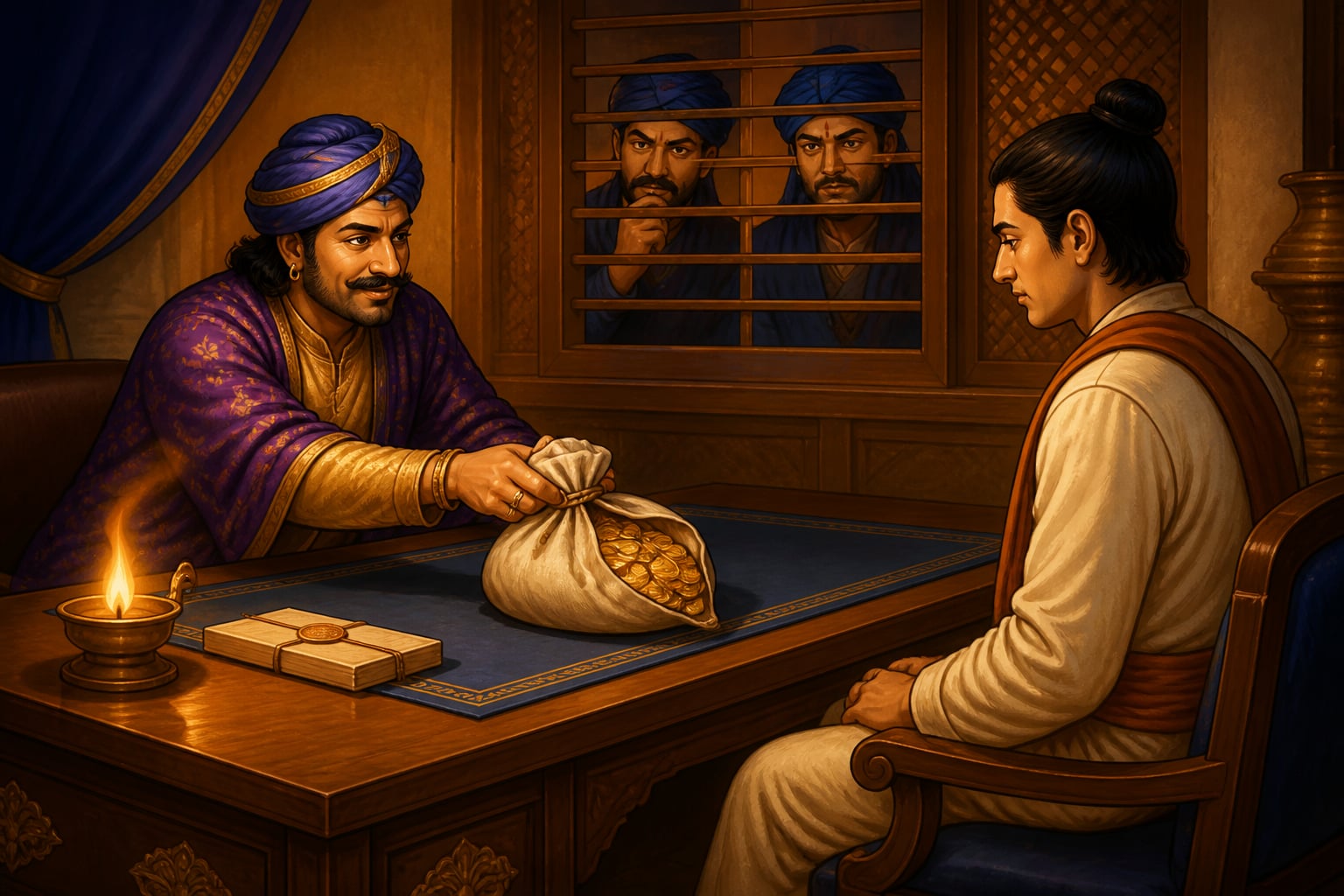
Kautilya interviewing the young candidate Rudradaman for treasurer's post

In 318 BCE, Kautilya personally interviewed candidates for the position of Kosha-adhyaksha (Treasurer) in the newly established Mauryan administration. One candidate, Rudradaman, presented impeccable credentials - noble birth, scholarly training, administrative experience.

Kautilya posed a scenario: "A merchant offers you 10,000 panas to expedite his customs clearance. No one would know. What would you do?"

Rudradaman answered correctly: "I would refuse and report him."

Kautilya nodded, then said: "You are appointed. Your first assignment is handling customs at Taxila. Your salary is 1,000 panas monthly."

Six months later, Kautilya's gudhapurusha reported that a merchant had indeed approached Rudradaman with exactly such an offer - and Rudradaman had accepted. The interview answer was theory; reality proved different.

Rudradaman was arrested. Kautilya's lesson: selection systems must test behavior, not just words.

Beyond Detection and Punishment

In previous lessons, we explored how Kautilya detected corruption (gudhapurusha) and punished it (danda-niti). But the master strategist understood something profound: preventing corruption is more efficient than catching it.

"वृक्षच्छेदात् पतत्यङ्कुरः। तस्मात् मूलोच्छेदः कार्यः।"

"When a tree is cut, the shoot falls. Therefore, the root must be destroyed." , Arthashastra 7.16.31

The "root" of corruption is the combination of opportunity, motive, and weak selection. Address these, and you prevent corruption rather than merely responding to it.

The Four Pillars of Prevention

Kautilya's institutional design rested on four preventive mechanisms:

1. Selection (Pariksha) Not everyone can be trusted with public wealth. Kautilya prescribed rigorous testing of candidates before appointment:
Disguised agent offering gold to a candidate official as a pariksha test

Only candidates who passed all four tests received appointments involving wealth.

2. Rotation (Parivartana) No official held the same position for too long. Kautilya mandated regular rotation to prevent:

"एकस्मिन् स्थाने न चिरं तिष्ठेत्।"

"One should not remain in a single position for long." , Arthashastra 5.3.25

Modern IAS officers rotate every 2-3 years - a Kautilyan principle in contemporary practice.

3. Competing Jurisdictions (Adhikara-Vibhaga) Kautilya divided authority so that no single official controlled an entire process:

This separation meant that corruption required conspiracy - multiple people agreeing to cheat simultaneously. The more conspirators required, the higher the detection probability.

4. Adequate Compensation (Vetana) Kautilya understood the economic logic of corruption: officials steal when the benefit exceeds the cost. He addressed this from both directions:

The Mauryan treasury officials were among the best-paid in the empire - precisely because they handled the most wealth.

Global Perspectives on Institutional Design

Max Weber (1864-1920), the German sociologist, developed bureaucracy theory in Economy and Society. Weber identified characteristics of effective administration: hierarchical authority, written rules, merit-based selection, career service. His "rational-legal authority" describes exactly what Kautilya built - systems where rules govern, not personal relationships.

Weber wrote 2,000 years after Kautilya but described the same principles: formal qualifications (pariksha), defined jurisdictions (adhikara-vibhaga), career advancement based on performance (not patronage), and separation of personal and official property.

Douglass North (1920-2015), Nobel economist, argued that institutions - the "rules of the game" - determine economic development. Countries with strong institutions (clear property rights, contract enforcement, impartial administration) prosper; those with weak institutions stagnate. North's insight validates Kautilya: institutional design isn't administrative detail but the foundation of prosperity.

Lee Kuan Yew (1923-2015) transformed Singapore using explicitly Kautilyan methods: rigorous selection, high salaries, harsh punishment, separation of powers. Singapore moved from Third World to First in one generation - proving that institutional design works.

Thinker Era Focus Kautilyan Parallel
Kautilya 4th c. BCE Complete institutional design Original system
Weber 19th-20th c. CE Bureaucracy characteristics Described what Kautilya built
North 20th c. CE Institutions and development Validated through economics
Lee Kuan Yew 20th c. CE Practical implementation Applied in Singapore

Building Modern India's Institutions: Sardar Patel

When Sardar Vallabhbhai Patel assumed responsibility for integrating 562 princely states and creating India's administrative framework in 1947, he faced a Kautilyan challenge: how to build honest institutions from scratch?

Patel's solutions echo the Arthashastra:

All-India Services: Patel created the IAS and IPS as unified services with national loyalty, not provincial allegiance. Officers would serve across states, preventing the deep local ties that enable corruption.

Selection through UPSC: The Union Public Service Commission, constitutionally protected, would select officers through rigorous examination - pariksha institutionalized. No political interference in recruitment.

Transfer and Posting: Officers would rotate between states and departments - parivartana as policy. The "steel frame" would be mobile steel.

Constitutional Protection: Article 311 protected civil servants from arbitrary dismissal, encouraging honest dissent. Officers who refused illegal orders couldn't be punished without due process.

Patel told the first batch of IAS officers in 1947: "You will be the backbone of the administration... You must be incorruptible." He was building Kautilyan institutions with constitutional foundations.

Modern Echo: The SSB Selection Process

The Indian Army's Services Selection Board (SSB) process exemplifies Kautilyan selection principles in contemporary practice.

Army officer candidates working a group obstacle task under SSB assessors

When a young candidate arrives at an SSB center for officer selection, they face five days of rigorous testing:

Day 1-2: Intelligence and Aptitude Written tests assess cognitive ability - but this is merely the filter. The real selection begins after.

Day 3-4: Group Testing Candidates face group tasks, leaderless discussions, and progressive group exercises. Assessors watch for:

Day 5: Personal Interview The conference brings together all assessors. Each candidate's behavior across situations is triangulated. Inconsistencies between stated values and observed behavior are flagged.

The SSB doesn't just ask "what would you do if..." - it creates situations where candidates actually do things, then evaluates their choices. This is Kautilya's artha-pariksha and kama-pariksha operationalized: create the temptation, observe the response.

Results: Officers selected through SSB have remarkably low corruption rates compared to lateral entrants. The selection process works because it tests character through action, not words.

The Transparency Mandate

Kautilya required officials to declare their wealth at appointment and periodically thereafter:

"अमात्यानां धनं ज्ञातव्यम्।"

"The wealth of ministers must be known." , Arthashastra 5.3.4

Unexplained wealth was itself evidence of corruption. Modern asset declaration requirements for public servants - from Lokpal forms to judicial disclosures - continue this principle.

The logic is preventive: if you know your wealth will be scrutinized, you're less likely to accumulate unexplainable amounts.

Your Turn

Consider the Rudradaman story. He answered the ethical question correctly in the interview but failed in practice. Why?

Kautilya would say: because interview answers test knowledge of right and wrong, not capacity to choose right when wrong is profitable. The gap between knowing and doing is where corruption lives.

This has implications for how we select people for positions of trust. Are we testing their stated values or their demonstrated behavior? Are we creating situations where their character is revealed, or accepting their claims about it?

Institutional honesty isn't about finding saints. It's about designing systems where ordinary humans - with ordinary weaknesses - can do their jobs honestly because the structure makes honesty easier than corruption.

In our next lesson, we'll explore how these institutional principles apply to contemporary governance - Shuchi-Shasan (clean governance) through JAM trinity, DBT, and digital systems that make corruption structurally difficult.

Modern assessment centers, used by Fortune 500 companies, simulate job situations to observe actual behavior. Research shows behavioral tests predict job performance better than interviews or self-reported values.

The SSB process for military selection operationalizes Kautilyan principles: candidates face actual group tasks, leadership challenges, and pressure situations where their behavior - not claims - is evaluated.

Meta-analysis of selection methods shows structured behavioral observation has 0.54 validity correlation with job performance, versus 0.18 for unstructured interviews (Schmidt & Hunter, 1998).

The 'four-eyes principle' in modern banking requires multiple approvers for transactions. SOX compliance mandates separation between those who authorize, execute, and record transactions. Kautilya established these principles millennia earlier.

India's GST system separates registration, filing, and verification across different authorities - each checking the others. This adhikara-vibhaga makes GST fraud harder than earlier indirect taxes.

ACFE's 2024 Report found that organizations with separation of duties detected fraud 50% faster than those without - median 6 months vs. 12 months.

Key terms

Parīkṣā
Testing or examination; Kautilya's term for the rigorous evaluation of candidates before appointment. Includes behavioral tests, not just knowledge assessment.
Parivartana
Rotation or transfer; Kautilya's policy of regularly moving officials to prevent deep entrenchment and corrupt relationships.
Adhikāra-Vibhāga
Division of authority; Kautilya's structural separation of powers so that no single official controls an entire process.
Vetana
Salary or compensation; Kautilya's term for official remuneration, which he set high enough to reduce corruption incentives.

Verses

धर्मार्थकामभयैः परीक्षेत अमात्यान्। चतुर्णां परीक्षाणां शुद्धः सर्वार्थेषु योजयेत्।

dharmārthakāmabhayaiḥ parīkṣeta amātyān | caturṇāṃ parīkṣāṇāṃ śuddhaḥ sarvārtheṣu yojayet |

Test ministers through trials of ethics, wealth, pleasure, and fear. Only those pure in all four tests should be employed in all matters.

This anticipates modern assessment center methodology - using multiple simulated situations to predict actual job behavior. Psychometric testing validates what Kautilya intuited: behavior predicts better than claims.

Arthashastra, 1.10.1-2 (Patrick Olivelle (2013))

एकस्मिन् स्थाने न चिरं तिष्ठेत्। तिष्ठन् दोषं गच्छति।

ekasmin sthāne na ciraṃ tiṣṭhet | tiṣṭhan doṣaṃ gacchati |

One should not remain in a single position for long; staying invites corruption.

This anticipates findings from organizational psychology that tenure correlates with certain fraud types. The longer someone holds a position, the better they understand how to exploit it undetected.

Arthashastra, 5.3.25-26 (R.P. Kangle)

अमात्यानां धनं ज्ञातव्यम्। अज्ञातधनं चौर्यलक्षणम्।

amātyānāṃ dhanaṃ jñātavyam | ajñātadhanaṃ cauryalakṣaṇam |

The wealth of ministers must be known. Unexplained wealth is evidence of theft.

This is the foundation of modern 'disproportionate assets' cases under Prevention of Corruption Act. The principle that public servants' wealth is legitimately scrutinized originates here.

Arthashastra, 5.3.4 (L.N. Rangarajan)

Key figures

Kautilya (Chanakya)

Author of Arthashastra; Chief Advisor to Chandragupta Maurya · 4th century BCE

Kautilya developed comprehensive institutional design principles: four-fold selection testing, regular rotation, division of authority, adequate compensation, and wealth transparency. His innovation was understanding that preventing corruption through system design is more efficient than detecting and punishing it afterward. He built these principles into the Mauryan administration, creating what Max Weber would later describe as bureaucracy.

The entire prevention framework - pariksha, parivartana, adhikara-vibhaga, vetana - originates with Kautilya. His insight that institutional design determines institutional integrity remains foundational for modern governance.

Sardar Vallabhbhai Patel

First Deputy Prime Minister and Home Minister of India; 'Iron Man of India' · 1875-1950

Patel built India's administrative institutions from scratch. He integrated 562 princely states, created the All-India Services (IAS, IPS), established the Union Public Service Commission as constitutionally protected selector, and designed the transfer-posting system that prevents officers from becoming local power centers. His famous address to the first IAS batch (1947) established the service ethic that has, imperfectly but significantly, maintained administrative integrity for 75+ years.

Patel represents the successful application of Kautilyan principles in modern India. The IAS rotation policy, UPSC selection, and constitutional protections all implement the prevention framework Kautilya described.

Max Weber

German sociologist; founder of modern sociology and bureaucracy theory · 1864-1920

Weber's *Economy and Society* established bureaucracy theory: hierarchical authority, written rules, merit selection, career service, separation of personal and official property. His concept of 'rational-legal authority' describes administration based on rules rather than personal relationships. Weber showed why bureaucracy, despite its frustrations, produces more reliable outcomes than patronage systems. His work provides the theoretical vocabulary for what Kautilya built practically.

Weber arrived at institutional design principles 2,000+ years after Kautilya, but through theoretical analysis rather than practical statecraft. Comparing them shows that Kautilya's practical wisdom anticipated theoretical insights - Indian thought preceded Western theory.

Case studies

The SSB Selection: Kautilyan Pariksha in Action

The Services Selection Board (SSB) process for selecting Indian Army, Navy, and Air Force officers is perhaps the world's most rigorous military selection system. Each year, approximately 400,000 candidates apply; about 5,000 are finally selected. The five-day process subjects candidates to: Day 1 - intelligence and aptitude tests (basic filter); Day 2 - psychological tests including Thematic Apperception Test and self-description; Days 3-4 - group testing (progressive group tasks, group discussions, individual obstacles, command tasks); Day 5 - personal interview and conference. The process deliberately creates situations where candidates must act, not just speak. In group tasks, no leader is appointed - assessors watch who emerges, who helps others, who gives up, who cheats. In command tasks, candidates receive resources insufficient for the task and must improvise. The conference triangulates all observations: does stated self-description match observed behavior? Do interview claims align with group performance?

The SSB embodies Kautilya's four-fold pariksha: (1) **Dharma-pariksha** - Group tasks reveal whether candidates help struggling teammates or pursue individual glory; (2) **Artha-pariksha** - Resource constraints reveal whether candidates hoard or share; (3) **Kama-pariksha** - Pressure situations reveal who maintains composure versus who seeks shortcuts; (4) **Bhaya-pariksha** - Physical and psychological challenges reveal courage and resilience. The process tests behavior, not beliefs. Candidates cannot prepare 'correct answers' because there are no questions - only situations. This is exactly what Kautilya prescribed: create the temptation/pressure, observe the response.

Officers selected through SSB demonstrate remarkably low corruption rates compared to other services with less rigorous selection. The Army's institutional culture of integrity begins with selection. When scandals do occur (Adarsh housing, for instance), they typically involve officers who bypassed standard selection or were placed in positions without normal rotation. The SSB's success validates Kautilya: rigorous behavioral selection creates a foundation for institutional integrity that no amount of later surveillance can substitute.

Prevention starts with selection. The SSB invests five days per candidate because catching corruption later costs infinitely more. By testing character through action rather than asking about character through words, the process selects for integrity. Organizations that want honest institutions must start with honest selection.

Corporate India is increasingly adopting behavioral assessment in leadership hiring, moving beyond resume credentials to evaluate integrity under pressure. The SSB model demonstrates that character-based selection, while expensive upfront, prevents far costlier institutional damage from leaders who pass credential tests but fail integrity ones.

The SSB selection ratio (approximately 1-2% of screened-in candidates) is among the lowest for any professional service globally - reflecting the rigor of behavioral assessment over credential-based selection.

Historical context

4th-3rd century BCE (Mauryan Empire)

The Mauryan Empire was the first to administer the entire Indian subcontinent (excluding far south) under unified systems. Kautilya designed institutions for this unprecedented scale - selection centers in major cities, rotation policies across provinces, standardized training, and uniform rules. This was history's first subcontinental bureaucracy.

Contemporary civilizations - Ptolemaic Egypt, Seleucid Persia, early Roman Republic - relied on personal loyalty and patronage rather than institutional design. Rome's professional bureaucracy developed centuries later. China's examination system (Han dynasty, 206 BCE onward) paralleled Kautilyan selection but was knowledge-based rather than behavioral.

Megasthenes reported that Pataliputra's administration included specialized departments for foreigners, birth/death registration, trade, and public works - evidence of sophisticated institutional differentiation.

Understanding that institutional design theory is indigenous to India changes how we approach governance reform. We're not importing Western bureaucracy but recovering and modernizing our own traditions.

Living traditions

Kautilya's prevention principles persist in India's civil services framework, selection processes, and transfer policies.

The All-India Services structure, UPSC independence, rotation policies, and probationary training all implement Kautilyan prevention principles. Despite criticism, India's administrative services remain less corrupt than many developing country alternatives - a testament to institutional design.

Reflection

More in Economic Ethics & Anti-Corruption

All lessons in Economic Ethics & Anti-Corruption · Arthashastra: Economic Principles course