The Five Levels of Debate

Why Two Smart People Can Talk Past Each Other for Hours

Most debates fail because both sides argue at different levels without realizing it. Five levels (Pancha-Tala): Data (Tathya), Logic (Tarka), Frame (Prakarana), Value (Dharma), Meta (Vivechana). This lesson walks one carried example, two friends arguing about reservations in a Hyderabad canteen, up all five levels from start to finish. You watch them talk past each other, and you watch what it would have taken for them to meet.

The Argument That Will Not End

Picture two third-year engineering students, Raghav and Tanmay, at a canteen at a public university in Hyderabad on a Tuesday evening in October 2024. The monsoon is done. The fans above the plastic tables are running slow. They have been friends for two years. Tonight they are arguing about reservations.

The argument began thirty minutes ago. It started specific. Now it is in circles. Raghav has quoted the JEE cutoff numbers three times. Tanmay has quoted the historical exclusion data four times. Each time one of them hears the other's numbers and replies with a different set of numbers. Both feel they are being clear. Both feel the other person is not listening. Nothing moves. Raghav will go home tonight and tell his roommate that Tanmay will not see sense. Tanmay will go home tonight and tell his roommate that Raghav will not look at history.
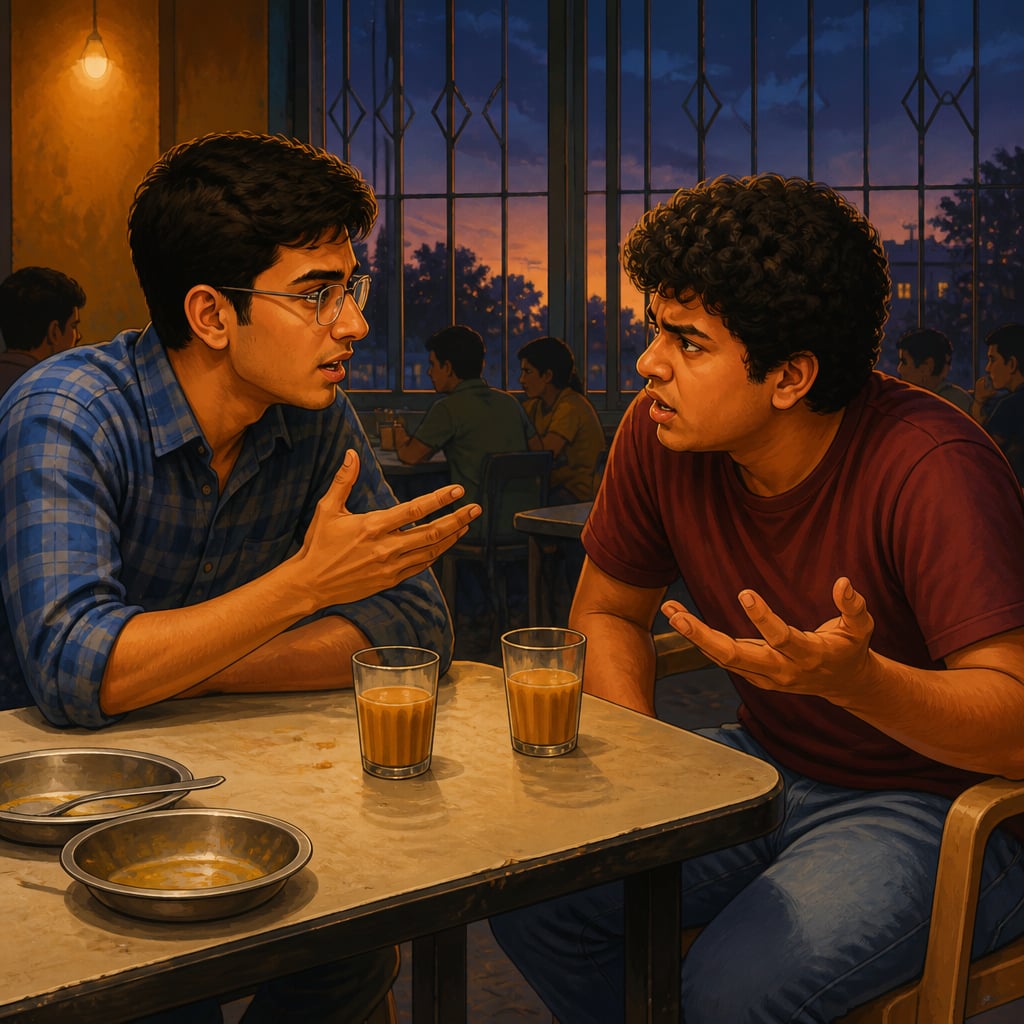
Two engineering students arguing over chai at a Hyderabad canteen

Two thousand years ago, the Nyaya tradition named this exact problem. A debate does not usually fail because one side is stupid and the other is smart. A debate fails because the two sides are standing on different planes and neither one notices. Indian logic calls the full stack Pancha-Tala: five planes. Data, logic, frame, value, meta. Most ordinary arguments live and die at plane one. Most serious disagreements actually belong at plane four but get dressed up in plane-one costumes. Learning to see which plane you are on, and which plane the other person is on, is one of the most portable skills this course will hand you.

This lesson walks Raghav and Tanmay up all five planes. Not to solve the reservations debate. To show you the shape of the stack so you can see it in your own arguments by tomorrow.

Plane One: Tathya (The Data Floor)

Tathya is the floor of facts. Numbers. Dates. Events. Counts. What happened, where, when, to whom, in what quantity.

On the data floor, Raghav and Tanmay are at war over two different data sets. Raghav cites cutoff scores, unfilled reserved seats in specialised branches, per-capita enrolment growth in the last decade. Tanmay cites historical exclusion from universities, continued under-representation in faculty positions, incident data from the last five years. Here is the subtle part: both sets of numbers are real. Neither person is making up data.

The first myth that Pancha-Tala dissolves is that honest arguments are usually about one side being wrong on the facts. They are usually not. A debate that stays on Plane One can last for decades without resolution if the two sides are drawing from two different data drawers. You can spot this pattern when the argument has the shape of "but what about..." repeated on both sides. That shape tells you nobody is climbing.

Plane Two: Tarka (The Logic Floor)

Tarka is reasoning. Cause and effect. If-then. The floor where the five-part syllogism from the last lesson lives.

Raghav moves up first. He says: if reservations pull down the entry score, then median student competence drops, then engineering output drops, then the country loses. It is a clean cause-effect chain. Tanmay replies with his own chain: if historic exclusion is not corrected structurally, then access gaps widen across generations, then social trust collapses, then the country loses. Also clean.

Both chains are logically valid. Neither is a fallacy. They are simply built on different starting premises. Plane Two, without climbing higher, ends the same way Plane One does. The debaters feel they are being rational, because they are. What they do not see is that rationality on a narrow premise is still bound to the premise.

Plane Three: Prakarana (The Frame Floor)

Prakarana is the frame: the lens through which the same data and the same logic acquire their meaning.

Raghav's frame is individual merit. In this frame, a scarce seat is a prize for the best-performing individual, and any mechanism that gives it to someone else distorts a fair contest. Tanmay's frame is civilizational correction. In this frame, a scarce seat is a tool the state uses to close a multi-generational wound, and a contest staged on top of that wound is not yet fair. Same data. Same logic. Different frame. Different conclusion.

Frames are not false. Frames are lenses. A debate that stays at Plane Two without naming the frame becomes what Raghav and Tanmay are doing: aiming clean logic at each other from inside incompatible lenses. When someone finally names the frame out loud, the argument changes shape. "I hear you. I think we are applying different frames." That single sentence is a climb.

Plane Four: Dharma (The Value Floor)

Dharma here means the underlying value: what kind of society, what kind of life, what kind of ordering of the world is being implicitly defended.

Raghav's deepest commitment is that a society is just when the contest is fair at the point of competition. Equality of opportunity at the moment the race begins. Tanmay's deepest commitment is that a society is just when outcomes, across generations, equalize. Equality of floor, not just equality of gate. Neither of these is un-dharmic. The Mahabharata defends both intuitions in different places. Bhishma's raja-dharma defends fair contest. Yudhishthira's dharma-for-the-unequal defends structural protection of those with less. The two strands coexist inside the tradition.

Most political debate in India, on reservations or otherwise, is actually a Plane Four debate wearing Plane One clothes. Two civilizational intuitions, both sincere, both partially rooted in the tradition, meet each other at midnight in a canteen and mistake each other for statistical opponents.

Plane Five: Vivechana (The Meta Floor)

Vivechana is the step outside the argument itself. Why are we debating this, here, now, in this form? Who benefits from the debate taking this shape? What question would actually move the underlying reality forward?

At Plane Five, Raghav and Tanmay would ask each other: what is the real goal? If both of us want a country where the next generation has more access to opportunity than we did, what policy lever actually delivers that? Is reservations yes or no even the right binary? Or is it one of six levers (early-education funding, teacher quality, caste census accuracy, enforcement of anti-discrimination law, industrial job creation, university capacity expansion) that we should be arguing about in some weighted combination?

Vivechana is what closes pointless debates. Not because it resolves them. Because it relocates them.

The Classical Precedent: Narada Approaches Sanatkumara

Sanatkumara teaching young Narada under a banyan in a forest hermitage

Long before Raghav and Tanmay, the Chandogya Upanishad recorded a case of Pancha-Tala done right. The sage Narada came to the sage Sanatkumara and said: Teach me, sir. Sanatkumara replied: Approach me with what you already know; I will take you higher from there.

Narada then listed everything he knew: the four Vedas, the Itihasa, the Puranas, grammar, astronomy, arithmetic, the science of omens, the science of weapons, logic, ethics. A complete Plane One and Plane Two inventory. Sanatkumara acknowledged all of it and then said the move that turns a debate into an ascent: "All this you have named is only name. There is something higher."

That single reply contains the Pancha-Tala method. Acknowledge the lower plane. Do not dismiss it. Then ask if there is something higher. Then climb together.

What the Dharmic Debater Does

The Dharmic move is not to win at Plane One or Plane Four. The Dharmic move is to name the plane out loud.

"Raghav, I think we are arguing two different data sets. Can we agree which one we are on?" Plane One named.

"I notice we both have clean logic, but we are starting from different premises. Can we talk about the premises?" Plane Two named, climbing invited.

"I think we are using different frames here. Yours is individual merit. Mine is civilizational correction. Neither of us is wrong inside our own frame." Plane Three named.

"At the bottom of this, I think we both want a just society. We just disagree about what justice requires when the starting line is unequal." Plane Four reached.

"Maybe the yes-or-no framing is not even the right question. What would actually help the kid from your hometown and the kid from mine?" Plane Five.

Resolution at Plane Five does not mean agreement. It means the argument has been relocated to the plane where real progress is possible. Sometimes you still disagree. But now you disagree cleanly, about something worth disagreeing about, in a way that does not waste the next thirty years.

Vidura warning blind King Dhritarashtra before the dice game

Modern Echoes

Jonathan Haidt, the American social psychologist, published The Righteous Mind in 2012. His core finding: political opponents in liberal democracies are not usually arguing about facts. They are reasoning from different moral foundations (care, fairness, loyalty, authority, sanctity, liberty) and only then recruiting facts to defend their position. Haidt calls this moral reasoning as press secretary. The Nyaya tradition called it Plane Four wearing Plane One's clothes, and mapped it twenty-five centuries earlier.

Back to the Canteen

At 10:14 PM the tea is cold. The canteen is almost empty. Raghav and Tanmay are silent. Neither of them has won. Neither of them has conceded. But if one of them had known the Pancha-Tala, at minute four he could have said: "I think we are on different planes. Let us figure out which." Thirty minutes of heat could have become five minutes of climbing.

You can now see the skeleton beneath any argument. In Chapter 3 you will learn why people break it on purpose.

Case studies

Farm Laws 2020-21: Three Laws, Two Planes, No Meeting

In September 2020, the Indian Parliament passed three farm laws. The government's case was built at Plane One (stagnating farm productivity, low private investment, mandi inefficiencies) and Plane Two (deregulation should attract capital; contract farming should raise incomes; middleman reduction should improve margins). The reasoning was internally clean. The farmers' response came mostly from Planes Three and Four. The frame was shaped by decades of memory: every historic land-law shift pitched as efficiency had produced concentration. The value was the mandi itself as a trust network, a source of identity, and a buffer against the open market.

When the state speaks from Plane One and the people respond from Plane Four, neither side sounds reasonable to the other. The Pancha-Tala diagnostic names exactly this: a policy framed purely in Plane One metrics but landing into a Plane Four reality will produce protest even when the Plane One case is strong. A Dharmic state names the plane of the people's objection first, then asks whether the policy can be rebuilt from that plane.

For most of 2021, the government sharpened Plane One arguments; the farmers made Plane Four commitments visible at the Delhi borders. Neither side named the plane mismatch. The laws were repealed in November 2021 without a shared conversation ever having been had.

Every major reform that fails in a democracy fails at a plane mismatch, not at a logic failure. A leader who cannot name Plane Four cannot ship Plane One reform. Pancha-Tala is not only a debate tool; it is a statecraft tool.

Vidura Before the Dice Game: Elevation Refused

In the Sabha Parva of the Mahabharata, as Duryodhana and Shakuni prepare the dice game that will drag the Pandavas into exile, Vidura approaches the blind king Dhritarashtra with a sequence of escalating arguments. At Plane One, Vidura cites the rigged game and Shakuni's known cheating; Dhritarashtra does not dispute the facts. At Plane Two, Vidura reasons from cause to consequence: humiliation, split, fire; Dhritarashtra does not dispute the logic. At Plane Three, Vidura reframes: this is not a game, it is a civilizational rupture dressed as a pastime. At Plane Four, Vidura appeals to dharma. At Plane Five, he asks the meta question: why permit this at all?

Dhritarashtra understood every plane. He refused to climb. His affection for Duryodhana held him where he was. Vidura's arguments were intellectually complete and operationally defeated. The Pancha-Tala lesson is that a refusal to climb is a debate outcome. More lower-plane evidence will not move someone whose refusal is at Plane Four.

The dice game proceeded. The Pandavas were stripped, exiled, and humiliated. The Kurus split. The war that followed was not a failure of argument; it was the price of refused elevation. Vidura's failure was to mistake a value-level refusal for a reasoning-level misunderstanding.

When the other side clearly understands every plane and refuses to move, stop arguing. The conversation has given you its answer. Protect the dharma, prepare the defence, and redirect energy toward what can still be protected downstream.

Sabarimala 2018: A Verdict on Plane One into a Conversation at Plane Four

In September 2018, a five-judge Constitution Bench of the Supreme Court of India ruled that the traditional restriction on women of menstruating age entering the Sabarimala temple was unconstitutional. The court's reasoning operated at Plane One (Articles 14, 15, 17, 25) and Plane Two (if the deity is a juristic person and the restriction is rooted in gender, it fails Article 14). The devotees' response came from Plane Three (the deity, Lord Ayyappa, is a Naishtika Brahmachari; the age restriction is a ritual consequence of the deity's own vow) and Plane Four (a living tradition observed for centuries by women and men of the community together, not an external deprivation).

When a state actor intervenes in a Plane Four question using Plane One tools, the result is usually a legal win that fails socially. Pancha-Tala predicts this outcome. The Dharmic move for an adjudicator is to first name the plane on which the community is experiencing the question, then decide whether the Plane One tool is the right instrument.

The protests that followed, including protests led by women, were not a legal rebellion; they were a plane mismatch. The ruling was referred to a larger bench in 2019 and has effectively been held in abeyance. Legally clean, socially uncaptured.

Sabarimala is not unique. Plane One verdicts regularly land into Plane Four conversations across religious practice, cultural tradition, and customary law. Pancha-Tala gives a rigorous vocabulary for noticing the mismatch in advance of the ruling, not in the aftermath.

Reflection

More in Tarka Vidya: The Architecture of Argument

All lessons in Tarka Vidya: The Architecture of Argument ยท Vaada Shastra: The Dharmic Art of Debate course