Purva Paksha: The Steelman Principle
Represent Your Opponent Better Than They Can
The Dharmic tradition's highest intellectual discipline. Before you respond, state your opponent's position better than they can. Then respond. This is what separates a Dharmic debater from a street fighter.
The Door in Mahishmati
Sometime in the eighth century, a young sannyasi in ochre robes walked up to a house in the town of Mahishmati on the banks of the Narmada. The house belonged to Mandana Mishra, the most formidable Mimamsa scholar of his generation. Inside the courtyard, smoke from Mandana's daily Vedic fires rose straight in the morning air. The legend of the house says that even the parrots in the cages near the door were arguing the valid means of knowledge.
The young sannyasi was Adi Shankara. He had come to debate.
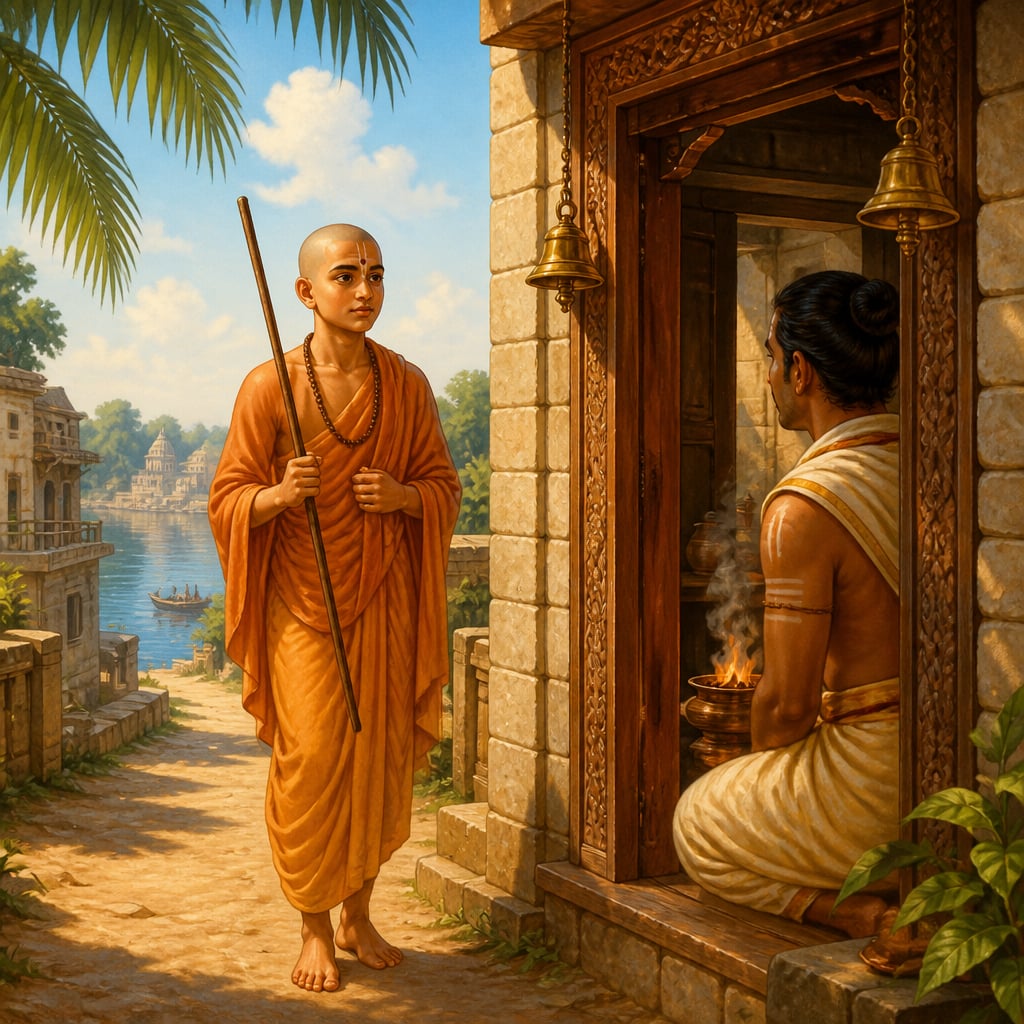
The terms were agreed in front of Mandana's wife, Ubhaya Bharati, who would act as judge. A fresh garland was placed between the two men. If the garland wilted first on Mandana's side, Mandana had lost. If it wilted first on Shankara's side, Shankara had lost. The debate ran for many days.
The detail worth pausing on is not who won. It is what Shankara did with his turns.
Mandana was a Mimamsaka. He believed that the Veda's karma-kanda, the ritual portions, were the heart of liberation. Shankara did not believe this. He was about to argue the opposite. But when his turn came, before he said a single word in refutation, he did something else first. He stated the Mimamsa position. Fully. Precisely. With every one of its strongest supporting arguments. He quoted Mimamsa sutras Mandana had written commentary on. He laid out the view so carefully that, by tradition, Mandana could not find a word to correct.
Only then did Shankara respond.
This lesson is about that move. It has a name. Purva Paksha, the prior view. It is the Dharmic tradition's highest intellectual discipline, and it is the move that separates a Dharmic debater from a street fighter.
What Purva Paksha Actually Is
Purva Paksha means the prior side, the view that comes first. In a Dharmic debate, you do not begin by stating your own position. You begin by stating your opponent's. You state it in the fullest and strongest form you can. Then, and only then, you offer your Uttara Paksha, your answer.
The discipline has three parts.
First, you read the opponent's actual sources, not a summary of them. Not a rebuttal of them. The originals. Ramanuja, centuries after Shankara, spent years reading the Advaita Vedanta corpus before writing a single line of Vishishtadvaita. His Sri Bhashya's purva paksha chapters are read even now by modern Advaitins as among the cleanest statements of their own position. Fidelity to the source is the first rule.
Second, you state the opponent's position in the form they would recognize. Not a caricature. Not the weakest version. The version their best defender would give if they were in the room. A good test: if you recited your purva paksha aloud and the opponent was listening, would they nod and say, yes, that is what I think?
Third, you only now respond. The Uttara Paksha is the answer to the strongest version. If your response also refutes the strongest version, the refutation is real. If your response only refutes a weaker version, you have refuted nothing. You have beaten a shadow of your choosing.
Call this the Dharmic debater's reading rule: you do not have the right to respond to a position until you can state it better than its holders.
Why Purva Paksha Is Higher Than Just Refutation
Purva Paksha does three things at once that no other debate move does.
It builds credibility in the room. When you state Mandana's position better than Mandana, Mandana's side stops treating you as an enemy. They start treating you as a fair opponent. The audience notices. The audience is always the third party in a debate, and the audience settles around the fair speaker.
It sharpens your own thinking. You cannot state a position accurately without understanding it. You cannot understand it without finding the places where it is actually strong. Those strong places are exactly where your own position will have to do real work. Lazy debaters only know the weak points of the other side. Serious debaters know the strong points too, because they have had to state them.
It tests your own position. If your view can only be stated next to a strawman of the opposing view, your view is not tested. A position that holds up against the steelman is a position that has actually been tried. Shankara's Advaita is weightier because the Mimamsa he refuted was the real Mimamsa, not a cartoon of it.
A debater who can steelman their opponent is feared more than one who can only attack. This is not a paradox. The room knows that a debater who is willing to state the opposition fairly has nothing to hide. The attack-only debater is suspected of being afraid of the strong version. Fair representation is confidence, and confidence is half the victory.
Dharmic Lens: What the West Teaches, and What India Teaches
The Western debate tradition recognizes a related problem. It calls the opposite failure a strawman fallacy: the mistake of attacking a distorted version of the other side. Western logic textbooks list the strawman, warn against it, and move on. The Western steelman principle, articulated by thinkers like John Stuart Mill and Daniel Dennett, is praiseworthy but recent and unsystematic. Mill, in On Liberty, wrote that a person who knows only their own side of the case knows little of that.
The Dharmic tradition did something different, and did it two thousand years earlier.
| Western debate tradition | Dharmic debate tradition |
|---|---|
| Names a failure (strawman) to avoid | Names a positive discipline (Purva Paksha) to perform |
| Negative prohibition: do not distort | Active injunction: state the other view fully first |
| Informally endorsed (Mill, Dennett) | Structurally required by the Nyaya Sutra debate system |
| One-shot: do not commit this error | Multi-stage: Purva Paksha, then Uttara Paksha |
| Absent from most live Western debate shows | Enforced in every classical Shastrartha |
The difference is not small. Telling a debater not to distort is like telling a driver not to crash. It does not tell them how to drive. The Dharmic tradition did not stop at the prohibition. It turned the fair representation into its own step and then enforced it as the opening move of every formal debate.

This is why Yajnavalkya in Janaka's court, Shankara in Mahishmati, Ramanuja at Srirangam, and Madhva after him all open their Bhashyas with elaborate Purva Paksha chapters. It is not politeness. It is the method.
The Four Moves of a Good Purva Paksha
You can run this in any serious debate, in the boardroom, the courtroom, or the dinner table.
- Move 1. Read the original. Not a summary. Not a critic's version. The primary source the other side actually uses. If you have not read it, you have not earned the right to respond to it.
- Move 2. State the position in one paragraph. In a form the other side would sign off on. Include the one strongest argument for it, not the weakest. Leave out the decoration.
- Move 3. Name the best case for it. Say out loud the reason a thoughtful person might hold this view. This is where you separate yourself from the attack-only debater. The audience notices.
- Move 4. Only now respond. Begin the Uttara Paksha with words like, given that, here is why I still disagree. Your response now lands against the real position, not a shadow.
If you cannot complete Move 1 through Move 3 honestly, you are not yet ready for Move 4. Most lost debates are lost here, not later.
The Uttara Paksha Arrives With Teeth
There is a common worry about the steelman. If I state the other side fairly, will my own response look weaker by comparison? The opposite is true.
A response that follows a strong Purva Paksha carries more weight, not less. The audience has already seen you acknowledge the best case for the other view. When your counter comes, they trust that you are not hiding from anything. The counter lands as the conclusion of a fair process. The same counter, delivered after a strawman, lands as noise.
Shankara's response to Mandana is a short, targeted correction inside an elaborate reading of the Mimamsa system. Ramanuja's response to Shankara is a short, targeted critique inside hundreds of pages of faithful Advaita exposition. In both cases the Uttara Paksha looks small against the Purva Paksha. And in both cases, the Uttara Paksha is what moved the tradition forward.
Modern Echoes
Rajiv Malhotra, in his book Being Different (2011) and the books that followed, has made Purva Paksha a working method for contemporary Indian thinkers. Before offering a Dharmic response to Western universalism, he states the Western position with a rigor that many Western scholars themselves have publicly acknowledged. Some of his critics have conceded that the Western case against Hindu philosophy has never been put more precisely than in the opening chapters of Being Different. Only then does Malhotra's Uttara Paksha arrive. Whether or not you agree with his conclusions, the method is exactly what Shankara did at Mahishmati, and what Ramanuja did at Srirangam. Purva Paksha is not a museum piece. It ships.
In a Western register, Daniel Dennett has formalized a similar move for contemporary philosophy, borrowing from Anatol Rapoport. Rapoport's rules for criticism require that you first re-express the target's position so clearly that they say, thanks, I wish I had thought of putting it that way. Only then are you allowed to criticize. The rule is good. What is striking, from the Dharmic side, is that this rule is treated in the West as a rare ideal, while the Indian tradition made it a structural requirement of every formal debate for two thousand years.

Back in Mahishmati, on whichever day the final move actually happened, Ubhaya Bharati did in fact rule the debate. The garland on Mandana's side wilted first. But the thing worth carrying out of that courtyard is not the ruling. It is the opening move that made the ruling mean something. Shankara did not win because he attacked Mandana well. He won because he had already shown the room that he understood Mandana better than Mandana's own students. Next, in Lesson 2.7, you will see that debates also run at five different levels at once, and that even a perfect Purva Paksha can land on the wrong one.
Case studies
Shankara and Mandana at Mahishmati
Sometime in the eighth century CE, the young sannyasi Adi Shankara traveled to the town of Mahishmati on the Narmada to debate Mandana Mishra, the foremost Mimamsa scholar of his age. The debate was held at Mandana's own house, with Mandana's wife Ubhaya Bharati accepted by both men as the judge. A fresh garland was hung between them. The garland wilting first on either side would signal defeat for that speaker. The debate ran for many days. When Shankara's turn to speak came, before offering a single word of Advaita refutation, he restated the Mimamsa position on karma-kanda as the path to liberation, drawing on the very sutras Mandana had written commentary on. He stated the case so accurately that Mandana, tradition says, could not find a word to correct. Only then did Shankara offer his response.
This is Purva Paksha done in a Shastrartha, in public, before a judge. Shankara follows the four moves: he has read the primary Mimamsa sources, he states the position in the form Mandana would recognize, he names the strongest case for it (ritual action rooted in Vedic injunction as binding reality), and only then begins the Uttara Paksha. The move earned him the right to be heard. It also sharpened his own position: the Advaita response had to survive against the real Mimamsa, not against a convenient caricature.
By the tradition's telling, the garland on Mandana's side wilted first, and Mandana accepted Shankara's position per the prior agreement. More importantly, Shankara's Brahma Sutra Bhashya and related works preserved the method. Every subsequent Vedanta commentary, including those by schools that disagreed with Shankara, inherited the structural requirement to run Purva Paksha before Uttara Paksha. The method outlasted the debate.
A debater who walks into the opponent's house and states the opponent's view better than the opponent is not being polite. They are preparing a response the room will trust. Public fairness is a form of preparation, not a concession.
Ramanuja's Purva Paksha of Advaita
In the late eleventh and early twelfth century at Srirangam, Ramanuja set out to articulate Vishishtadvaita, the qualified non-dualism that would become the theological foundation of Sri Vaishnavism. His target was the Advaita Vedanta of Shankara, which had dominated the philosophical landscape for three centuries. Rather than writing a direct counter, Ramanuja spent many years reading the Advaita corpus and its subsequent commentaries. His Sri Bhashya on the Brahma Sutras opens with purva paksha chapters that state the Advaita position, including Shankara's arguments for maya and the non-reality of difference, with extraordinary fidelity. Advaitins who read the Sri Bhashya centuries later have publicly acknowledged that the opening chapters are among the cleanest statements of their own position in the commentarial literature.
Ramanuja takes the four moves across generations. He reads the primary Advaita sources, not Advaita's critics. He states the position in the form a committed Advaitin would sign off on. He names the strongest case for non-dualism (scriptural passages from the Chandogya and Brihadaranyaka Upanishads, coupled with the Mandukya Karika's analysis of the three states). Only then does the Uttara Paksha arrive, and when it does, his critique lands on the real Advaita, not on a straw Advaita. His disagreement is real because his representation was first real.
The Sri Bhashya became one of the foundational commentaries of Indian Vedanta. Even in centuries of polemic between Advaita and Vishishtadvaita lineages, Ramanuja's purva paksha of Advaita remained uncontested as a faithful statement. The tradition took the method seriously enough that later Madhva Dvaita commentators ran a similar Purva Paksha against both Shankara and Ramanuja before stating the Dvaita position.
Purva Paksha is a multi-year discipline for the most serious positions, not a paragraph's pause. If you want your disagreement to count, you read the other side until they themselves would say, yes, that is us.
Rajiv Malhotra and the Modern Purva Paksha
In 2011, Rajiv Malhotra published Being Different: An Indian Challenge to Western Universalism, a book structured explicitly around Purva Paksha. The opening chapters state the case for Western universalism: its roots in Judeo-Christian-Greek metaphysics, its claim to unique access to rational and moral progress, and its working assumption that non-Western traditions must eventually be mapped onto Western categories to be legitimate. Only after stating this case at length does Malhotra offer the Dharmic response. In the years since, several Western scholars of religion have publicly acknowledged that the Western position has rarely been formulated more precisely than in the opening chapters of Being Different. The books that followed, including Breaking India and Indra's Net, use the same method.
Malhotra is explicit that he is doing Purva Paksha in the classical sense. He reads Western Indology's primary authors (Roberto de Nobili, Jonathan Z. Smith, Wendy Doniger, and others) in their own words. He states their positions in a form they themselves would endorse. He names the strongest case for the Western universalist frame. Only then does the Uttara Paksha arrive: the argument that Dharmic traditions have their own complete epistemic and experiential categories that cannot be dissolved into Western frames without loss.
Being Different and its successors have become foundational texts for a generation of Indian thinkers working at the intersection of tradition and the modern Western academy. The method has been adopted by other Indian writers and public intellectuals working on civilizational questions. Whether or not a reader accepts Malhotra's conclusions, the structural move (long, rigorous Purva Paksha before any Uttara Paksha) is the same one Shankara used at Mahishmati and Ramanuja used at Srirangam. Purva Paksha ships.
A contemporary Indian thinker who wants to be taken seriously in global debates cannot skip Purva Paksha. Reading the Western tradition in its strongest form is not a concession to it. It is the move that earns the right to respond to it.
Reflection
- Think of a view you strongly disagree with on a contested topic (political, religious, economic, or personal). Could you, right now, state the strongest case for that view in a form its best defender would endorse? If not, what does that tell you about your current disagreement?
- Shankara walked into Mandana's own house to debate him. Why would a Dharmic debater seek out the strongest opponent on the opponent's territory, rather than a weaker one on more comfortable ground?
- If Purva Paksha requires stating the opposing view as strongly as possible, is there any position that should not be steelmanned? Are there views so harmful that a fair representation would itself be wrong? How does a Dharmic debater decide where the line is?