The Topic Shifter
The Art of Not Answering
The Topic Shifter smoothly moves the conversation to entirely different territory when cornered. Level 2 (Subtle) archetype in the Palayaka Vadin (Escapists) cluster of the Chatur-Vadin Framework. The shift is fast, plausible, and almost never named in the room. The Vaadin's counter is one sentence: you have not answered the original question.
The Question Vikarna Asked
The Sabha hall at Hastinapura was full and silent. Draupadi had been dragged in by her hair. Dushasana had begun to pull at her single garment. The Pandavas, who had wagered her in the dice game and lost, sat with their heads down and could not meet her eyes. Bhishma, the grandfather, said nothing. Drona, the teacher, said nothing. Vidura had already spoken twice and been ignored.
Then a young man stood up.
He was Vikarna, one of the hundred Kaurava brothers, junior to Duryodhana but full-grown and present in the assembly. He had no political ambition. He was not a known scholar. He had no faction supporting him. But he could see what was happening, and he could see that no one else was going to say it.
He addressed the assembly. He named one question, and one only. Was what was being done to Draupadi dharma, or was it adharma? He listed his reasons: a king who has lost himself first cannot wager his wife, a wife is not property to be staked, the rules of the dice game itself had been broken. He sat down.
The hall held its breath.
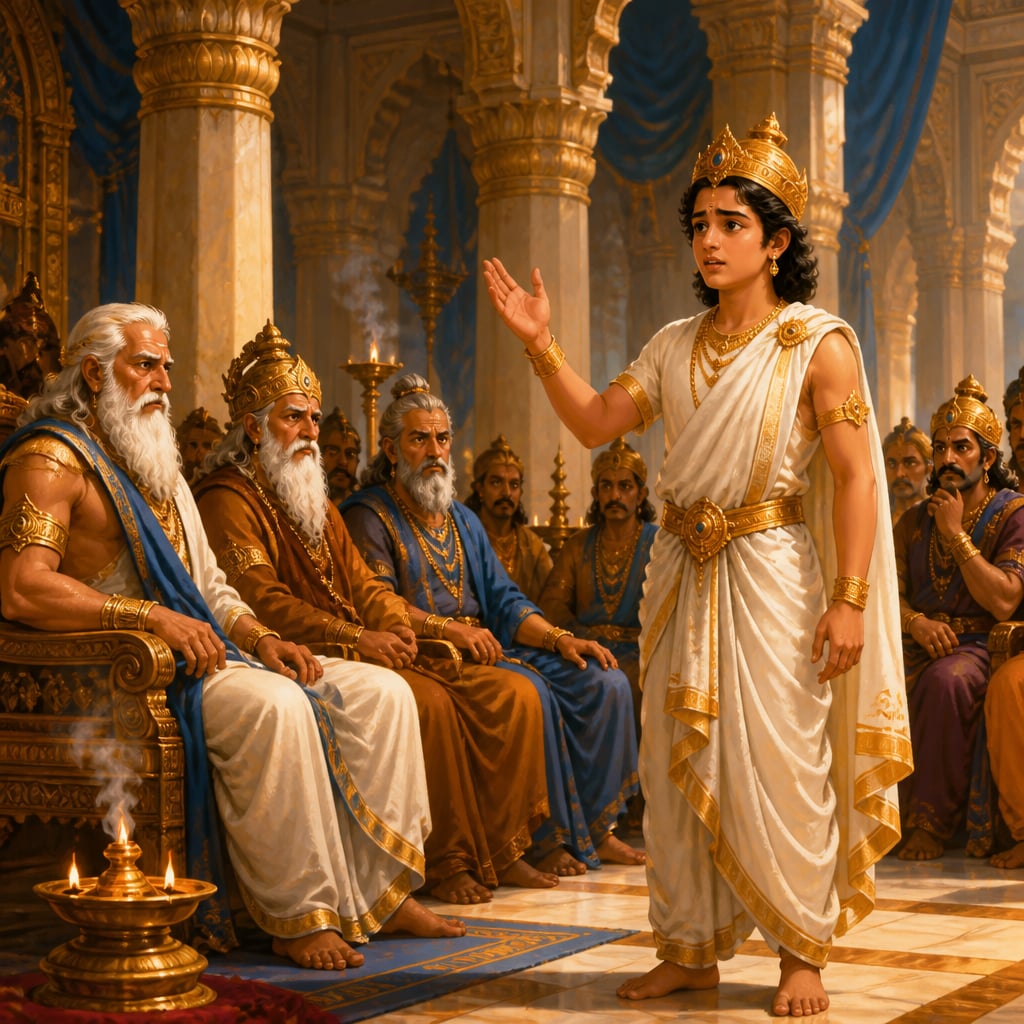
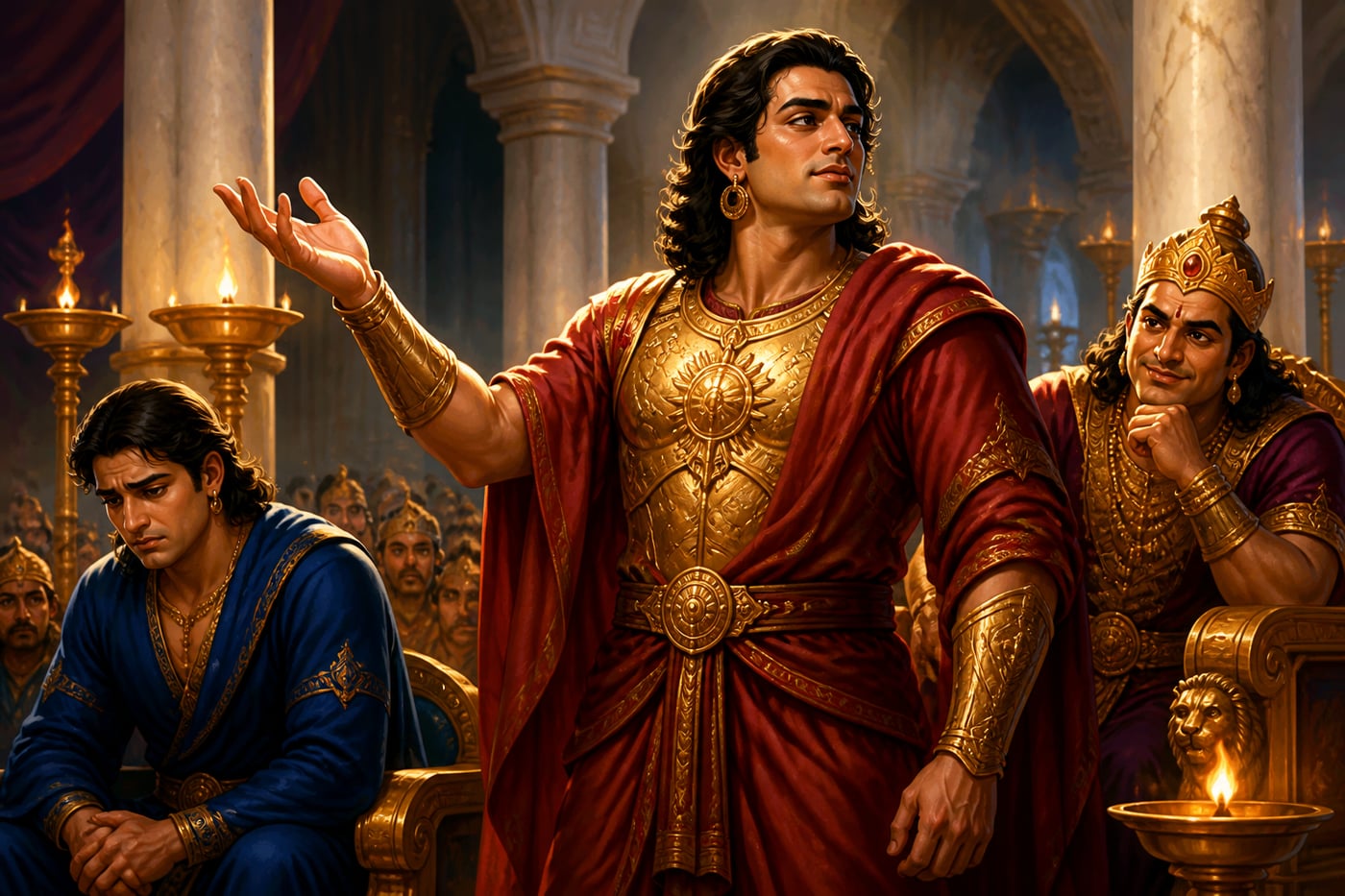
Then Karna spoke.
Karna did not answer the dharma question. He did not say yes, this is dharma with reasons. He did not say no, this is adharma with reasons. He said something else entirely. He said that Draupadi, having married five husbands at once, was not really anyone's wife in the proper sense, and so the dharma question Vikarna had raised did not arise. Then he said, in the same breath, that she had been wagered fairly under the rules of the game, and so the Pandavas now owned her in the way one owns property, and so the dharma question Vikarna had raised did not arise.
Vikarna had asked one question. Karna had answered two different questions, both of them designed to make Vikarna's question disappear. The original question, the only one that mattered, was never spoken to again that day. Dushasana continued. Krishna eventually intervened to save Draupadi's honour.
This is the archetype the lesson is about. The smooth, fast, plausible move from the question on the table to a different question, never returning to the first. Its name in this course is the Topic Shifter, and it is the second archetype in the Palayaka Vadin (Escapists) cluster of the Chatur-Vadin Framework.
Difficulty Level: 🟧 Subtle
This is a Level 2 (Subtle) archetype. It is harder to spot than the Whatabouter (Level 1, the previous lesson), because the Topic Shifter does not announce the shift the way a Whatabouter does. The Whatabouter says but what about X, and the marker is in the words. The Topic Shifter just starts answering a different question, and the audience often does not realise the question has changed.
The shift is usually fast. The course plan describes the canonical modern version: a politician asked about the economy who pivots to national security in eight seconds. Eight seconds is the right number. By second nine the audience has accepted the new topic. By second twenty the original question is gone. By the end of the segment, no one in the room remembers what was actually asked.
The Topic Shifter is in the Escapists cluster because the goal of every archetype in the cluster is to avoid the substantive ground. Each does this in a different shape.
| Archetype | Level | What it does |
|---|---|---|
| Whatabouter | ⬜ L1 | Replies to your point with but what about X |
| Topic Shifter | 🟧 L2 | Smoothly answers a different question without saying so |
| Data Flooder | 🟧 L2 | Drowns the question in 47 links and 12 statistics |
| Moving Goalpost | 🟥 L3 | Changes the criteria the moment you meet them |
| Circular Reasoner | ⬜ L1 | Uses the conclusion as the premise |
Each archetype in the cluster has a different surface tell. The Topic Shifter's tell is a real answer to a different question. The audience hears a coherent reply and assumes the original question was addressed.
The Anatomy Of The Eight-Second Pivot
The Topic Shifter's move has three predictable beats.
- The acknowledge. A short verbal acknowledgement of the original question, often a single phrase like "That is an important question" or "Glad you raised that." The acknowledgement creates the impression that the answer will follow. It rarely does.
- The bridge. A connector phrase that moves to the new ground without naming the shift. "And the broader context here is..." "What we should really be asking is..." "The deeper issue at stake..." The bridge is the eight-second window.
- The new question. The speaker now answers the new question with full substance. The new answer is often genuinely interesting and worth hearing on its own. That is what makes the shift work: the audience stops mourning the original question because the new content is engaging.
Karna's reply to Vikarna in the Sabha follows this exact structure. He does not refuse to engage. He engages fully, on two different questions: the marriage question and the property question. Both are arguable. Neither is the dharma question Vikarna asked. The substance of his answers carries the room.
The Bhagavad Gita's later teaching, given by Krishna to Arjuna a few years later on the same field where this Sabha decision led, includes a verse on what makes a senior speaker's choice spread through a room.
यद्यदाचरति श्रेष्ठस्तत्तदेवेतरो जनः। स यत्प्रमाणं कुरुते लोकस्तदनुवर्तते॥
yad yad ācarati śreṣṭhas tat tad evetaro janaḥ sa yat pramāṇaṃ kurute lokas tad anuvartate
Whatever a great person does, lesser people imitate. Whatever standard a great person sets, the world follows.
Bhagavad Gita 3.21
The verse runs in two directions. When Karna in the Sabha showed that the senior voices in the room could substitute a different question for the question asked, the rest of the room learned that this was the standard. By the end of the war eighteen years later, the standard had spread. The Mahabharata itself is in part the long story of what happens when no one in a senior chair will answer the question on the table.
The Counter, In One Sentence
The Vaadin's counter to the Topic Shifter is one sentence delivered in a calm voice, as soon as the bridge phrase is heard.
"You have not answered the original question. The question on the table was X. Let us return to it."
The sentence does three things at once. It names the move out loud, which removes the silence the Topic Shifter relies on. It restates the original question, which puts it back on the table for the audience to track. And it offers a return, which gives the speaker a graceful way back without losing face.
The Topic Shifter has two responses available. They can return to the original question, in which case the substantive ground is back. Or they can shift again, which makes the pattern visible to the audience. Either response is a win for the Vaadin. The full counter strategies are spelled out in the moral lessons of this lesson.
Modern Echoes

The political scientist Pratap Bhanu Mehta has written for years about the hollowing of substantive accountability in Indian primetime political debate. His diagnosis points at the same mechanism the lesson names. When a minister or party spokesperson is asked a specific question about a specific number, the answer pivots to a different theatre within seconds. The pivot is rarely challenged by the anchor, because the anchor's incentive structure is to keep the segment moving rather than to recover the original question. The audience by the end of the show has heard many things and very few of them are answers to the questions that were asked.
The pattern is not Indian. American political scientist Ezra Klein has written extensively about the same eight-second pivot in US Congressional testimony from technology executives. Sundar Pichai's December 2018 House Judiciary Committee testimony on Google's data and content practices runs to several hours of pivots from specific algorithmic and product questions to general statements about Google's user mission. Mark Zuckerberg's April 2018 Senate testimony on Cambridge Analytica produced the now-famous exchange where Senator Hatch asked how Facebook sustains a business model where users do not pay, and Zuckerberg replied "Senator, we run ads." The reply is a shift. The original question, on the wider data-monetisation chain that turns user attention into advertising spend, was never returned to.
The Topic Shifter's longest-running achievement is the audience training that comes with it. After enough years of pivots, the audience stops asking. The original questions stop being asked, because everyone knows the answer will be a pivot. The room learns to settle for the new content as the substitute for the old answer.
Back in the hall at Hastinapura, Vikarna's question never received its reply. The dharma question he raised died in the room with him. The war that followed was, among other things, the long working-out of the question the Sabha had refused to answer in the only place where the answer could have stopped what came next.
Case studies
Karna's Two-Stage Shift in the Sabha
In the Sabha Parva of the Mahabharata, after Yudhishthira had lost the dice game and Draupadi had been dragged into the assembly hall by Dushasana, the third Kaurava brother Vikarna stood up and named one specific question. Was what was being done to Draupadi dharma, or was it adharma? He listed his reasons: a king who has lost himself first cannot wager his wife, a wife is not property to be staked, the rules of the dice game itself had been broken. The hall waited. Karna, the warrior of the age, friend of Duryodhana, and the voice with the highest standing in the assembly besides the elders, rose to reply. He did not address the dharma question. He shifted, in two clean moves. First: Draupadi having married five husbands at once is not properly anyone's wife in the dharmic sense, so the question of dharma toward her does not arise. Second: she was wagered fairly under the rules of the game, so the Pandavas have lost ownership of her, so the question of dharma toward her does not arise. The original dharma question was never spoken to again that day.
Karna's reply is the textbook two-stage Topic Shift in the strict Nyaya sense. He does not refuse engagement, which would have been visible. He engages fully, on two questions of his own choosing. Both new questions are arguable. Neither is the question Vikarna asked. The substance of his answers carries the room precisely because the answers ARE substantive. The Bhagavad Gita 3.21 mechanism then propagates the standard: the senior voice in the room having shifted, the standard for the rest of the room is now the shift. By the end of the war the standard has spread through the entire Kuru line.
The dharma question Vikarna asked was never answered by the Sabha. Krishna eventually intervened to save Draupadi's honour through a different mechanism entirely. The war that followed eighteen years later was, in significant part, the working-out of the question the Sabha had refused to answer. Vikarna himself was killed in the war by Bhima. The traditional account preserves Bhima's grief at having to slay the one Kaurava who had spoken for dharma.
When a senior voice in a room substitutes a different question for the question on the table, and the room accepts the substitution, the room has set its standard. The original question does not die quietly. It returns later, at scale, as consequence.
Vikarna was one of the hundred Kaurava brothers and the only one, by the Mahabharata's own accounting, who stood up to question the disrobing of Draupadi in the Sabha. The asymmetry is one against ninety-nine, in front of grandfather, teacher, and king.
Ravana Shifts From Sita's Return to Khara's Death
In the Yuddha Kanda of the Ramayana, with Hanuman's burning of Lanka still fresh and Rama's bridge under construction, Ravana's senior ministers raised the only question that could save the city. Return Sita, accept the wrong, end the war before it begins. The question was specific: you took another man's wife by force, return her. Ravana did not answer the question that had been put. He shifted, smoothly. He spoke instead of the killing of his brother Khara and fourteen thousand of his soldiers in the Dandaka forest. He spoke of the human princes invading his territory. He spoke of the affront to rakshasa honour. The new content was real. Khara had been killed. The Dandaka encounter had happened. The grievance was not invented. But none of it was an answer to the question of returning Sita. The ministers who had raised the original question fell silent because the new content carried the room.
Ravana's reply is a near-mirror of Karna's reply in the Sabha. The shift is not refusal: the speaker engages fully, with substance, on a different question. The new question is genuinely arguable. The audience accepts the new question as the conversation because the original question has not been formally taken off the table, only abandoned. The Vidura Niti diagnosis applies cleanly. Ravana's ministers are pleasant speakers in the Vidura sense: they raised the question once and did not insist when the king shifted. The unpleasant beneficial answer would have been the second insistence. They did not have it in them to insist on it twice in a row.
The dharma question of returning Sita was never answered by the Lanka court. The war proceeded. Khara was avenged in name only. Lanka burned. Ravana was killed. Vibhishana, the one minister who had insisted twice and finally left for Rama's camp when the second insistence was rejected, was crowned king of the city after the war. The cost of the unanswered question was the city itself.
When a head of state shifts from the question of the wrong they have done to the question of a wrong done to them, the shift is fast, plausible, and historically expensive. The minister who insists once is normal. The minister who insists twice is the rare second listener. The cost of not insisting twice is paid by the kingdom.
The Family WhatsApp Topic Shift on a Positive Indian Update
A composite Indian family WhatsApp group of twenty-three members on a Tuesday evening. A young engineer-cousin in Pune shares a specific update: the IMF October 2025 World Economic Outlook has confirmed India as the fourth-largest economy in the world by nominal GDP, having crossed Japan, with growth above six percent for the year. The cousin has done the work: she has linked the IMF table, the Reserve Bank of India press note, and a plain-English explanation of nominal versus PPP figures. She is asking what the family thinks. A senior aunt in Delhi replies within four minutes. She does not engage the IMF figure or dispute the explanation. She writes about unemployment, the price of tomatoes in her colony market, a recent story from Manipur, communal tensions, and her view that things were better in the 1980s. Each item is a genuine concern. None is engagement with the specific data point the cousin shared. The cousin's update has not been refuted. It has been replaced. By morning the thread has moved on.
The aunt's reply is a textbook Topic Shift in the Nyaya sense. The original praśna was a specific, well-sourced data point with a clear request for engagement. The reply does not address the praśna. It answers a different set of questions, all of which are arguable on their own merits, none of which is an answer to what was actually asked. The Bhagavad Gita 3.21 mechanism propagates: the senior voice in the family group having shifted, the rest of the group accepts the shift as the new standard for the conversation. The cousin learns, over months of similar shifts, that sharing specific positive data is not rewarded. She stops sharing. The group conversation drifts to grievance and reaction. This is how Vaada disappears from a family chat: not through being defeated, but through being made expensive for the speaker.
Over the following months, the cousin's data-sharing slows to nothing. The group's conversational floor settles at the shift level: any specific update, positive or negative, is replaced within minutes by the senior member's preferred topics. The capacity of the group to engage substantive economic, governance, or civilizational data goes to zero. The family loses, quietly, a forum that could have been useful for shared analysis.
When a specific data-sharing post in a family group is met with a Topic Shift to general grievance, the cost of the shift is not the lost data point. It is the lost capacity of the group to handle specific data at all. Insisting once on the original question is the gift the group most needs from its members.
Reflection
- Recall the last conversation in which you asked a specific question and got an interesting answer to a different question. Did you notice the shift in real time, or only later? What was the bridge phrase the other speaker used to leave your question?
- Why did Karna choose to shift the dharma question in the Sabha rather than engage it directly, given that he had the intellectual capacity to engage it on its merits?
- When, if ever, is shifting the topic legitimate? Krishna's reply to Arjuna in the Bhagavad Gita's second chapter is technically a topic shift: Arjuna asked a question about kinship and grief, Krishna answered a question about the nature of the self. What separates a deepening reframe from an evading deflection?