The Moving Goalpost

When the Finish Line Keeps Moving

Level 3 (Elite) archetype. The Moving Goalpost sets a condition for being persuaded, then quietly replaces it when you meet it. You do not catch this archetype by providing more evidence. You catch it by locking the record of what was asked and what was provided.

Krishna Comes to Hastinapura

In the months before the Kurukshetra war, Krishna arrived at Hastinapura as the Pandavas' envoy. The Udyoga Parva of the Mahabharata records the scene in detail. The court had assembled. Dhritarashtra on the throne. Bhishma, Drona, Kripa, Vidura and the hundred Kaurava princes around him. Karna stood beside Duryodhana. The court jewels glittered under oil lamps. The floor had been scrubbed for the occasion. Outside, the streets of Hastinapura were lined with citizens who had heard that Krishna himself was coming to prevent the war.

Krishna's task was simple. Bring back an agreement. Avoid the battle that was only weeks away.
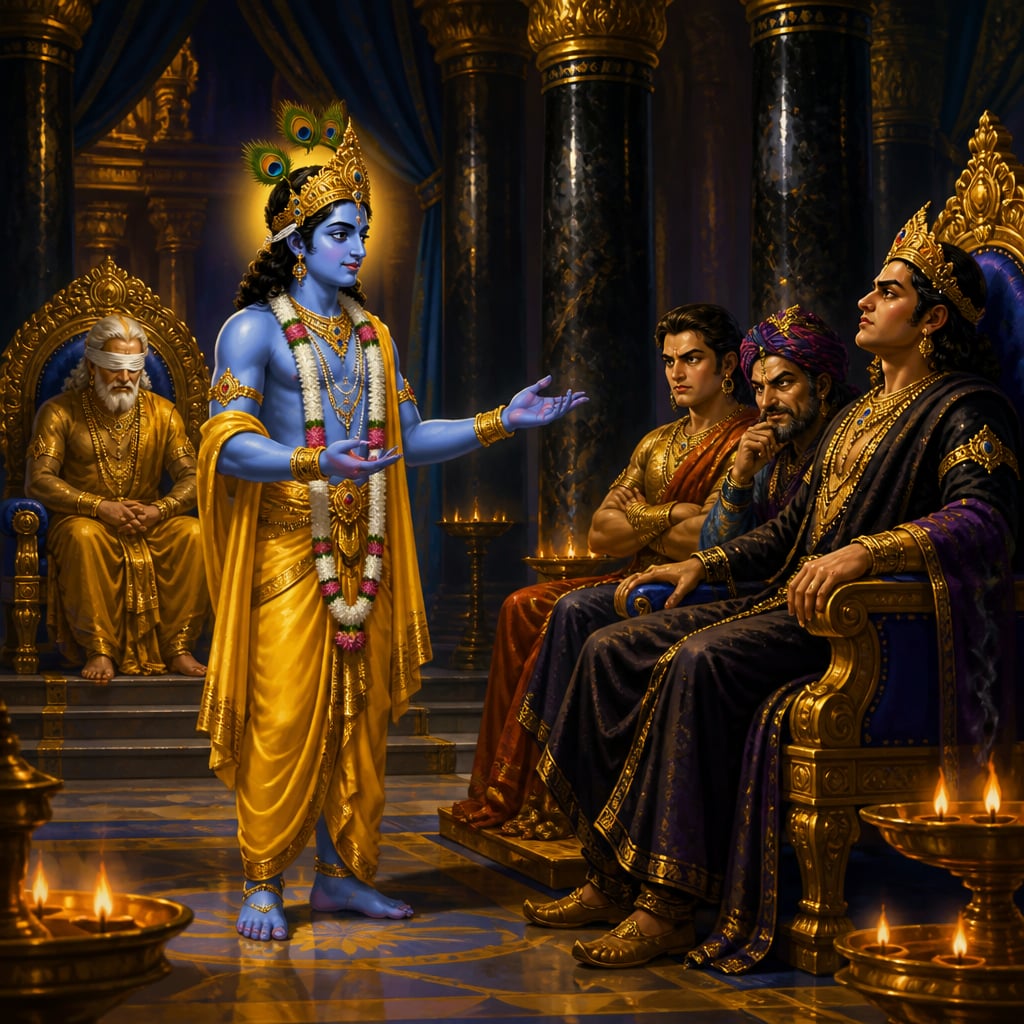
Krishna addresses the Hastinapura court as Pandava envoy before the war

He began by reminding the court of the Pandavas' original claim. Half the kingdom, as the elder branch was due under Kshatriya law. Duryodhana refused. Krishna reduced the ask. Half would not come. Give them five provinces. Duryodhana refused. Krishna reduced again. Five villages only, one each. Duryodhana refused. Then came the line the Mahabharata preserved almost word for word. Not even as much land as the point of a needle will I give without war.
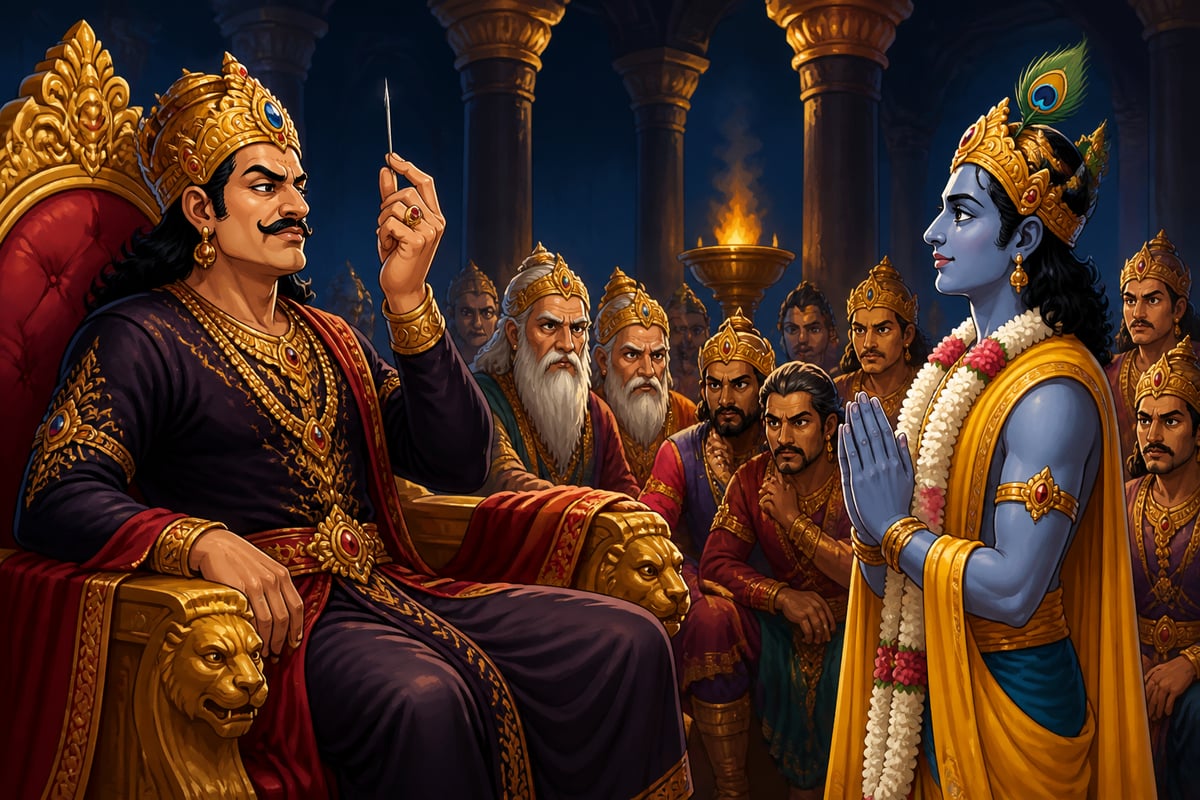
Duryodhana raises the needle of refusal before Krishna

That single line is the archetype this lesson names. The criteria had already been shifted four times. Every time Krishna met the previous bar, Duryodhana moved the bar. Each refusal arrived with new grounds. Sovereignty. Honour. Precedent. Destiny. The final refusal shifted the measure itself, from land in provinces to land in needle-points.

Welcome to the fourth archetype in the Chatur-Vadin Framework's Escapist cluster. The Moving Goalpost is tagged Level 3 (Elite). You do not catch this archetype by providing more evidence. You catch it by locking the record of what was asked and what was provided, before the goalpost can move again.

What a Moving Goalpost Actually Is

A clean definition: the Moving Goalpost is the debater who sets a condition for being persuaded, and then, when the condition is met, replaces it with a new one without acknowledging the shift.

The move runs in a cycle:

At no point does the Moving Goalpost concede. At no point does the debater own the shift. Each new criterion is presented as if it had been the criterion all along. The exchange feels like progress to an observer, because evidence is being marshalled and examined. In fact, no persuasion is possible, because the conditions for persuasion never stay still long enough to be met.

Duryodhana's Sandhi scene is the canonical model. Notice what he never says: I will not agree to peace on any terms. That would have been honest. Instead, every refusal comes wearing a specific reason, which shifts with each round. The elder-branch claim is refused on grounds of sovereignty. The five-province ask is refused on grounds of honour. The five-village ask is refused on grounds of precedent. The needle-point ask is refused on grounds of destiny. Four refusals, four different grounds. The grounds are the costume. The refusal was fixed from the first moment.

Why It Is Level 3 Elite

This archetype is elite because it looks like engagement. A Strawman distorts visibly. An Overgeneralizer inflates visibly. A Cherry Picker omits, and the omission can be shown. The Moving Goalpost, by contrast, is marshalling real criteria and engaging with each piece of evidence one at a time. Each individual round is defensible. The manipulation only becomes visible when you zoom out across the full sequence.

Nyaya Shastra named this pattern with surgical precision two and a half thousand years ago. The Nyaya Sutras list twenty-two nigrahasthana, formal defeat conditions on which a debater is declared to have lost a Shastrartha. One of them is apasiddhanta: abandoning one's own accepted position mid-debate. Gautama's definition is clean. If you begin with one position, are pressed on it, and then quietly switch to a different position while acting as though it had always been your position, you have committed apasiddhanta. The debate is lost at that moment, not later.

सिद्धान्तमभ्युपेत्यानियमात्कथाप्रसङ्गोऽपसिद्धान्तः।

siddhāntam abhyupetyāniyamāt kathā-prasaṅgo 'pasiddhāntaḥ

Abandoning the established position one has accepted, and continuing the debate without acknowledging the abandonment, is apasiddhanta.

Nyaya Sutra 5.2.23

The Moving Goalpost is apasiddhanta run as a live pattern. Duryodhana is the Mahabharata's clearest example. Every modern Moving Goalpost is his structural cousin.

The Counter: Lock the Record

The counter for this archetype has one shape, stated in the course plan almost word for word: You asked for X. I provided X. The original question is settled. This move is called locking the record. It has three beats.

Beat 1. Restate the criterion, verbatim. Before offering your evidence, pause and repeat what was asked. You asked for a peer-reviewed paper in a major journal showing Y. Am I correct? Wait for confirmation. The confirmation is the lock.

Beat 2. Provide the evidence. Cleanly. Without rhetorical ornament. One citation, one link, one source. Do not bundle the provision with a rebuttal to a future goalpost move. Give what was asked. Nothing more.

Beat 3. Close the round. I have provided what you asked for. Before we move on, do you agree the original question is now settled? If the answer is yes, you proceed. If the answer introduces a new criterion, you have caught apasiddhanta on the record. Now you can name the shift and decide whether to continue.

The reason this works is simple. The Moving Goalpost relies on an unstated assumption: that each new round is a fresh conversation unconnected to the previous ones. The lock breaks that assumption. It makes the sequence visible. Once visible, the shift cannot hide behind new grounds, because the previous grounds are in the transcript.

How Krishna Closed the Sandhi

Krishna closes the Sandhi mission and walks out

Krishna did not waste energy on a fifth round. After the needle-point refusal, he did not reduce further. He named what had happened. On the record, in front of the full court, he set out the sequence: half the kingdom, then five provinces, then five villages, then a needle's point, and at each step a different refusal. He locked the record. Then he walked out of the assembly.

The walk-out is the second half of the counter. When the Moving Goalpost has been named and the shift continues, the Dharmic debater does not extend the sequence. This is not defeat. It is Kshetra Bodha, the battlefield awareness Chapter 10 will build out. Some debates are not Vaada. Some are not even Jalpa. When a goalpost has been moving this long, the debate has already become Vitanda. The correct move is to stop playing.

Modern Echoes

The same archetype runs at civilizational scale. Consider the recurring Western academic claim that Hinduism is not really a religion. When Hindu doctrinal continuity is shown across two millennia, the criterion shifts to but it has no single founder. When unifying figures are named (Veda Vyasa, Adi Shankara), the criterion shifts to but it has no single text. When the Vedas, the Gita, and the Brahma Sutras are cited, the criterion shifts to but it has too many texts. Rajiv Malhotra documents this chain across Being Different (2011) and Indra's Net (2014). At each step, the criterion looks neutral. Across the sequence, the conclusion never moves. The criteria were never real. The conclusion was.

The same pattern runs in the history of organised climate-science denial, as historians Naomi Oreskes and Erik Conway documented in Merchants of Doubt (Bloomsbury, 2010). The goalposts shifted across decades. Warming is not happening became it is happening but is not human-caused became humans cause some but the amount is small became the amount is significant but we cannot afford to act. Each shift was presented as a fresh debate. Each kept the conclusion intact. Oreskes and Conway traced the funding and the same small set of authors across all four phases. The criteria were the costume. The position was fixed.

Back at Hastinapura, Krishna did not try to meet a fifth criterion. He named the four shifts, locked the record in the court's memory, and returned to the Pandava camp. War followed. Sometimes the correct outcome of a debate is not agreement. It is the clean record that history can read afterwards. In Lesson 5 you will meet the Circular Reasoner, a Level 1 Escapist whose trick is the mirror opposite of this one.

Case studies

Krishna's Sandhi Mission at Hastinapura

In the Udyoga Parva of the Mahabharata, Krishna travels to Hastinapura as the Pandavas' envoy in the months before the Kurukshetra war. He arrives in the Kaurava court before Dhritarashtra, Bhishma, Drona, Vidura, the hundred Kaurava princes, and Karna. He begins with the Pandavas' original claim, half the kingdom as the elder branch is due under Kshatriya law. Duryodhana refuses. Krishna reduces the ask to five provinces. Duryodhana refuses. Krishna reduces again to five villages, one for each Pandava brother. Duryodhana refuses. Krishna, by the tradition's account, finally asks for a village, a house, a shelter, anything that could forestall war. Duryodhana's final refusal is the line the Mahabharata preserves verbatim: not even as much land as the point of a sharp needle will be given without war.

Every round of the Sandhi is a goalpost shift. Each refusal arrives with a different stated ground: sovereignty, honour, precedent, finally destiny. Four refusals, four different costumes, one fixed position. This is exactly the pattern Gautama's Nyaya Sutras named apasiddhanta centuries later, raised to civilizational scale. Krishna's decisive move was not to offer a fifth reduction. It was to set the whole sequence on the record in open court, then leave. Pratishtha, the firm standing the Gita describes as acala-pratiṣṭha in 2.70, is precisely what he demonstrated by refusing to chase the fifth criterion.

The Sandhi failed. War followed. But the Mahabharata records the sequence in full, and Duryodhana's conduct in that court became the tradition's case study in how not to negotiate. Krishna's Sandhi is referenced across classical Indian political writing as the paradigm of good-faith negotiation exhausted by a bad-faith counterparty, and the record Krishna locked is the reason history treats Duryodhana's case as closed on merit, not just on battlefield outcome.

When a counterparty keeps shifting grounds, your fifth concession will not close the deal. Your second or third should already have revealed the pattern. Name the sequence, lock the record, and decide whether the debate is still worth having.

The 'Hinduism Is Not Really a Religion' Sequence

A recurring academic claim in Western religious studies is that Hinduism is not really a religion, but a colonial construct or a modern political invention. When defenders cite the Hindu tradition's doctrinal continuity across two millennia, the criterion shifts to 'but it has no single founder.' When unifying figures are named (Veda Vyasa, Adi Shankara, Ramanuja), the criterion shifts to 'but it has no single canonical text.' When the Vedas, the Bhagavad Gita, and the Brahma Sutras are cited as canonical, the criterion shifts again to 'but it has too many texts, with internal disagreement.' Rajiv Malhotra documents the full chain of goalpost shifts in Being Different (2011) and Indra's Net (2014), naming specific authors and specific criteria at each round.

Each shift is apasiddhanta at civilizational scale. The criterion looks neutral: a founder, a text, a doctrine. Across the sequence, the conclusion never moves, only the grounds for it. A Dharmic debater entering this conversation for the first time often spends years providing evidence for the criterion currently on the table, not realizing the criterion itself is mobile. The fix is the same as in Krishna's Sandhi: lock the record early. State, in writing, the criterion the opponent has put forward. Meet it. Ask whether it is settled before the next round. Force the apasiddhanta into the open, where it can be named.

The last fifteen years of Indic scholarship have, in part, been a project of locking this record. Malhotra, Jakob De Roover, Shrinivas Tilak, and others have documented the goalpost chain in print. Several Western scholars have subsequently modified their own criteria in response. The pattern still runs, but it now runs with its shift documented, which is half of the counter.

A century-old goalpost shift can still be locked. The first move is always to write down the criterion the opponent set, before providing the evidence for it. Everything else follows.

Organised Climate-Science Denial, 1989 to 2010

Between roughly 1989 and 2010, organised denial of climate science in US public discourse shifted its criteria across four recognisable phases. Phase 1: warming is not happening. Phase 2: warming is happening but is not human-caused. Phase 3: warming is human-caused but the magnitude is small. Phase 4: the magnitude is significant but the cost of action is prohibitive. At each phase transition, the same small set of authors and think-tanks presented the new criterion as though it had been the criterion all along. Historians Naomi Oreskes and Erik Conway documented the sequence in detail in Merchants of Doubt (Bloomsbury, 2010), tracing funding flows and named authors across all four phases.

This is apasiddhanta at the scale of public-policy discourse across two decades. Each criterion was individually debatable. The full sequence revealed that the criteria were never the real position. The fixed position was behind them. Oreskes and Conway's contribution was not to refute any one phase. It was to lock the record of the whole sequence, so that the shift itself became visible as the pattern it had always been.

Merchants of Doubt became a foundational reference in the history of science communication. Subsequent public debate increasingly treats the sequence, rather than any single phase, as the thing to address. The archetype continues to operate, but it can now be named. Naming is not victory, but it is the precondition for any other useful response.

When a debate has been running for years with shifting criteria, the most useful scholarly move is usually not to refute the current criterion but to document the full sequence. The sequence, once visible, is the argument.

Reflection

More in Palayaka Vadin: The Escapists

All lessons in Palayaka Vadin: The Escapists · Vaada Shastra: The Dharmic Art of Debate course