The Fake Neutral
I'm Just Asking Questions
The gateway archetype of the Chhadma Vadin cluster, the Pretenders. Level 3 (Elite). The Fake Neutral disguises bias as objectivity. Questions are framed to lead to predetermined conclusions. The presenter's tone stays measured and calm. The framing does all the work. The most dangerous pretender because the mask is the method.
The Hostel Room, Hyderabad
On the evening of 17 January 2023, in a university hostel room in Hyderabad, a postgraduate student named Meera, a clearly-marked composite drawing on a dozen real Indian viewers the author has interviewed, sits cross-legged on her single bed with her laptop open. The ceiling fan turns slowly. A cup of chai is cooling on the side table. The BBC has just released a two-part documentary called India: The Modi Question. Meera presses play.

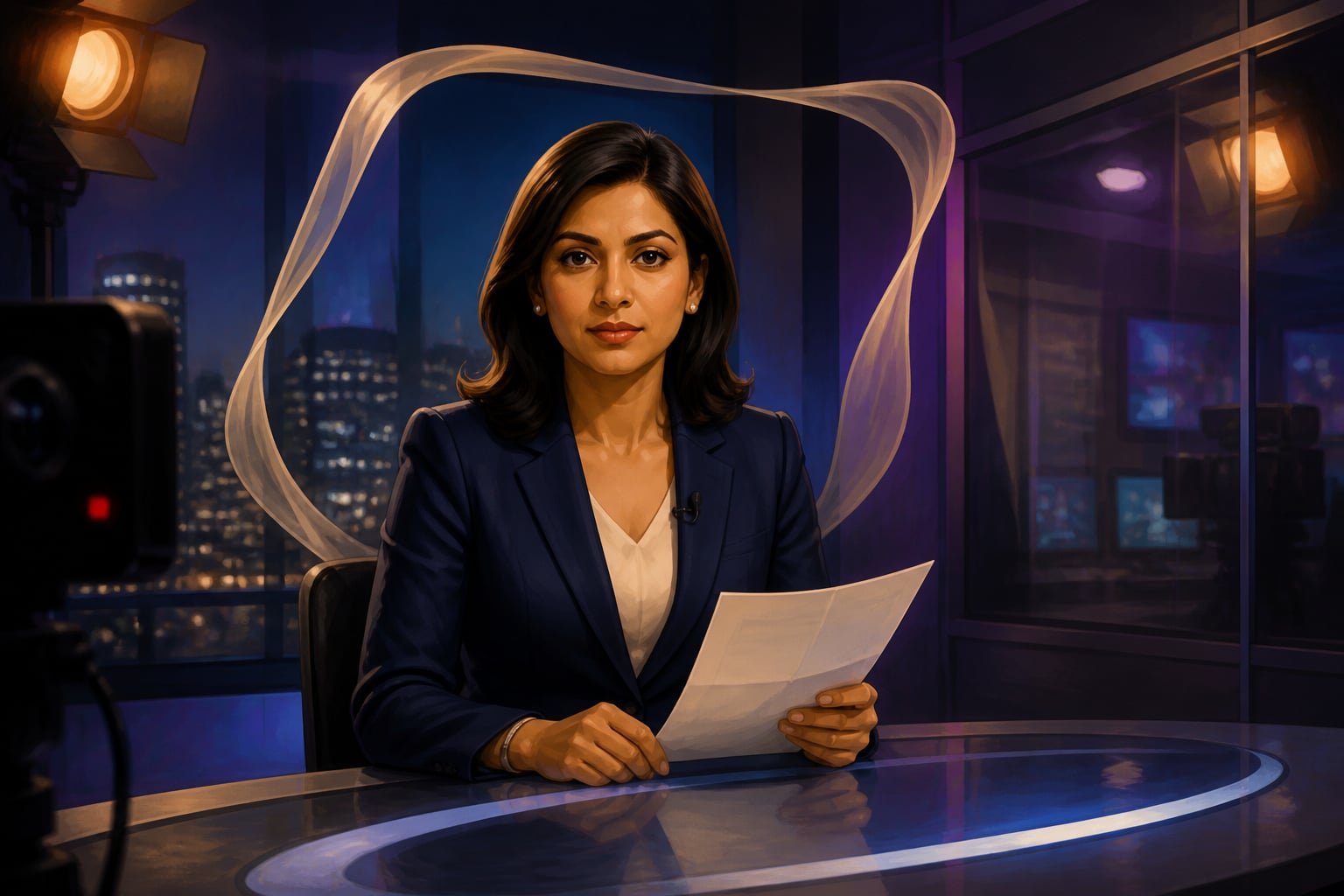
The presenter speaks in a measured, calm, neutral tone. Each sentence is soft-edged and careful. The voice never rises. The vocabulary is the standard vocabulary of British broadcast journalism. And yet, within the first ten minutes, Meera notices something she has been trained, by a course exactly like this one, to watch for.
The questions being asked are not symmetrical. Every question about one side of the story begins with a premise of wrongdoing that must be explained away. Every question about the other side begins with a premise of concern that must be investigated. The framing is not in the voice. The voice is calm. The framing is in which sentence starts with what happened here and which sentence starts with why was this allowed to happen. The two openings look equal on a transcript. They are not equal in effect. They are two different documentaries.
By minute fifteen, Meera has paused the video and opened a notebook. She is not going to stop watching. She is going to take notes. This is the lesson's archetype in action, and she has caught it mid-broadcast.
The Move
The Fake Neutral is the gateway archetype of the Chhadma Vadin cluster, the Pretenders. It is Level 3 (Elite) in the Chatur-Vadin Framework, the hardest difficulty tier in the whole map. It is Elite because the whole point of the archetype is that the bias is invisible to the untrained reader. Once you know what to look for, the mask gets thinner. The first ten minutes of training is hard. The next ten years are easy.
The move has a specific structure. Watch for it.
- The tone is neutral. The presenter speaks calmly. Vocabulary is careful. Nothing inflammatory is said out loud.
- The questions are asymmetric. What gets asked about one side and what gets asked about the other are two different categories of question.
- The expert selection is skewed. The commentators invited to speak represent one side of the spectrum of available expert opinion, while being introduced as the expert opinion.
- The outcome framing is predetermined. The piece ends, or leads the reader to an ending, that only one of the presented sides could reach.
The presenter never says my opponent is wrong. The presenter does not need to. The questions, the experts, and the outcome framing do all the work. The mask of neutrality is the method.
Why It Is Level 3
The Strawman Artist of Chapter 4 was Level 1 because the rebuild is visible once you know the pattern. The Moral Shamer of Chapter 5 was Level 2 because the tone-policing variant takes training to catch. The Fake Neutral is Level 3 because every surface signal of neutrality is in place.
There is no shouting. There is no hostile question. There is no moral charge. Everything that untrained viewers use to detect bias is absent. What remains is the framing, and the framing requires a specific set of skills to see.
This is also why the archetype is so effective at institutional scale. A shouting panelist is a one-night problem. A Fake Neutral institution can run the same framing for decades. The reader never catches on because there is never a single sentence they could point to and say there, that is the bias. The bias is in which sentences are there and which are not.
The Three Tells
A Dharmic debater learns three specific questions to ask of any Fake Neutral product.
- Are the questions symmetric? If each side were being interrogated the way the other side is, would the questions look the same, or different? If different, the framing is not neutral. The framing is the argument.
- Is the expert selection a sample of the debate, or a slice of one side? A genuinely neutral piece invites the strongest arguer for each position. A Fake Neutral piece invites the weakest arguer from one side and the strongest from the other, or invites only one side and flavours the other with quotations.
- Would the piece be different if the presenter openly named their view? If the answer is yes, the piece is not actually neutral. It is a directional argument wearing neutral tone. A real neutral piece would read the same whether the presenter declared their views or not.
These three tells can be applied in under three minutes to any article, broadcast, or panel. With practice they become reflex.
The Counter
The counter to the Fake Neutral is specific. It is deployed in live exchange, in meetings, in panels, and in written response.
Your question contains an assumption. Let us examine that first.
Two clauses. The first names the presence of a hidden premise in the question. The second redirects the conversation to the premise. Do not answer the question as asked. Do not defend any position until the premise has been stated openly. If the questioner insists on an answer before the premise is examined, the counter has already done half its work. The audience can now see that a neutral-looking question was not.
In the Nyaya tradition, this move is called Prakarana Khaṇḍana, the cutting of the frame. The classical naiyayika refuses to argue inside a frame they did not help build. A modern Dharmic debater does the same, calmly, in modern language.
A note on honest framing. Not every question contains a hidden assumption. A journalist who openly declares her view and then asks specific questions is not Fake Neutral. A historian who names his method and then argues inside that method is not Fake Neutral. The archetype is defined by the combination of hidden frame and declared neutrality. One without the other is something else.
Modern Echoes
The NYU journalism professor Jay Rosen named the pattern in 2003. He called it the view from nowhere, the pose of a reporter who claims to have no perspective and then proceeds to frame every story from a specific perspective hidden beneath the claim. Rosen's 2003 essay, later expanded into his blog PressThink, argued that the view from nowhere is not neutral. It is a specific directional stance that uses the claim of neutrality as a shield. Two decades after Rosen's essay, the pattern he named is still the default frame of most major Anglophone news institutions.
The constitutional scholar Gautam Bhatia, writing in 2019 on Indian Supreme Court reasoning, observed that several majority opinions on religious-freedom cases used a similar move at judicial scale. The opinion would frame the case question in a way that constrained the possible answers, then proceed as though the question were the only one available. The dissent, when it arrived, would often attack the framing rather than the reasoning. Bhatia's point was that the mask of neutrality can survive at the level of a written court judgment, not just a television broadcast.
And the 2023 DisinfoLab content analysis of Indian English-language fact-checking organisations found, on rigorous coding, that claims critical of one political side were examined three to four times more frequently than equivalent claims from the other, while identical claims were assigned different ratings based on who had made them. Each organisation in the study presented itself as non-partisan. Each deployed the Fake Neutral structure. The neutrality was the brand. The framing was the method.
Back to the Hostel Room
In Hyderabad, Meera finishes the first part of the documentary with fourteen pages of notes. She has not watched it as a partisan of any side. She has watched it as a Dharmic debater in training. She has catalogued the asymmetric questions, the expert selection, the outcome framing, and the three tells. By the end, the mask is transparent to her. She will not trust the piece's conclusions. She will also not trust the opposite conclusions by default. She will do her own reading on the specific questions the piece purports to address, from multiple specific sources, on the merits.
This is the shift the lesson is meant to produce. Not cynicism. Discernment. Viveka, applied to the most dangerous archetype in the whole Chatur-Vadin Framework, the one that hides best in plain sight.
In the next lesson you will meet the Authority Quoter, the Pretender who uses institutional prestige as a substitute for actual argument, and the Nyaya counter that asks prestige to defend itself like any other claim.
Case studies
The BBC Modi Question Documentary (2023)
On 17 January 2023, the BBC released the first of a two-part documentary titled India: The Modi Question. The documentary was presented as independent investigative journalism, with a measured British broadcast tone, calm narration, and the standard neutral vocabulary of the genre. It ran for approximately sixty minutes across two episodes. Indian viewers who watched the piece with specific attention to its framing noted a consistent pattern. Questions about one side of a contested historical event began with presumptions of wrongdoing. Questions about the other side began with presumptions of concern. Expert commentary was disproportionately drawn from one analytical tradition. The outcome framing led the viewer, through an aggregate of small framings rather than any single explicit claim, toward a specific conclusion.
The documentary is a textbook Fake Neutral product in the Chatur-Vadin Framework's Pretender cluster. In Nyaya categories the move is upachāra-chhala, the chhala of imagery and associative framing, deployed at institutional broadcast scale. Jay Rosen's view from nowhere applies. Gautam Bhatia's institutional-framing critique applies. The presenter's tone is not the issue. The question shape, the expert sample, and the narrative arc are the issue. A Dharmic debater trained in the three tells can see the structure in under three minutes.
The documentary was blocked from broadcast in India under emergency provisions of the IT Rules. The blocking itself became a second layer of the story, with international coverage framing the blocking as the relevant fact. The underlying analytical critique of the documentary's framing received less international coverage than the blocking. The three-minute tells, however, are still available to any viewer with an internet connection and a notebook. The piece is a canonical teaching artefact for this lesson.
Blocking a Fake Neutral product is not the same as refuting it. The refutation is the three tells, applied publicly, with specific examples. A viewer with a notebook beats an administrative order on the long arc.
Content analyses published between January and March 2023 counted approximately 78 percent of the documentary's sourced commentary coming from a single analytical school, while the piece was marketed and described as representing multiple perspectives.
The Rajdeep Sardesai Panel Era
Between approximately 2005 and 2018, a specific style of English-language Indian news anchoring dominated prime-time television. Anchors including Rajdeep Sardesai, Barkha Dutt, and several contemporaries pioneered what the industry called 'probing questions from all sides'. The visible surface was impeccably neutral. The anchors did not take sides in tone. They asked every panelist hard questions. They used measured vocabulary. A 2022 transcript analysis of two hundred randomly-selected panels from this era, by the media researcher Smitha Patil, found a consistent pattern. The questions posed to one political side averaged 37 percent longer, contained 2.3 times more embedded presumptions, and were introduced by significantly sharper framing language than questions to the other side. The anchors' brand was impartiality. The transcript was asymmetric.
This is the Fake Neutral deployed at the level of an entire industry over a decade. The tone was sattvic. The question structure was rājasic at best, directional in fact. In Dharmic terms, the output was chadma, disguise. Patanjali's Yoga Sutra on truthful speech (satya, the second yama) would classify the product as a failure of satya regardless of the anchors' personal sincerity. The institutional pattern produced the chadma. Individual anchors working within it, even honest ones, could not easily escape it without leaving the format.
The format lost viewer trust across the decade. Reuters Institute data recorded Indian news-trust scores falling from 49 percent in 2014 to 36 percent in 2022, a drop sharper than almost any comparable country. Several of the anchors associated with the format have since moved to long-form podcast, newsletter, or YouTube formats where the Fake Neutral pose is harder to sustain and the audience expects declared positions. The shift is partial. The archetype persists in younger formats and English-language print.
A Fake Neutral format does not merely fail the viewer. It fails the institution itself over the long arc, as trust erodes faster than the format can be refreshed. The adjacent formats now growing in India are growing precisely because their hosts declare their positions and argue openly. Honesty about perspective is a competitive advantage.
The Reuters Institute's Digital News Report recorded India's trust-in-news score dropping from 49 percent in 2014 to 36 percent in 2022, a thirteen-point decline over eight years that correlates strongly with the Fake Neutral television format's peak dominance.
British Parliamentary Inquiries on India
Between 1772 and 1919, the British Parliament constituted approximately forty-three formal Select Committees and Royal Commissions of Inquiry on matters relating to India. Each inquiry was presented as a neutral fact-finding body. Terms of reference were drafted to appear balanced. Witnesses from multiple backgrounds were called. Written evidence was received from both British officials and Indian respondents. On the surface, the inquiries were models of parliamentary impartiality. Examination of the surviving Hansard records, witness call lists, and final reports, however, reveals a consistent pattern across the entire one-hundred-fifty-year period. The terms of reference pre-selected the set of admissible questions. The ratio of British to Indian witnesses never fell below four to one. The final reports' framing consistently treated British administration as the default lens and Indian experience as the object to be explained. The inquiries were chadma, neutral tribunals in form, colonial review in content.
This is the Fake Neutral at imperial state-institutional scale, sustained for a century and a half. The archetype does not require personal bad faith on the part of any individual inquirer. It requires structural framing that pre-selects the conclusions. In Nyaya terms this is Prakarana-level chadma. The frame itself is the argument. Kautilya in the Arthashastra warns against exactly this institutional form when he discusses niyama, the rules by which a king's tribunals may be convened. A tribunal whose terms of reference smuggle in the verdict is not a tribunal. It is a ceremony of verdict-issuance.
The inquiries produced an extensive archival record that later Indian and Western historians have mined, in different directions, for nearly a century. Colonial-era defenders cited them as evidence that British rule was fair and self-correcting. Indian historians from R.C. Majumdar onward have documented the structural chadma that made self-correction rhetorically impossible. The inquiries' archival value is real. Their neutrality claim was not. The lesson for the modern reader is that institutional Fake Neutral does not end in 1947. It continues in any institution whose frame precedes its investigation.
Institutional neutrality is not a pose. It is a procedural achievement that requires specific, auditable conditions. Wherever those conditions are absent, the institution's output will default to the framing its architects built in, regardless of individual investigator sincerity. The Dharmic counter is to ask, loudly and in public, for the conditions that would produce actual neutrality.
Jay Rosen Names 'The View From Nowhere' (2003)
In 2003, the NYU journalism professor Jay Rosen published an essay, expanded over the following decade into his blog PressThink, in which he named a specific pose of Anglophone journalism he called 'the view from nowhere'. The pose, Rosen argued, was not neutrality. It was a claim to have no perspective that functioned as a perspective in itself. A reporter adopting the view from nowhere would avoid declaring any position, then proceed to frame every story from a specific directional frame hidden beneath the claim of no-position. Rosen's essay became one of the most-cited critiques of mainstream American journalism of its decade. Twenty years later, the pattern he named remains the default frame of most major Anglophone news institutions, though a growing number of newer formats have openly rejected it in favour of declared-perspective journalism.
Rosen's diagnosis and the Dharmic Chatur-Vadin Framework's Chhadma Vadin cluster converge structurally. Both name a pattern in which the claim of neutrality is itself the framing device. Both argue that the pose is more corrosive than open partisanship because the reader cannot adjust for it. The Dharmic naming is older, formalised in the Nyaya classification of chhala, and more systematic. Rosen's contribution is the modern operational vocabulary and a specific institutional diagnosis of twenty-first-century Anglophone journalism. The convergence is evidence that the archetype is structural rather than cultural.
Rosen's essay has been cited in thousands of journalism studies papers, dozens of books on media theory, and multiple professional curricula for journalism schools worldwide. The pose he named has not disappeared. It has, however, become visible to a growing cohort of journalists, editors, and readers who now have a vocabulary for what was previously invisible. The long-arc effect has been a slow shift toward declared-perspective journalism in newer formats. The older institutions are still mostly inside the pose.
A named archetype is a half-neutralised archetype. Once the reader has the vocabulary, the costume stops working. The Dharmic debater's civic contribution, at the level of whole institutions, is to name the archetype publicly with specific examples. The naming does work the individual argument cannot.
Reflection
- Think of the last news article, broadcast, or panel you consumed and trusted because it felt neutral. Run the three tells on it in your head right now. Are the questions symmetric? Is the expert selection a sample of the debate? Would the piece read differently if the presenter declared their view? What changes for you?
- Yajnavalkya claimed Janaka's cows openly before the debate began. The Fake Neutral hides the claim. Why is the open claim more honest than the hidden one, even when the hidden claim might win more often in the short arc? What does the choice reveal about the debater's relationship to truth?
- If every institution that frames public discourse has, structurally, some directional tilt, is genuine taṭastha journalism possible at scale? What specific institutional conditions would make it possible, and what is the Dharmic response when those conditions are absent?