The Authority Quoter

When Prestige Becomes The Argument

The Authority Quoter uses institutional prestige as a substitute for actual argument. Level 2 (Subtle) archetype in the Chhadma Vadin (Pretenders) cluster of the Chatur-Vadin Framework. The Vaadin's counter is one sentence: authority is not evidence, what is the actual reasoning?

The Cows With Gold-Tipped Horns

King Janaka of Videha had announced a great yajna. A thousand cows stood in the courtyard, each with its horns tipped in gold and its hooves decorated, the bahu-dakshina the king had set aside as the prize. The condition was simple. Whichever assembled brahmana believed himself the most learned should take the cows home.

The hall was full. Brahmanas had come from every kingdom. They sat in their hundreds, robed and seated by rank, waiting for the king to call the question.

Then a tall figure rose at the back, walked to the front of the hall, and said to his student Samasravas: "Drive these cows home, my son."

The man was Yajnavalkya. He had not waited for the question. He had simply taken the prize.
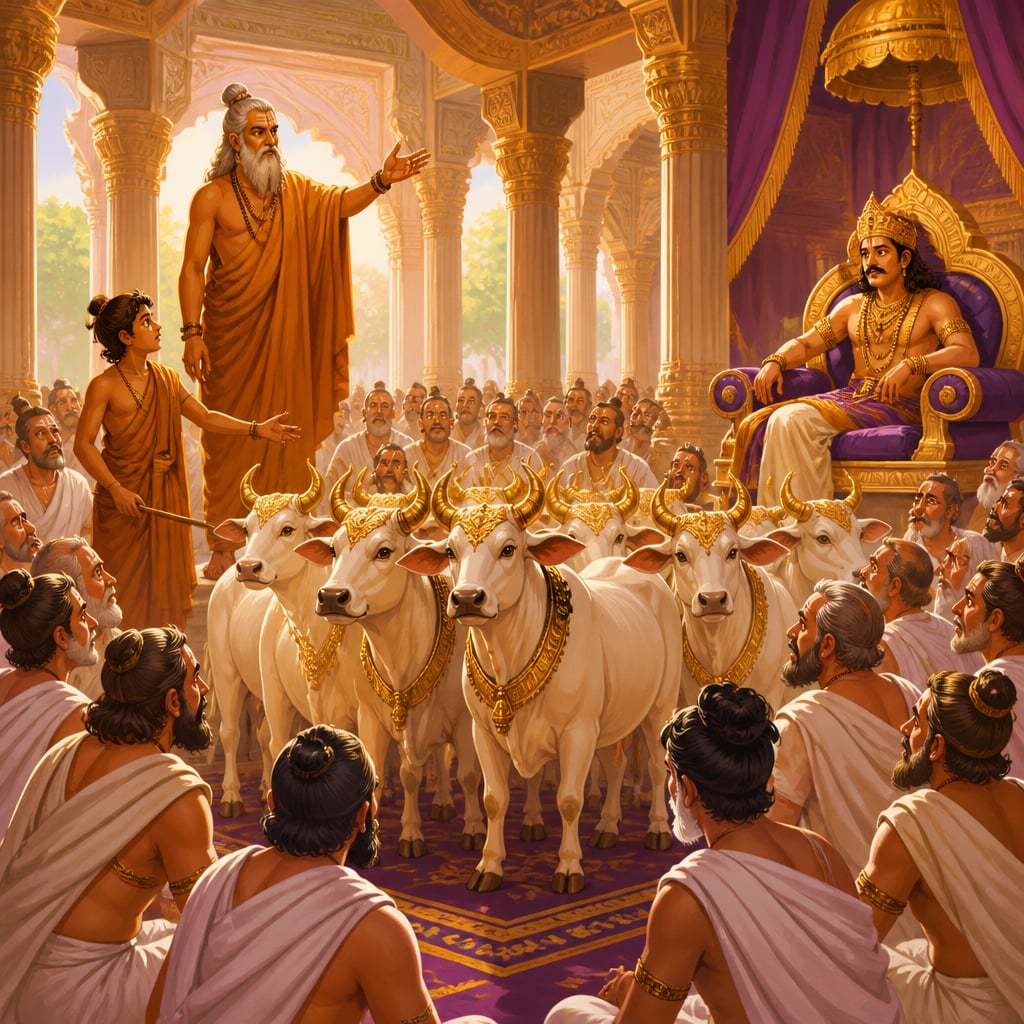
Yajnavalkya claiming the gold-tipped cows

The hall erupted. Eight brahmanas stood up in succession to challenge him. Each had earned standing in his own kingdom. Each had a question to put to the man who had walked off with the cows. Yajnavalkya answered each in turn. He answered the questions of Aśvala the priest, of Ārtabhāga of the Jaratkārava lineage, of Bhujyu the grandson of Lahya, of Uṣasta and Kahola in their respective challenges, and of Gargi Vacaknavi twice. The hall watched the answers land.
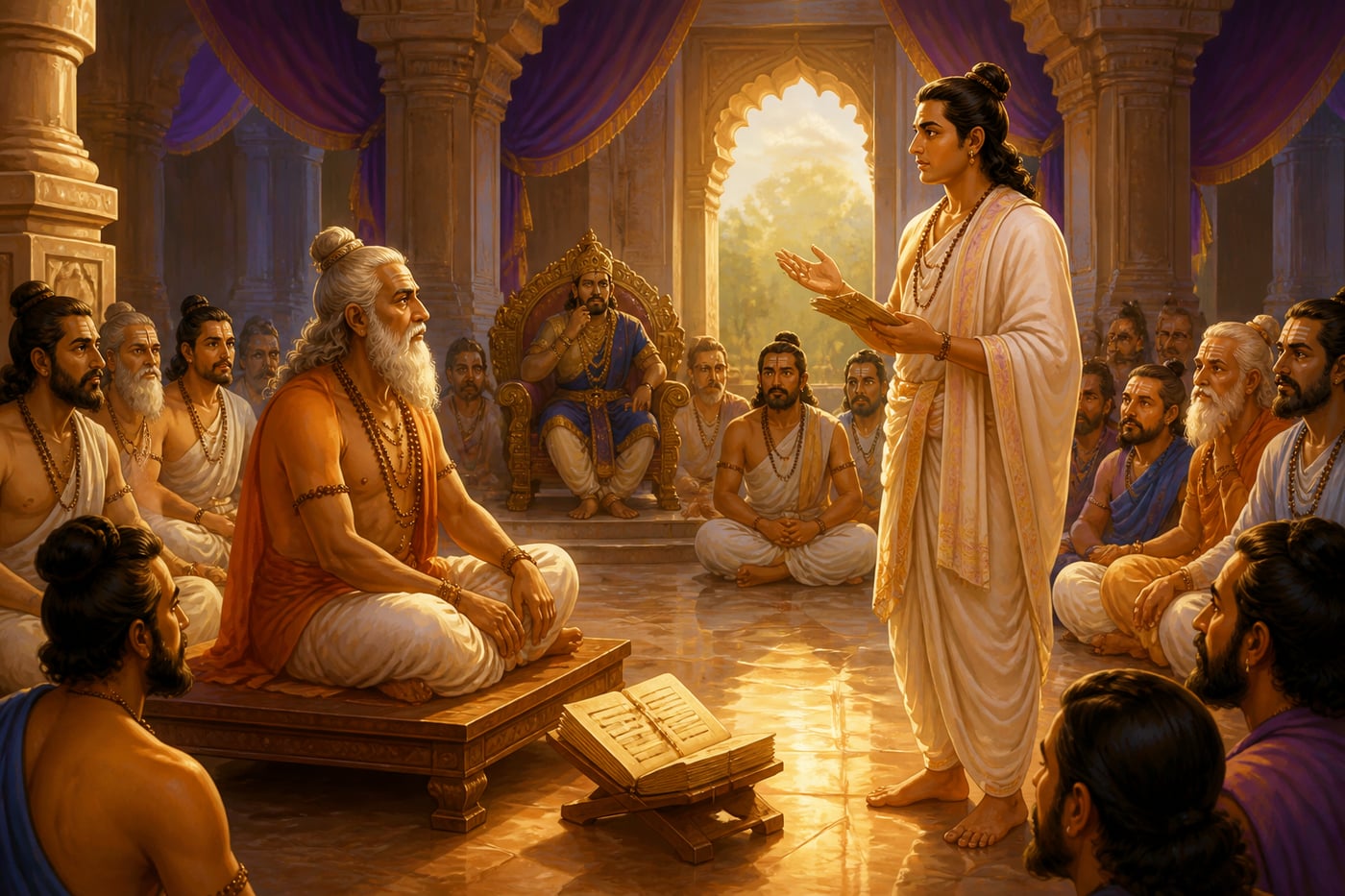
Yajnavalkya facing the eighth challenger Vidagdha Shakalya

The eighth challenger was Vidagdha Shakalya. Shakalya did not bring philosophy. He brought authority. He invoked the Vedic count of gods, the lineage of teachers, the standing of the assembled brahmanas. He cited rather than reasoned. Yajnavalkya answered each citation by demanding the reasoning under it.

The Brihadaranyaka Upanishad records what happened next.

Yajnavalkya warned Shakalya, calmly, that if he did not know that on which the cosmos and all the gods rest, his head would burst. Shakalya did not know. He had only the citations. The traditional account says that at the next exchange, his head fell apart on the floor of King Janaka's hall.

This is the archetype the lesson is about. The citer who cannot defend the citation. Its name in this course is The Authority Quoter, and it is the second archetype in the Chhadma Vadin (Pretenders) cluster of the Chatur-Vadin Framework.

Difficulty Level: 🟧 Subtle

This is a Level 2 (Subtle) archetype. It is harder to spot than the loud archetypes of the Manipulators cluster because the Authority Quoter sounds careful, scholarly, and well-prepared. Citations are real. Institutional names are real. The speaker has done some homework. The deception is one layer below: the citation has been put forward as the argument, with no underlying reasoning the speaker can defend if pressed.

The Authority Quoter sits in the Pretenders cluster because the cluster's common engine is appearance over substance. Each archetype in the cluster wears a mask of objectivity, scholarship, or fairness, while the substantive ground is missing.

Archetype Level The mask
Fake Neutral 🟥 L3 Frames hostile questions as objective inquiry
Authority Quoter 🟧 L2 Cites institutional weight in place of reasoning
Selective Historian 🟥 L3 Picks one historical event, ignores ten others
Concern Troll 🟥 L3 Disguises hostility as worry
Pseudo-Intellectual 🟥 L3 Uses jargon to look smart, says little
Sealioner 🟥 L3 Endless polite questions to exhaust the speaker

The Authority Quoter is the only Level 2 in the cluster. The other five are Level 3, harder to spot, requiring more training. The Authority Quoter is recognizable in seconds once the listener knows what to listen for. The signal: the speaker names an institution and stops.

The Anatomy Of The Citation Drop

The Authority Quoter's move has a stable shape. The speaker introduces a claim. They attach a citation. They do not develop the citation into reasoning. They proceed as if the citation were itself the proof. The shape comes in four common forms.

  1. The institution drop. "A Harvard study found..." "According to a Stanford paper..." "The Lancet published..." The institutional name does the work. The methodology, sample size, replication record, and underlying reasoning are not discussed.
  2. The credential drop. "As a PhD in this field..." "As a senior scientist at..." "Speaking as a former diplomat..." The credential is the argument. The reasoning the credential is supposed to back is left as an exercise to the listener.
  3. The consensus drop. "Ninety-seven percent of experts agree..." "Every reputable scientist knows..." "All historians of the period accept..." The count is the argument. The actual claim being counted is left vague, and the listener is invited to assume the count is precise.
  4. The hierarchy drop. "Read Sheldon Pollock and then we will talk." "Until you have a Sanskrit chair, you should not speak on this." "Senior scholars have settled this question." The credential gradient becomes a barrier to entry rather than a defence of any specific claim.

All four forms produce the same effect: the listener defers to the institution rather than to the reasoning. The substantive ground is never tested.

The Bhagavad Gita, in the chapter on the path of knowledge, names the dharmic relationship between authority and inquiry.

तद्विद्धि प्रणिपातेन परिप्रश्नेन सेवया। उपदेक्ष्यन्ति ते ज्ञानं ज्ञानिनस्तत्त्वदर्शिनः॥

tad viddhi praṇipātena paripraśnena sevayā upadekṣyanti te jñānaṃ jñāninas tattva-darśinaḥ

Know that by approaching the wise with humility, by questioning them, by serving them. The wise who have seen the truth will teach you knowledge.

Bhagavad Gita 4.34

The verse names three moves. Pranipata (humble approach), pariprashna (questioning), seva (service). Note the middle one. Questioning is not a violation of the relationship to authority. It IS the relationship to authority. Authority that cannot withstand pariprashna is not authority in the dharmic sense. It is performance. The Authority Quoter relies on the audience treating pariprashna as disrespect. The Vaadin treats it as duty.

Legitimate Versus Illegitimate Use Of Authority

The Authority Quoter critique cuts both ways. Authority is not evidence. Authority is also not nothing. The same tradition that produced the Yajnavalkya-Shakalya scene also produced the entire Nyaya Sutra apparatus on shabda-pramana, the conditions under which testimony counts as a means of knowledge.

The Nyaya tradition lists four conditions a citation must meet to be valid pramana.

When all four hold, citation IS evidence in the technical sense. When any of the four fails, citation is decoration.

This means the Vaadin's counter is not anti-authority. It is pro-pramana. The question is not 'are you citing an institution?' The question is 'does this citation meet the four conditions, and can you walk me through why?' An Authority Quoter who can walk the listener through the methodology, the apta status of the source, and the absence of contradiction with other evidence is no longer an Authority Quoter. They are an honest citer of authority. The archetype lives in the gap between the citation and the reasoning.

The Counter, In One Sentence

The Vaadin's counter to the Authority Quoter is one sentence delivered the moment the citation lands without reasoning.

"Authority is not evidence. What is the actual reasoning?"

The sentence does not deny the institution. It asks the institution to back itself. The Authority Quoter has two responses available. They can produce the underlying reasoning, in which case the conversation is now on the substantive ground that the citation was supposed to defend. Or they can repeat the citation, possibly louder, in which case the audience now sees the gap. Either response is acceptable. The Vaadin does not need the speaker to choose the first. The full counter strategies are spelled out in the moral lessons of this lesson.

Modern Echoes

In 2015, the psychologist Brian Nosek and the Open Science Collaboration published the results of a large attempt to replicate one hundred peer-reviewed psychology studies from top journals. Only thirty-six of the hundred replicated at the original effect size. Casualties of subsequent replication efforts have included the 1971 Stanford Prison Experiment, the 1972 marshmallow test, the doctrine of ego depletion, and the 2010 power-posing finding (the original first author of which has since publicly disowned it). Each had been cited for decades on the institutional weight of the original publication. The replication crisis was the empirical demonstration that institutional citation, by itself, is not pramana.

A retracted prestige citation in a modern laboratory

In May 2020, The Lancet published a study using Surgisphere data claiming that hydroxychloroquine increased COVID-19 mortality. The World Health Organization halted its global hydroxychloroquine trials within days. Eleven days later, on June 4, the paper was retracted when independent investigators discovered Surgisphere's underlying data could not be verified and its claimed hospital network largely did not exist. The Lancet's institutional weight had carried the paper into global health policy before anyone had read the methodology. The retraction is one of the cleanest recent demonstrations that authority is not evidence.

The physicist Richard Feynman, in his 1974 Caltech commencement address, called the citation-without-reasoning pattern "cargo cult science". He named the structure: the form of science is performed (the labs, the journals, the credentials), but the substance (the ability to predict and replicate) is missing. Feynman insisted that a real test of any claim was whether the speaker could explain why their reasoning could be wrong. The Authority Quoter, by definition, cannot answer that question. The citation IS the reasoning, and the reasoning has no edges.

Back in King Janaka's hall, the cows had already left with Samasravas. The brahmanas who had stood up to challenge Yajnavalkya had asked the harder questions, and seven of them had received reasoned answers. Only Shakalya had brought citations without reasoning. The traditional account preserves the moment when the gap between his citations and his understanding ran out. The cows did not return. The hall remembered, for the next twenty-five centuries, what had happened to the citer who could not defend the citation.

Case studies

Yajnavalkya Defeats Shakalya in Janaka's Court

In the Brihadaranyaka Upanishad 3.9, King Janaka of Videha hosted a great assembly. A thousand cows with gold-tipped horns stood as the prize for the most learned brahmana. Yajnavalkya rose, took the cows without waiting for a question, and was immediately challenged by eight scholars in succession. The eighth was Vidagdha Shakalya. Shakalya brought citations rather than arguments: he invoked the Vedic count of gods, the lineage of teachers, the standing of the assembled brahmanas. Yajnavalkya answered each citation by demanding the reasoning under it. He reduced Shakalya's count of 3306 gods to 33, then 6, then 3, then 2, then 1.5, then 1, justifying each reduction by argument from the source texts rather than by competing citation. When Shakalya finally pressed a question whose answer required reasoning he did not have, Yajnavalkya warned him calmly that if he did not know the answer his head would burst. He did not. The traditional account says it did.

The scene is the founding moment in the Indian tradition's confrontation between citation-only debate and reasoning-from-citation debate. Yajnavalkya does not reject the Vedic citations Shakalya brings; he accepts them and demands their reasoning. This is shabda-pramana applied honestly, not as institutional deference but as a working epistemic test. The Nyaya Sutras compiled centuries later would formally codify the four conditions Yajnavalkya was already operating under: the apta status of the source, the absence of contradiction with other valid pramanas, the unambiguous nature of the language used, and the inferability of meaning from context. Shakalya's authority did not survive the four-condition test, even before the test had its formal name.

Yajnavalkya retained the cows and the title. The Brihadaranyaka 3.9 dialogue became one of the most-studied passages in the entire Vedantic tradition. The lesson Janaka's hall took home, that authority must defend itself with reasoning, was preserved as the operating norm of every subsequent Indian shastric debate for over two millennia.

Citation alone is not pramana. The Vaadin's discipline is to accept the citation and ask for the reasoning under it. When the reasoning is there, citation becomes evidence. When it is not, the gap is visible to the entire room.

Brihadaranyaka 3.9 has Yajnavalkya answer eight challengers in succession. The Shakalya exchange alone runs to 28 verses. The dialogue is the longest sustained scene of philosophical debate in the principal Upanishads.

The Charvaka Rejection of Shabda-Pramana

From at least the sixth century BCE, the Charvaka or Lokayata school of Indian materialism systematically refused to accept shabda-pramana, the testimony of authority, as a valid means of knowledge. They accepted only pratyaksha (direct sense perception) and a limited form of anumana (inference grounded in perception). The Charvakas were intellectually marginal in the broader tradition, but their critique was institutionally important. Every other Indian school, from Nyaya to Vedanta to Buddhism to Jainism, had to defend WHY their citations of the Vedas, the Buddha, the Mahavira, or the Acharyas counted as evidence rather than mere assertion. The Charvakas forced the entire tradition to articulate the conditions under which shabda is pramana. The four-condition test in Nyaya Sutra 1.1.7 and its bhashyas is in significant part a response to the Charvaka challenge.

The Charvaka school is the institutional Authority Quoter critique made into a philosophy. Its rejection of shabda-pramana was extreme, but its forcing function on the rest of the tradition was healthy. By making every citation defend itself against the question 'why does this count?', the Charvakas raised the floor of Indian shastric debate. The modern Vaadin is downstream of this tradition: every demand to back a citation with reasoning operates in the lineage the Charvakas opened. The Charvakas were not the Vaadin model, but they made the Vaadin model possible.

The Charvaka school did not survive as a living tradition. Its texts were preserved largely through the refutations its opponents wrote against it. But the four-condition test for shabda-pramana, the Vatsyayana commentary on apta status, and the entire Indian discipline of demanding reasoning under citation are downstream of the Charvaka challenge. The opponent who forces you to articulate your foundations is, in the long run, your most useful interlocutor.

An institution that has never been forced to defend its citations against a serious skeptical challenge has weak foundations. The Vaadin who rejects nothing and questions everything is the Charvaka in friendly form. The questioning makes the tradition stronger.

Adi Shankara vs Mandana Mishra at Mahishmati

In the eighth century, the young sannyasi Adi Shankara travelled to Mahishmati to debate the senior Mimamsa scholar Mandana Mishra. Mandana was the leading exponent of karma-kanda, the Vedic ritual system, and his authority on its interpretation was institutionally settled. The seventeen-day debate was judged by Mandana's own wife, Ubhaya Bharati. Mandana opened by citing the karma-kanda's authoritative status as the question's answer: ritual injunction is the operative form of dharma. Shankara refused to accept the institutional standing as the argument. He demanded that Mandana defend the underlying jnana that any ritual ultimately serves. Over seventeen days, the debate moved from competing citations to competing reasoning. Mandana's authority was real. His reasoning, when finally laid out, did not survive Shankara's pressure on its foundational assumption. The pivot of the debate was when Mandana accepted that authority must justify itself by reasoning, not the reverse.

Shankara's method against Mandana mirrors Yajnavalkya's against Shakalya across thirteen centuries. The senior speaker has institutional standing. The challenger refuses to accept standing as the argument and forces the substantive ground to be tested. In both scenes, the Vaadin's posture is not anti-authority; it is pro-paripraśna. Shankara does not reject the karma-kanda. He demands that Mandana articulate the jnana the karma-kanda ultimately serves. When Mandana cannot defend the karma-kanda as itself the answer, the debate has been won not by counter-citation but by the demand for reasoning.

Mandana accepted defeat per the agreed terms and became Shankara's disciple, taking the name Sureshvaracharya. He went on to author the Naishkarmya-Siddhi, a major Advaita Vedanta text. The institutional authority that had been the strongest barrier to advaita's spread became, after the debate, one of advaita's most rigorous transmitters. The conversion was made possible by Shankara's willingness to demand reasoning under citation.

When you demand reasoning from an institution rather than rejecting the institution, you offer the institution a path forward rather than a wall. The honest authority joins you. The dishonest authority is exposed. Both outcomes serve the Vaadin's purpose.

'A Harvard Study Says...' as Standalone Evidence

A composite scenario any reader of contemporary Indian or global media will recognize. A news story, social media post, WhatsApp forward, or LinkedIn essay leads with a phrase like 'A Harvard study found...' or 'Stanford research shows...' or 'A recent Lancet paper documented...' The institutional authority of the cited source is presented as the entire argument. The methodology, sample size, replication record, funding source, and underlying reasoning are not discussed. The reader's natural instinct to ask 'how did they show that?' is suppressed by the institutional weight. The same pattern repeats across health coverage, economic commentary, climate reporting, sociology, and technology journalism. The citation is performed; the substantive backing is rarely made available.

The Authority Quoter at industrial scale. The Nyaya four-condition test would dispatch most of these citations within a paragraph: the apta status of a single Harvard or Stanford researcher in a complex domain is far from established merely by their institutional affiliation, the proposition often contradicts other valid evidence the writer has not consulted, the language is frequently ambiguous (what does the study actually claim, and at what effect size?), and the contextual inference is left undone. The lesson's counter sentence, 'authority is not evidence, what is the actual reasoning?', would, applied consistently by readers, raise the floor of media coverage measurably.

The pattern persists because the audience permits it. Every reader who shares the post without checking the methodology rewards the citation-only approach. Over years, the audience trains itself to accept institutional citation as proof. The professional incentive for careful methodology coverage drops. The professional incentive for headline-friendly citation rises. The replication crisis is one downstream cost. Public trust in expert authority, declining across surveys for two decades, is another.

Every citation you accept without checking the four conditions trains the next citation to be lazier. The Vaadin's most productive single habit is to ask, before sharing or accepting any institutional citation, what the actual reasoning is.

The Lancet COVID Origins Letter, February 2020

On 19 February 2020, The Lancet published a letter signed by 27 prominent scientists, organised by Peter Daszak of EcoHealth Alliance, declaring that the signatories 'stand together to strongly condemn conspiracy theories suggesting that COVID-19 does not have a natural origin.' The letter was structured as a collective authority statement rather than an evidentiary argument. The signatories' institutional weight, combined with The Lancet's reputation, effectively foreclosed the lab-leak hypothesis in mainstream scientific and policy discourse. Mainstream media outlets treated the question as settled. Researchers who continued to investigate the lab-leak possibility reported professional consequences. By 2022 and 2023, the picture had shifted substantially. The US Department of Energy and the FBI publicly stated they assessed a lab-leak origin as more likely than a natural one. Daszak himself disclosed previously unstated conflicts of interest related to EcoHealth Alliance's funding of coronavirus research at the Wuhan Institute of Virology. Congressional inquiries reopened the question the 2020 letter had foreclosed.

The letter is a textbook case of authority deployed without the corresponding evidentiary backing. The Nyaya four conditions fail across the board: the apta status of the signatories was compromised by undisclosed conflicts of interest, the proposition contradicted contemporaneous evidence the signatories had access to, the language was deliberately broad enough to suppress legitimate inquiry rather than to make a specific scientific claim, and the contextual inference was foreclosed by the publication's tone of finality. A Vaadin in February 2020 with the four-condition test in hand would have flagged the letter as authority-without-pramana within a single reading.

The lab-leak inquiry was effectively suppressed in mainstream scientific and policy discourse for nearly two years. By the time the question was reopened, key witnesses had died, key data had been destroyed, and key Chinese laboratories had withdrawn cooperation. The cost of authority-deployed-as-suppression was measured in years of lost evidentiary access on a question of global pandemic policy. Public trust in scientific authority has not recovered to pre-2020 levels in major surveys.

When prominent signatories collectively declare a question closed without producing the evidentiary work that would close it, the signature list itself is the warning sign. The Vaadin's first move is not to accept or reject the conclusion. It is to ask for the reasoning that the signatures were meant to substitute for.

Reflection

More in Chhadma Vadin: The Pretenders

All lessons in Chhadma Vadin: The Pretenders · Vaada Shastra: The Dharmic Art of Debate course