If Everything Is One, Why Does It Look Like Many?

Yajnavalkya's salt-in-water teaching and the problem of the One and the Many.

Brihadaranyaka Upanishad vs Parmenides and Plotinus. Unity does not cancel diversity; it pervades it, the way salt pervades the water into which it dissolves.

The Last Conversation

On the morning Yajnavalkya decided to leave home for the forest, the courtyard of the family compound smelled of wood-smoke and wet earth. Katyayani, his younger wife, was tending a cooking fire by the back wall. Maitreyi, his elder wife, sat in the shade of the veranda, and she had not slept well. The sage was past sixty, white-bearded, one of the most celebrated teachers of the late Vedic age, and he had decided that the household life was finished for him. Before he walked out of the world, he wanted to divide his wealth between the two women and see them provided for.

He called them both into the front room of the house. Katyayani said nothing the text records. Maitreyi asked a question that turned the entire conversation inside out, and that would go on, for the next two and a half thousand years, to sit at the bottom of the oldest question in philosophy: if everything is secretly one, why does it so stubbornly look like many?

'If the whole earth filled with wealth were mine,' she says, 'would I become immortal through it?' Yajnavalkya is honest. 'No. Your life would be the life of the wealthy. But there is no hope of immortality through wealth.' Maitreyi replies without hesitation: 'What should I do with that which will not make me immortal? Tell me, sir, what you know.'
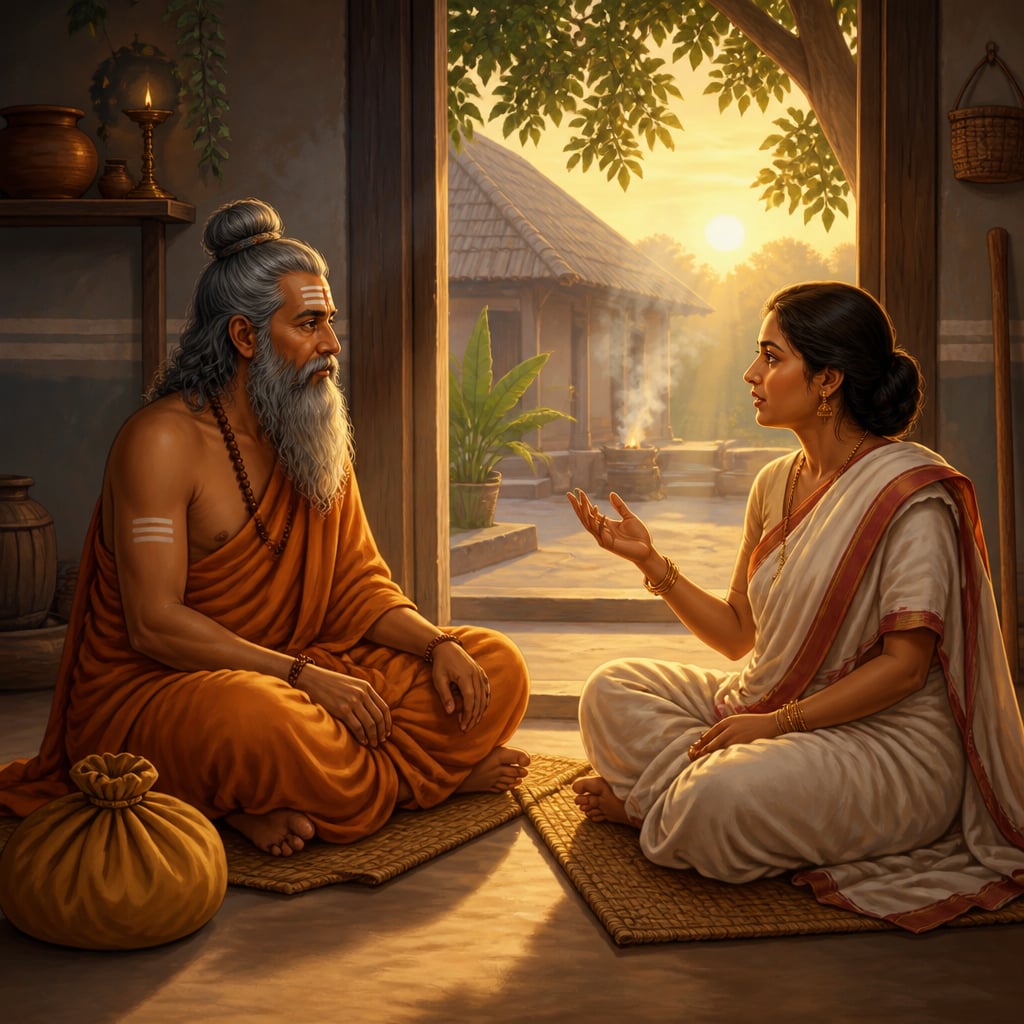
Yajnavalkya teaching Maitreyi in the household courtyard

This is one of the most significant exchanges in Indian philosophy and also one of the most underappreciated moments in the history of women in philosophy. Maitreyi refuses the inheritance because she understands, faster than the sage himself, that the only thing worth asking for is the teaching. Yajnavalkya sits her down and teaches.

He begins with a strange observation. A husband is dear not for the sake of the husband, he says, but for the sake of the Self. A wife is dear not for the sake of the wife but for the sake of the Self. Sons, wealth, animals, worlds, gods, beings: all of them are dear not for their own sake but for the sake of the Self. Every love, every attachment, every hunger is a refracted love of the Self that shines through them. Therefore, says Yajnavalkya, the Self alone should be seen, heard, reflected upon, and meditated upon. When the Self is known, all of this is known.

Then comes the claim that must have sounded impossible, because Maitreyi reacts with visible alarm. Yajnavalkya says that this great being, infinite and boundless, is pure consciousness, and that it arises out of the elements and dissolves back into them, and that there is no consciousness after death. Maitreyi protests. 'Sir, you have thrown me into confusion. I do not understand this.'

And here Yajnavalkya gives the image that will carry the Upanishads' answer to the question of the One and the Many for two and a half thousand years. He asks her to imagine a lump of rock salt thrown into water.

The lump of salt

A lump of rock salt dissolving in a bowl of water

Drop a solid block of saindhava salt into a bowl of fresh water. For a moment it sits at the bottom, distinct, its outline visible. Then it begins to dissolve. Within minutes the lump is gone. You cannot pick it out again. It is not hiding at the bottom of the bowl waiting to be retrieved. There is no part of the water where the salt is and another part where it is not. You reach into the water with a finger and taste it, and it is salty. You taste any other part, and it is salty there too. The salt has become the water, not by being scattered into chunks but by pervading it entirely.

This, Yajnavalkya tells Maitreyi, is what the Self is like in relation to the world. The Self does not sit in one place, waiting to be found. It does not exist as a hidden object inside things. It pervades everything the way the dissolved salt pervades the water. Wherever you reach in, the taste is the same. There is no corner of experience that is empty of it and no experience that is purely it and nothing else. The salt and the water are indistinguishable at every point in the bowl, and yet the bowl is full of saltwater, not just salt.

Then Yajnavalkya clarifies what he meant by his earlier shocking statement about consciousness ending at death. He was describing the cessation of the ordinary subject object relation, the particular experience of a particular individual addressing a particular world. When the individual dissolves back into the universal Self, there is no longer an 'I' who knows a 'that,' because there is no longer an 'I' separate from what is known. The saltiness has not disappeared. It has become the whole bowl. Where there was duality, there one sees another, hears another, thinks of another. Where everything has become the Self, Yajnavalkya asks Maitreyi, by what and by whom would one see, hear, smell, think, or know?

Maitreyi understands. The text does not describe her expression. It does not need to. The conversation ends with the most important teaching about the nature of unity that Indian philosophy has produced, and it ends in a household about to be broken up because the husband is leaving for the forest.

Parmenides draws a hard line

Some distance to the west, in a Greek colony in southern Italy called Elea, a philosopher named Parmenides was composing a poem in the early fifth century BCE. The poem, known as On Nature, survives only in fragments, but the fragments are enough. Parmenides narrated a journey in which a goddess revealed to him the two ways of thinking about reality. The Way of Truth says that what is, is, and what is not, is not. Being is ungenerated, indestructible, whole, continuous, immovable, and complete. Plurality, change, motion, and distinction all belong to the Way of Opinion, the path ordinary mortals walk without knowing they are wrong.

This is the strongest monism in Western philosophy. Parmenides concluded, with the icy logic of a geometer, that if Being is truly one, then the multiplicity we see cannot be real at all. His student Zeno would defend this conclusion with the famous paradoxes of motion: if you think multiplicity is real, show me how Achilles overtakes the tortoise, or how an arrow in flight is ever anywhere. The paradoxes were not jokes. They were meant to force the reader into Parmenides' position by showing that plurality leads to contradiction.

The appeal of Parmenides is his intellectual honesty. The cost is severe. If the Way of Opinion is simply false, then the entire apparent world, including the body reading this paragraph, is a kind of mass hallucination. Plato would later wrestle with this problem and try to save the appearances through the theory of forms. Aristotle would try to save them through a theory of substance. No one in the Greek tradition quite solved the puzzle Parmenides set.

Plotinus and the flight of the alone to the Alone

Plotinus in ecstatic union with the One

Nearly eight centuries later, in the third century CE, a philosopher named Plotinus picked the problem up again. Plotinus lived in Alexandria and Rome, studied under a teacher named Ammonius Saccas, and composed a body of work his student Porphyry would edit into the Enneads. His answer to the problem of the One and the Many was more elegant than Parmenides' and, in some ways, closer to the Upanishads.

Plotinus argued that reality has a hierarchy. At the top is The One, utterly simple, beyond even being. The One does not strictly exist, because existence would make it one thing among others. From The One emanates Nous, the universal Intellect, which is the first intelligible multiplicity. From Nous emanates Soul, which animates the world. From Soul arises the visible cosmos, the world of bodies and particulars. Each level is less unified and more differentiated than the level above it. The whole system flows out of The One the way light flows from the sun, never diminishing the source.

Plotinus also taught that the individual soul can return. Porphyry tells us that Plotinus himself achieved a direct, ecstatic union with The One four times during the years they knew each other. The final line of the Enneads describes this return as 'the flight of the alone to the Alone.' It is one of the most beautiful phrases in Western philosophy, and it is almost indistinguishable from what Yajnavalkya was teaching Maitreyi in the Brihadaranyaka.

Plotinus saved the appearances where Parmenides did not. Multiplicity is not an illusion. It is a real emanation from The One. But there is a cost here as well. In Plotinus' hierarchy, the further you are from The One, the less real you are. The material world is not fully real, only partially. The soul is caught between the world and the One, and the spiritual life is a climb back up. Unity and multiplicity are arranged vertically, with unity on top.

What the salt does that Parmenides and Plotinus could not

Yajnavalkya's teaching gets something past both of them, and the image of the salt is where the trick lives.

Parmenides says the One is real and the Many is illusion. He pays for his consistency by throwing out the world. The Upanishad refuses this move. The water in the bowl is not illusory. You can touch it, drink it, fill another bowl from it. What the Upanishad denies is not the reality of the water but the idea that the water and the salt are two separate things after the salt dissolves. Plurality and unity are not alternatives. They are two descriptions of the same saltwater.

Plotinus says the Many is a hierarchy of emanations descending from the One, and the soul climbs back toward the source. He pays for his elegance by introducing a ranking of reality, in which the world becomes less real the further you descend. The Upanishad refuses this move too. There is no top and bottom in the bowl. Every drop is as salty as every other drop. The sage who tastes the Self in their own body and the sage who tastes it in a distant star are tasting the same thing at the same concentration. Unity is not the high end of a scale. It is the ground that is fully present in every appearance.

And here is the final move, the one most easily missed. The Upanishad is not asking you to accept any of this by argument. It is handing you an empirical image. You can actually dissolve salt in water. You can actually taste it at different points. The teaching is not 'take my word for it.' The teaching is 'here is the experiment, now perform it.' Yajnavalkya is not a logician trying to box Maitreyi into a conclusion. He is a sage pointing to an operation she can carry out herself. The verification is experiential, not syllogistic.

This is why later Vedanta calls the central term vijnana-ghana, which is often translated as 'pure consciousness' or more literally as 'a mass of knowing.' The claim is that what pervades the world of experience is not an abstract Being, as with Parmenides, and not a transcendent One beyond all categories, as with Plotinus. It is awareness itself, and awareness is the one thing you cannot step outside to verify from a distance. You have to look through it, as the water looks through its own saltiness.

Why it matters today

We live in a moment when the problem of the One and the Many has come back through an unexpected door. Physicists talk about quantum entanglement, the phenomenon in which particles separated by vast distances remain correlated as if they were parts of a single system. Cognitive scientists talk about the binding problem, the mystery of how the brain produces a unified experience out of millions of firing neurons. Environmental thinkers talk about ecosystems and the interdependence of species. Each of these conversations is a modern form of the same question. If the deepest level of reality is unified, why does the surface level appear so thoroughly divided?

The Brihadaranyaka's answer is older than any of these conversations and, at least in structural terms, still the most elegant. Unity does not compete with diversity. Unity is what allows diversity to hold together at all. The salt did not disappear when it dissolved. It became the whole bowl. When a physicist finds that two entangled particles behave as a single system across a great distance, the Upanishad would say: of course. That is what being dissolved in the same water looks like. When you sit on a quiet morning and notice that the boundary between you and what you are noticing is less crisp than it seemed, the Upanishad would say: of course. That is what it feels like to taste the saltiness from inside the bowl.

Key figures

Yajnavalkya

Late Vedic Period (c. 800 to 700 BCE)

Maitreyi

Late Vedic Period (c. 800 to 700 BCE)

Parmenides of Elea

Pre-Socratic Greek (c. 515 to 450 BCE)

Plotinus

Late Antiquity (204 to 270 CE)

Case studies

Plotinus and the Four Ecstatic Unions With The One

Porphyry, in his Life of Plotinus composed shortly after his teacher's death in 270 CE, reports with precision that during the years he lived and studied with Plotinus in Rome, Plotinus achieved a direct, unmediated union with The One on four distinct occasions. Porphyry himself claims to have achieved this union only once, and only at a much more advanced age. The passage is striking because Porphyry is a careful editor and philologist, not a hagiographer, and he offers the detail almost as an aside while describing his teacher's character and habits.

The Upanishadic tradition would recognize what Plotinus was reporting without much difficulty. What Plotinus called the flight of the alone to the Alone is, in Yajnavalkya's language, the moment when every apparent duality has dissolved and the remaining consciousness has nothing to contrast itself against. The Brihadaranyaka describes this as the state in which 'by what and of whom would one see, smell, or taste?' because the seer and the seen have both become the Self. Plotinus' Greek vocabulary is different, but the structure is the same. Where the Upanishads hand out an image (salt in water) and a method (the direct inquiry into the Self), Plotinus offers a philosophical architecture (One, Nous, Soul) and a contemplative practice drawn from Platonic and Pythagorean sources. Both arrive at the same recognition. Plotinus is, in effect, a Greek Yajnavalkya who had to invent the vocabulary from scratch because no Greek tradition before him had put this experience at the center of the philosophical project.

The Enneads became the foundation of Neoplatonism, which shaped Christian mysticism through Augustine and Pseudo-Dionysius, Islamic philosophy through Al-Farabi and Ibn Sina, and Jewish mysticism through Kabbalistic sources. Nine hundred years later, Meister Eckhart in the Rhineland and other Christian contemplatives would describe experiences in terms nearly identical to Plotinus, which are in turn nearly identical to Yajnavalkya. The salt image never traveled west, but the recognition did, through at least three independent lineages.

The same reality gets tasted through different civilizations and gets described in the vocabulary each civilization has to hand. The Upanishad says salt in water. Plotinus says the flight of the alone to the Alone. Eckhart says the birth of God in the soul. The recognition that unity is verifiable at first hand, not just argued for, is the common thread. Parmenides reached for the conclusion by logic alone and could not save the world he was sitting in. Plotinus, like Yajnavalkya, got there by a practice, and the world survived the journey.

Porphyry records that Plotinus achieved ecstatic union with The One on four occasions over the approximately six years the two philosophers lived and studied together in Rome (circa 263 to 268 CE).

Shankaracharya's Commentary on the Salt Verse

Sometime in the late eighth century CE, a young Brahmin from the village of Kaladi in Kerala took up the task of writing commentaries on the principal Upanishads, the Bhagavad Gita, and the Brahma Sutras. His name was Adi Shankaracharya, and he would die before his thirty-third birthday. By the time he died, he had produced the philosophical foundation of Advaita Vedanta, consolidated four monastic centers across the Indian subcontinent, and made the salt-in-water verse one of the most commented-upon passages in Indian intellectual history.

Shankara's commentary on Brihadaranyaka 4.5.13 is a small masterpiece of philosophical analysis. He reads Yajnavalkya's image not as poetic suggestion but as an exact technical statement about the nature of the Self. The salt has no inside and no outside, he notes, not because these distinctions have been erased but because they were never applicable to begin with. Likewise the Self has no inner and outer not because it has been unified but because division into inner and outer belongs to objects in space, and the Self is not an object in space. Shankara uses this reading to defend Advaita against two rival positions, one that would make the Self a hidden substance inside the body (which misreads the image by treating the salt as a separate ingredient still lurking in the water) and one that would make the Self a mere collection of mental states (which misreads the image by ignoring that the water genuinely tastes salty, uniformly, everywhere). His commentary shows how the image blocks both errors at once. Non-duality is not 'a substance is hiding inside' and not 'nothing is really there.' It is 'the taste is everywhere and there is nothing underneath to locate.'

Shankara's commentaries became the philosophical backbone of Advaita Vedanta and have been studied without interruption in the Sringeri, Dwarka, Puri, and Jyotir mathas he founded, as well as in hundreds of affiliated teaching lineages across India and abroad. His reading of the salt verse is the standard reference in nearly every subsequent Vedantic textbook. When later philosophers such as Ramanuja and Madhva challenged Advaita with alternative interpretations of the Upanishads, the salt verse was one of the battlegrounds. None of them could replace Shankara's reading with an equally compact and defensible alternative.

A careful reader with the right training can unfold a whole philosophical school out of a single image, provided the image is good enough. Shankara did not invent the Upanishadic content. He clarified it, defended it against misreadings, and showed that a small analogy in a domestic conversation could sustain an entire metaphysical tradition for more than a thousand years.

Shankaracharya composed twelve surviving Upanishadic commentaries, the Brahma Sutra Bhashya, and the Bhagavad Gita Bhashya in a lifetime of roughly 32 years (c. 788 to 820 CE), all while traveling the length of the Indian subcontinent to establish the four principal Advaita mathas.

Quantum Entanglement and the 2022 Nobel Prize

In 1935, Einstein, Podolsky, and Rosen published a paper arguing that quantum mechanics must be incomplete, because it predicted that two particles, once they had interacted, would remain correlated no matter how far apart they were subsequently moved. Einstein called this 'spooky action at a distance' and believed it was impossible. In 1964, the Irish physicist John Bell proved a theorem showing that the question could be tested in the laboratory. Over the following five decades, Alain Aspect in France, John Clauser in the United States, and Anton Zeilinger in Austria built increasingly refined experiments that tested Bell's inequality and repeatedly confirmed, to higher and higher confidence, that the correlations are real, instantaneous, and cannot be explained by any local hidden variable. In 2022, the Nobel Prize in Physics was awarded to Aspect, Clauser, and Zeilinger for this work.

The Brihadaranyaka Upanishad did not predict quantum mechanics. It was not doing physics. But the structural analogy between Yajnavalkya's salt-in-water image and the Bell-theorem experimental results is worth stating precisely. Yajnavalkya's claim is that the Self has no inside and no outside, and that what appears to be two locations sharing a common consciousness is not in fact two separate locations with a communication problem between them. It is one underlying condition appearing at two places. The Bell experiments demonstrate that for certain pairs of quantum systems, no local explanation can account for the observed correlations. The physicist must either abandon the assumption that each particle has independent properties prior to measurement or abandon the assumption that no information passes faster than light. Neither option is comfortable. What the Upanishad would say, in its own vocabulary, is that the discomfort comes from trying to hold on to the view that the two particles are fundamentally separate and then asking how they communicate. The salt has no inside and no outside. Once you accept that what you called 'two particles' was in fact one underlying entanglement appearing at two points, the communication problem dissolves. No one needs to say that the Upanishads anticipated physics to notice that Yajnavalkya's image gets at the same structural point: apparent separation at the level of name and form does not imply separation at the level of what underlies name and form.

Quantum entanglement has moved from a philosophical embarrassment for early quantum theory to a cornerstone of modern physics and an engineering resource. Quantum cryptography, quantum computing, and quantum teleportation all rely on entangled states. Governments and private companies are investing billions of dollars in building quantum networks that exploit non-local correlations deliberately. The Schrodinger-Heisenberg generation of physicists, many of whom were reading the Upanishads while they worked, would recognize the progression: an intuition that the world is more unified than it looks, followed by mathematical formalization, followed by a century of experimental confirmation, followed by practical technology built on the result.

A philosophical tradition that treats unity as the ground and multiplicity as appearance does not compete with physics. It sets a frame in which physics can be done without metaphysical panic when non-local correlations turn out to be real. The Upanishad is not a substitute for quantum mechanics. It is a reminder that the idea of strict separation between distinct locations in space was always a working assumption, not a logical necessity, and that letting go of it when evidence demands is not the end of coherence. It may be the beginning of a more accurate one.

The 2022 Nobel Prize in Physics was awarded to Alain Aspect, John Clauser, and Anton Zeilinger for experiments demonstrating the violation of Bell inequalities and the reality of quantum entanglement, closing a debate that began with Einstein, Podolsky, and Rosen in 1935.

Historical context

Late Vedic Period, composition of the Brihadaranyaka Upanishad (c. 800 to 600 BCE), with comparative material from Pre-Socratic Greece, late antique Rome, classical Advaita, and modern physics

The Brihadaranyaka is the longest and philosophically most ambitious of the principal Upanishads. It is attached to the Shukla Yajurveda and centers on the figure of Yajnavalkya, who is portrayed as the philosopher par excellence of the court of King Janaka of Videha. The Maitreyi Brahmana sits within a broader philosophical program that includes the debate with Gargi, the dialogue with Janaka on the states of consciousness, and the teaching on Aham Brahmasmi. The cultural context is one of intense debate among Brahmanical, proto-Buddhist, and proto-Jain inquirers in the region of Mithila and Kosala.

The salt-in-water image is one of the cleanest philosophical demonstrations ever offered of how unity and diversity can coexist without contradiction. It predates Parmenides by several centuries and Plotinus by nearly a millennium. It is the scriptural anchor for Advaita Vedanta, which is still one of the world's most rigorously developed non-dualist traditions. And it continues to offer a structural frame in which modern physical discoveries about entanglement, field theory, and cosmology can be absorbed without requiring a complete metaphysical overhaul.

Living traditions

The salt-in-water verse has traveled farther than almost any other Upanishadic image. It anchored Advaita Vedanta for more than a thousand years through Shankaracharya's commentaries and their successors. It passed into European philosophy in the early nineteenth century through Anquetil Duperron's Latin translation of the Upanishads, where it shaped Schopenhauer's mature thought. It entered the vocabulary of twentieth century physicists like Schrodinger, who read the Upanishads directly and used the vocabulary of non-duality to make sense of quantum mechanics. It now sits in the background of contemporary conversations about quantum entanglement, consciousness studies, and ecological interdependence. The image is unusually portable because it is empirical rather than doctrinal. Anyone with a bowl, some water, and a lump of salt can repeat the experiment and see what Yajnavalkya was pointing at.

Reflection

More in What Is Real? Reality, Illusion, and Perception

All lessons in What Is Real? Reality, Illusion, and Perception ยท The Big Questions: Upanishads and the Philosophers Who Followed course