Does the World Exist Independently of You Observing It?
Schrodinger read the Upanishads. Then he changed physics.
Chandogya Upanishad vs Berkeley and Schrodinger. Consciousness is singular and fundamental, not a byproduct of matter.
The Bowl of Saltwater
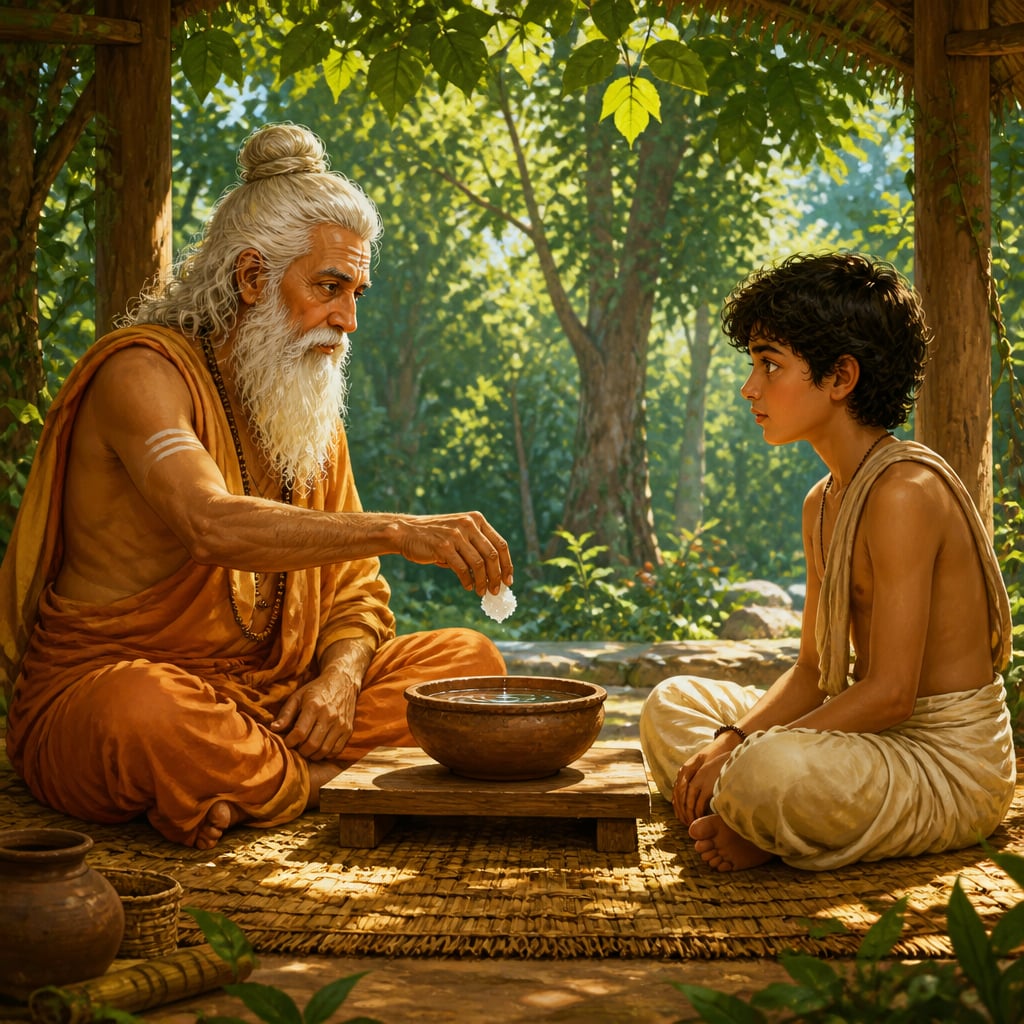
In a forest hermitage somewhere in the north of the subcontinent, sometime before 600 BCE, a boy named Svetaketu came home from twelve years of Vedic school and found his father waiting for him. The boy was twenty-four. He had memorized most of the Vedas and was quietly proud of it. He walked into his father's hut expecting a welcome and perhaps a meal. What he got was a bowl, a lump of rock salt, and a single question.
Uddalaka Aruni, his father, looked him over. The hut smelled of cooking smoke and the river beyond the trees. 'Did you ask for that teaching,' Uddalaka said, 'by which the unheard becomes heard, the unthought thought, the unknown known?' Svetaketu had not. Nobody at the school had mentioned such a teaching. Nobody had told him it existed. He was, the Chandogya Upanishad tells us plainly, furious and curious at the same time.
Uddalaka did not begin with a doctrine. He handed the boy the lump of salt. 'Put it in this bowl of water,' he said, 'and come see me tomorrow.'
What would pass between father and son across that bowl of saltwater would become, twenty-five centuries later, the cleanest answer anyone had ever given to a question that would eventually keep Bishop Berkeley awake in Dublin and Erwin Schrödinger awake in a room in Arosa. The question was the one every child has already asked without knowing its name. When you close your eyes in the kitchen, is the kitchen still there?
The Chandogya's Classroom
The Chandogya Upanishad, compiled sometime before 600 BCE, contains the teaching scene Svetaketu walked into in its sixth chapter. It should be in every physics syllabus.
Uddalaka begins with a statement that would not have been out of place in Parmenides two centuries later, and that modern physicists quietly struggle with today. 'In the beginning, my son, this was Being alone, one only, without a second.' Sat, Being, singular. Everything that appears to be many is actually this one Sat showing up under different conditions. The proof is not offered as doctrine. It is offered as a set of experiments.
Uddalaka hands Svetaketu a lump of salt. 'Put it in this bowl of water and come see me tomorrow.' The next day the salt is gone. Uddalaka asks him to take a sip from any part of the bowl. Every sip is salty. 'You cannot see the salt, but it is everywhere in the water. In the same way, son, you cannot see Being, but it pervades this whole world. That subtle essence, in it all that exists has its self. It is the Real. It is the Self. And that, Svetaketu, you are.'
Tat tvam asi. That thou art. It is repeated nine times in the chapter, once after each experiment. A banyan seed split open contains nothing visible, yet a tree grows from it. A sleeping man loses the waking world and still exists. A man traveling with his eyes covered finds his way home the moment the cover is removed. Nine experiments. One conclusion. The world you see is not the floor. It is a surface, and a witness is required for the surface to appear.
Berkeley Draws a Line

Jump forward to 1710. Bishop George Berkeley, a young Irish philosopher, publishes A Treatise Concerning the Principles of Human Knowledge. He has read Locke. He notices a gap. Locke says the world is made of objects that cause sensations in our minds. But the only data we ever have is the sensation. The 'object behind the sensation' is a guess, an inference we cannot check. Berkeley takes the honest step. If all we ever have is experience, and 'existence independent of experience' is a hypothesis with no testable content, why not drop it?
He coins a famous phrase. Esse est percipi: to be is to be perceived. The world exists only insofar as it is in some mind. He is ridiculed. Samuel Johnson kicks a stone and says 'I refute it thus,' as if impact could answer the question. But Berkeley's argument is harder to dismiss than it looks. The kick is another perception, not a proof that perception is not the whole story.
Berkeley faces an obvious problem. If the tree in my garden exists only when I perceive it, does it pop in and out of existence as I look away? His answer is theistic. God is always perceiving everything, so the tree is continuously held in the divine mind. This is philosophically elegant but also clearly a patch. Berkeley had to borrow a universal observer to plug a hole that a single observer could not fill.
Schrodinger Reads the Upanishads

Now jump to 1925. Erwin Schrodinger, age 38, is in Arosa in the Swiss Alps trying to derive a wave equation that will describe the electron. On his desk, among the technical papers, are the German translations of the Upanishads by Paul Deussen. He has been reading Vedanta since his teenage years. He writes about it in his diaries and, later, in the small book What Is Life. The sentence that matters is this one. 'Consciousness is a singular of which the plural is unknown. There is only one thing, and that which seems to be a plurality is merely a series of different aspects of this one thing, produced by a deception, the Indian maya.'
That is not the Chandogya quoting a physicist. That is a physicist quoting the Chandogya, almost word for word.
In the same decade, Schrodinger's equation reshaped physics. Quantum mechanics revealed that the electron does not have a definite position until something measures it. What counts as measurement? Physicists still argue. What is not controversial is that the observer has somehow become part of the equation. Matter, in the strict classical sense of 'stuff out there independent of any mind,' is no longer the most natural picture.
Schrodinger, asked whether this was coincidence, said no. He wrote that his worldview was Vedantic and that quantum theory, if anything, had confirmed rather than disturbed the framework he had absorbed from the Upanishads.
Where Berkeley Stopped and the Chandogya Kept Going
Berkeley had the honesty to reject 'matter behind the perception' and the courage to call the result idealism. But he could not solve the continuity problem without importing God as a universal observer. The move feels ad hoc because it is ad hoc. He needed something to hold the tree in existence when no human was looking, and he invoked a theological patch.
The Chandogya does not need the patch. It never splits the world into 'perceivers over here' and 'perceptions over there' in the first place. Being is already one, already without a second, and every finite observer is a localization of that one Being looking at itself. The tree does not need to be continuously watched by a separate God. The tree and the watcher are already the same Sat, appearing in different shapes. Tat tvam asi is not a comforting metaphor. It is the structural answer to Berkeley's continuity problem.
Schrodinger, arriving at the same corner from quantum mechanics, sensed the point. If consciousness is singular, there is no problem of 'when is the wavefunction collapsed by whom,' because the 'whom' in every lab on earth is, underneath the labels, the same witnessing. The measurement problem is a problem only if you insist on keeping observers apart. The Chandogya never started that way.
Why This Matters Today
You are not going to defend the Chandogya in a physics department. That is fine. The point is not to convert quantum mechanics into theology. The point is that the oldest clean answer to 'does the world exist without an observer' refuses the question as badly posed. The world is not a stage with watchers in the audience. The world and the watchers are the same underlying Being, and what we call observation is that Being noticing its own surface.
If this sounds abstract, try it where it lives. The moment you feel most alone, most separated, most convinced that reality is indifferent stuff happening far from any inner life, the Chandogya is asking you a quiet question. Are you sure the line between you and that stuff is real, or is it a line drawn across a single undivided Being? You cannot answer that by thinking harder. You can only answer it the way Uddalaka taught: by tasting the salt in any part of the bowl and noticing that what you are tasting is everywhere.
Case studies
Uddalaka and Svetaketu: Teaching by Experiment
In the sixth chapter of the Chandogya Upanishad, Uddalaka Aruni greets his son Svetaketu after twelve years of formal Vedic study. Uddalaka asks him for 'the teaching by which the unheard becomes heard, the unthought thought, the unknown known.' Svetaketu has not received it. Over nine carefully staged experiments, Uddalaka leads him from common sense to metaphysics. A lump of salt dissolved in water. A banyan seed cut open to reveal nothing. Rivers flowing toward the ocean. A sleeping man losing the world. A man led home with his eyes covered. Each experiment ends with the same refrain: 'That subtle essence, in it all that exists has its self. It is the Real. It is the Self. And that, Svetaketu, you are.'
The scene is not a parable. It is a protocol. Uddalaka is not asking Svetaketu to believe him. He is handing him empirical operations: taste this, split this, look again. Each operation is designed to pry attention off the visible surface and onto the invisible substrate. This is exactly the move Berkeley would attempt 2,300 years later and that Schrodinger would endorse. The Chandogya got there first by insisting that Being is singular and that the observer is not outside the observed.
Svetaketu understands, or more accurately stops not understanding. The Chandogya does not pretend the son becomes enlightened after one conversation. It shows him receiving a map he will now spend his life verifying. The sixth chapter remains, in Sanskrit philosophical tradition, the founding text of the mahavakya 'tat tvam asi,' one of the four great sayings around which all later Vedanta organizes itself.
Philosophical questions about observation and reality are not answered by argument alone. They are answered the Chandogya way, by experiments the student can actually perform, each one loosening the grip of the visible surface.
The Double-Slit Experiment and the Watched Electron
The double-slit experiment is the most famous demonstration in modern physics. Electrons fired one at a time at a barrier with two slits produce an interference pattern on the screen behind, as if each electron had passed through both slits at once, as a wave. The moment a detector is placed at one of the slits to see which one the electron went through, the interference pattern collapses and the electrons behave like particles. Richard Feynman called this 'the central mystery' of quantum mechanics. The pattern on the screen depends on whether an observation was made, not on any classical property of the electrons themselves.
Mainstream physics interpretations disagree about what counts as measurement and how the observer enters the equation. What is not disputed is that the clean picture of 'stuff out there, minds in here' does not survive the experiment. The Chandogya states, without any apparatus, that Being is one and observation is how that Being shows up to itself. This does not 'explain' quantum mechanics. It does remove the surprise. A tradition that never separated observer from observed is not startled when physics refuses to separate them either.
Nearly a century after Schrodinger wrote his wave equation, the measurement problem is still open. Interpretations multiply: Copenhagen, many-worlds, QBism, relational. A quiet minority of working physicists openly cite Vedanta as the most natural frame for what the experiments seem to say. Most stay silent about metaphysics and focus on the math. The experiment itself has been run with electrons, photons, whole molecules, and with objects of roughly two thousand atoms. The interference pattern keeps depending on whether anyone looks.
When the central experiment of 20th century physics implies that observation is not incidental to matter, the Chandogya stops being a curiosity and becomes a live option. The oldest inherited answer may be the one physics is groping back toward.
The double-slit experiment was performed with single electrons by Claus Jonsson in 1961 and with large molecules of up to about two thousand atoms by Anton Zeilinger's Vienna group. At every scale tested, the pattern depends on whether a detector is watching.
Schrodinger at Arosa, Reading the Upanishads
Erwin Schrodinger, born in 1887, began reading Schopenhauer in his teenage years. Schopenhauer sent him to Paul Deussen's German translations of the Upanishads. By the time Schrodinger was formulating wave mechanics in 1925 and 1926, the Chandogya and Brihadaranyaka were part of his working worldview. Years later, in his 1944 lectures published as What Is Life, he wrote plainly: 'Consciousness is a singular of which the plural is unknown. There is only one thing, and that which seems to be a plurality is merely a series of different aspects of this one thing, produced by a deception, the Indian maya.' He returned to this theme until his death in 1961.
Schrodinger did not treat Vedanta as a decoration. He treated it as a hypothesis about the structure of reality and found that modern physics, far from embarrassing it, was moving in its direction. He did not claim the Upanishads 'predicted' quantum mechanics. He claimed that a framework in which consciousness is singular and observation is intrinsic to Being is the one framework in which the new physics was not anomalous. The Chandogya's 'tat tvam asi' was, for him, not poetry but the least strained reading of the data.
Schrodinger's Vedantic commitments are awkward for textbook histories of physics and are often left out. His own words survive in his letters, his diaries, and in What Is Life, which remains one of the most cited popular science books of the 20th century. His wave equation is still the first equation a physics student learns after classical mechanics. The full man, who derived that equation while reading the Chandogya, is rarely presented in class.
The most significant Western echo of the Chandogya is not a philosopher who read it as literature but a physicist who took it as a working hypothesis and changed physics. In his case, the claim that 'Eastern thought inspired Western science' is not hype. Schrodinger said it himself, in print, more than once.
Schrodinger derived his wave equation in Arosa, Switzerland in late 1925 and early 1926. His book What Is Life, published in 1944, is widely credited with inspiring Francis Crick and James Watson to pursue DNA, and is the same book that contains his most direct Vedantic statements.
Reflection
- When you walk out of a room, what do you actually know about the room in the next moment, as opposed to what you are assuming?
- Why does the Chandogya ask Svetaketu to perform the salt experiment instead of simply telling him 'Sat is one without a second'?
- Berkeley needed God as a universal observer. Schrodinger needed consciousness to be singular. What does the Chandogya have that neither man needed to add?