Vishwa-Artha-Kendra: India as Global Economic Hub
When India Commanded a Quarter of World GDP
In 1 CE, when Rome ruled the Mediterranean and Han China dominated the East, one civilization quietly commanded nearly a third of all wealth produced on Earth. This lesson reveals the data behind India's economic dominance and why understanding this history is essential for India's resurgence.
The Roman Emperor's Frustration
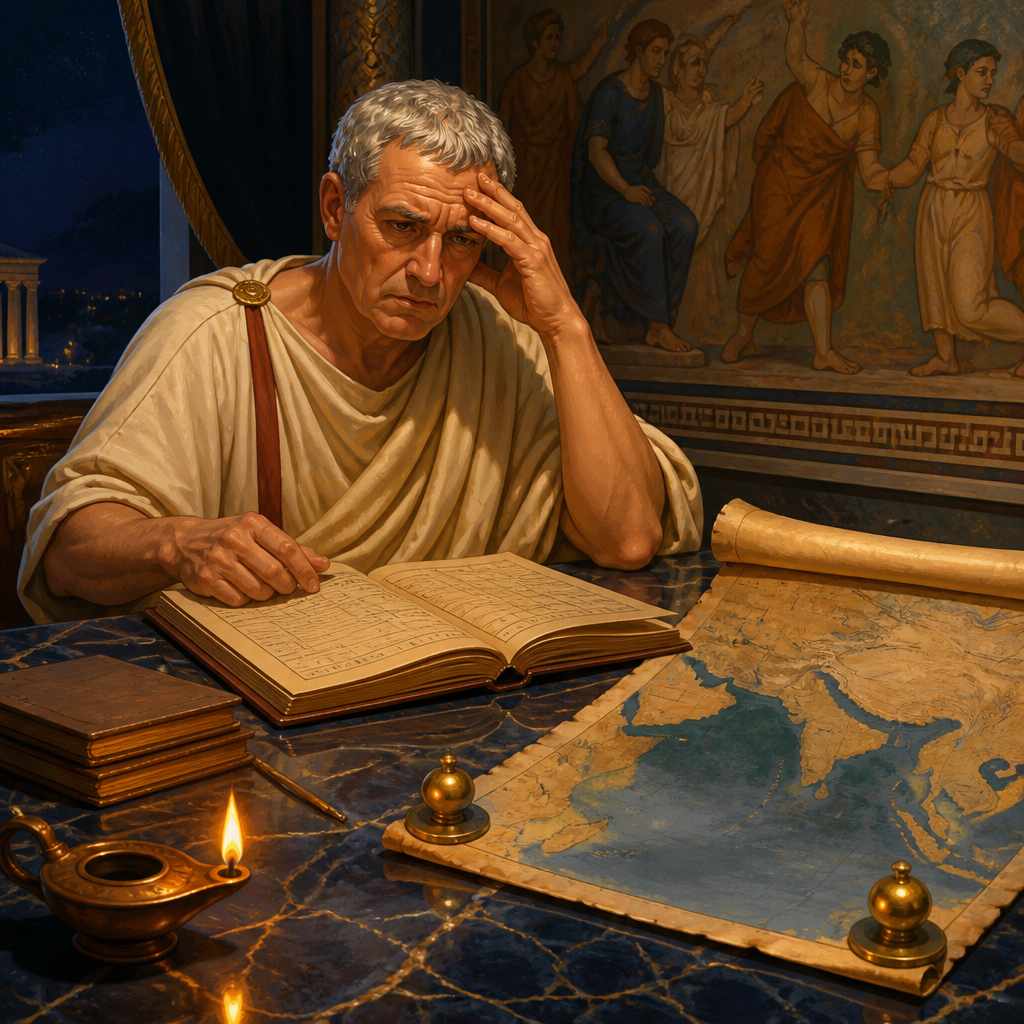
In the year 77 CE, Pliny the Elder sat in his study in Rome, poring over trade ledgers that made his blood boil. As a naval commander and naturalist serving Emperor Vespasian, he had access to the empire's most sensitive economic data. What he saw troubled him deeply.
"Not a year passes," he would later write in his monumental Natural History, "in which India does not drain the Roman Empire of at least fifty-five million sesterces."
That was not a complaint about a trade partner. It was a confession of economic defeat.
Rome, the mightiest empire the Western world had ever seen, was hemorrhaging gold and silver to a distant civilization across the sea, and there was nothing it could do about it. The Romans needed Indian pepper for their banquets, Indian muslin for their togas, Indian steel for their finest swords. India needed almost nothing from Rome except payment.
The Numbers That Rewrote History
For centuries, Western historians portrayed India as a land of spiritual wisdom but material poverty, a civilization that had chosen the soul over the market. Then came Angus Maddison.
This British economic historian spent decades reconstructing global GDP data stretching back two millennia. His findings, published by the OECD, shattered comfortable assumptions:
| Year | India's Share | China's Share | Europe's Share |
|---|---|---|---|
| 1 CE | 32.9% | 26.2% | 10.8% |
| 1000 CE | 28.9% | 22.7% | 8.7% |
| 1500 CE | 24.4% | 25.0% | 17.8% |
| 1700 CE | 24.4% | 22.3% | 21.9% |
| 1947 CE | ~4% | ~5% | ~26% |
Look at the first row. In 1 CE, India alone produced nearly a third of everything the world made. More than Rome, Greece, and Egypt combined. More than all of Europe. This wasn't a decade or a century of dominance, this was millennia of sustained economic supremacy.
"विश्वस्य धनं भारतवर्षे।" "The wealth of the world resides in Bharatavarsha."
This wasn't nationalist rhetoric. It was simply true.
What Made India the Engine
Geography played its part, India sat at the crossroads of all ancient trade routes. But geography alone doesn't explain two thousand years of dominance. Other well-positioned civilizations rose and fell. India persisted.
The answer lay in what Kautilya called Varta, the three pillars of economic strength:
Krishi (Agriculture): The monsoons, when managed through sophisticated irrigation, made India's agricultural yields legendary. The subcontinent could feed its massive population and still export grain.
Vanijya (Commerce): Indian merchants didn't wait for customers. They established trading colonies across Southeast Asia, the Middle East, and East Africa. The Nagarasresthi (chief merchant) of any major Indian city commanded networks spanning continents.
Pashupalan (Animal Husbandry): India's livestock provided not just food but leather, wool, and the bullocks that powered an entire logistics system.
But above all, there was manufacturing. India didn't just export raw materials. It exported finished goods of such quality that no one else could replicate them.
The Manufacturing Superpower
Consider what India produced:

Textiles: Dhaka's muslin was so fine it was called baft hawa, "woven wind." A full six-yard saree could pass through a finger ring. Roman women paid fortunes for fabric that made them look like they were wrapped in mist. Inscriptions from the Satavahana period record Sivadevi, a woman merchant from Nashik who traded textiles to Roman markets through the port of Sopara. Tamil Sangam literature celebrates Adiyaman Neduman Anji's queen, who managed extensive trade networks. These weren't exceptions, women controlled significant portions of India's textile economy, from spinning and weaving to trade.
Steel: Indian Wootz steel, known to Arabs as fuladh hindī (Indian steel), made Damascus swords legendary across three continents. Metalsmiths in Karnataka, Tamil Nadu, and Gujarat had mastered carbon control techniques that European metallurgists wouldn't understand for another thousand years. The secret lay in a sophisticated crucible process: iron ore, charcoal, and specific plant materials were sealed in clay pots and heated for days, creating steel with carbon nanotubes embedded in the metal, a feat that modern materials scientists confirmed only in 2006 using electron microscopy. When European smiths finally analyzed a Damascus blade in the 19th century, they couldn't replicate it. Roman naturalist Quintus Curtius wrote that Indian swords could "cleave a feather floating in the air." Alexander's soldiers, despite their military victories, adopted Indian swords because Greek iron couldn't match Wootz. This wasn't just metallurgy, it was accumulated scientific knowledge, refined over centuries in guild workshops from Hyderabad to Kodumanal.
Spices: Black pepper was worth its weight in silver. Cardamom, cinnamon, turmeric, these weren't luxuries but necessities for food preservation, medicine, and ritual.
Ships: Indian vessels, built with teak and stitched rather than nailed, were so seaworthy that Arab and European traders commissioned them from Indian shipyards.
Each of these industries represented not just production but accumulated knowledge, techniques passed through guilds called shreni, secrets guarded within communities, excellence refined over generations.
Global Perspectives on Trade Dominance
India's economic supremacy didn't go unnoticed by global observers across centuries. Three perspectives from different eras help contextualize what made India exceptional.
Ibn Battuta (1304-1369), the Moroccan explorer who spent eight years in India, wrote extensively about the subcontinent's wealth. Serving as a qazi in Delhi under Muhammad bin Tughlaq, he observed: "The land of India is extensive and wealthy... the horses of India are renowned, its steel the finest in the world, its textiles without equal." Ibn Battuta documented the merchant networks stretching from Malabar to China, noting that Indian traders dominated sea routes the way Arab traders dominated land routes. His account reveals India as the hub of a vast trading system, not an isolated civilization.
Adam Smith (1723-1790) curiously barely mentioned India in The Wealth of Nations (1776), despite India being one of the wealthiest places on Earth for most of recorded history. Why? Perhaps because India's economic model didn't fit his narrative of individual self-interest as the engine of growth. India's system was built on dharma, on obligations, community, and the idea that commerce served society. The Shukraniti declared: "राष्ट्रस्य मूलं वाणिज्यं तस्मात्तं परिरक्षयेत्।" (Trade is the root of the nation; therefore, protect it.) This wasn't capitalism or socialism, it was an economic philosophy rooted in reciprocity.
Fernand Braudel (1902-1985), the French historian who pioneered world-systems analysis, acknowledged in Civilization and Capitalism that India was "the center of gravity" of pre-modern world trade. He noted that European traders were essentially peripheral players seeking access to an existing system centered on the Indian Ocean, not creators of global trade.
| Thinker | Observation | Indian Reality |
|---|---|---|
| Ibn Battuta | Documented India's unmatched textiles and steel | First-hand witness to manufacturing excellence |
| Adam Smith | Ignored India in economic theory | India's dharmic model challenged individualist assumptions |
| Braudel | India as "center of gravity" of world trade | Europe sought access to Indian-dominated networks |
The Long Collapse and Modern Recovery
Look again at Maddison's data. In 1700, India still held 24.4% of world GDP. By 1947, that had crashed to roughly 4%.
Two and a half centuries erased two millennia of wealth. The story of how that happened, colonial deindustrialization, the destruction of artisan communities, the conversion of a manufacturing superpower into a raw material supplier, is one of history's great tragedies. We will explore it in Chapter 6.

But today, something remarkable is happening. India's economy has crossed $4 trillion. The government's target is $10 trillion by 2030. Finance Minister Nirmala Sitharaman and economic advisor Sanjeev Sanyal speak not of "development" in the Western sense but of recovery, of returning to a position India held for most of human history.
Your Place in This Story
Here's what Maddison's data means for you:
When someone says India is a "rising power," they're using the wrong verb. India is a recovering power. The capability, the commercial instinct, the entrepreneurial DNA, these are not new acquisitions. They are ancestral inheritances temporarily suppressed.
Every Indian entrepreneur building a business, every professional earning abroad and remitting home, every policymaker removing barriers to trade, all are participating in what is really a civilizational project of restoration.
In our next lesson, we'll examine exactly how India accumulated such wealth, by following the trail of Roman gold that flowed inexorably eastward.
Western economic history often treats European dominance as natural and Indian poverty as baseline. Maddison's data inverts this: European dominance was a 200-year anomaly; Indian prosperity was the norm.
This reframing transforms psychology, from 'aspiring to be developed' to 'reclaiming what was temporarily lost.' The capability is proven, not hypothetical.
India's GDP share dropped from 24.4% (1700) to ~4% (1947), a 600% decline in 247 years that is now reversing.
Modern economics recognizes that countries exporting manufactured goods gain more than those exporting raw materials. India knew this two millennia ago, muslin cloth was worth 100x raw cotton.
India's guilds (shreni) maintained quality standards and protected techniques, creating durable competitive advantages that lasted centuries.
Dhaka muslin sold for its weight in gold in European markets; the same cotton as raw fiber was worth a fraction.
Key terms
- Vishwa-Artha-Kendra
- Global economic center or hub. Describes India's historical position as the world's primary economic powerhouse.
- Vārtā
- The science of livelihood; the economic triad of agriculture, animal husbandry, and trade that forms the foundation of state prosperity.
- Nagaraśreṣṭhī
- Chief merchant or head of the merchant guild in a city; the leader of commercial activities in urban centers.
- Wootz
- A high-carbon crucible steel produced in India from the 6th century BCE onwards, renowned worldwide for its exceptional hardness, flexibility, and distinctive watered pattern. Wootz steel was the material behind legendary Damascus swords.
Verses
राष्ट्रस्य मूलं वाणिज्यं तस्मात्तं परिरक्षयेत्
rāṣṭrasya mūlaṃ vāṇijyaṃ tasmāttaṃ parirakṣayet
Trade is the root of the nation; therefore, it must be protected.
This predates mercantilism by centuries, recognizing that a nation's power is directly tied to its commercial vitality. It mandates active state involvement in protecting and promoting trade.
Shukraniti, Chapter on Rajadharma (Traditional rendering)
वार्ता कृषिपाशुपाल्यवणिज्या च
vārtā kṛṣipāśupālyavaṇijyā ca
The economy consists of agriculture, animal husbandry, and trade.
Unlike modern economics that often prioritizes finance or services, Kautilya's framework grounds prosperity in productive activities, growing, raising, and trading tangible goods.
Arthashastra, Book 2, Chapter 1 (R.P. Kangle)
Key figures
Pliny the Elder
Roman naturalist, author, naval commander, and administrator under Emperor Vespasian · 23-79 CE (Roman Empire)
Angus Maddison
British economic historian and Professor at University of Groningen · 1926-2010 (Modern era)
Ibn Battuta
Moroccan explorer, scholar, and qazi who spent eight years in India under Muhammad bin Tughlaq's Delhi Sultanate · 1304-1369 CE (Medieval period)
Case studies
IMEC: Reclaiming Ancient Trade Routes
In September 2023, on the sidelines of the G20 Summit in New Delhi, Prime Minister Narendra Modi announced the India-Middle East-Europe Economic Corridor (IMEC) alongside leaders from the UAE, Saudi Arabia, the EU, and the United States. The $20 billion infrastructure project would connect India to Europe through a network of railways, ports, and digital links, bypassing traditional routes controlled by other powers. The corridor would reduce shipping time from India to Europe from 40 days to 15 days, cutting logistics costs by 40%. But IMEC was more than infrastructure. It was a statement: India was reasserting its position at the center of global trade, exactly where it had been for two millennia before colonial disruption.
The Shukraniti's principle, 'Trade is the root of the nation; therefore, protect it', explains IMEC's strategic logic. Unlike purely market-driven Western approaches, India's corridor strategy integrates commercial benefit with civilizational recovery. The route deliberately connects India to partners along historical spice trade paths. This is not just economics, it is dharmic restoration. Where colonial powers severed India's trade networks, IMEC rebuilds them. The lesson's theme of India as vishwa-artha-kendra (global economic hub) is being enacted in real-time through infrastructure policy.
While IMEC is still under development, initial MoUs have been signed and feasibility studies completed. The UAE's DP World has committed to port development. Saudi Arabia's railway authority is planning the overland connections. The European Union sees IMEC as a strategic alternative to China's Belt and Road Initiative. For India, IMEC represents potential annual trade increases of $25 billion and strategic positioning that mirrors its historical role as the indispensable hub of global commerce.
India's economic resurgence is not about copying Western models, it is about restoring historical patterns. IMEC proves that the infrastructure of global trade naturally gravitates toward India when political conditions allow. The vishwa-artha-kendra is being rebuilt.
IMEC mirrors how ancient trade corridors like the Silk Road were built through multi-state cooperation. Today's infrastructure mega-projects succeed when they align geopolitical interests with commercial logic, exactly as India's spice routes once did.
IMEC could reduce India-Europe shipping time from 40 days to 15 days, a 62% reduction that would make India competitive with any manufacturing hub on Earth.
Apple's India Bet: Return of the Manufacturing Superpower
In 2024, Apple produced over $14 billion worth of iPhones in India, a 60% increase from the previous year. By 2025, India is expected to manufacture 25% of global iPhones. Foxconn, Apple's primary manufacturer, invested $1.6 billion in a Karnataka facility. Tata Electronics acquired Wistron's iPhone plant in Karnataka. The shift represented more than supply chain diversification away from China. It signaled global recognition that India could once again be a manufacturing superpower. As Apple CEO Tim Cook noted during his India visit: 'India has incredible energy and talent.' The world's most valuable company was betting on Indian manufacturing excellence, the same excellence that once produced Wootz steel and Dhaka muslin.
The lesson's analysis of India's historical manufacturing dominance, where value-added goods (not raw materials) created wealth, applies directly. Colonial rule converted India from a finished-goods exporter to a raw-material supplier. Apple's investment reverses this precisely: India now exports the world's most sophisticated consumer electronics, not cotton or iron ore. This is the Varta principle (agriculture, husbandry, commerce) updated for the 21st century: India's strength lies in skilled manufacturing, not resource extraction. The dharmic approach to work, skill as sacred duty (shilpa-dharma), creates the quality that global brands demand.
India's electronics exports crossed $30 billion in 2024, with mobile phones becoming the largest export category. iPhone production in India is projected to reach $50 billion by 2027. Tata Group's entry into semiconductor manufacturing (with a $11 billion chip fabrication facility in Gujarat) signals that India is moving up the value chain, from assembly to components. The pattern mirrors ancient trade: India exporting finished goods of unmatched quality while the world pays premium prices.
Manufacturing excellence is India's civilizational inheritance, not a new capability. When policy conditions align and infrastructure improves, global capital naturally flows to Indian manufacturing, just as Roman gold once flowed to Indian workshops.
Apple's shift to Indian manufacturing echoes the pattern where global capital follows proven skill ecosystems. Countries that invest in workforce capability, not just cheap labor, attract high-value production, just as ancient India attracted Roman gold through quality, not price.
India's mobile phone exports grew from $0.3 billion (2017) to $15.6 billion (2024), a 52x increase in seven years.
Historical context
Classical Period (1 CE - 300 CE)
The Satavahana dynasty controlled the Deccan and western trade routes while the Kushans dominated the north. Both facilitated extensive trade with Rome. Indian ports like Barygaza (Bharuch), Muziris, and Arikamedu served as major trade hubs. Merchant guilds (shreni) operated sophisticated commercial networks.
While Rome spent its gold on Indian luxuries and military campaigns, and Han China focused on internal consolidation, India accumulated precious metals through sustained trade surpluses. This made India the 'sink of precious metals', gold and silver flowed in but rarely left.
Archaeological excavations at Arikamedu (near Pondicherry) have uncovered Roman coins, amphorae, and artifacts, confirming the scale of Indo-Roman trade described in ancient texts.
Understanding India's historical economic dominance is essential for three reasons: (1) it disproves narratives of inherent Indian poverty, (2) it provides models for modern economic strategy, and (3) it reframes current growth as recovery rather than unprecedented development.
Living traditions
India's current economic policies explicitly invoke this heritage. Finance Minister Nirmala Sitharaman's Budget speeches reference 'civilizational continuity.' The Sagarmala port development program, Gati Shakti infrastructure plan, and IMEC corridor all represent modern attempts to restore India's position as the vishwa-artha-kendra. UPI's global adoption mirrors ancient patterns, Indian innovation becoming world standard.
- Lakshmi Puja and Diwali Business Rituals: Indian businesses opening new account books on Diwali, worshipping Lakshmi, and treating commerce as a sacred activity reflects the ancient integration of artha with dharma. This isn't superstition but a living connection to the belief that ethical commerce is blessed.
- Trading Community Networks: Marwari, Gujarati, Chettiar, and Sindhi business networks continue to operate on community trust, extending credit across vast distances, a direct descendant of ancient shreni (guild) practices.
- Lothal, Gujarat
- Arikamedu, Tamil Nadu
- Shore Temple, Mahabalipuram: This 8th-century Pallava temple served as a landmark for maritime traders approaching the Coromandel Coast. Its location on the shore made it visible to ships, functioning as both a spiritual beacon and navigational aid for ancient trade routes.
- Somnath Temple: One of the twelve Jyotirlingas, Somnath's legendary wealth came from maritime trade revenues. Located near the ancient port of Veraval, the temple received donations from traders across the Arabian Sea trade network.
Reflection
- Maddison's data shows India held 25-33% of world GDP for nearly two millennia. How does knowing this historical reality change your perception of what India is capable of economically? Does it feel more like aspiration or recovery?
- The Shukraniti declares 'Trade is the root of the nation.' In your work or business, how might you contribute to India's economic recovery? Identify one concrete way your professional activity strengthens the national economy.