Bhugola-Prabhava: Geography as Economic Destiny

5000 Years of Trade

Archaeological evidence of Harappan trade networks stretching to Mesopotamia, Central Asia, and beyond, proof that India's commercial DNA is 5000 years old.

The World's First Global Traders

When we speak of India's trade dominance, we often begin with the Roman era or the medieval spice trade. But this dramatically understates the antiquity of Indian commerce. India's trade dominance didn't begin in the classical period, it stretches back 5000 years to the Indus Valley Civilization, making Indians among the world's first global traders.

The Harappan Commercial Revolution

The Indus Valley Civilization (3300-1300 BCE), also called the Harappan Civilization, was not merely an agricultural society that happened to trade. It was, at its core, a commercial civilization, organized around trade, standardized for commerce, and connected to distant markets.

Evidence of Long-Distance Trade:

The scale is remarkable: Harappans regularly traded over distances of 2000+ kilometers, equivalent to modern international commerce, in an age when most human communities never traveled beyond their immediate villages.

What Made Harappan Trade Special

The Harappan trade system wasn't primitive barter. It showed sophistication matching modern commercial practices:

Standardization: The Harappan weight system followed a binary-decimal pattern (1, 2, 4, 8, 16, 32...) that was identical across every major city, from Harappa in Punjab to Lothal in Gujarat to Dholavira in Kutch. This wasn't accidental convergence; it was deliberate standardization for trade. A merchant's weights in Mohenjo-daro matched those in Lothal, 800 kilometers away.

Seals and Authentication: Over 3,500 Harappan seals have been discovered. These weren't decorative, they were commercial tools. Found along trade routes and in Mesopotamian ports, they likely served as ownership marks, authentication devices, or merchant identification. This is the world's first documented system of commercial authentication.
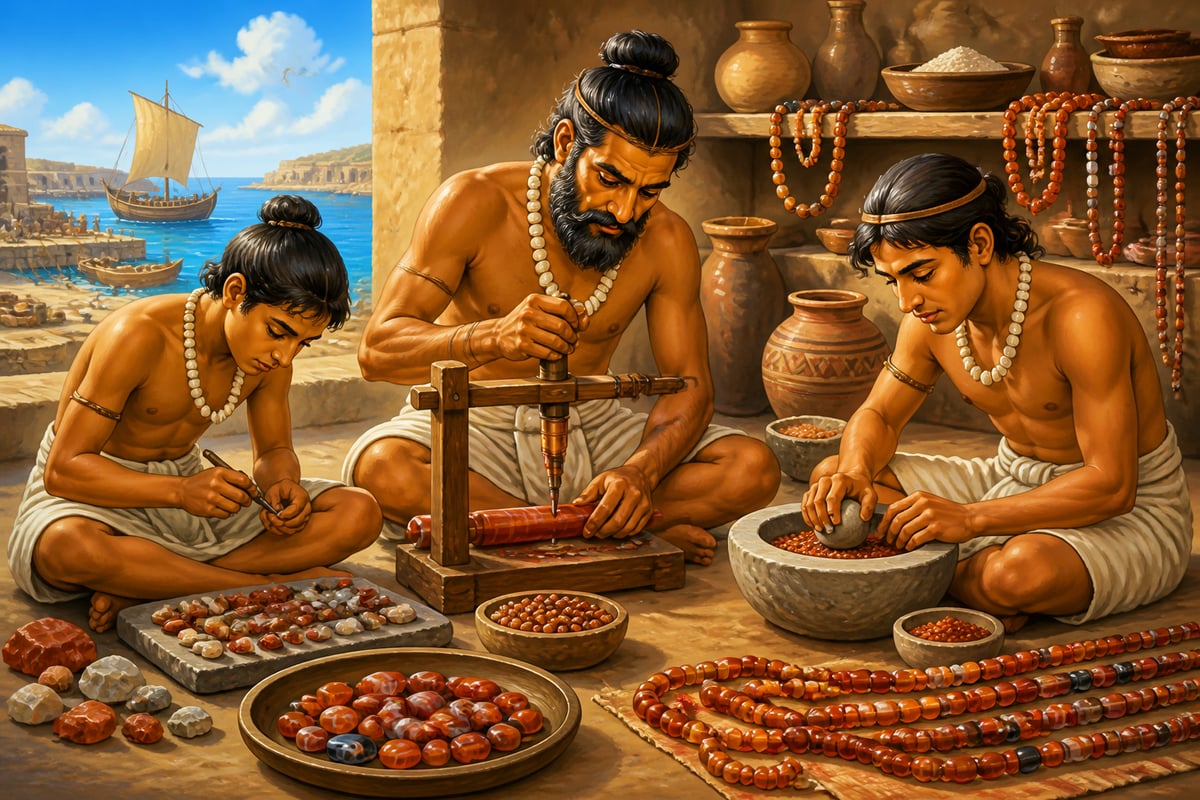
Harappan craftsmen drilling carnelian beads at Lothal workshop

Specialized Manufacturing: Harappan cities specialized in export goods:

This specialization indicates not subsistence production but export-oriented manufacturing, the ancient equivalent of modern industrial clusters.

Lothal: The World's Oldest Known Dock

Harappan dockworkers loading carnelian beads at Lothal's basin

Lothal, in modern Gujarat, contains perhaps the most stunning evidence of Harappan maritime capability: the world's oldest known dock.

Engineering Marvel: The dock measures 218 meters × 37 meters, large enough to accommodate multiple seagoing vessels. It was constructed with remarkable sophistication:

What This Proves:

The existence of Lothal's dock demolishes any notion that ancient Indians were land-bound or commercially unsophisticated. This was a maritime trading civilization.

Meluhha: India in Mesopotamian Records

The Harappan connection to Mesopotamia is documented from both ends. Mesopotamian texts refer to "Meluhha", widely believed to be the Indus Valley region:

"Ships from Dilmun, Magan, and Meluhha... anchored at the quay of Akkad." , Akkadian texts, circa 2300 BCE

Meluhha was described as a source of:

The trade wasn't one-way. Harappans imported:

This was genuine international trade, specialized exports, strategic imports, maritime shipping, and formal recognition in foreign records.

Urban Planning for Commerce

Harappan cities were designed with trade in mind:

Commercial Infrastructure:

Trader-Friendly Features:

The Great Bath at Mohenjo-daro: Often interpreted as religious, the Great Bath may also have served commercial hospitality, providing visiting merchants with facilities expected in a sophisticated trading center.

The Continuity Thesis

Perhaps the most remarkable aspect of Harappan trade is its continuity. The routes, products, and patterns established 4,500 years ago persisted through subsequent millennia:

Same Routes:

Same Products:

GIFT City Gandhinagar financial skyline at dusk

Geographic Continuity: Gujarat, home to Lothal, remains India's most trade-oriented state today. The Mundra port complex is now India's largest. Surat, nearby, was the greatest port of medieval India. The Kutchi merchants trace their trading heritage to pre-Harappan times. This isn't coincidence, it's 5,000 years of accumulated commercial advantage.

Global Perspectives on Harappan Commerce

The archaeological rediscovery of Harappan civilization has transformed understanding of ancient economic history, both in India and globally. Three scholars, using different methodologies, converged on revolutionary conclusions about India's commercial antiquity.

S.R. Rao (1922-2013), the Indian archaeologist who excavated Lothal from 1955-1962, made the discovery that reframed everything: the world's oldest known dock. Rao's meticulous documentation proved that organized maritime trade, port infrastructure, and export manufacturing existed in India 4,500 years ago. His work demolished the colonial myth that ancient Indians were land-bound. Lothal's dock, 218 meters by 37 meters, with inlet and outlet channels for managing water levels, demonstrated engineering sophistication matching anything in the ancient world. Rao also pioneered underwater archaeology at Dwarka, connecting archaeological evidence to literary traditions.

R.S. Bisht (1940-present), excavating Dholavira from 1989-2005, revealed perhaps the most sophisticated example of Harappan urban planning. His discovery of the famous 'signboard', large Harappan script characters, possibly the world's earliest public inscription, suggested a commercially literate society. Dholavira's elaborate water harvesting system, supporting a major city in an arid region, showed that Harappans engineered their environment to enable trade. Bisht's work led directly to Dholavira's UNESCO World Heritage designation in 2021.

Gregory Possehl (1941-2011), the American archaeologist at the University of Pennsylvania, synthesized global scholarship in 'The Indus Civilization: A Contemporary Perspective' (2002). His key insight was revolutionary: the Harappan civilization was uniquely 'peaceful', achieving vast geographic reach through commerce rather than military conquest. Unlike Egypt with its pharaonic monuments or Mesopotamia with its warrior-kings, Harappan cities show no palaces, no grand military architecture, no evidence of warfare. Possehl proposed that commerce itself was the organizing principle of Harappan society. He calculated that the civilization covered 1.5 million square kilometers with 5 million people, larger than Egypt and Mesopotamia combined, held together by trade networks rather than armies.

Scholar Key Discovery Implication
S.R. Rao Lothal dock, world's oldest known Maritime trade 4,500 years old
R.S. Bisht Dholavira signboard and water system Commercial literacy and urban engineering
Gregory Possehl Harappan 'peaceful' expansion through trade Commerce as civilizational organizing principle

Together, these scholars established that India's commercial orientation isn't recent, it's civilizational, stretching back to the Bronze Age.

What Harappan Trade Teaches Modern India

The Harappan commercial system offers several lessons:

Standardization Enables Scale: The uniform weight system across the Harappan world meant that a merchant from one city could trade seamlessly in another. Modern equivalent: GST creating one market from 28 states. Standardization isn't bureaucracy, it's essential trade infrastructure.

Infrastructure Investment Pays: Lothal's dock required massive investment, coordinated labor, engineering expertise, ongoing maintenance. But it enabled trade volumes impossible through beach landing. Modern equivalent: Sagarmala's port investment program. Infrastructure creates trade capacity.

Export Specialization Works: Harappan cities specialized in what they did best, Lothal in beads, Chanhu-daro in seals. They didn't try to make everything. Modern equivalent: PLI schemes building specialized manufacturing clusters. Comparative advantage was understood 4,500 years ago.

Geography is Destiny: Gujarat's coastline made it a natural trading hub in 2500 BCE. It remains so in 2025. Geographic advantages persist across millennia. Policy should recognize and leverage permanent geographic assets.

The Commercial DNA of Bharat

The evidence from the Indus Valley Civilization establishes something profound: Indians have been traders for at least 5,000 years. This isn't a recent phenomenon or a foreign import. Commerce is woven into the civilizational DNA of Bharat.

When we see a Gujarati merchant negotiating in Dubai, or a Marwari family running businesses across India, or a Chettiar banking network spanning Southeast Asia, we're seeing the continuation of a tradition older than the pyramids, older than writing itself in most of the world.

This commercial heritage was interrupted, suppressed, and nearly destroyed during the colonial period. But DNA doesn't disappear, it awaits expression. The economic reforms since 1991 and the entrepreneurial explosion of the 21st century are not India becoming something new. They are India becoming itself again.

Standardization reduces transaction costs. Without common weights, every trade requires verification. With standardization, trust can extend to strangers. The Harappan achievement was recognizing this 4,500 years ago. Modern equivalents: GST replacing 17 different taxes, unified UPI interface, common quality standards.

Infrastructure is multiplier investment. A port doesn't just move goods, it enables manufacturing clusters, generates employment, creates ecosystem effects. The Harappans understood that public goods investment creates private prosperity. Modern application: Sagarmala's port development, IMEC corridor.

Unlike technology or skills, geographic advantage cannot be replicated. Gujarat's coastline, Mumbai's natural harbor, Chennai's proximity to Southeast Asia, these are permanent assets. Smart strategy leverages permanent advantages.

Key terms

Bhugola-Prabhava
The influence or impact of geography - the concept that geographic factors shape economic and civilizational outcomes.
Meluhha
The Mesopotamian name for the Indus Valley region, appearing in Akkadian and Sumerian texts describing trade ships arriving from the East.
Pattana
A port or harbor town - a place where trade and shipping activities concentrate.
Śreṇī-Mudrā
Guild seal, a stamp or embossed marker used by merchant guilds (shreni) to authenticate goods, mark ownership, and certify quality. Harappan seals represent the world's earliest known system of commercial authentication.

Verses

पन्थानं विद्धि वाणिज्यस्य यः प्राचीनो यः सनातनः

Panthānaṃ viddhi vāṇijyasya yaḥ prācīno yaḥ sanātanaḥ

Know the path of commerce, that which is ancient and eternal.

This sutra captures the insight that trade routes, once established, persist across millennia. The 'eternal path' of commerce follows geography, coastlines, mountain passes, river valleys. The routes Harappan merchants used to reach Mesopotamia are essentially the same routes that later carried Roman trade and now carry oil tankers. Understanding these ancient paths illuminates modern trade opportunities.

Rigvedic tradition, Derived maxim (Traditional rendering)

तुलामानं च शास्त्रोक्तं सर्वत्र समम् आचरेत्

Tulāmānaṃ ca śāstroktaṃ sarvatra samam ācaret

Let weights and measures, as science prescribes, be practiced uniformly everywhere.

The Harappan weight system was uniform across their entire civilization, the earliest known implementation of this principle. Standardization enables trust between distant parties who cannot personally verify each transaction. This insight, implemented 4,500 years ago, underlies modern institutions from GST to international standards bodies.

Arthashastra, Principles on commerce (Traditional rendering)

Key figures

S.R. Rao

Indian archaeologist and marine archaeologist; excavator of Lothal; pioneer of underwater archaeology in India · 1922-2013 (Modern era)

R.S. Bisht

Indian archaeologist; excavator of Dholavira; former Joint Director General of the Archaeological Survey of India · 1940-present (Contemporary)

Gregory Possehl

American archaeologist; Professor at the University of Pennsylvania; leading Western authority on Indus Valley Civilization · 1941-2011 (Modern era)

Case studies

Cambay Beads: 4,500 Years of Unbroken Craft

In the narrow lanes of Khambhat (ancient Cambay), Gujarat, artisans still practice bead-making techniques recognizable from Harappan workshops. The craft has continued unbroken for 4,500 years. Lothal's 'bead factory', discovered by S.R. Rao, produced carnelian and agate beads that reached Mesopotamia. Today, Khambhat produces over 80% of India's semi-precious stone beads, exporting to 60+ countries. The techniques, selecting raw carnelian, heating it to enhance color, drilling with bow-drills, polishing with bamboo, connect directly to Harappan methods. In 2023, Khambhat's bead industry generated ₹2,000+ crore in annual revenue, employing over 50,000 artisans. UNESCO has recognized this as among the world's oldest continuously practiced crafts. The same beads that Akkadian merchants purchased in 2300 BCE are still manufactured in the same region, by descendants of the same artisan communities.

The continuity of Khambhat's bead craft embodies the concept of 'parampara', unbroken transmission of knowledge across generations. The artisan families view their work not as mere commerce but as 'kula-dharma' (family duty). Skills are transmitted father to son, mother to daughter, in what artisans call 'guru-shishya' relationships within families. The craft itself is considered sacred, many artisans perform puja before beginning work. This dharmic orientation explains the remarkable continuity: the craft isn't just livelihood, it's identity and inheritance. The Harappan bead-makers, if they returned today, would recognize their techniques in modern Khambhat workshops.

Khambhat's bead industry demonstrates that heritage crafts can be economically vibrant. The industry has adapted to global markets, online sales now reach customers in Japan, Europe, and America. Yet the core techniques remain unchanged. Young artisans are returning to the craft as exports grow. The Gujarat government has proposed Khambhat for UNESCO Intangible Cultural Heritage status. The continuity proves that commercial traditions, when embedded in community identity, can survive empires rising and falling, religions changing, and economies transforming.

Commercial heritage is not museum artifact, it is living competitive advantage. Khambhat's 4,500 years of accumulated craft knowledge cannot be replicated overnight by any competitor. The lesson for modern India: protect and leverage heritage industries rather than abandoning them for 'modern' alternatives. The GI (Geographical Indication) protection now given to Khambhat beads recognizes what Harappan merchants knew, place-based manufacturing excellence creates durable trade advantage.

Heritage craft industries worldwide, from Swiss watchmaking to Japanese ceramics, prove that millennia of accumulated technique creates competitive moats no factory can replicate. GI protections are the modern legal equivalent of ancient guild secrecy.

Khambhat produces 80% of India's semi-precious stone beads. Annual industry value exceeds ₹2,000 crore. Over 50,000 artisans work in the craft. Export destinations span 60+ countries. The technique is documented in Harappan sites dated to 2500 BCE, a continuous craft tradition of 4,500 years.

Kutch Resilience: From Earthquake to Trade Powerhouse

On January 26, 2001, a devastating 7.7 magnitude earthquake struck Kutch, Gujarat, killing over 20,000 people and destroying 400,000 homes. The district, historically one of India's most trade-oriented regions (Dholavira was located here), seemed finished. Yet within two decades, Kutch transformed into an economic powerhouse. Mundra port, just 60 km from Dholavira, became India's largest private port, handling 150 MTPA by 2024. The Adani group invested over ₹40,000 crore in the region. Special Economic Zones attracted ₹1.5 lakh crore in investments. Wind and solar farms made Kutch a renewable energy hub. The same geographic advantages that made Dholavira a trading center 4,500 years ago, access to Arabian Sea routes, proximity to Middle Eastern markets, minimal monsoon disruption, powered Kutch's modern resurgence.

Kutch's recovery exemplifies the concept of 'sthitaprajna', steadiness in crisis, from the Bhagavad Gita. The trading communities of Kutch, inheritors of Harappan commercial DNA, didn't abandon their homeland after the earthquake. Instead, they rebuilt with characteristic merchant pragmatism: assess damage, cut losses, invest in future capacity. The Kutchi merchants' response echoed their ancestors' adaptation to Harappan civilization's decline around 1900 BCE, when climate and river changes destroyed cities, the commercial networks survived by relocating and adapting. The same resilience, encoded across millennia, reappeared in 2001. The Gita's teaching that 'the wise grieve neither for the living nor the dead' enabled focus on reconstruction rather than mourning.

By 2024, Kutch district had one of Gujarat's highest per capita incomes. Mundra port processed more cargo than any other Indian port. The Dholera Special Investment Region, 150 km east of Kutch, was planned as India's largest industrial city. Kutch's renewable energy capacity exceeded 10 GW. The earthquake, paradoxically, accelerated modernization, new infrastructure replaced old, fresh investment flowed in, and the region leapfrogged decades of incremental development. The trading heritage proved stronger than the natural disaster.

Geographic advantage persists across catastrophes. The same location that made Dholavira prosperous in 2500 BCE makes Mundra prosperous in 2025 CE. Temporary disasters cannot eliminate permanent advantages. For modern India, this suggests that infrastructure investment in geographically advantaged regions, Gujarat's coast, Tamil Nadu's ports, Karnataka's tech clusters, will compound across centuries, as Kutch's 4,500-year commercial continuity demonstrates.

Kutch's post-earthquake transformation parallels how cities like Rotterdam and Kobe rebuilt after devastation by doubling down on their geographic trade advantages. Locations with inherent commercial logic attract reinvestment even after catastrophic disruption.

Mundra port capacity: 150 MTPA (2024), making it India's largest by volume. Investment in Kutch SEZs: ₹1.5+ lakh crore. Renewable energy capacity: 10+ GW. Distance from Dholavira to Mundra: ~60 km. Time span: 4,500 years of trading activity in the same region.

GIFT City: India's First International Financial Centre

In 2007, Gujarat announced GIFT City (Gujarat International Finance Tec-City), India's first operational smart city and international financial services centre. Located near Ahmedabad, GIFT City sits roughly 80 km from Lothal, the Harappan port. By 2024, GIFT City housed over 450 financial services firms, processed $450 billion in daily transactions, and employed 30,000+ professionals. The IFSC (International Financial Services Centre) within GIFT offers regulatory parity with Singapore and Dubai, enabling global financial transactions under Indian jurisdiction. Aircraft leasing, bullion trading, foreign fund management, and international arbitration all operate from GIFT. The explicit vision: make India a global financial hub, restoring a position Gujarat held when Lothal's merchants financed trade across the Arabian Sea 4,500 years ago.

The Arthashastra's teaching, 'kosha-mūlo daṇḍaḥ' (the treasury is the root of state power), underlies GIFT City's conception. Gujarat's leaders explicitly framed GIFT as civilizational restoration: bringing back to India the financial services that colonial rule had outsourced to London, and globalization had shifted to Singapore and Dubai. The location in Gujarat was deliberate, connecting to the state's commercial heritage. Just as Lothal's shrenis (guilds) pooled capital and managed risk for maritime ventures, GIFT's IFSC provides institutional infrastructure for modern financial flows. The bead-makers of Khambhat and the fund managers of GIFT are expressions of the same commercial DNA.

GIFT City has attracted global names: JP Morgan, Deutsche Bank, HSBC, and over 20 foreign banks operate from GIFT IFSC. Aircraft leasing, formerly conducted entirely offshore, has partially returned to India, with ₹5,000+ crore in assets now registered in GIFT. India's first international bullion exchange operates from GIFT, reconnecting to Gujarat's ancient role in precious metals trade. The city plans to expand to 7 million square feet of commercial space by 2027. Finance Minister Nirmala Sitharaman has called GIFT 'a gateway for global finance to access India.'

Financial infrastructure follows commercial heritage. Gujarat's 5,000 years of trading expertise created the human capital and institutional trust that makes GIFT viable. The lesson: modern financial centers don't emerge randomly. They grow from centuries of accumulated commercial knowledge. India's financial services future will be built on the same foundations that made Lothal's merchants successful, standardization, trust networks, geographic advantage, and institutional continuity.

GIFT City's proximity to ancient Lothal illustrates a pattern visible from London to Shanghai: financial centers emerge where centuries of commercial activity have built institutional knowledge, trust networks, and regulatory sophistication. Finance follows trade heritage.

GIFT City daily transaction value: $450+ billion (2024). Registered entities: 450+ financial services firms. Employment: 30,000+ professionals. Aircraft leased through GIFT IFSC: 100+. Distance from Lothal archaeological site: ~80 km. Investment attracted: ₹20,000+ crore.

Living traditions

Reflection

More in India: The Ancient Engine of World Economy

All lessons in India: The Ancient Engine of World Economy · Trade Routes of Ancient Bharat course