Samanyahita: Common Good

When everyone thinks they're right, wisdom finds what's fair for all

The final lesson of the Nyaya chapter presents conflicts without villains. In The Water Dispute, two villages fight over a shared river, both need water, neither is wrong. In The Shared Field, brothers quarrel over land their father left them. Tenali shows that true justice isn't about picking winners and losers, it's about finding solutions that serve everyone.

The Water Dispute

The two villages had been neighbors for generations. Ramapur sat upstream on the River Tungabhadra. Krishnapur lay downstream. And they had always shared the water peacefully.

Until the drought came.

For three years, the rains had failed. The river, once wide and generous, had shrunk to a stream. And suddenly, there wasn't enough water for everyone.

"We need to build a dam," said Ramapur's headman. "Store water during the good months. Otherwise our crops will die."

"If you dam the river," said Krishnapur's headman, "NO water will reach us! You'll kill OUR crops!"

"We were here first! The water passes through OUR village!"

"The river doesn't belong to anyone! God gave it to all!"
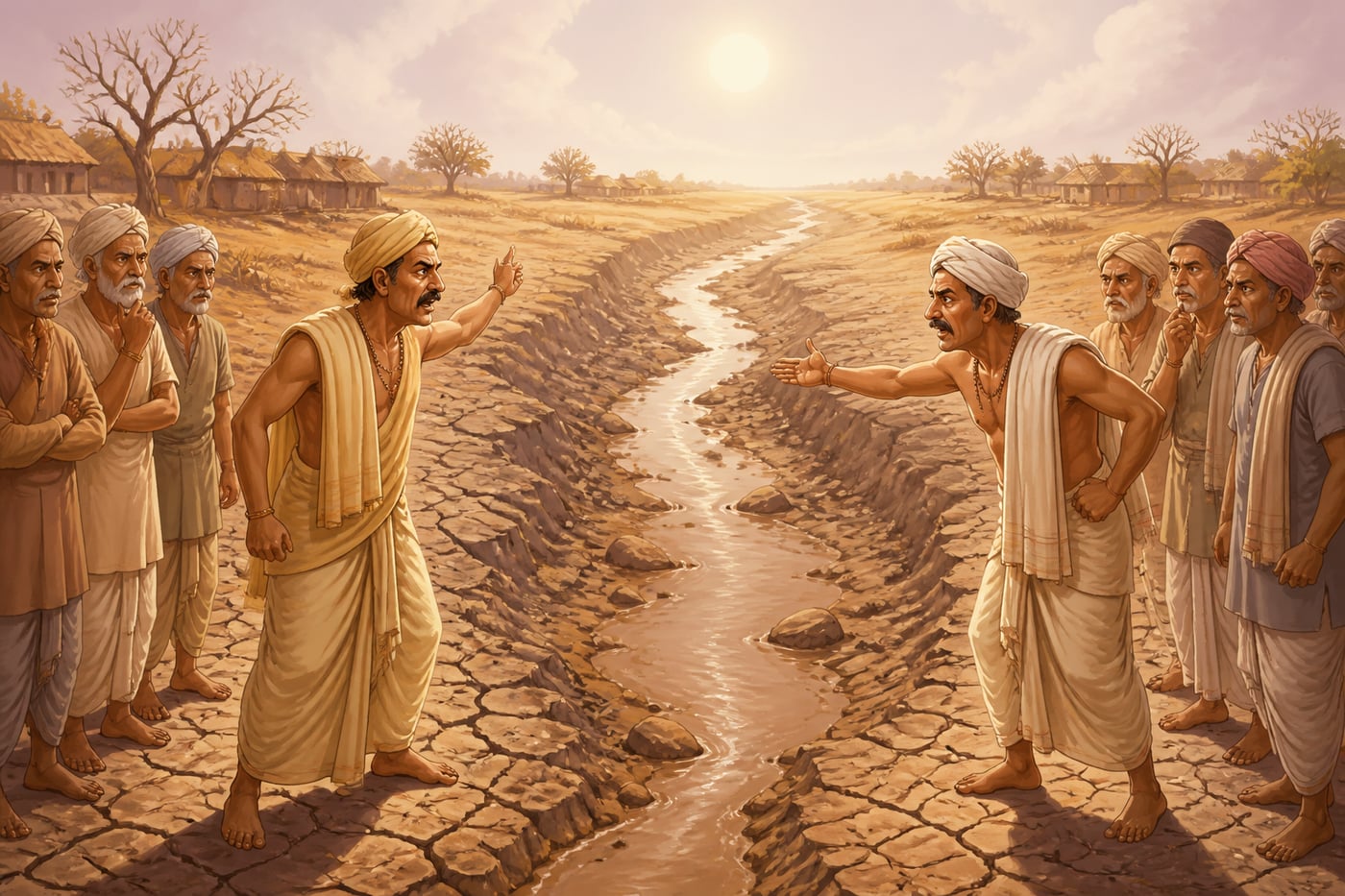
Two village headmen arguing fiercely at a parched riverbed during drought

The argument grew heated. Young men from both villages started carrying weapons to the river. A fight seemed inevitable.

The king sent Tenali to resolve the dispute.

Tenali spent three days walking along the river, talking to farmers from both villages. He examined their fields, their wells, their irrigation channels. He listened more than he spoke.

Then he called both village councils together.

"I've studied your situation," he said. "You're both right. And you're both wrong."

Both headmen started to protest, but Tenali raised his hand.

"Ramapur, you're right that you need to store water. Without storage, the drought will destroy you. But Krishnapur, you're also right, if Ramapur takes all the water, you'll have nothing."

"So who gets the water?" Ramapur's headman demanded.

"Both of you. Together."

Tenali unrolled a map he'd drawn.

"Here's my proposal: Build ONE dam, not at Ramapur, but between both villages. Both villages contribute labor. Both villages maintain it. And the water is shared according to a schedule."

"Share?" Krishnapur's headman looked skeptical.

"Yes. During planting season, Ramapur gets water Monday, Wednesday, Friday. Krishnapur gets Tuesday, Thursday, Saturday. Sunday, both villages rest. During harvest, we reverse it."

"But who decides the schedule?"

"A water council. Three elders from each village. They meet monthly, adjust for conditions, resolve disputes. No single village controls the water."

Tenali shows the two village headmen the shared dam map between their settlements

The headmen looked at each other. Neither had gotten everything they wanted. But neither had been defeated either.

"What if we can't agree?" Krishnapur asked.

"Then you appeal to the king's court. But I suspect..." Tenali smiled, "that once you're working together on the dam, you'll find agreement easier than you expect."

He was right. The shared dam was built. The water council met monthly. And over time, Ramapur and Krishnapur became closer than they'd been in generations.

The Shared Field

When farmer Venkatesh died, he left behind three sons and one problem: his field.

The eldest, Ramu, wanted the northern third, closest to the well.

The middle son, Shyam, wanted the southern third, it had the best soil.

The youngest, Gopi, wanted the eastern third, it got the most sunlight.

But here was the problem: none of the thirds worked alone. The northern third had water but poor soil. The southern third had good soil but no water access. The eastern third had sunlight but neither water nor good soil.

"Father should have divided it better!" Ramu complained.

"Father was wise," Shyam argued. "He wanted us to stay together."

"Then why didn't he just say that?" Gopi demanded.

They came to Tenali, each expecting him to award them the piece they wanted.

Tenali visited the field. He walked every inch of it, studying the soil, the slope, the water flow. Then he returned to the brothers.

"I have good news and bad news," he said.

"Bad news first," Ramu said grimly.

"None of you can have the piece you want."

All three brothers started shouting at once.

"The GOOD news," Tenali continued calmly, "is that your father was wiser than you realized."

He drew in the dirt.

"Look at your field. The northern third has water but poor soil. The southern third has good soil but no water. If you dig an irrigation channel HERE, " he drew a line ", the water from the north reaches the good soil in the south."

"But that cuts through MY portion!" Shyam protested.

"Exactly. Which is why you can't divide the field. Your father knew this. That's why he didn't specify portions in his will."

Tenali with the three brothers Ramu, Shyam and Gopi at their inherited field

Tenali looked at each brother.

"He didn't leave you three separate fields. He left you ONE field that requires THREE brothers to work properly. Water from Ramu's section. Soil from Shyam's section. Sunlight from Gopi's section. Alone, each piece is nearly worthless. Together, it's the most productive field in the region."

"So... we can't divide it?" Gopi asked slowly.

"You CAN divide it. You'll each get a poor piece of land that barely produces anything. Or..."

"Or we work it together," Ramu finished.

"And share the harvest equally," Tenali confirmed. "Your father's final gift wasn't the land, it was keeping you together."

The brothers looked at each other. The anger slowly faded from their faces.

"He always said we were stronger together," Shyam admitted.

"He was right," Gopi said.

The field was never divided. The three brothers worked it together for the rest of their lives, producing harvests that made their neighbors envious.

The Wisdom

Both stories share a crucial insight: sometimes there's no villain.

The two villages weren't fighting because one was evil. They were fighting because both had legitimate needs and not enough resources. The three brothers weren't fighting because they were greedy. They were fighting because they didn't understand what their father had given them.

Tenali's genius wasn't finding the "right" side. It was finding solutions where nobody had to lose for others to win.

This is what samanyahita, the common good, really means. Not splitting things equally and walking away. But working together so that everyone ends up with MORE than they could have gotten alone.

In Your Life

Think about disagreements in your family or friend group. When everyone wants to watch a different show. When everyone wants to play a different game. When there's one last piece of cake.

The easy solution is to fight until someone wins and someone loses. Or for an adult to just decide.

But there's often a better way. Can you take turns? Can you find something that combines what everyone wants? Can you share in a way that actually makes everyone happier?

The best solutions to disagreements aren't "I win, you lose." They're "We figure this out together."

That's the common good. And finding it makes you wise.

Reflection

More in Nyaya: Justice and Fairness

All lessons in Nyaya: Justice and Fairness · Tenali Rama: The Wit of Vijayanagara course